Utility-scale solar, wind and battery storage design is a volume business. A developer's engineering team or a small EPC design group runs the same handful of calcs across dozens of sites: pile embedment for the trackers, wind on the array, cable sizing, foundations for the BESS enclosures. The maths rarely changes between sites. The inputs always do.
That makes the calcs worth getting right once, and worth running somewhere built for repetition. Mathcad is the established choice for readable engineering maths. For teams building out the energy transition, there's now a better fit.
The calcs behind solar, wind and BESS sites
- Pile design for single-axis tracker and fixed-tilt piles: embedment and lateral capacity of driven or screw piles against each site's geotechnical data, checked against pile load test results.
- Wind loads on ground-mounted arrays to the local loading code (AS/NZS 1170.2, ASCE 7 or EN 1991-1-4), including stow position, which then drive the pile and torque tube checks.
- Cable sizing and voltage drop on DC strings and AC collector runs (AS/NZS 3008.1.1 or the NEC), where a small error repeats across a whole site.
- Foundations for BESS enclosures, inverter skids and MV transformers.
Each one feeds the next. Change the wind region and the pile loads change, and so does the embedment. In a folder of separate spreadsheets that change has to be carried through by hand, on every site.
A calc platform built for teams building the energy transition
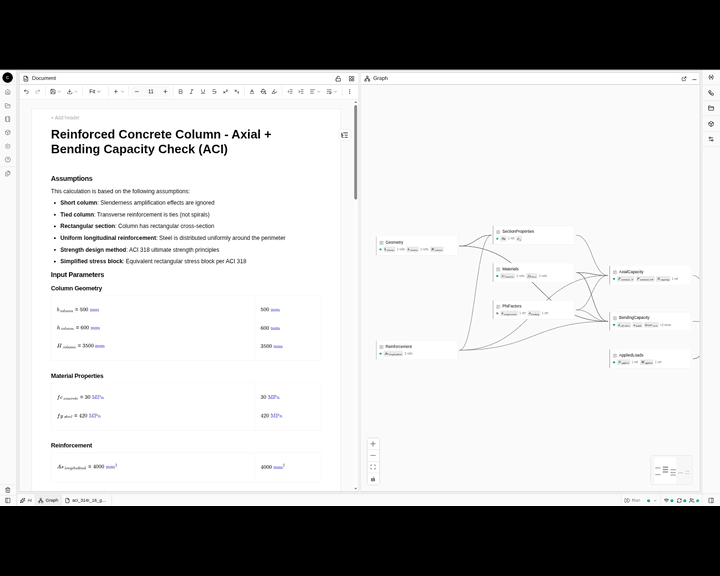
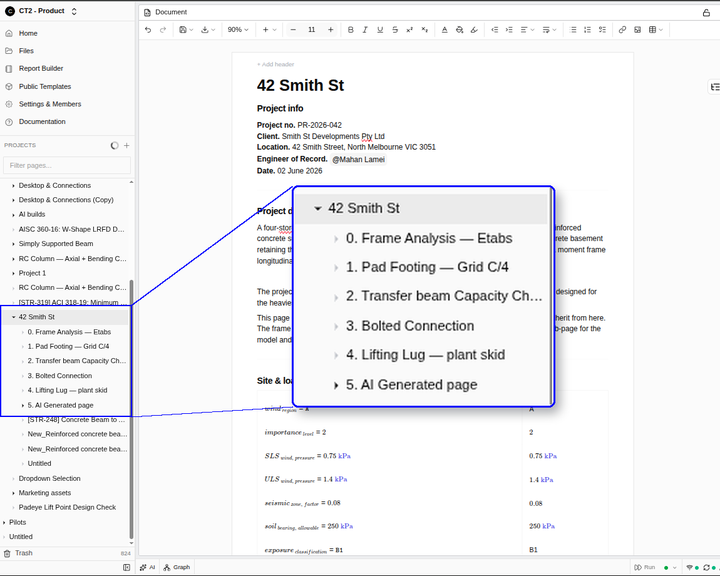
Mathcad has been the standard for readable engineering maths for decades. It was designed around one engineer and one file. CalcTree is built for the way renewables teams work: many sites, shared calcs, scripted schedules and AI assistance.
- Cheaper to start. A free plan, and paid plans from US$14 to US$34 per user per month (pricing). Mathcad Prime starts from about US$859 per user per year (PTC store, checked October 2026).
- More capable on one page. Readable maths with real units, Python in the same page, and AI that drafts new calcs from the ones you've already verified.
- Built to connect. An API, an Excel add-in and an LLM skill, so checked calcs run inside the software and scripts you already use (more below).
- Reviewed and versioned. The checker signs off on the page, with full history, so the owner's engineer sees exactly which revision was approved.
If you're weighing up every option, free ones included, see our honest guide to Mathcad alternatives.
What renewables calcs need
One checked calc, many sites
Build the pile check once, have it reviewed, and run it with each site's geotech and wind inputs. The logic stays the same reviewed logic on every site, instead of forty edited copies that have quietly drifted apart.
Calcs that pass numbers to each other
Linked calcs carry the wind load into the pile check and the pile check into the foundation summary, so a changed input updates everything downstream instead of being copied between files.
Review the owner's engineer can follow
The owner's engineer and the lenders' technical adviser review this work before IFC. Readable maths with units, code clauses on the page, and a checker's sign-off with version history mean the calc answers their questions before they ask them.
Works with the rest of your stack
Renewables design lives in site schedules, scripts and layout software. CalcTree plugs into the parts that carry calcs.
- API. Run a checked calc from your own code, scripts or pipelines, and get the result back with the working. See automating calcs with Python and the API.
- Excel add-in. Call a checked calc from a spreadsheet cell, so the logic lives in one reviewed place and the workbook just passes inputs. See the Excel add-in.
- LLM skill. Claude, ChatGPT, Gemini or Cursor can find, run and build CalcTree pages. The AI does the reasoning and CalcTree does the maths, with real units. See the CalcTree LLM skill. An MCP server is coming soon.
So a pile schedule in Excel can run the reviewed embedment check for every pile location on a site, and a layout script can call the same check through the API.
Moving over
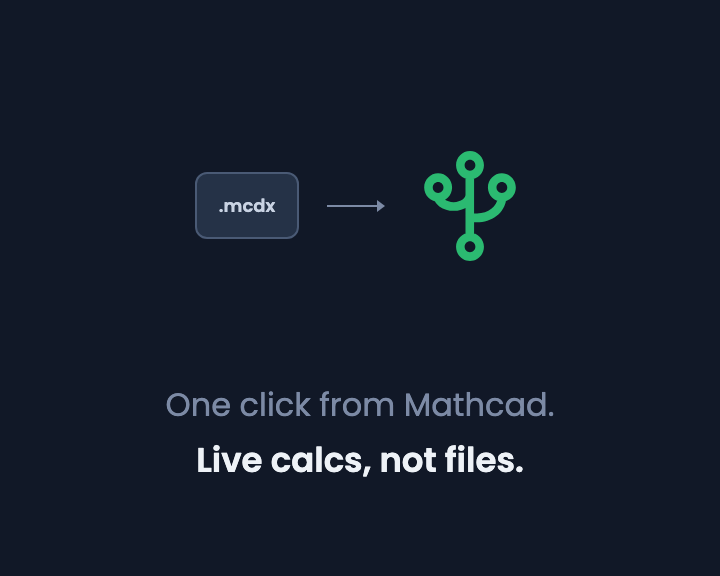
The free plan includes Python, the API and the Excel add-in; linking calcs across pages is on the Business plan. Existing Mathcad files can be converted into CalcTree rather than retyped.
One honest limit: CalcTree runs in a desktop browser and needs a connection today. Offline use is coming, but it isn't here yet.
Start with one calc
Pick the calc you re-run on every site, usually pile embedment, and build it once properly. Request a calc and we'll build it for you, or send us a Mathcad or SMath file and we'll convert it. Book a call with our team.