
Compute the moment-curvature response of a reinforced concrete section using a fibre model in OpenSees. Get cracking, yield and ultimate points plus ductility.

This template is not available yet. You can sign up and create it yourself!
Or let us know if you'd like to be notified when it’s ready:
No items found.
No items found.
About this calculation
This page computes the full moment-curvature response of a reinforced concrete section under constant axial load. It runs a real finite element analysis in the browser using OpenSees, with a fibre section and nonlinear material models, and pushes the section to failure. Because the analysis is fibre based, you enter arbitrary geometry and reinforcement as a table rather than picking a fixed standard case, and you get diagrams and contour plots alongside the numbers.
What a moment-curvature curve tells you
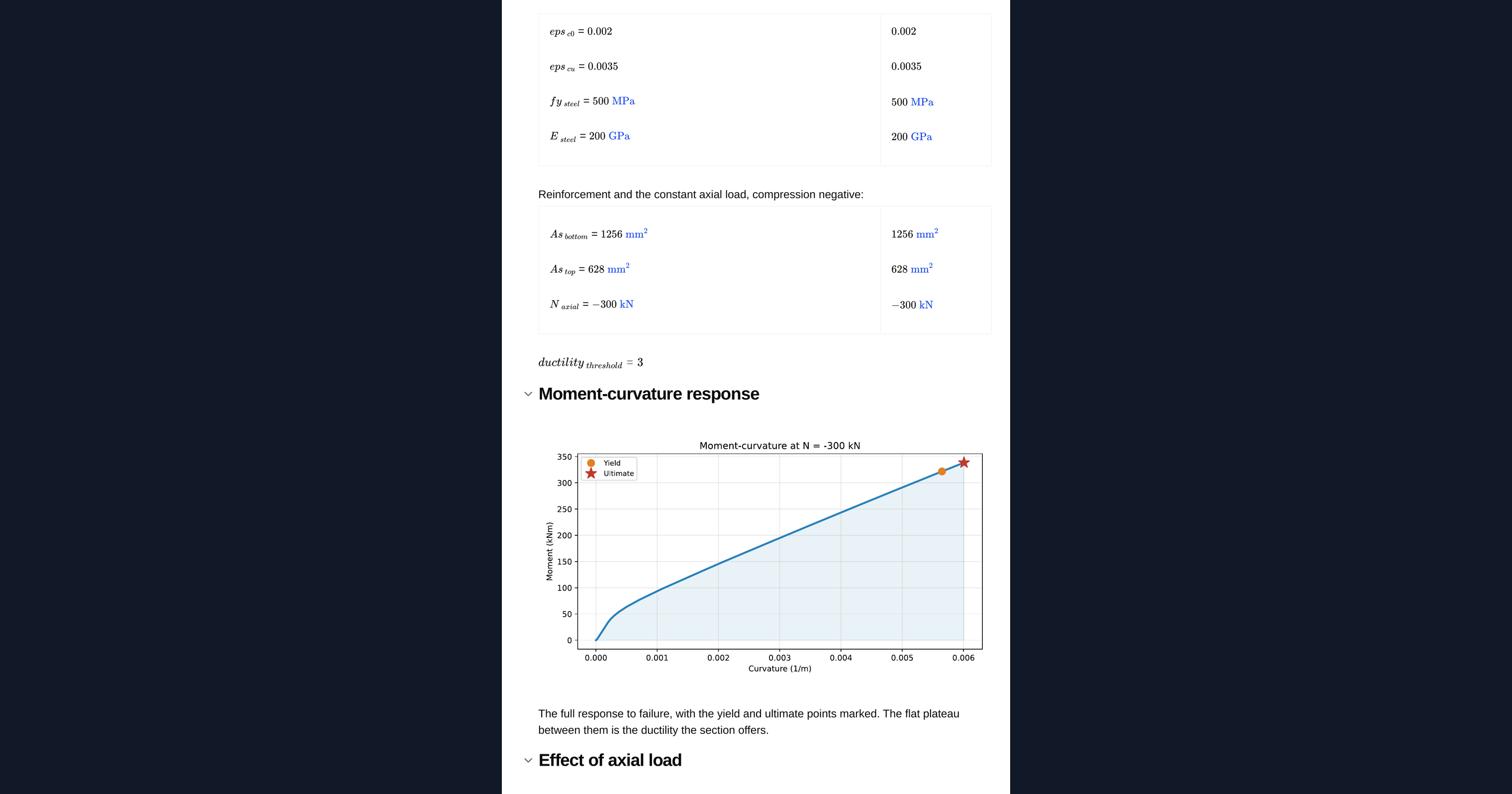
The moment-curvature curve is the section's constitutive response: how much moment it carries at each level of imposed curvature, all the way to failure. It is the input to any plastic-hinge or pushover model, and it is what separates a section that fails gracefully from one that does not.
How it works
The section is divided into fibres. Concrete fibres use a parabolic stress-strain law with a descending branch after the peak, so crushing is captured. Steel fibres are elastic-plastic with a small strain-hardening slope. The axial load is applied first and held constant, then curvature is imposed in small increments and the resisting moment is recorded at each step. The analysis stops when the section can no longer find equilibrium, which is the physical failure point.
Three landmarks come out of the curve:
- Cracking: the first sharp loss of stiffness, as the concrete in tension gives up.
- Yield: the knee, where the tension steel reaches its yield strain and the curve flattens.
- Ultimate: the peak, followed by the descending branch as the compression concrete crushes.
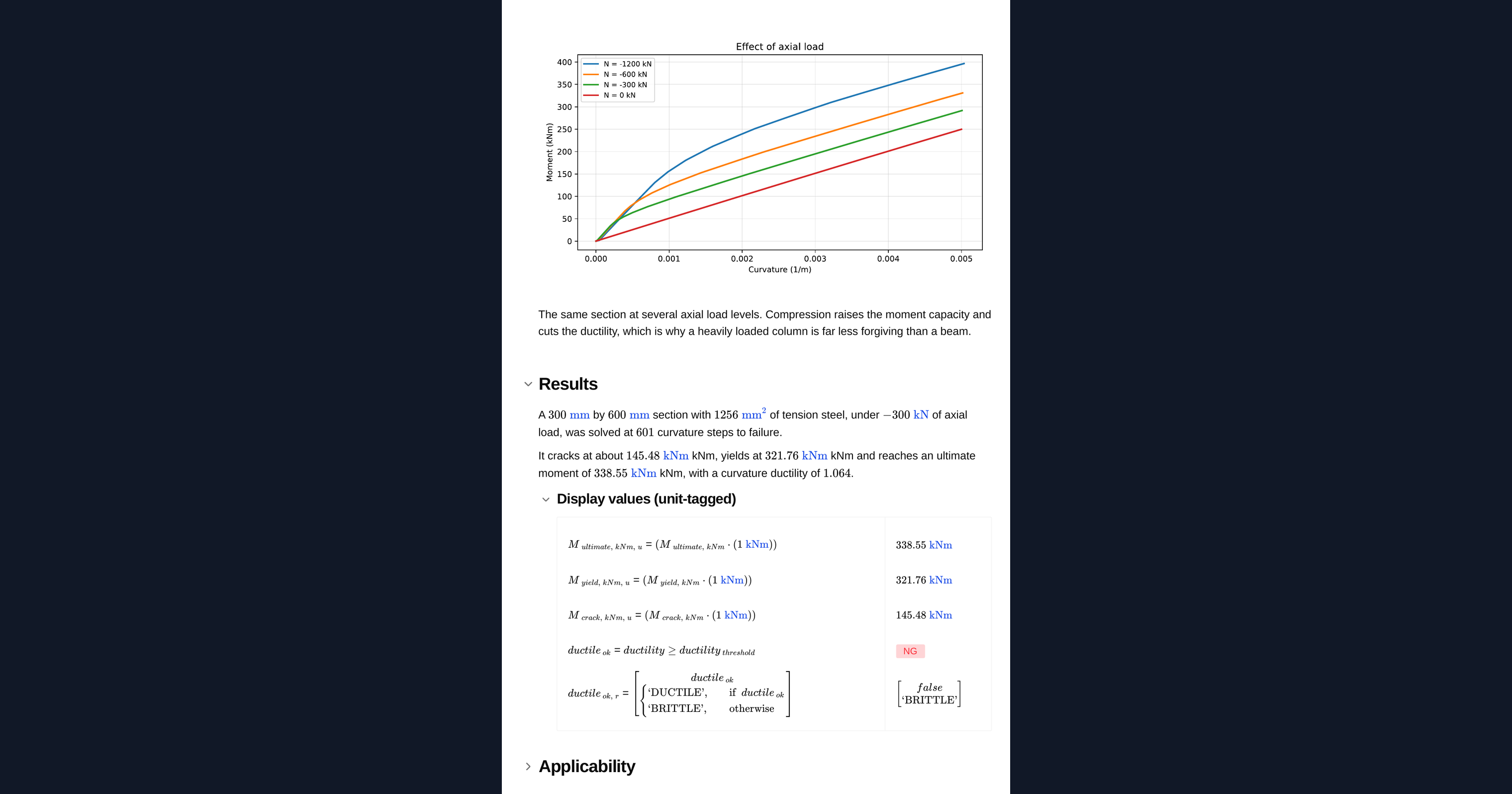
Ductility is the ratio of ultimate to yield curvature, and it is the single most important number here. A section with a ductility of 1 fails the moment it yields. A ductility above about 3 gives the warning and redistribution that seismic and robustness provisions rely on. Adding tension steel raises the moment capacity but lowers the ductility, so the two have to be read together.
Limits and caveats
This is a sectional analysis with mean material properties and no partial factors. It gives the section's real expected response, which is what a plastic-hinge or pushover model needs. It is not a code design capacity. For that, apply the governing code's partial factors and stress block.
The concrete material has no tensile strength, so the cracking point above comes from the stiffness change as tension fibres unload rather than from a modelled tensile rupture. Treat it as indicative. There is no confinement model either: real stirrups raise both the crushing strain and the ductility substantially, and modelling them requires a confined concrete law for the core fibres with the cover left unconfined.
Bond slip, shear deformation and buckling of the reinforcement between stirrups are all excluded, and each of these reduces ductility in a real member. Read the result as the response of an idealised section, then judge how far your detailing moves you from it.
Engineering templates
Common calculators
Design guides




Is this a code design capacity?
No. The analysis uses mean material properties with no partial factors, so it reports the section's real expected response rather than a factored design capacity. Use it to feed a plastic-hinge or pushover model. For design capacity, apply the governing code's partial factors and stress block.
Why does the cracking point look approximate?
The concrete material carries no tensile strength, so the cracking landmark is identified from the sharp change in stiffness as the tension fibres unload, not from a modelled tensile rupture. Treat it as indicative.
Does it account for stirrup confinement?
Not in the base model. There is no confinement law, so the crushing strain and the ductility are conservative relative to a well-confined section. To capture confinement, assign a confined concrete law to the core fibres and leave the cover unconfined.
What is ductility and what value should I aim for?
Ductility here is the ratio of ultimate curvature to yield curvature. A value of 1 means the section fails the moment it yields. A value above about 3 gives the warning and redistribution that seismic and robustness provisions rely on. Adding tension steel raises moment capacity but lowers ductility, so read them together.
Can I enter a non-standard section?
Yes. Because the calculation runs a fibre-based finite element analysis, you enter geometry and reinforcement as a table and are not limited to a fixed standard shape.
What is left out of the model?
Bond slip, shear deformation and buckling of the reinforcement between stirrups are excluded. Each of these reduces ductility in a real member, so treat the output as the response of an idealised section.
Learn about the benefits of using CalcTree on engineering projects!