
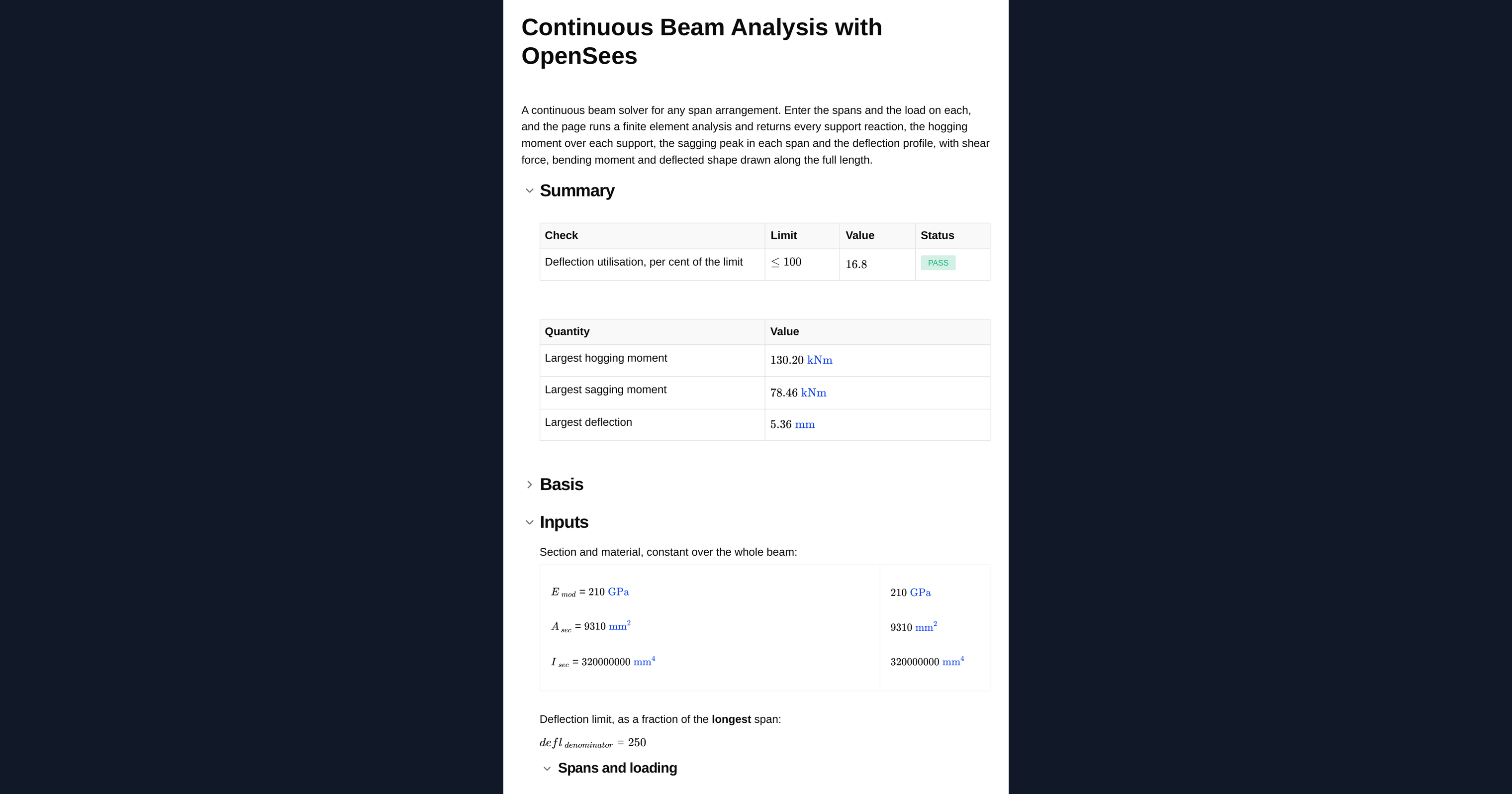
Free continuous beam calculator. Enter spans and loads, run a finite element analysis for support reactions, hogging and sagging moments, shear and deflection.

This template is not available yet. You can sign up and create it yourself!
Or let us know if you'd like to be notified when it’s ready:
No items found.
No items found.
About this continuous beam calculator
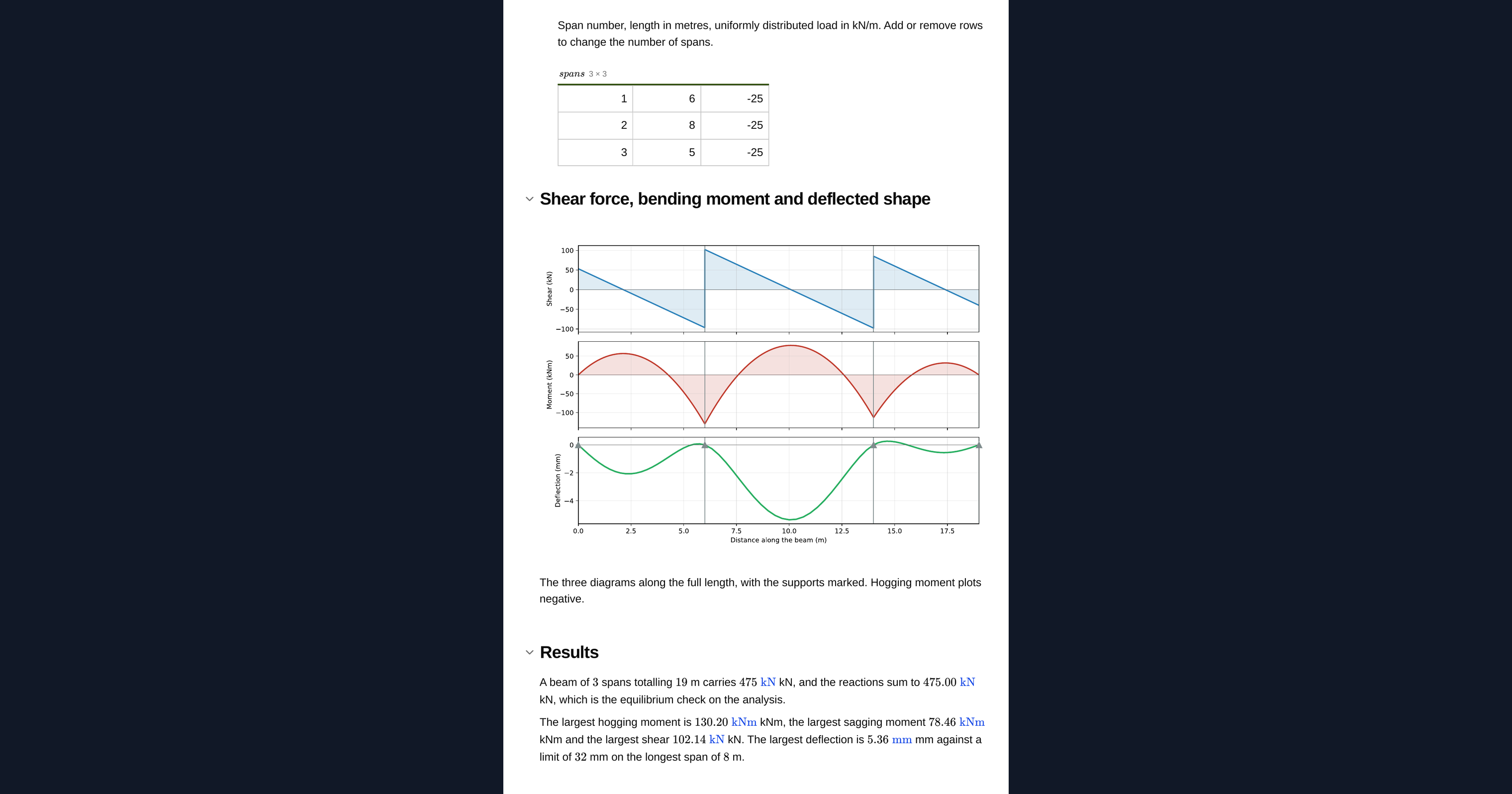
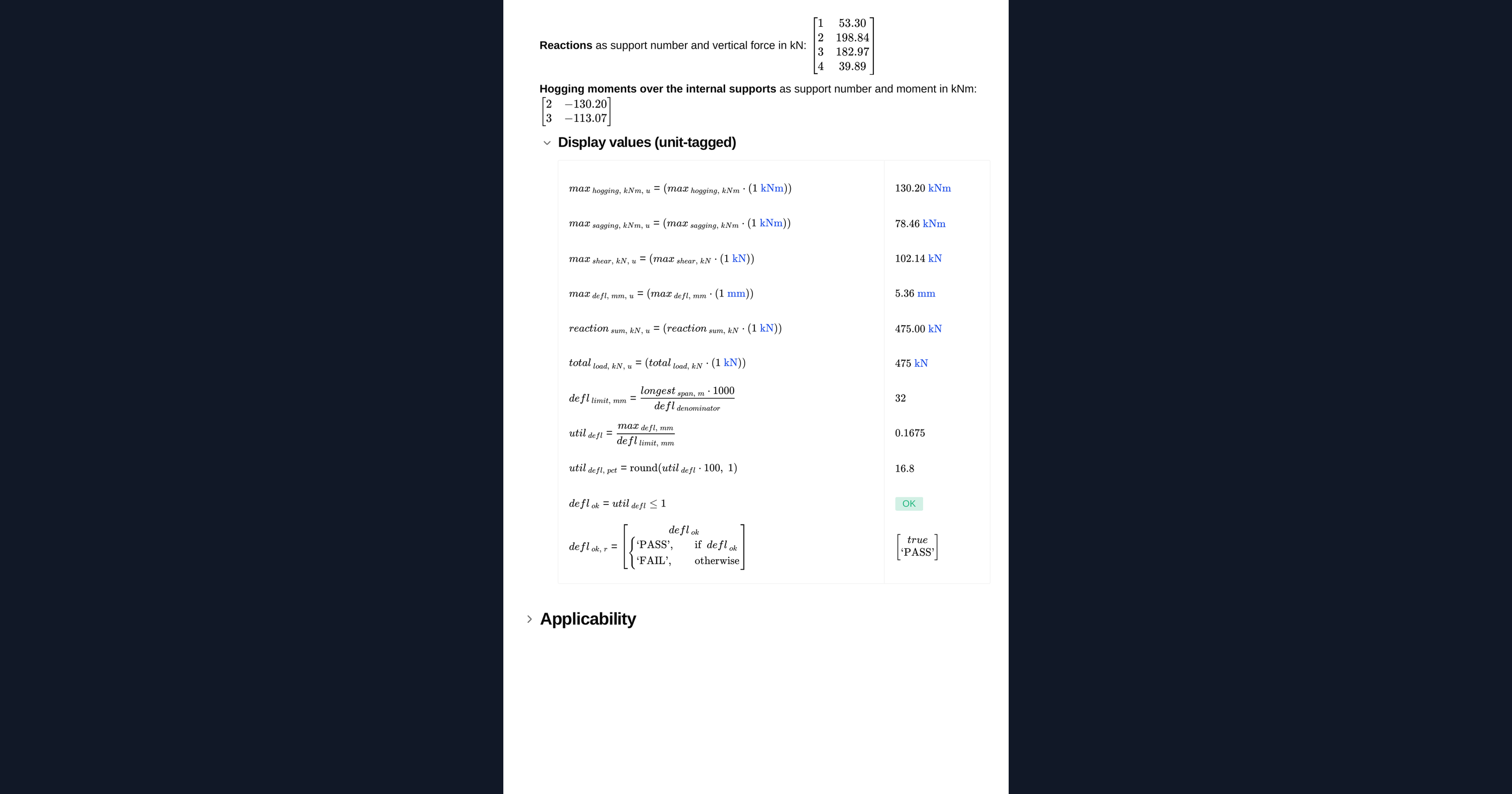
This page solves a continuous beam over any number of spans. Enter each span length and the uniformly distributed load it carries, and the calculation runs a finite element analysis in the browser and returns every support reaction, the hogging moment over each support, the sagging peak in each span and the full deflection profile. Shear force, bending moment and deflected shape are drawn along the whole length of the beam.
How it works
A continuous beam is statically indeterminate to the number of internal supports. The classical hand route is the three-moment equation solved simultaneously across the supports. This page meshes the beam into elements and solves it by the direct stiffness method instead. The result is the same, but the method does not care how many spans there are, or whether the spans and loads are equal, so you can enter a real arrangement rather than fitting your beam to a standard case.
The first support is pinned and the rest are rollers, so the beam is free to extend axially. Supports are unyielding and free to rotate; support settlement is not modelled.
Pattern loading is the point
Each span carries its own uniformly distributed load, so pattern loading is a matter of editing one column. This matters more than the uniform case. Loading alternate spans maximises the sagging moment in the loaded spans, and loading adjacent spans maximises the hogging moment over the support between them. The design envelope needs both, so run each pattern with the appropriate combination factors and envelope the results. Because the load column is editable per span, switching between patterns is cheap.
Input conventions
The span table takes the span number, then the length in metres, then the uniformly distributed load on that span in kN/m, taken negative downwards.
Limits and caveats
The analysis is linear elastic with a constant section over the whole beam. A haunched member, or a change of section at a support, needs the members modelled individually. Supports are unyielding: differential settlement changes the reaction distribution directly and is the usual reason a real continuous beam behaves differently from this analysis, so where settlement is credible it must be applied as an imposed displacement. Shear deformation is neglected, which is accurate for the span-to-depth ratios normal in building beams. In reinforced concrete, cracking softens the section and redistributes moments, which a constant-stiffness elastic run does not capture.
Engineering templates
Common calculators
Design guides




Why solve a continuous beam with finite elements instead of the three-moment equation?
The three-moment equation is the classical hand method and gives the correct answer, but it has to be set up and solved simultaneously for every arrangement. The direct stiffness method used here gives the same result while handling any number of spans and any mix of span lengths and loads without reformulating the problem, so you enter the real beam as a table.
Does the uniform load case give me the design moments?
No. The uniform case is not the design case. Loading every span maximises the hogging moments over the supports, and loading alternate spans maximises the sagging moments in the spans. You need to run the relevant load patterns with the appropriate combination factors and envelope the results. This page makes that quick because the load on each span is its own editable column.
How do I enter loads?
Enter each span as a row: span number, length in metres, and the uniformly distributed load in kN/m, negative for downward load. To create a pattern, set the load to zero on the spans you want unloaded and keep the design load on the rest.
Does it account for support settlement?
No. Supports are treated as unyielding and free to rotate. Differential settlement redistributes the reactions directly and is the most common reason a real beam differs from this analysis. Where settlement is credible, it has to be applied as an imposed support displacement rather than read off this run.
Can I model a haunch or a change of section at a support?
Not directly. The analysis assumes a constant section over the whole beam. A haunched member or a step change in section needs the members modelled individually with their own properties.
Is it suitable for reinforced concrete beams?
It gives the elastic distribution, but it does not model cracking. In reinforced concrete, cracking softens the section and redistributes moments away from the elastic result, so treat this as the elastic baseline and apply your code's moment redistribution rules on top.
Is shear deformation included?
No, shear deformation is neglected. This is accurate for the span-to-depth ratios normal in building beams and only becomes significant for deep, short members.
Learn about the benefits of using CalcTree on engineering projects!