
Run an online elastic buckling analysis of a multi-storey moment frame, get the critical load factor and mode shapes, see if second-order analysis is needed.

This template is not available yet. You can sign up and create it yourself!
Or let us know if you'd like to be notified when it’s ready:
No items found.
No items found.
This calculation finds the elastic critical load factor and the buckled mode shapes of a multi-storey moment frame. It assembles the frame's elastic and geometric stiffness, solves the linear buckling eigenproblem, and reports the factor by which the applied load can grow before the frame becomes unstable.
Stability, not vibration
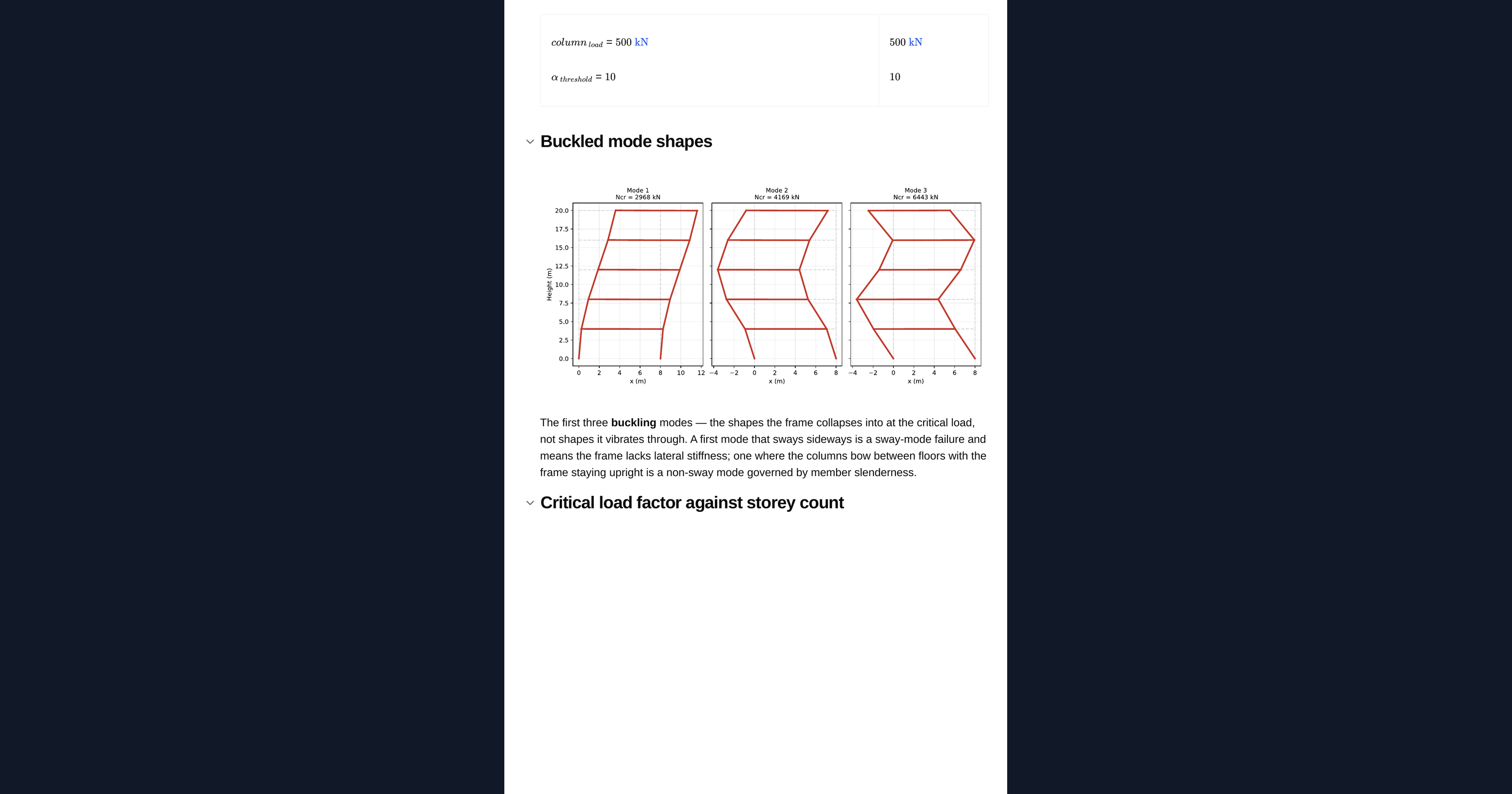
This asks how much load the frame can carry before it becomes unstable, and it needs no mass at all. The companion modal page asks how fast the frame vibrates, and it needs no applied load. Both solve an eigenproblem and both draw mode shapes, so they look alike, but a buckling mode is a shape the frame collapses into while a vibration mode is a shape it oscillates through.
How it works
Under axial load a frame's stiffness reduces. The tangent stiffness is K = Ke + λ Kg, where Ke is the elastic stiffness, Kg the geometric stiffness produced by the axial forces, and λ a multiplier on the applied load. Instability is the value of λ at which that matrix becomes singular, which is the generalised eigenproblem Ke φ = −λ Kg φ.
The page recovers both matrices from the assembled model, once with no axial load and once with a reference load, and solves the eigenproblem directly. That is a whole-frame result, not a member check. It accounts for the columns leaning on each other and for the restraint the beams provide, neither of which an effective-length table can capture.
Reading the critical load factor
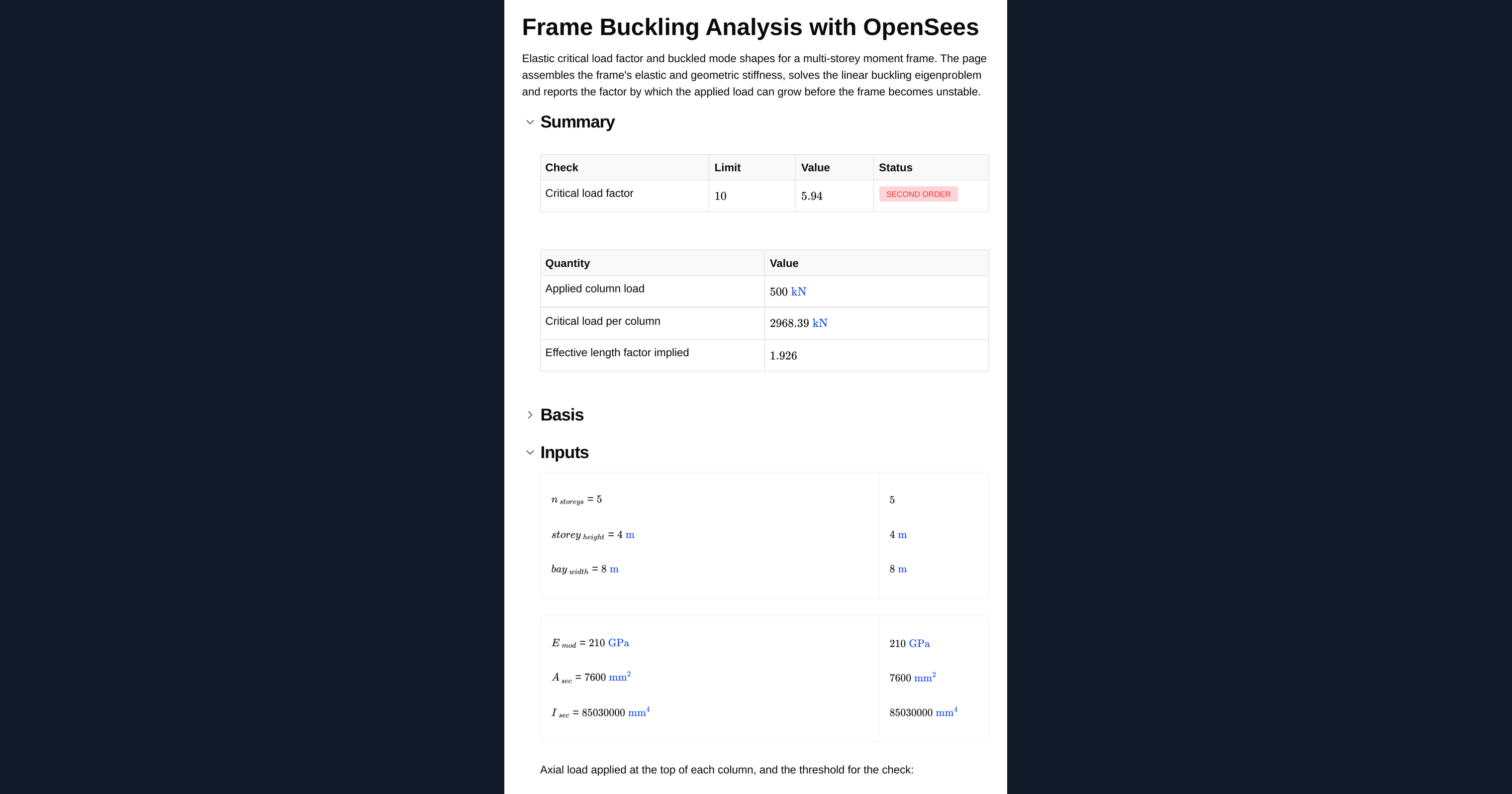
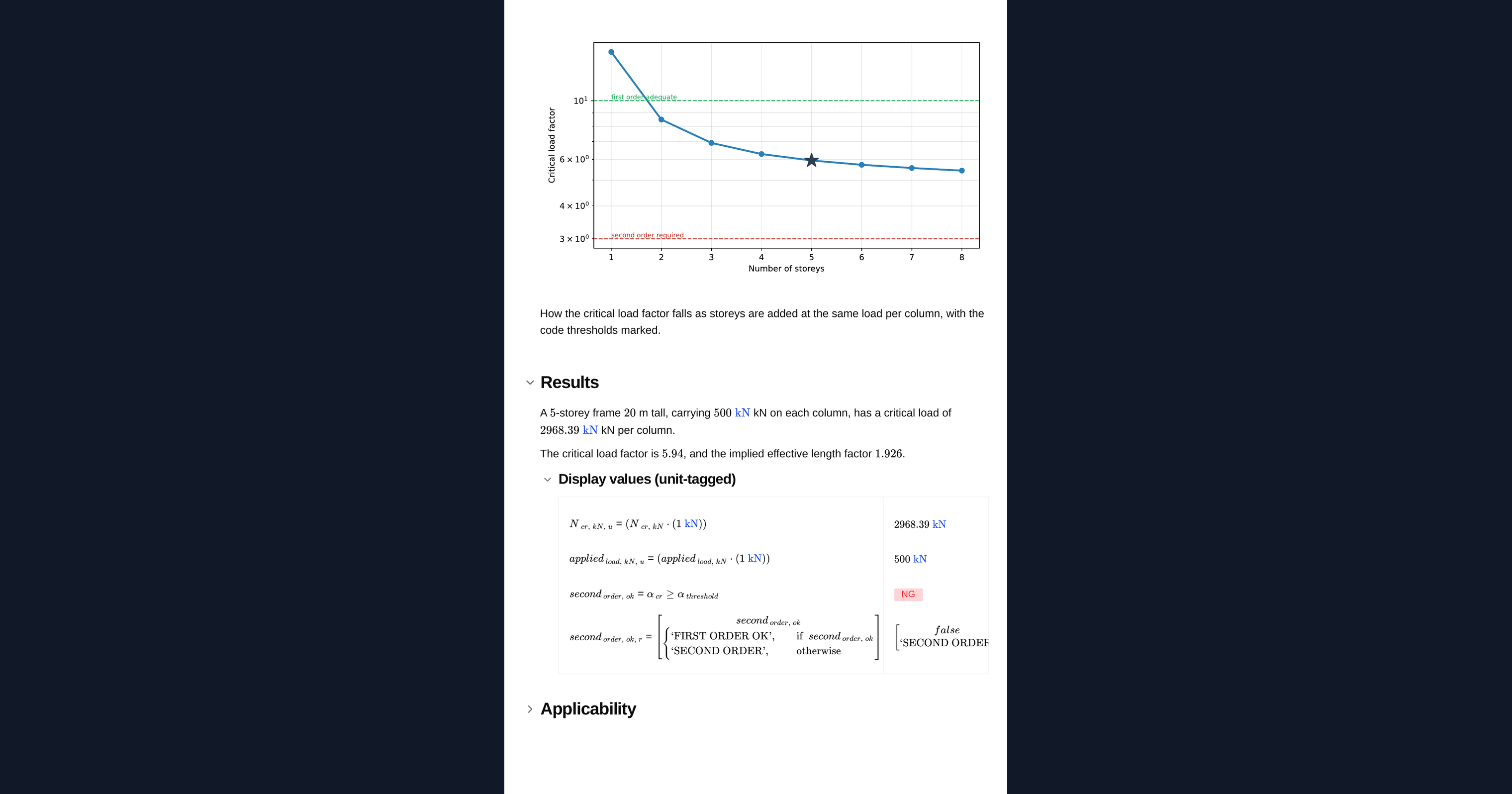
λcr is the number to read. It is the factor by which every applied load could grow before the frame buckles, and codes use it to decide whether a first-order analysis is adequate:
- λcr ≥ 10 — second-order effects are small and a first-order analysis will do.
- λcr between 3 and 10 — amplify the sway moments, or run a second-order analysis.
- λcr < 3 — the frame is sway-sensitive and a full second-order analysis is required.
Because it runs a real finite element analysis
This calculation runs OpenSees in the page, so it handles arbitrary geometry entered as a table rather than a fixed standard case, and it returns diagrams and contour plots alongside the numbers.
Limits and caveats
This is linear elastic buckling. It finds the load at which a perfect frame becomes unstable, which is an upper bound and not a strength. A real frame has out-of-plumb erection tolerances, member bow and residual stresses, and it will show second-order effects well below λcr. Codes handle that with notional horizontal forces or equivalent imperfections applied alongside the real loads, and those are not modelled here.
The critical load factor is the right screen for whether second-order analysis is needed, and the wrong instrument for member design. Members still need their own buckling checks, and any implied effective length factor is offered for comparison with hand methods rather than as a design value.
The model is planar with the same section throughout, elastic material and gross section properties. Cracked stiffness in concrete lowers the critical load substantially, and only in-plane buckling is captured.
Engineering templates
Common calculators
Design guides




Frequently asked questions
What is the critical load factor λcr?
It is the factor by which every applied load could grow before the frame becomes unstable. If λcr is 8, the frame reaches its elastic buckling load at eight times the applied load.
How is this different from a modal (vibration) analysis?
Both solve an eigenproblem and both draw mode shapes, but this analysis asks how much load the frame carries before it becomes unstable and needs no mass, while a modal analysis asks how fast the frame vibrates and needs no applied load. A buckling mode is a shape the frame collapses into; a vibration mode is a shape it oscillates through.
Does λcr tell me if the frame is strong enough?
No. This is linear elastic buckling, which gives an upper bound on stability, not a strength. It is the right screen for whether a second-order analysis is needed. Members still need their own buckling checks.
When do I need a second-order analysis?
Codes commonly treat λcr ≥ 10 as low sensitivity where first-order analysis is adequate, between 3 and 10 as requiring amplified sway moments or a second-order analysis, and below 3 as requiring a full second-order analysis. Check the thresholds in your governing code.
Why solve the whole frame instead of checking each column?
A whole-frame eigen-analysis accounts for columns leaning on each other and for the restraint the beams provide. An effective-length table cannot capture either, so the frame result is more representative of real behaviour.
Are imperfections included?
No. Out-of-plumb tolerances, member bow and residual stresses are not modelled. Codes handle these with notional horizontal forces or equivalent imperfections applied alongside the real loads, and you apply those separately.
Can I use it for concrete frames?
The model uses gross, uncracked section properties. Cracked stiffness in concrete lowers the critical load substantially, so results will be unconservative unless you reduce the stiffness to reflect cracking.
Can I enter my own frame geometry?
Yes. Because the page runs a real OpenSees finite element analysis, you enter the geometry as a table rather than choosing a fixed standard case, and you get diagrams and contour plots with the numbers.
Learn about the benefits of using CalcTree on engineering projects!