
Find the natural periods, frequencies and mode shapes of a multi-storey moment frame. A real OpenSees eigenvalue analysis that runs in the page, free to use.

This template is not available yet. You can sign up and create it yourself!
Or let us know if you'd like to be notified when it’s ready:
No items found.
No items found.
What this calculator does
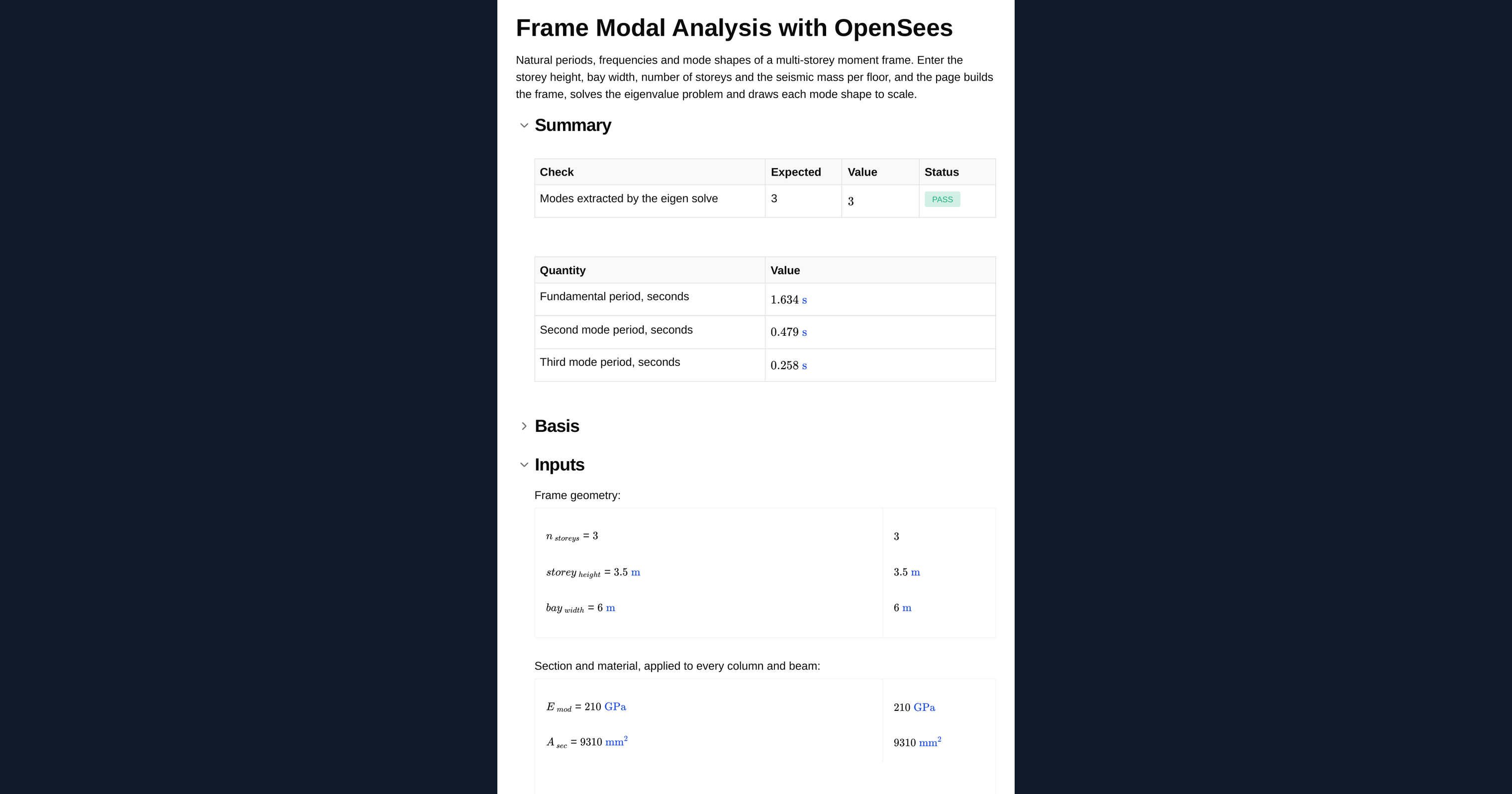
This page finds the natural periods, frequencies and mode shapes of a multi-storey moment frame. You enter the storey height, the bay width, the number of storeys and the seismic mass per floor. The page then builds the frame, solves the eigenvalue problem and draws each mode shape to scale alongside the numbers.
The analysis is a genuine finite element run in the browser using OpenSees, so it works from arbitrary geometry entered as a table rather than a fixed standard case, and it returns diagrams and contour plots next to the periods and frequencies.
Vibration, not stability
Modal analysis asks how fast the frame oscillates under its own mass. It needs no applied load. This is a different question from buckling, which asks how much load the frame carries before it becomes unstable and needs no mass at all. The two problems look similar because both solve an eigenproblem and both draw mode shapes, but they answer unrelated design questions. If you are chasing a critical load rather than a period, use the companion buckling page instead.
How it works
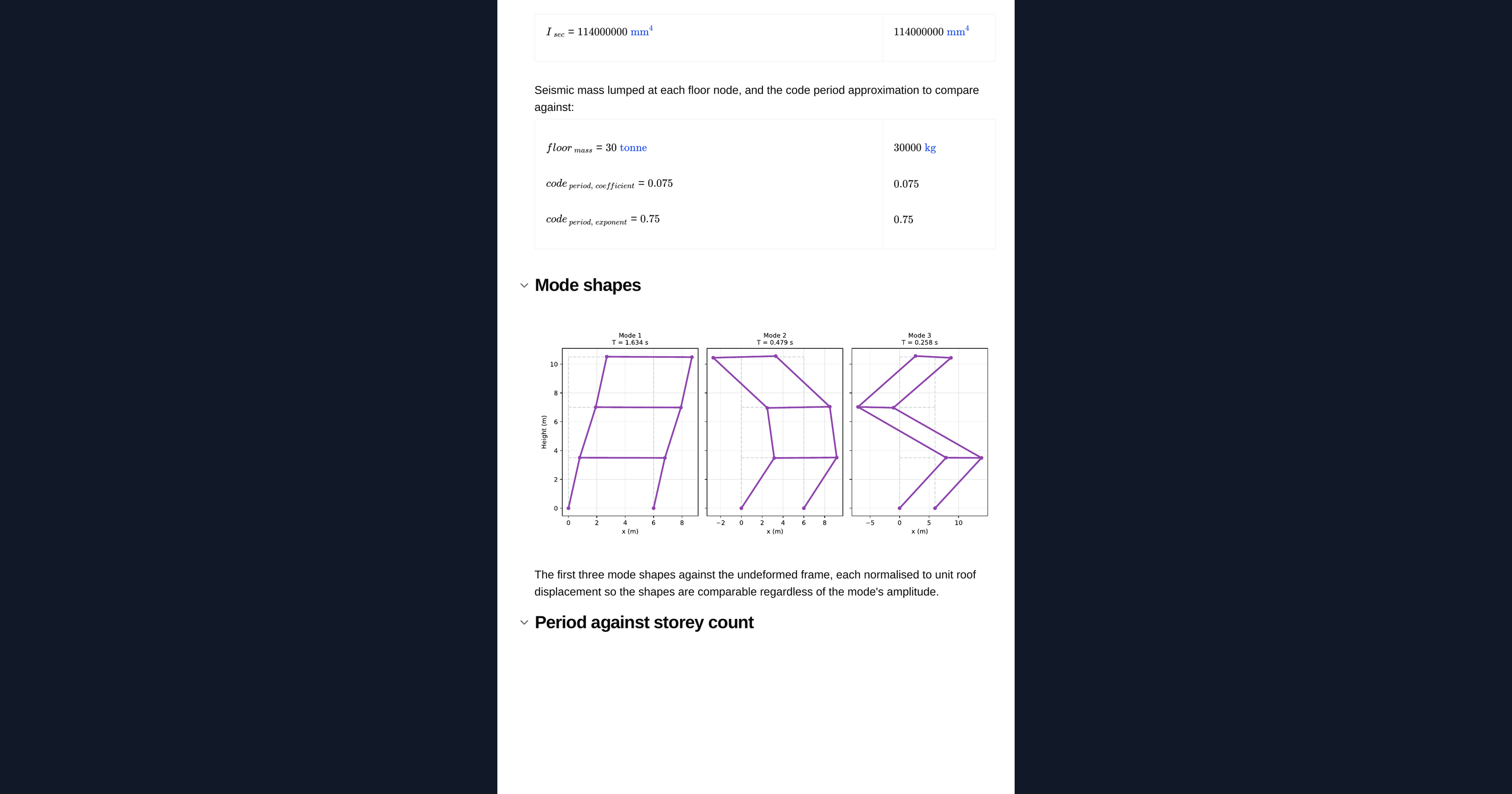
Free vibration of an undamped frame is the eigenvalue problem (K minus omega squared times M) times phi equals zero, where K is the stiffness matrix and M is the mass matrix. Each root omega is a natural circular frequency and its vector phi is the shape the frame takes when vibrating at that frequency. The period follows as T equals two pi divided by omega.
The frame is modelled with real beam-column members rather than as a shear building, so the beams are flexible and the joints rotate. That matters. A shear-building idealisation assumes infinitely stiff beams and always returns a shorter period than the real frame, sometimes by a wide margin when the beams are comparable in stiffness to the columns.
Mass is lumped at the floor nodes in the horizontal direction only. This is the standard idealisation for a building frame, because vertical and rotational inertia contribute almost nothing to the lateral modes.
What to read off the results
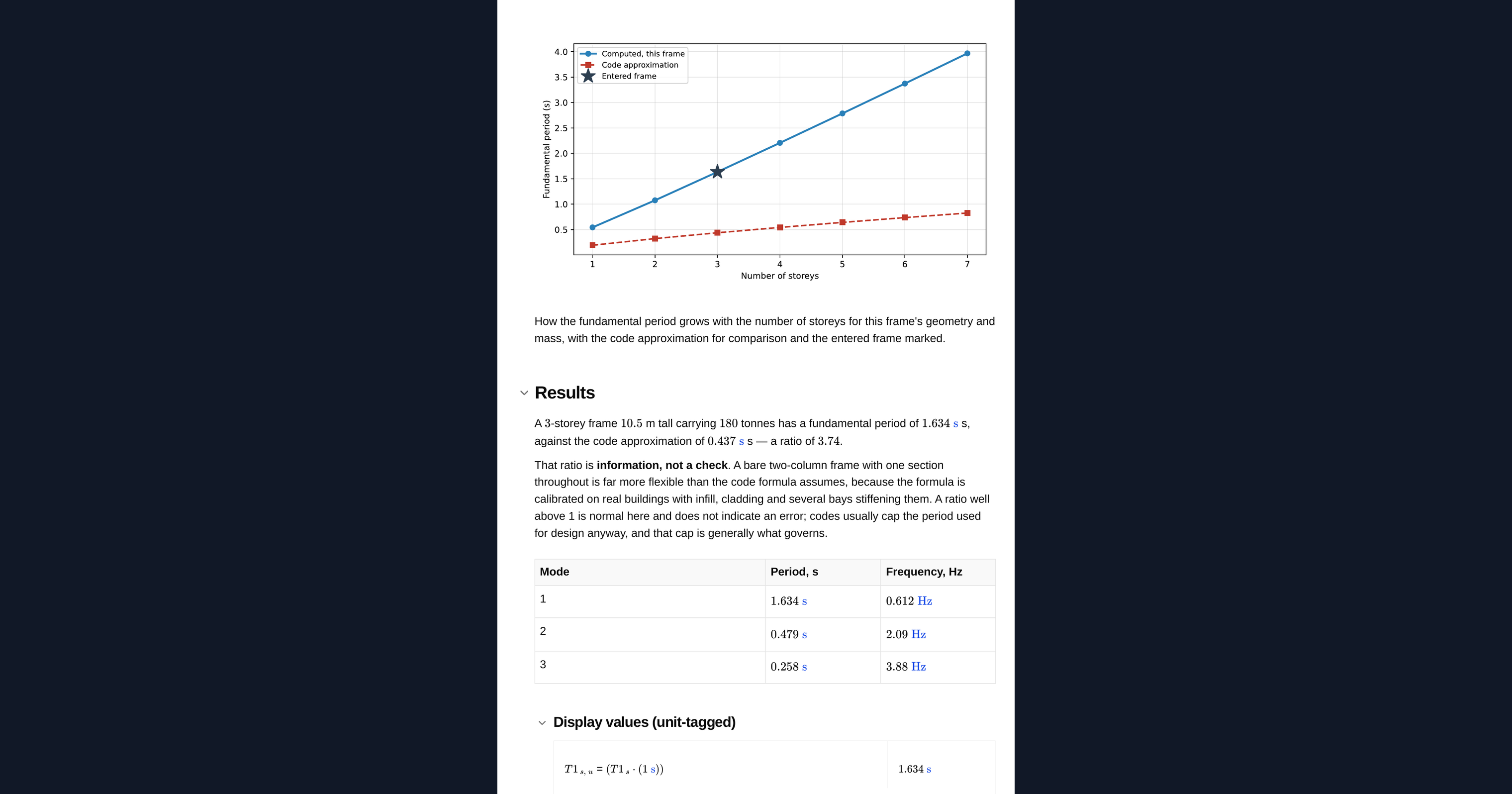
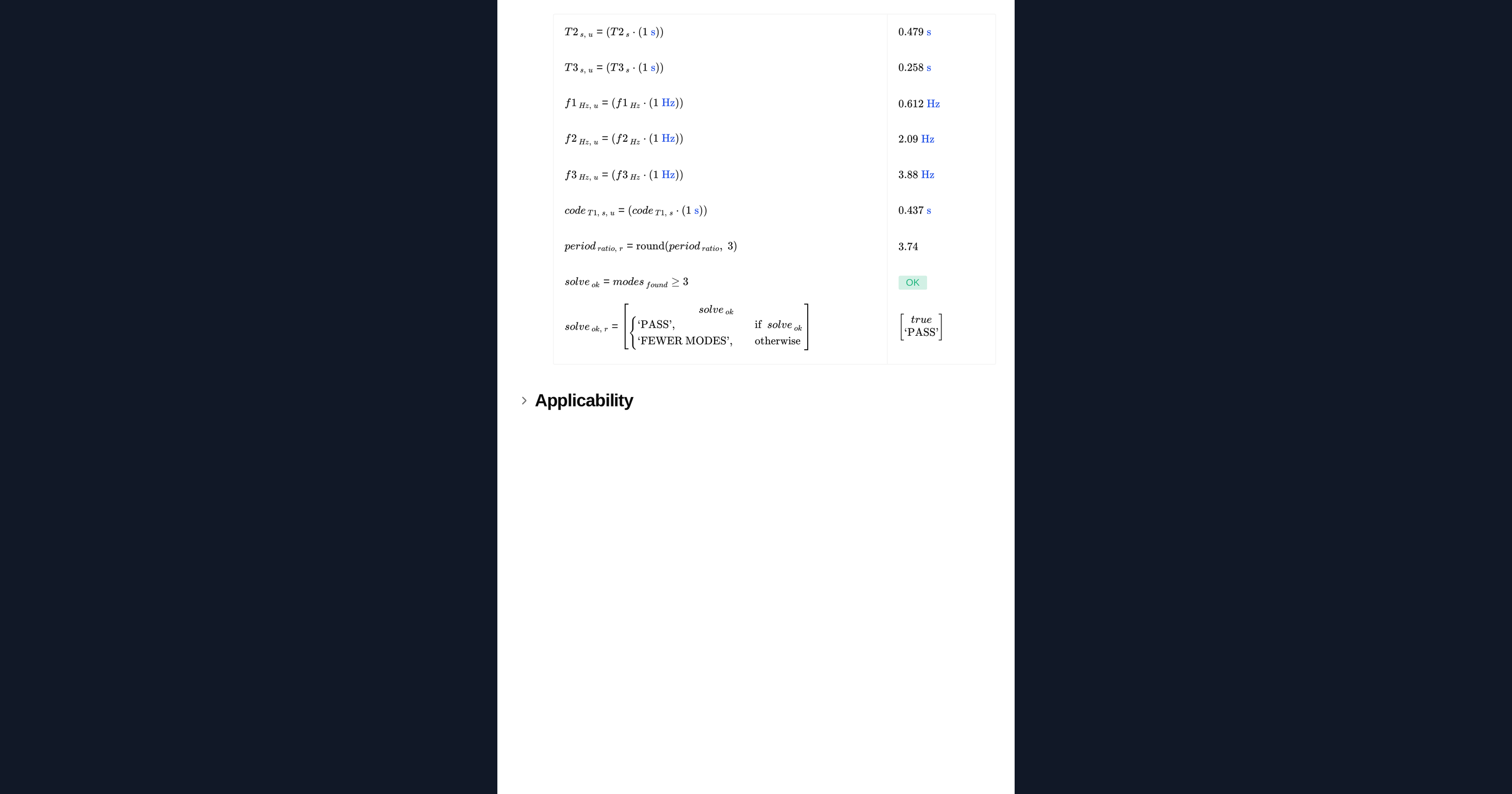
- The fundamental period. This is the longest period and it drives the design acceleration in any code spectrum. Codes give an approximate period from the building height, and a computed value much longer than that formula usually means the frame is more flexible than the code assumes.
- The mode shapes. The first mode is normally a clean sway. Higher modes show reversals up the height, and reading them helps you understand how the mass participates in each period.
Limits and caveats
These are undamped natural periods computed on gross, uncracked section properties, for a bare frame with no infill and mass lumped at the floor nodes. Each of those assumptions pushes the answer in a known direction:
- Damping. At building levels damping changes the period by well under one per cent and can be ignored.
- Cracked stiffness. In concrete, cracking lengthens the period substantially, often by 30 to 40 per cent, and seismic assessment normally requires it.
- Infill and cladding. Panels stiffen a frame and shorten the period, sometimes dramatically. A partial-height infill can create a soft storey that the bare-frame model cannot see at all.
- Two dimensions. The model captures only the in-plane translational modes. A real building has modes about both axes and torsional modes, and where the centre of mass and the centre of stiffness do not coincide those modes couple. None of that appears here.
Treat the result as a clean, transparent baseline for the bare in-plane frame, then adjust for cracking, infill and three-dimensional behaviour as your assessment requires.
Engineering templates
Common calculators
Design guides




What is frame modal analysis?
It is the calculation of a structure's natural periods, frequencies and mode shapes: the rates at which the frame wants to oscillate under its own mass, and the deformed shapes it takes at each of those rates. It needs no applied load, only the mass and the stiffness.
How is this different from a buckling analysis?
Modal analysis asks how fast the frame vibrates and needs mass but no load. Buckling asks how much load the frame carries before it becomes unstable and needs load but no mass. Both solve an eigenproblem and both draw mode shapes, which makes them look alike, but they answer unrelated questions. Use the companion buckling page for critical loads.
Why model real beam-columns instead of a shear building?
A shear-building idealisation assumes infinitely stiff beams and rigid joints. Real beams are flexible and real joints rotate, which lengthens the period. The shear-building shortcut always returns a shorter period than the real frame, and the gap widens when the beams are comparable in stiffness to the columns. This page uses real beam-column members so the joint flexibility is included.
Why is my computed period longer than the code formula?
Code formulas estimate the period from building height alone and are deliberately conservative. A computed period much longer than the code value usually means your frame is genuinely more flexible than the code assumes, which is worth understanding before you rely on the code acceleration.
Should I use cracked section properties?
This page uses gross, uncracked properties. For concrete, cracking lengthens the period substantially, often by 30 to 40 per cent, and seismic assessment normally requires cracked stiffness. Reduce your section properties accordingly if your code demands it.
Does damping change the period?
At building levels of damping the change to the natural period is well under one per cent, so these undamped periods are effectively the damped periods for design purposes.
Can it capture torsion or three-dimensional modes?
No. The model is two-dimensional and captures only the in-plane translational modes. Modes about the other axis, torsional modes, and the coupling that occurs when the centre of mass and centre of stiffness do not coincide are all outside its scope.
Does infill affect the result?
Yes, and this is a bare-frame model. Infill and cladding stiffen the frame and shorten the period, sometimes dramatically, and a partial-height infill can create a soft storey the bare-frame model cannot represent.
Learn about the benefits of using CalcTree on engineering projects!