Punching shear in flat slabs and footings to AS 3600 and EN 1992-1-1: control perimeters, concrete capacity, shear studs and a worked internal column example.
Punching shear design checks whether a concentrated load, usually a column, can push a cone of concrete out of a flat slab or a pad footing. It is a brittle failure with little warning, which is why both AS 3600 and EN 1992-1-1 (Eurocode 2) treat it as a separate check from one-way beam shear, with its own control perimeter, its own stress limits and its own reinforcement rules. This guide runs the two codes side by side and works one example to Eurocode 2.
What punching shear is and where it happens
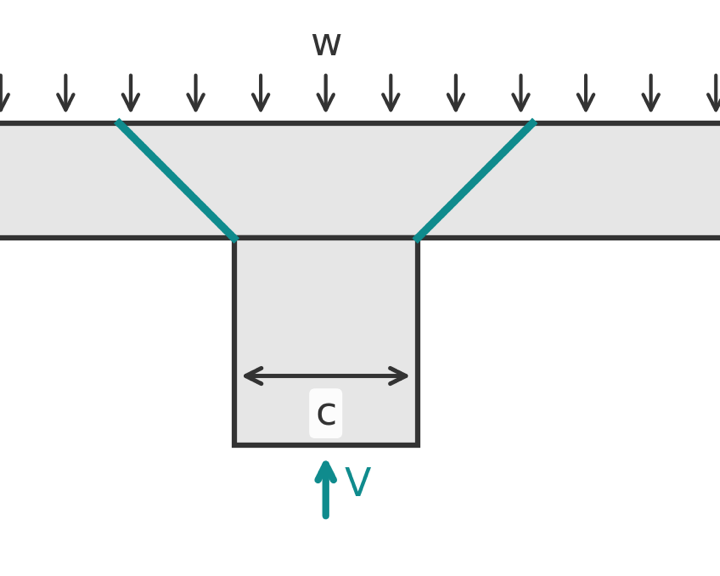
Around a column, the slab's shear force is spread over a perimeter rather than a width, and the shear stress is highest close to the column face. If the stress exceeds what the concrete can carry, a truncated cone of slab breaks away around the column, at roughly 25 to 35 degrees to the horizontal. The same mechanism occurs in a pad footing under a column, in a transfer slab under a wall end, and in a slab under a heavy point load.
Unbalanced moment makes it worse. An edge column, a corner column, or an internal column with unequal spans either side transfers moment into the slab, and part of that moment is carried by uneven shear around the perimeter. Both codes handle this with a multiplier on the shear or a reduction on the capacity.
The design sequence
- Fix the slab thickness, cover, bar sizes and the column dimensions.
- Find the effective depth \(d\) as the mean of the two reinforcement directions.
- Find the design shear \(V^*\) (or \(V_{Ed}\)) and any unbalanced moment transferred to the column.
- Set out the control perimeter.
- Check the stress at the column face against the crushing limit.
- Check the stress at the control perimeter against the concrete capacity.
- If the concrete alone is not enough, design shear reinforcement and find the perimeter where it can stop.
Geometry and the control perimeter
The single largest difference between the codes is where they check.
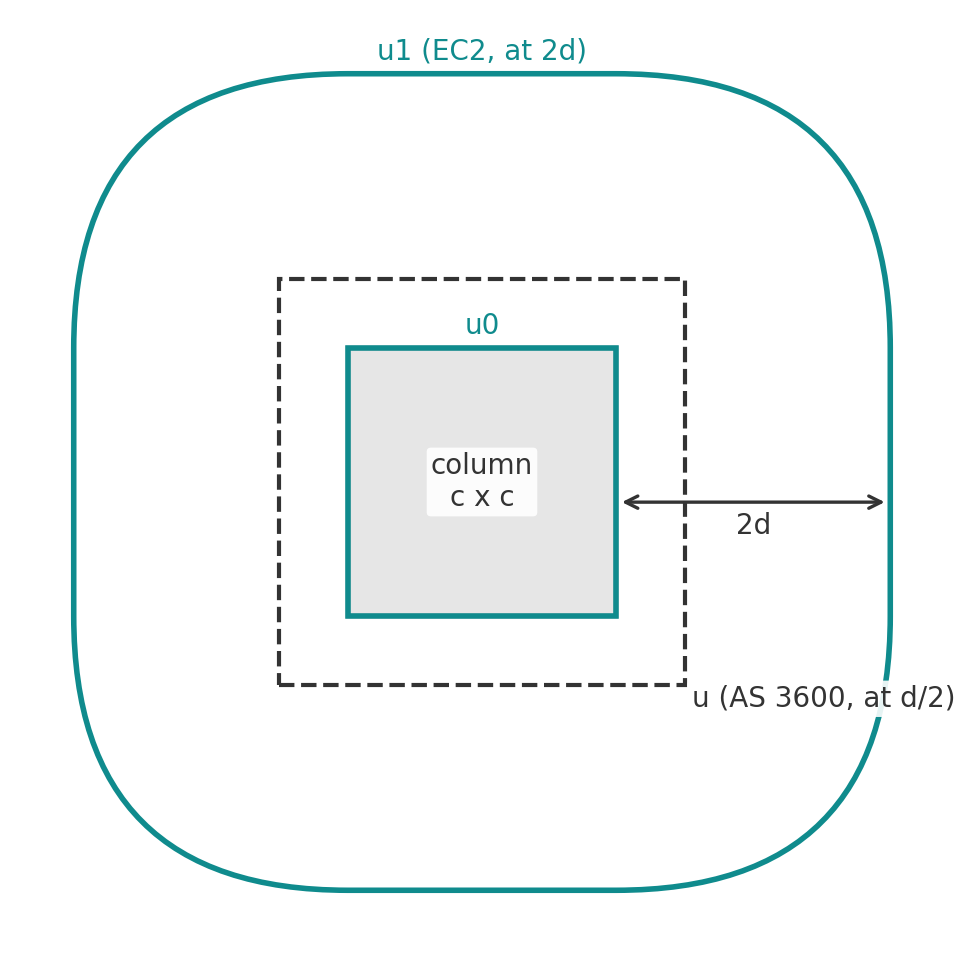
- EN 1992-1-1: the basic control perimeter \(u_1\) sits at \(2d\) from the loaded area, with rounded corners. For a square column of side \(c\), \(u_1 = 4c + 4\pi d\). The column perimeter itself is \(u_0\).
- AS 3600: the critical shear perimeter \(u\) sits at \(d/2\) from the column face, with square corners. For the same square column, \(u = 4(c + d)\).
Because the AS 3600 perimeter is much shorter, its allowable stress is correspondingly higher. The two approaches cannot be compared stress for stress, only load for load. Near a free edge the perimeter is cut off at the edge in both codes, and openings close to the column remove the part of the perimeter shadowed by the opening.
The effective depth is averaged over the two directions: \(d = (d_y + d_z)/2\). For a 250 mm slab with 30 mm cover and 16 mm bars in both directions, the outer layer has \(d = 212\) mm and the inner layer \(d = 196\) mm, giving \(d = 204\) mm.
Loads and load combinations
The punching shear force is the column reaction from the slab at that level, less any load applied inside the control perimeter (for a footing, less the soil pressure inside the perimeter). For a regular flat slab a quick estimate is the tributary area times the design floor load; a frame or finite element analysis gives the reaction and the unbalanced moment together.
- AS/NZS 1170.0: \(1.2G + 1.5Q\).
- EN 1990: \(1.35G_k + 1.5Q_k\).
Our guide to dead load and live load covers the inputs. Note that punching is an ultimate limit state check only; there is no serviceability counterpart.
Material properties
- EN 1992-1-1: \(\gamma_c = 1.5\), \(\gamma_s = 1.15\). Design concrete strength \(f_{cd} = \alpha_{cc} f_{ck}/\gamma_c\) with \(\alpha_{cc}\) from the National Annex (1.0 recommended, 0.85 in some countries).
- AS 3600: capacity reduction factor \(\phi = 0.7\) for shear in a slab without shear fitments (Table 2.2.2; 0.75 where Class N fitments are provided), applied to the whole punching capacity.
The flexural reinforcement ratio matters too. In Eurocode 2 the tension steel crossing the control perimeter raises the concrete shear capacity through \(\rho_l\); in AS 3600 the basic capacity is independent of the steel.
Check at the column face
Whatever reinforcement you add, the concrete next to the column can crush in shear. Both codes cap the stress at the column perimeter.
- EN 1992-1-1 Equation 6.53: \(v_{Ed} = \beta V_{Ed}/(u_0 d) \le v_{Rd,max} = 0.4\,\nu f_{cd}\), with \(\nu = 0.6(1 - f_{ck}/250)\) (Equation 6.6N). The 0.4 factor dates from the 2014 amendment to EN 1992-1-1; the original 2004 text used 0.5, and the National Annex may set \(v_{Rd,max}\) differently, so check which version applies to your project.
- AS 3600: the capacity with shear reinforcement is capped as well, but the cap is tied to the torsion strip and shear head provisions rather than to a stress at the column face.
Capacity without shear reinforcement
EN 1992-1-1 Clause 6.4.4
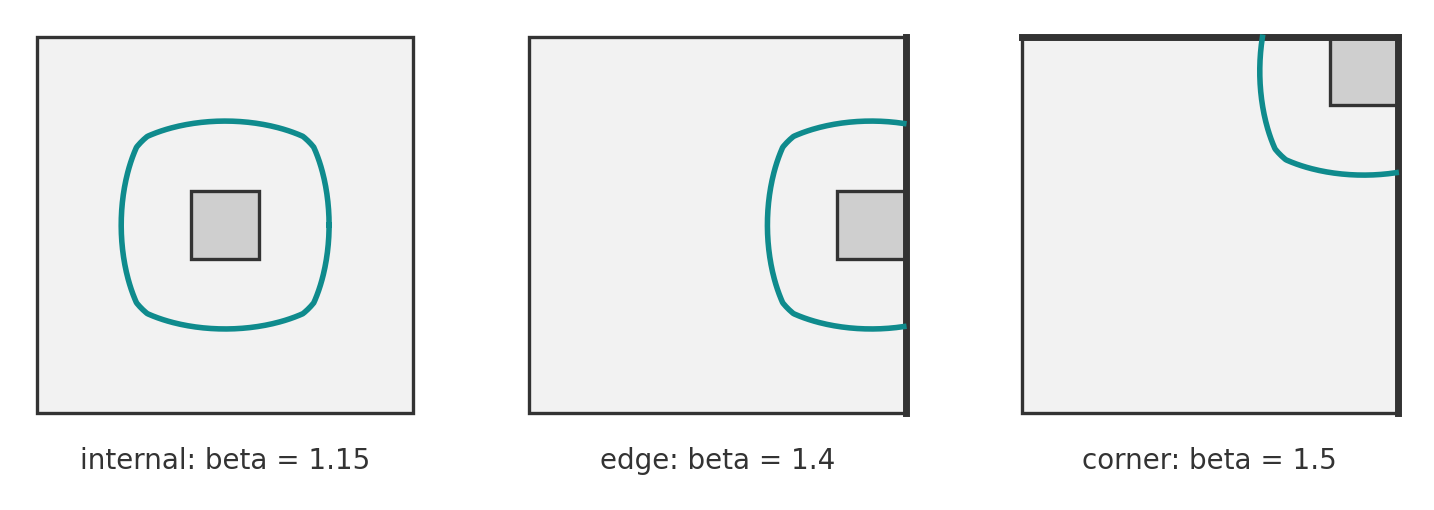
The design shear stress on \(u_1\) is \(v_{Ed} = \beta V_{Ed} / (u_1 d)\), where \(\beta\) accounts for unbalanced moment. The simplified values of Clause 6.4.3, Figure 6.21N, are \(\beta = 1.15\) for an internal column, 1.4 for an edge column and 1.5 for a corner column, valid where adjacent spans do not differ by more than 25 percent and the structure is braced. Otherwise compute \(\beta\) from the moment.
The capacity (Equation 6.47) is
$$ v_{Rd,c} = C_{Rd,c}\, k\, (100 \rho_l f_{ck})^{1/3} + k_1 \sigma_{cp} \ge v_{min} + k_1 \sigma_{cp} $$
where \(C_{Rd,c} = 0.18/\gamma_c\), \(k = 1 + \sqrt{200/d} \le 2.0\) with \(d\) in mm, \(\rho_l = \sqrt{\rho_{ly}\rho_{lz}} \le 0.02\) is the mean tension reinforcement ratio over a width of the column plus \(3d\) each side, \(\sigma_{cp}\) is any axial prestress, \(k_1 = 0.1\), and \(v_{min} = 0.035 k^{3/2} f_{ck}^{1/2}\).
If \(v_{Ed} \le v_{Rd,c}\) no shear reinforcement is needed.
AS 3600
The ultimate shear strength of a slab with no moment transfer and no shear reinforcement is
$$ V_{uo} = u\, d\, f_{cv}, \qquad f_{cv} = 0.17\left(1 + \frac{2}{\beta_h}\right)\sqrt{f'_c} \le 0.34\sqrt{f'_c} $$
where \(\beta_h\) is the ratio of the longer to the shorter column dimension and \(f'_c\) is in MPa. For a square or near-square column the \(0.34\sqrt{f'_c}\) cap governs.
With an unbalanced moment \(M^*_v\) transferred to the column, the capacity reduces to
$$ V_u = \frac{V_{uo}}{1 + \dfrac{u M^*_v}{8 V^* a d}} $$
where \(a\) is the dimension of the critical perimeter measured parallel to the direction of \(M^*_v\).
The check is \(V^* \le \phi V_u\). Where it fails, AS 3600 offers a torsion strip or spandrel beam approach, or shear heads and stud rails designed to the relevant provisions, rather than the perimeter-by-perimeter method of Eurocode 2. Our concrete slab design to AS 3600 guide places punching within the overall slab design.
Capacity with shear reinforcement
In EN 1992-1-1 Clause 6.4.5 (Equation 6.52), studs or links placed on perimeters around the column add to a reduced concrete contribution:
$$ v_{Rd,cs} = 0.75\, v_{Rd,c} + 1.5\left(\frac{d}{s_r}\right) A_{sw}\, f_{ywd,ef}\, \frac{1}{u_1 d}\sin\alpha $$
where \(A_{sw}\) is the area of shear reinforcement on one perimeter, \(s_r\) is the radial spacing of perimeters, \(\alpha\) is the angle of the reinforcement to the slab (90 degrees for studs), and \(f_{ywd,ef} = 250 + 0.25d \le f_{ywd}\) in MPa recognises that thin slabs cannot anchor the full yield strength.
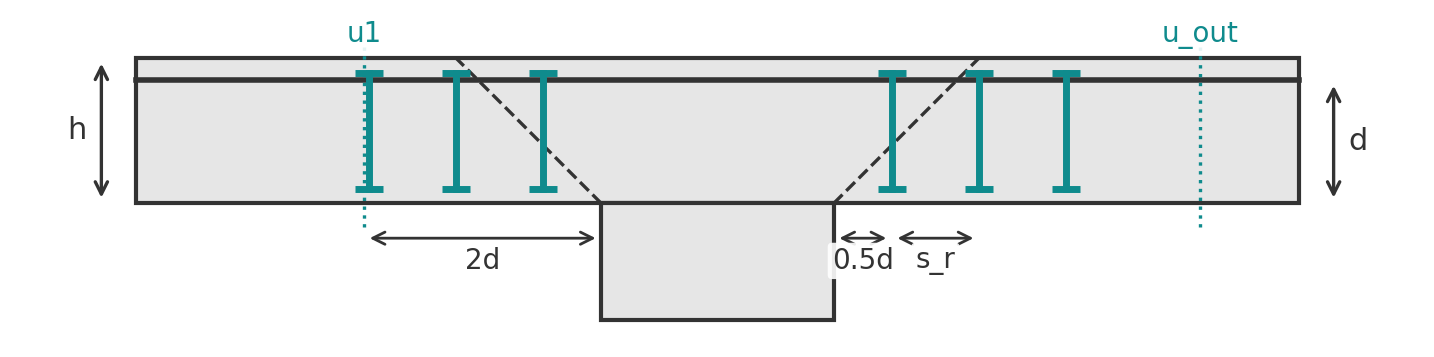
Detailing rules in Clause 9.4.3 put the first perimeter between \(0.3d\) and \(0.5d\) from the column face, at a radial spacing \(s_r \le 0.75d\). Clause 6.4.5 (Equation 6.54) carries the reinforcement out to a perimeter \(1.5d\) inside the outer perimeter \(u_{out}\), at which the concrete alone is adequate:
$$ u_{out} = \frac{\beta V_{Ed}}{v_{Rd,c}\, d} $$
Worked example: internal column to Eurocode 2
A 250 mm flat slab, C32/40 concrete (\(f_{ck} = 32\) MPa), 30 mm cover, on a 400 mm square internal column. Top reinforcement over the column is 16 mm bars at 150 mm centres each way. The column reaction from the analysis is \(V_{Ed} = 650\) kN. Spans are regular, so \(\beta = 1.15\). Take \(\alpha_{cc} = 1.0\), \(f_{ywk} = 500\) MPa.
1. Geometry
\(d_y = 250 - 30 - 8 = 212\) mm, \(d_z = 212 - 16 = 196\) mm, \(d = 204\) mm. \(u_0 = 4 \times 400 = 1600\) mm. \(u_1 = 1600 + 4\pi(204) = 4164\) mm.
2. Column face
\(\nu = 0.6(1 - 32/250) = 0.523\), \(f_{cd} = 32/1.5 = 21.3\) MPa, \(v_{Rd,max} = 0.4 \times 0.523 \times 21.3 = 4.46\) MPa.
$$ v_{Ed,0} = \frac{1.15 \times 650\times10^3}{1600 \times 204} = 2.29\ \text{MPa} \le 4.46\ \text{MPa} $$
3. Concrete capacity on the control perimeter
\(A_s = 201 / 0.150 = 1340\) mm\(^2\)/m each way. \(\rho_{ly} = 1340/(1000 \times 212) = 0.00632\), \(\rho_{lz} = 1340/(1000 \times 196) = 0.00684\), \(\rho_l = \sqrt{0.00632 \times 0.00684} = 0.00658\). \(k = 1 + \sqrt{200/204} = 1.99\).
$$ v_{Rd,c} = \frac{0.18}{1.5} \times 1.99 \times (100 \times 0.00658 \times 32)^{1/3} = 0.659\ \text{MPa} $$
\(v_{min} = 0.035 \times 1.99^{1.5} \times \sqrt{32} = 0.556\) MPa, so \(v_{Rd,c} = 0.659\) MPa governs.
$$ v_{Ed} = \frac{1.15 \times 650\times10^3}{4164 \times 204} = 0.880\ \text{MPa} > 0.659\ \text{MPa} $$
The concrete alone is not enough. Shear reinforcement is needed.
4. Shear reinforcement
\(f_{ywd,ef} = 250 + 0.25 \times 204 = 301\) MPa \(\le 500/1.15 = 435\) MPa. Take \(s_r = 150\) mm (\(\le 0.75d = 153\) mm). Rearranging the \(v_{Rd,cs}\) expression for the area per perimeter:
$$ A_{sw} \ge \frac{(0.880 - 0.75 \times 0.659) \times 4164 \times 204}{1.5 \times (204/150) \times 301} = 533\ \text{mm}^2 $$
Eight 10 mm studs per perimeter give 628 mm\(^2\), and \(v_{Rd,cs} = 0.75 \times 0.659 + 1.5 \times 1.36 \times 628 \times 301 / (4164 \times 204) = 0.949\) MPa \(\ge 0.880\) MPa.
5. Outer perimeter
$$ u_{out} = \frac{1.15 \times 650\times10^3}{0.659 \times 204} = 5558\ \text{mm} $$
For a square column with rounded corners, \(u_{out} = u_0 + 2\pi a\), so \(a = (5558 - 1600)/2\pi = 630\) mm from the column face. The last stud perimeter must sit at least \(1.5d = 306\) mm inside that, so at 324 mm or beyond. With the first perimeter at 100 mm (\(0.5d\)) and \(s_r = 150\) mm, perimeters at 100, 250 and 400 mm do it: three perimeters of eight 10 mm studs.
The same slab to AS 3600
For comparison, \(u = 4(400 + 204) = 2416\) mm, \(f_{cv} = 0.34\sqrt{32} = 1.92\) MPa, \(V_{uo} = 2416 \times 204 \times 1.92 = 948\) kN and \(\phi V_{uo} = 664\) kN. Against \(V^* = 650\) kN (the AS/NZS 1170.0 factors would give a slightly different figure) the slab just passes with no moment transfer, and any unbalanced moment would tip it into needing shear reinforcement or a thicker slab. Both codes point the same way for this slab: it is at the limit of what plain concrete can do.
Run it in CalcTree
The full check, from perimeter geometry through \(v_{Rd,c}\) to the stud layout, can be built as a live, checkable CalcTree page with the slab, column and reinforcement as inputs. Start from EC2 Punching Shear at an Internal Column for Eurocode 2, or Concrete Punching Shear Design to AS 3600-2018 for the Australian check.