
Check punching shear at an internal column to Eurocode 2: control perimeters, resistance and reinforcement. Try the free calculator.

This template is not available yet. You can sign up and create it yourself!
Or let us know if you'd like to be notified when it’s ready:

No items found.
No items found.
About this EC2 Punching Shear at an Internal Column Calculator
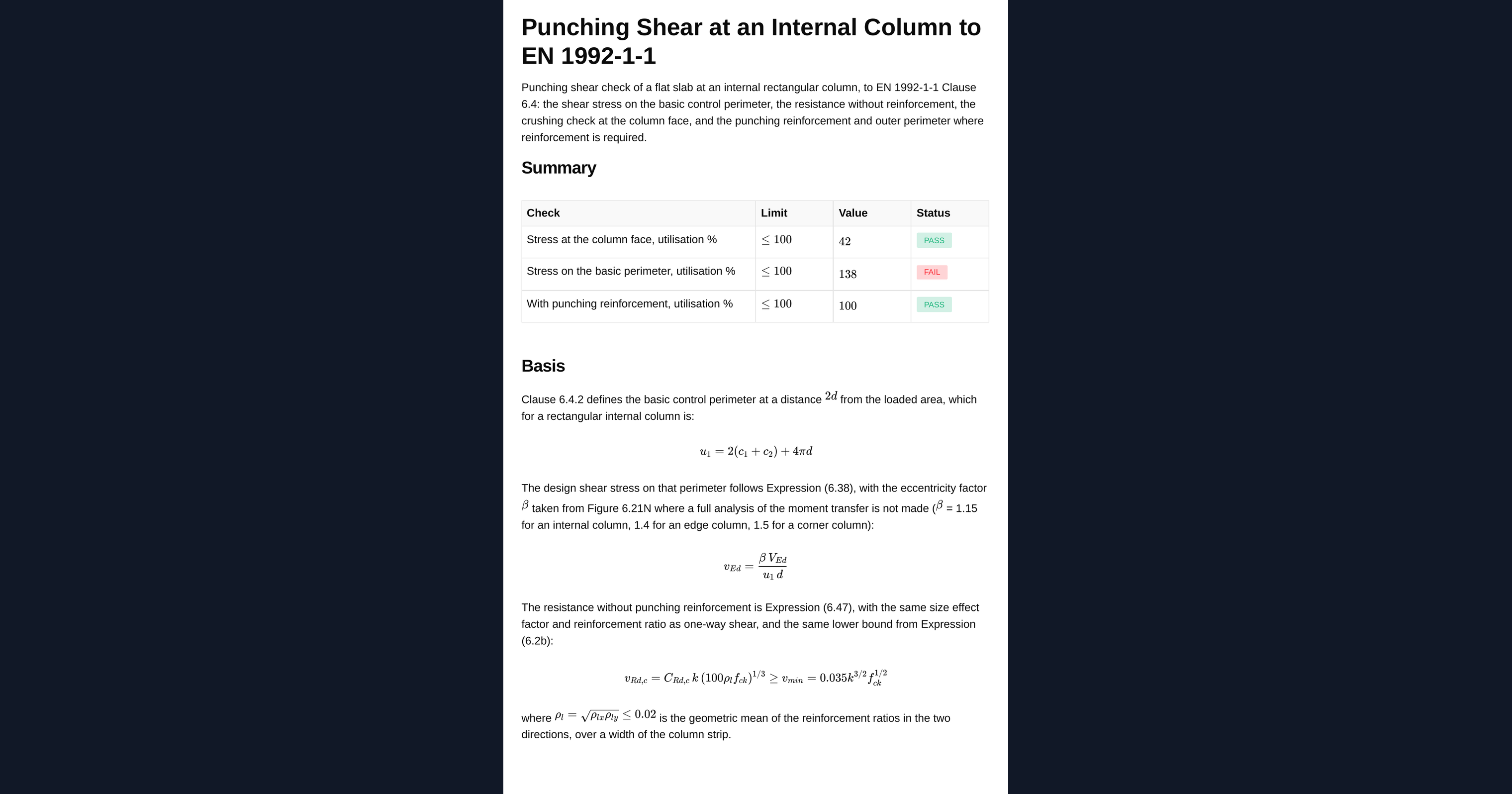
This calculator checks punching shear at an internal column in a flat slab to Eurocode 2 (EN 1992-1-1) Clause 6.4. It builds the control perimeter at the basic distance from the column face and the perimeter at the face itself, applies the eccentricity factor, and compares the design shear stress against the crushing limit at the face and the concrete resistance without shear reinforcement. Where the concrete alone is not sufficient it determines the reinforcement required per perimeter and the perimeter beyond which none is needed.
- Structural engineer. Enter the column size, slab depth, flexural reinforcement and design load, and read the governing utilisation and the shear reinforcement required.
- Design reviewer. Confirm which of the three checks governs, which is not obvious from a single utilisation figure.
- Engineer assessing an existing slab. Test whether an increased load can be carried without strengthening the slab or the column head.
Every perimeter, stress and resistance is shown as calculated with units carried through. It is an engineering-grade calculator you can audit, adapt and save to a project page in CalcTree.
More info on EC2 Punching Shear at an Internal Column
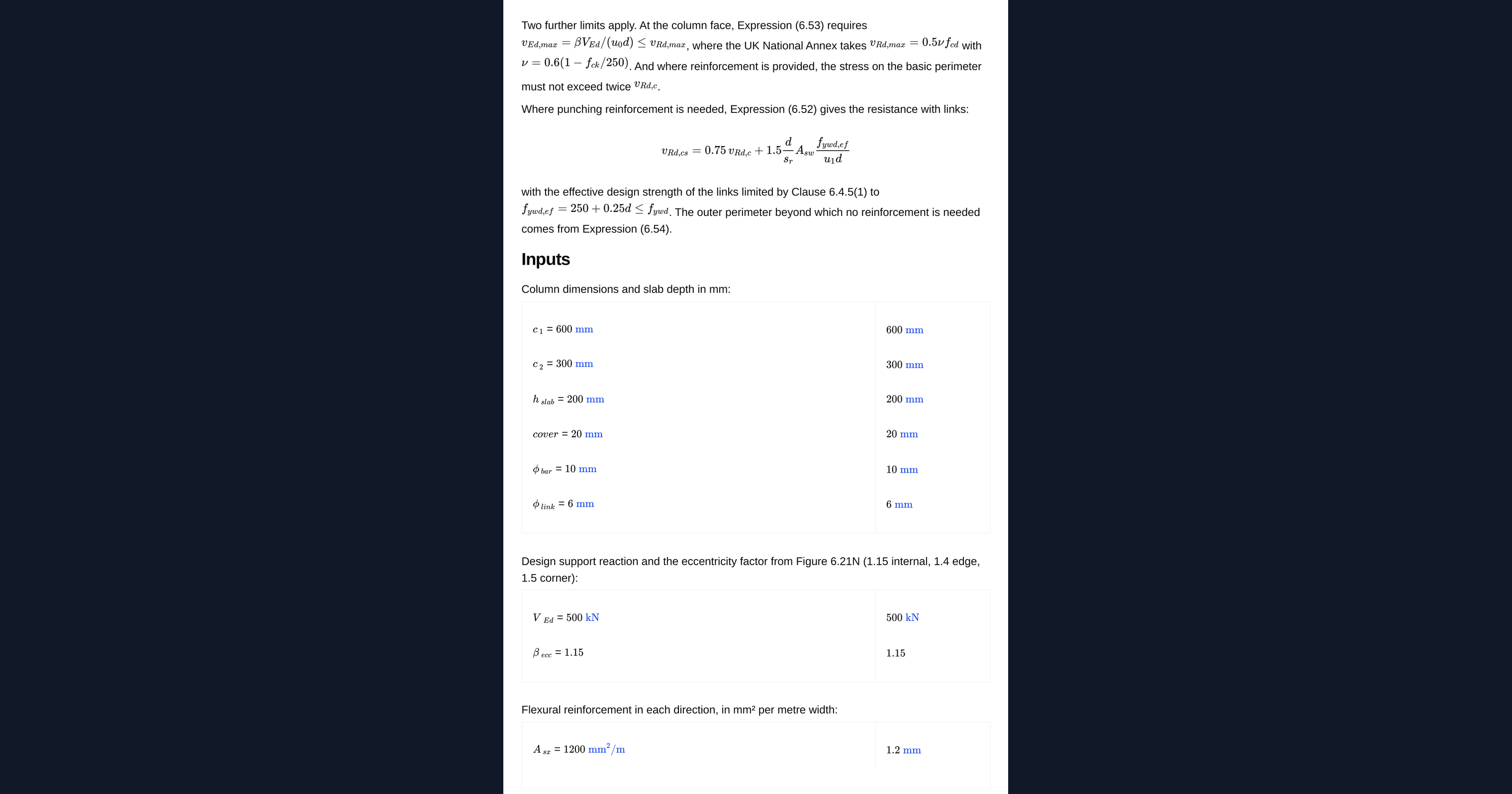
Inputs
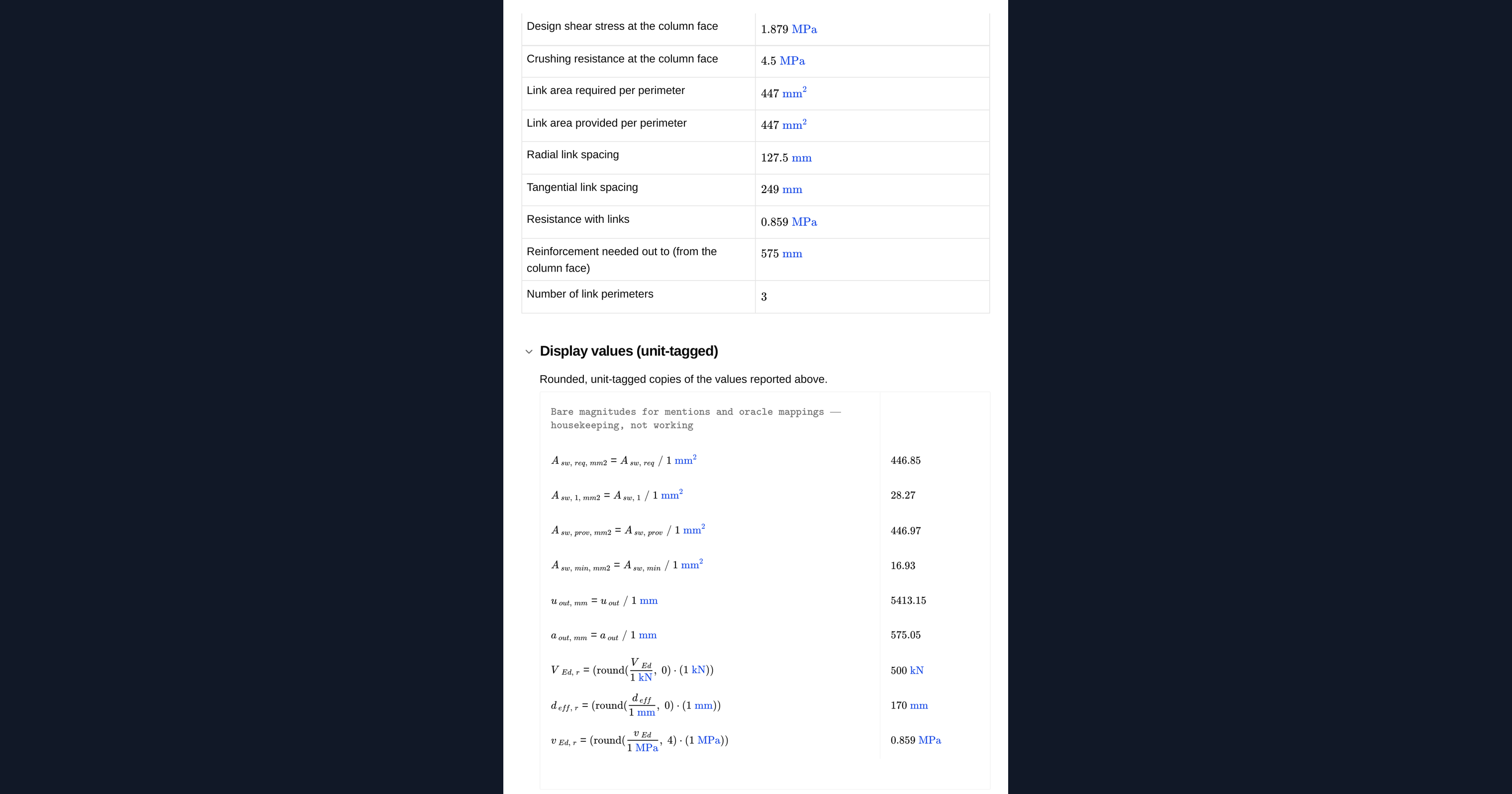
Column dimensions, slab effective depth in each direction, the flexural reinforcement ratios in the two orthogonal directions, the concrete grade, and the design shear force transferred to the column. An eccentricity factor accounts for moment transfer between slab and column.
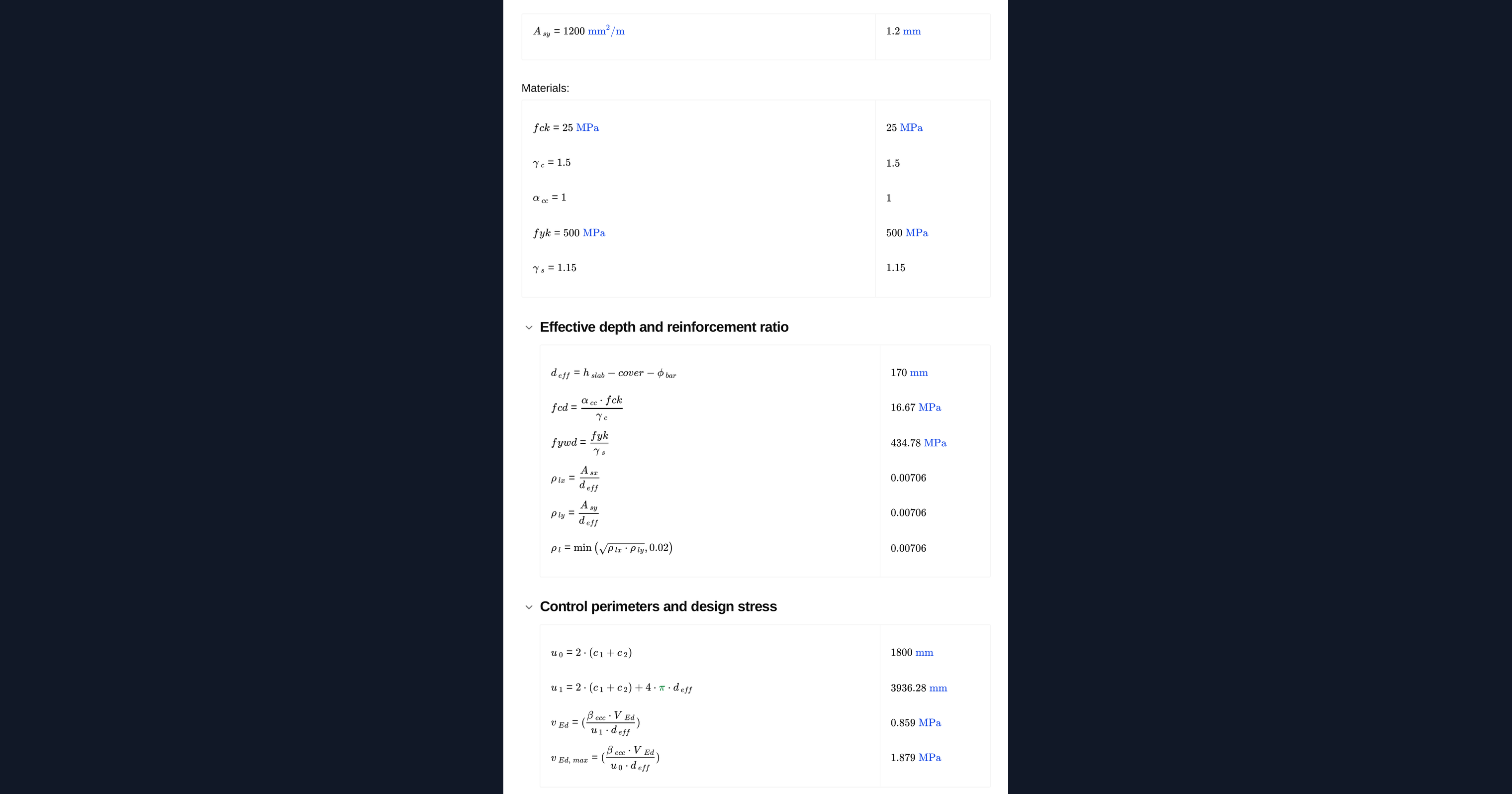
Control perimeters
The basic control perimeter is constructed at twice the effective depth from the column face, following the column shape with rounded corners, per Clause 6.4.2. The perimeter at the column face is used for the crushing check. Both are reported so the geometry can be confirmed.
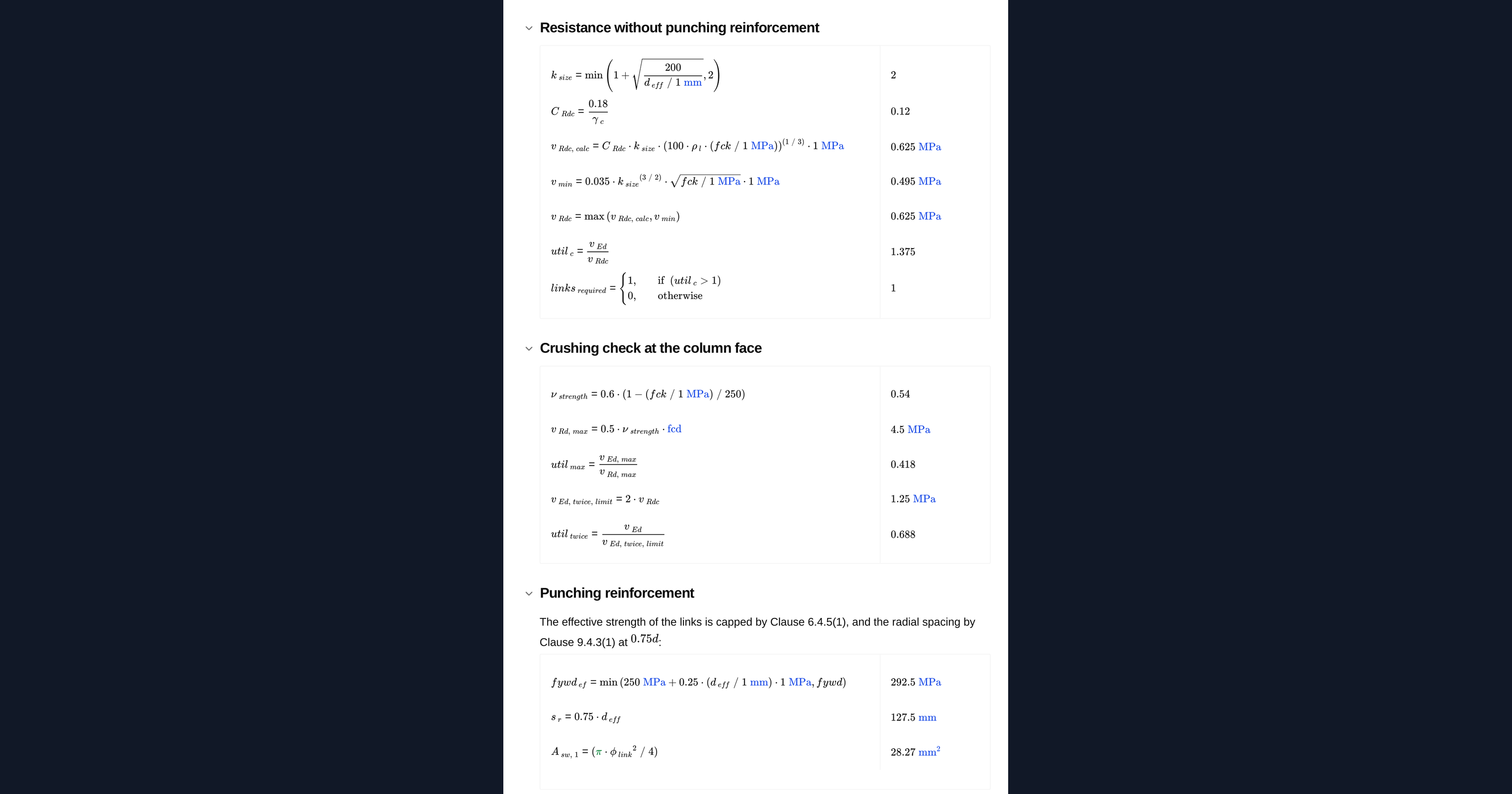
Resistances
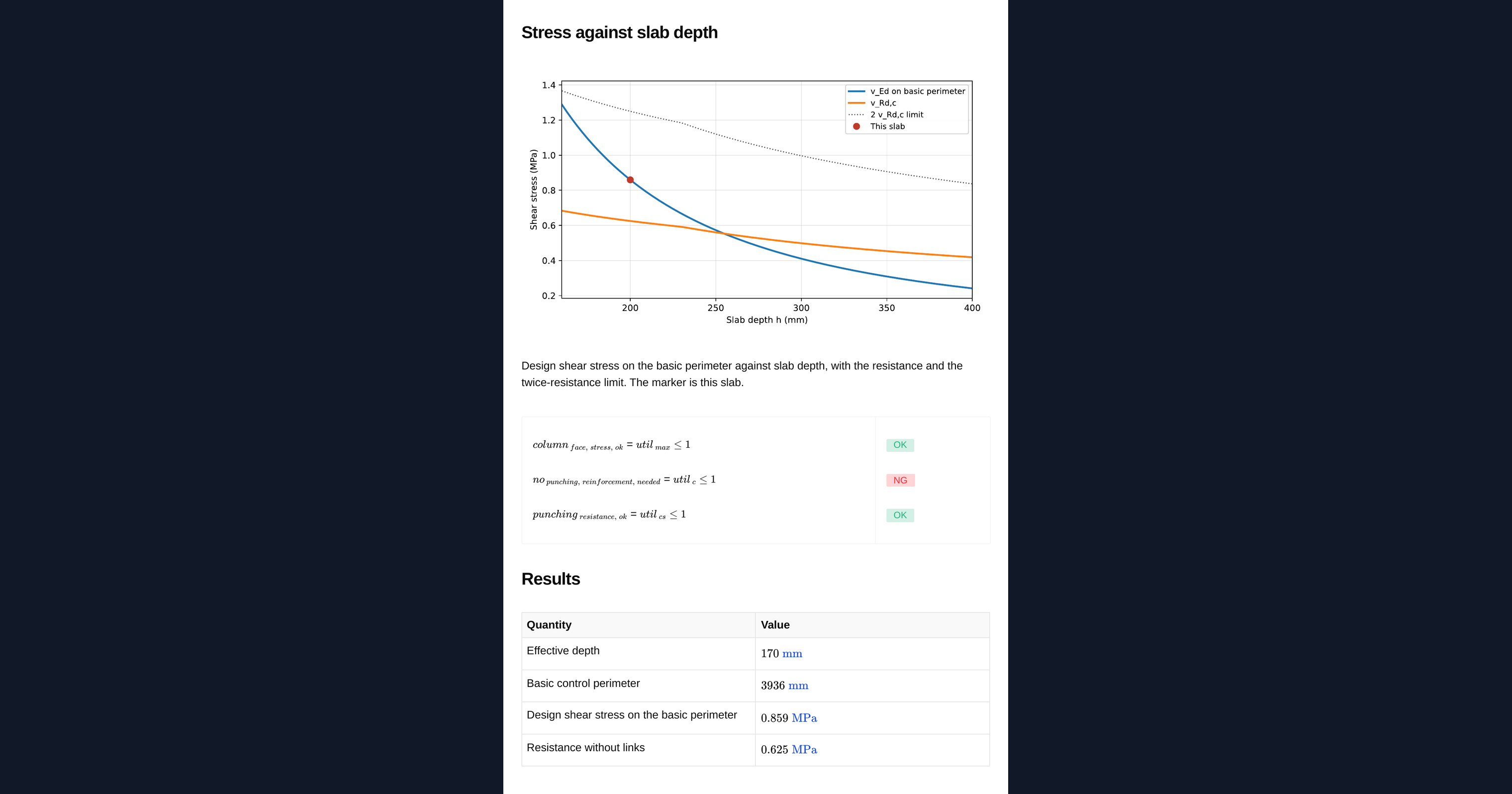
Three resistances are evaluated: the maximum shear stress the concrete can carry at the column face before crushing, the shear stress the slab can carry at the basic perimeter without shear reinforcement, and where reinforcement is required, the combined resistance of concrete and shear reinforcement.
Shear reinforcement
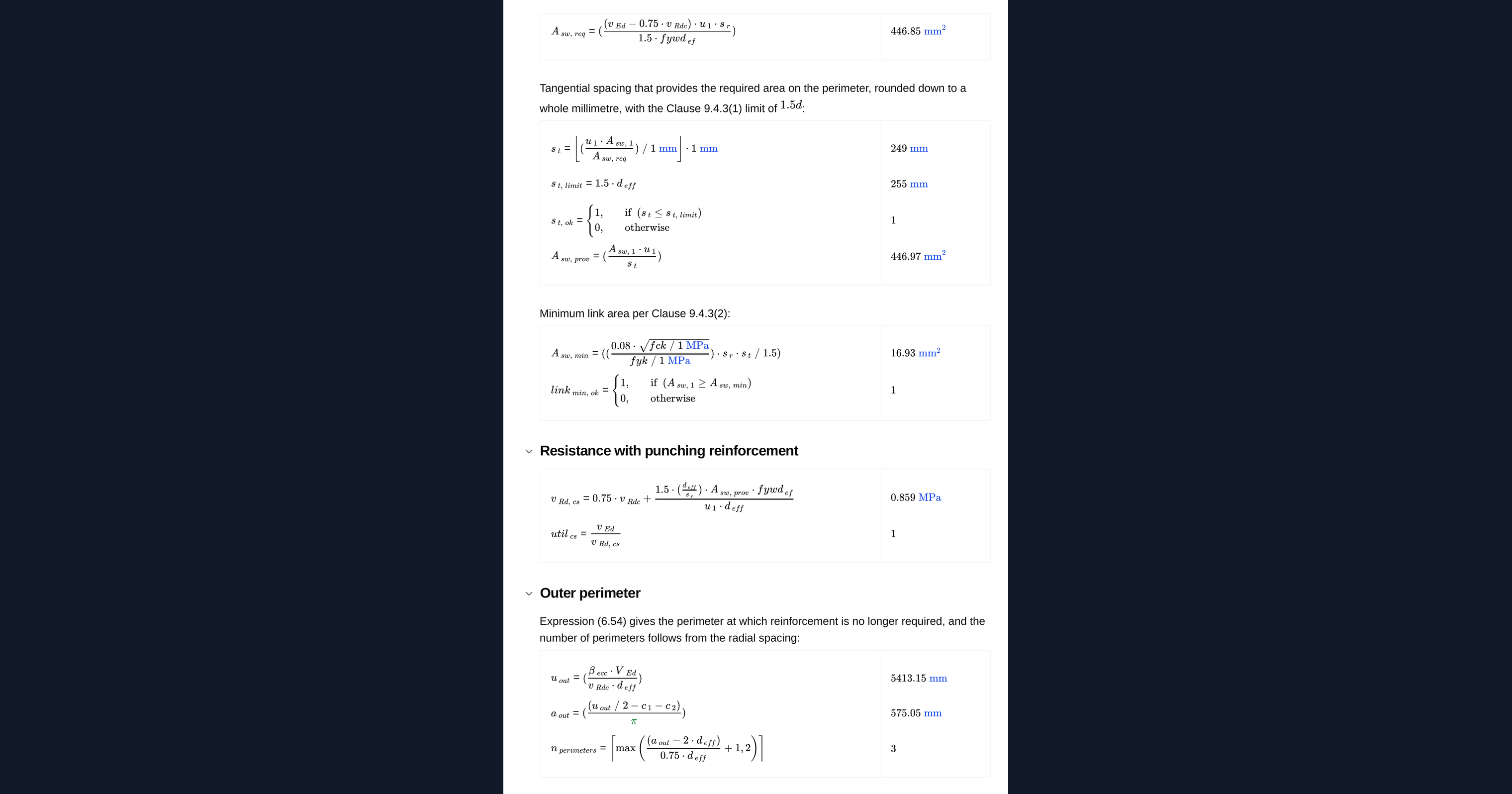
Where the applied stress exceeds the concrete resistance, the area required per perimeter is determined along with the radial and tangential spacing limits. The outer perimeter at which shear reinforcement is no longer required is also reported, which sets the extent of the reinforced zone.
Common Calculation Errors to Avoid
- Taking the control perimeter at the wrong distance. The basic perimeter sits at twice the effective depth from the face with rounded corners. Using a rectangular perimeter at the face, or a different multiple of the depth, changes the result substantially.
- Omitting the eccentricity factor. Moment transfer raises the shear stress around part of the perimeter. Applying the shear force uniformly is unconservative even for a regular internal column.
- Using the reinforcement ratio in one direction only. The clause takes the geometric mean of the ratios in the two orthogonal directions, and the code caps the value used.
- Assuming shear reinforcement can fix a crushing failure. If the stress at the column face exceeds the maximum, the slab depth, column size or concrete grade must change. Adding links does not raise that limit.
- Ignoring the extent of the reinforced zone. Reinforcement must continue out to the perimeter where it is no longer required. Stopping at the basic perimeter leaves a failure surface unreinforced.
- Using the average effective depth carelessly. The two directions have different effective depths because the bars are in layers, and the mean is what the clause intends.
Engineering templates
Common calculators
Design guides




FAQs
Where is the basic control perimeter taken?
At twice the effective depth from the column face, following the shape of the column with rounded corners, per Clause 6.4.2. The calculator constructs it from the column dimensions and the effective depth entered.
What does the eccentricity factor represent?
It accounts for the moment transferred between the slab and the column, which concentrates shear on part of the control perimeter. The code allows a recommended value for regular internal columns, and a calculated value where the layout is irregular.
What reinforcement ratio should I enter?
The flexural tension reinforcement ratio in each orthogonal direction within the column strip. The clause takes the geometric mean of the two and applies an upper cap, which the calculator enforces.
What if the stress at the column face exceeds the maximum?
The failure mode is crushing of the concrete strut at the face, and shear reinforcement cannot help. The slab depth, the column dimensions or the concrete grade must increase, or a column head or drop panel is needed.
Does this cover edge and corner columns?
No. This calculation is for an internal column. Edge and corner columns have reduced control perimeters and different eccentricity treatment under the same clause, and need to be checked separately.
Learn about the benefits of using CalcTree on engineering projects!