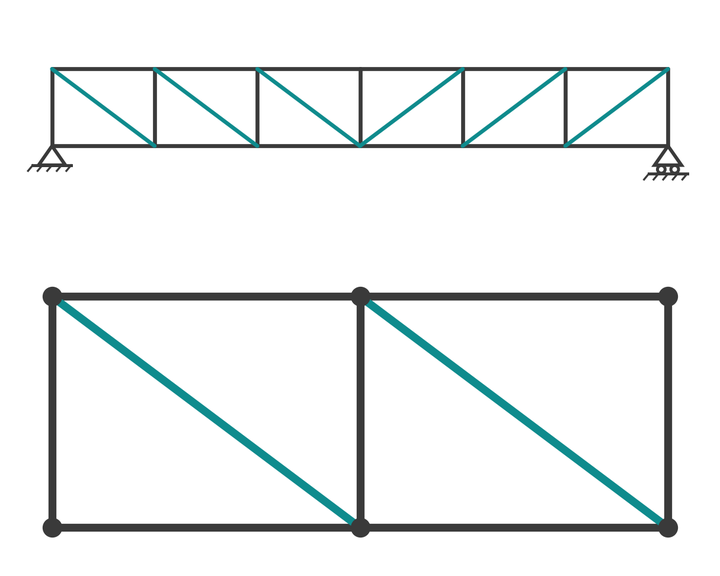
How a Pratt truss works, why its diagonals are in tension and verticals in compression, and a worked example by the method of joints and sections.
The Pratt truss is the parallel-chord truss whose diagonals slope down toward mid-span, so that under gravity load the long diagonals are in tension and the short verticals are in compression. That arrangement is the reason it became the default form for steel railway and highway bridges from the 1850s onward, and it is still the first pattern most engineers sketch for a steel bridge or a long-span roof girder.
This guide describes the Pratt truss, works through a six-panel example by the method of joints and the method of sections, and shows which members carry tension and which carry compression. For the general approach to trusses, see our truss analysis and design guide. The Howe truss is the mirror image of the Pratt and is covered separately.
What is a Pratt truss?
A Pratt truss has a top chord and a bottom chord, a vertical post at every panel point, and one diagonal in each panel. In the left half of the span the diagonals run from the top of a vertical down to the bottom of the next vertical toward the centre; in the right half they mirror. Seen from the side, the diagonals form a V pointing at mid-span.
The form was patented by Thomas and Caleb Pratt in 1844. Its logic is to put the longer members, the diagonals, into tension where buckling is not a concern, and to keep the compression members, the verticals, short. In the original timber and wrought iron bridges that meant slender iron rods for the diagonals and timber posts for the verticals. In modern steel it means the diagonals can be light angles, flats or rods while the verticals and top chord take heavier rolled or hollow sections.
Variants include the Parker truss, a Pratt with a curved or polygonal top chord that deepens the truss where the moment is largest, and the Baltimore and Pennsylvania trusses, which subdivide the panels for longer spans. The analysis here covers the plain parallel-chord form.
Static system
As with any hand truss analysis, the members are treated as pin-connected and weightless with loads applied only at the joints, so every member carries pure axial force. A single span sits on a pin at one end and a roller at the other, giving three reaction components.
The truss is statically determinate when
$$ m + r = 2j $$
where \(m\) is the number of members, \(r\) the number of reaction components and \(j\) the number of joints.
The example has 6 bottom chord members, 6 top chord members, 7 verticals and 6 diagonals, so \(m = 25\), with \(r = 3\) and \(j = 14\): \(25 + 3 = 28 = 2 \times 14\). It is determinate.
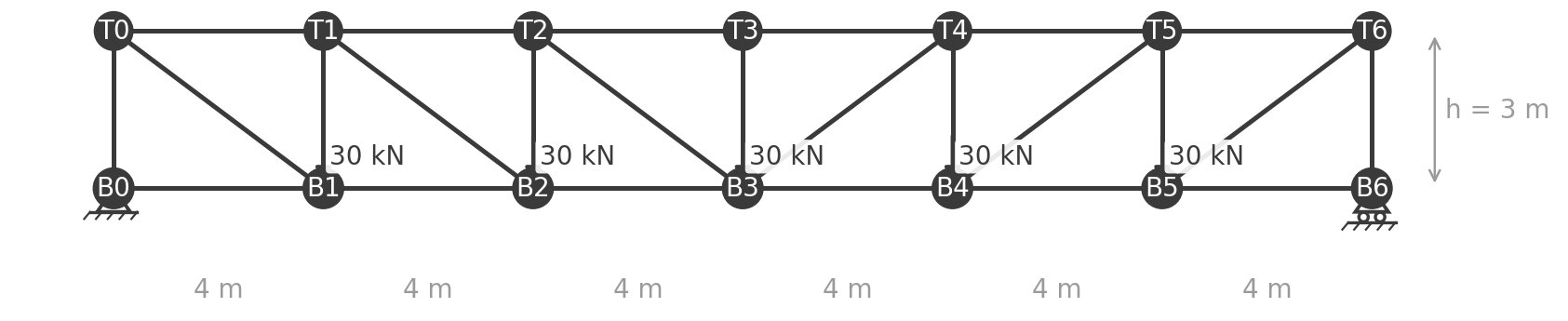
The example spans 24 m in six panels of 4 m with a depth of 3 m, so every diagonal is a 3-4-5 triangle: 5 m long, with \(\sin\theta = 0.6\) and \(\cos\theta = 0.8\). The deck sits on the bottom chord and delivers 30 kN to each of the five interior bottom chord joints. Loads landing directly over the supports go straight into the bearings without stressing the truss, so they are left out.
Pratt truss analysis
Every number in this section can be reproduced in the truss analysis calculator: choose Pratt, a 24 m span, 3 m depth, six panels and 30 kN on the bottom chord, and read the reactions and member forces off the page.
Reaction forces
The applied load totals \(5 \times 30 = 150\) kN and is symmetric, so
$$ R_A = R_B = \frac{150}{2} = 75 \text{ kN} $$
For an asymmetric load, take moments about one support to find the other reaction, then use vertical equilibrium. The horizontal reaction at the pin is zero because there is no horizontal load.
Method of joints
Begin at the left support B0, where the unknowns are the bottom chord B0B1 and the end post B0T0. With tension positive, vertical equilibrium gives
$$ 75 + F_{B0T0} = 0 \quad\Rightarrow\quad F_{B0T0} = -75 \text{ kN} $$
The end post carries the whole reaction in compression. Horizontal equilibrium at B0 has only one member in it, so \(F_{B0B1} = 0\). The first bottom chord panel of a Pratt truss with a bottom-chord deck is a zero-force member.
At joint T0 the end post pushes up with 75 kN. The only member with a vertical component to balance it is the diagonal T0B1, which must pull down and to the right:
$$ 75 - F_{T0B1} \sin\theta = 0 \quad\Rightarrow\quad F_{T0B1} = \frac{75}{0.6} = 125 \text{ kN} $$
Horizontal equilibrium at T0 gives the top chord: \(F_{T0T1} = -125 \times 0.8 = -100\) kN, compression.
At joint B1 the diagonal T0B1 pulls up and to the left with components 100 kN horizontal and 75 kN vertical, and the 30 kN load acts down. Vertical equilibrium gives the vertical B1T1:
$$ 75 - 30 + F_{B1T1} = 0 \quad\Rightarrow\quad F_{B1T1} = -45 \text{ kN} $$
and horizontal equilibrium gives the bottom chord \(F_{B1B2} = 100\) kN in tension. Continuing joint by joint produces the full set below.
Method of sections
To pick out a member in the middle of the span without working through every joint, cut the truss through the second panel so the cut passes through T1T2, T1B2 and B1B2, and keep the left-hand part.
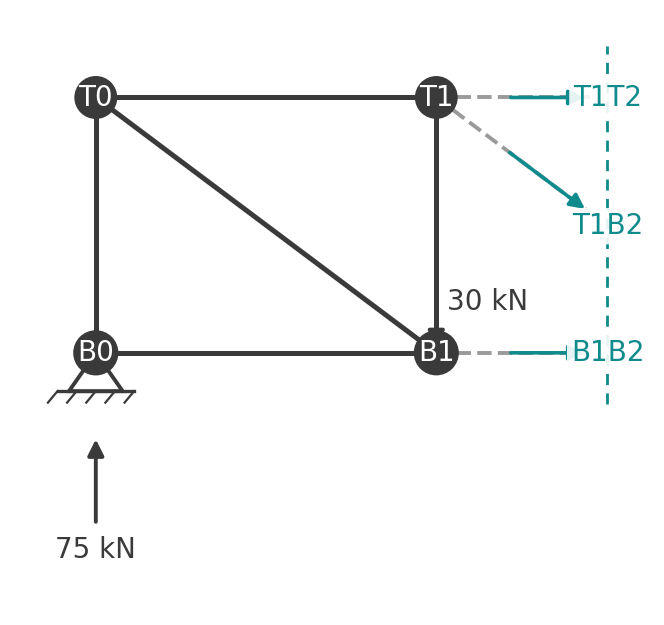
Moments about T1, where the top chord and the diagonal meet, isolate the bottom chord:
$$ F_{B1B2} \times 3 = 75 \times 4 \quad\Rightarrow\quad F_{B1B2} = 100 \text{ kN} $$
Moments about B2, where the diagonal and the bottom chord meet, isolate the top chord:
$$ F_{T1T2} \times 3 = -(75 \times 8 - 30 \times 4) \quad\Rightarrow\quad F_{T1T2} = -\frac{480}{3} = -160 \text{ kN} $$
Vertical equilibrium of the free body gives the diagonal, because the two chords are horizontal:
$$ 75 - 30 - F_{T1B2} \sin\theta = 0 \quad\Rightarrow\quad F_{T1B2} = \frac{45}{0.6} = 75 \text{ kN} $$
The general pattern is the same as for a beam. A chord force is the bending moment at the opposite chord's joint divided by the depth \(h\). A diagonal force is the shear in its panel divided by \(\sin\theta\). A vertical carries the shear in the adjacent panel, adjusted for any load at its own joint.
Compression and tension members
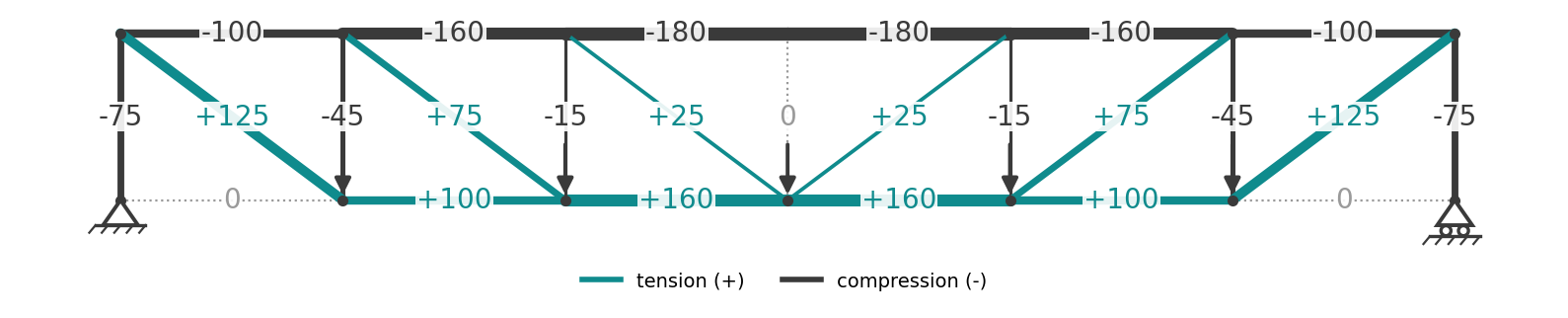
The full set of member forces, with tension positive:
- Bottom chord: 0, 100, 160, 160, 100, 0 kN, tension.
- Top chord: 100, 160, 180, 180, 160, 100 kN, compression. The 180 kN peak is at mid-span.
- Diagonals, from the support inward: 125, 75, 25 kN, all tension, mirrored on the right.
- Verticals, from the support inward: 75, 45, 15 kN, all compression, with the centre vertical at zero.
This is the signature of the Pratt truss under gravity load: every diagonal is in tension and every vertical is in compression. The verticals are 3 m long and the diagonals 5 m, so the long members are the ones that cannot buckle. The end posts are the heaviest compression members in the web, carrying the full reaction, and the mid-span top chord is the heaviest compression member overall.
The centre vertical has zero force because the shear changes sign there with no load applied at its top joint. In a bridge with a moving load the diagonals near mid-span do see reversal, which is why historic Pratt trusses often have crossed counter-diagonals in the middle panels. The steel bracing guide discusses the same tension-only versus tension-compression choice for bracing.
Member design and code references
With the forces known, each member is designed for axial load:
- Tension diagonals: EN 1993-1-1 clause 6.2.3, \(N_{pl,Rd} = A f_y / \gamma_{M0}\) and \(N_{u,Rd} = 0.9 A_{net} f_u / \gamma_{M2}\) at bolted ends. AS 4100 clause 7.2, \(N_t = A_g f_y\) and \(N_t = 0.85 k_t A_n f_u\), with \(\phi = 0.9\). The \(k_t\) factor matters for single angles connected by one leg.
- Compression verticals and chords: EN 1993-1-1 clause 6.3.1, \(N_{b,Rd} = \chi A f_y / \gamma_{M1}\). AS 4100 clauses 6.2 and 6.3, \(N_s = k_f A_n f_y\) and \(N_c = \alpha_c N_s\).
- Load combinations: EN 1990 or AS/NZS 1170.0. Bridge live load from EN 1991-2 or AS 5100.2.
The compression chord's out-of-plane effective length is the distance between lateral restraints, which for a through truss can be the whole span unless there is overhead bracing. That check usually sets the chord section. The steel member design to AS 4100 page runs the section and member capacities for a trial section, and the bolt group page covers the diagonal end connections.
Advantages and disadvantages
Advantages:
- Long members in tension, short members in compression, so the web is light and buckling checks are easy.
- Repetitive geometry and simple connections, and the pattern scales to spans of 30 to 100 m.
- Verticals at every panel point give a short chord panel length for deck stringers or purlins.
- Well understood: easy to analyse by hand and to check.
Disadvantages:
- More members and joints than a Warren truss of the same span.
- Under uplift or load reversal the diagonals go into compression, and tension-only diagonals then need counters or a heavier section.
- The end posts and top chord carry high compression and often end up as the largest members.
Pratt truss FAQ
Which way do the diagonals go in a Pratt truss?
They slope down toward the centre of the span: from the top of each vertical to the bottom of the next vertical nearer mid-span. If they slope the other way, up toward the centre, the truss is a Howe.
Why are Pratt truss diagonals in tension?
The shear in each panel has to be carried by the diagonal's vertical component. Near the left support the shear is upward on the left face of a cut, and a diagonal running down to the right can only resist that by pulling, which is tension. Mirroring the diagonals in the right half keeps the same sign throughout.
Is a Pratt truss better than a Warren truss?
For a static gravity load on a long span, the Pratt's tension diagonals give a lighter web. For shorter spans or where simplicity matters, the Warren's fewer members usually win. For loads that reverse, such as wind uplift on a roof, the Warren handles reversal without extra members.
What is a Pratt truss used for?
Steel bridges, long-span roof girders, gantries and crane runways, and as the web pattern in many open-web steel joists.
Run it in CalcTree
The truss analysis calculator runs this example live, and switches between the Warren, Pratt, Howe and K forms on the same span. The joint equilibrium above is a short set of equations that suits a live CalcTree page: span, panel count, depth and joint loads as inputs, with reactions, member forces and the governing compression and tension members as checkable outputs. Pair it with the AS 4100 steel member check to size each member, or browse the template library for the Eurocode 3 version.