
Cross-sectional area formulas for rectangles, circles, I sections, CHS, RHS, channels, T sections and angles, with a worked example to AS 4100 and Eurocode 3.
The cross sectional area formula for a structural section is rarely more than adding and subtracting rectangles, yet it sits under more design checks than any other section property: axial stress, self-weight, tension and compression capacity, shear capacity through the web area, and every stiffness property that is quoted per unit area. This page gives the formulas for the common shapes, shows how to handle hollow and built-up sections, and works through a 300 mm I section from area to self-weight, stress and code capacity under AS 4100 and Eurocode 3.
The area is also the denominator in the centroid and radius of gyration calculations, so it pairs with our centroid formulas and moment of inertia guides.
What the cross-sectional area is
Cut a member perpendicular to its axis and the exposed face is the cross-section. Its area \( A \) is the quantity of material resisting whatever acts along the member. Under an axial force \( N \) the average normal stress is:
$$ \sigma = \frac{N}{A} $$
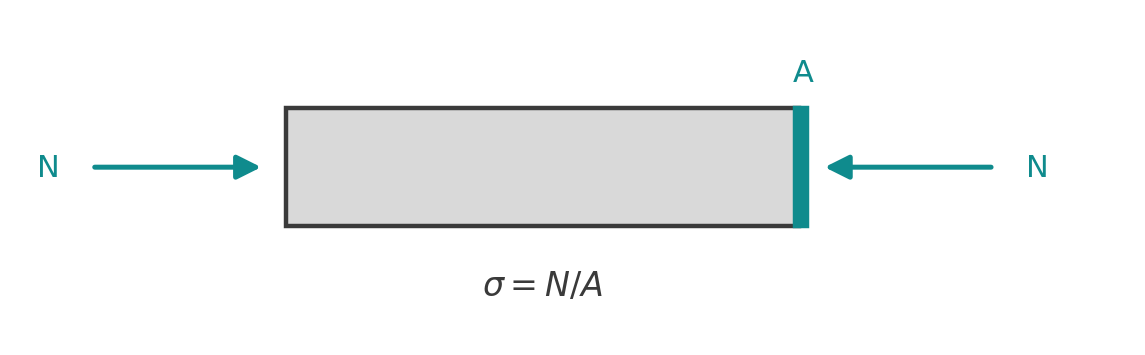
Units are length squared. Work in \( \text{mm}^2 \) for section calculations; section tables often quote \( \text{cm}^2 \), and \( 1 \text{ cm}^2 = 100 \text{ mm}^2 \). With steel at 7850 \( \text{kg/m}^3 \), the mass per metre follows directly: \( m = \rho A \), with \( A \) in \( \text{m}^2 \). That is where the "kg/m" in every section designation comes from.
Three different areas appear in design, and it pays to keep them apart:
- Gross area \( A_g \): the full section, used for compression, stiffness and self-weight.
- Net area \( A_n \): gross area minus bolt holes, used for tension at a connection. \( A_n = A_g - \sum d_h t \), where \( d_h \) is the hole diameter and \( t \) the plate thickness at each hole.
- Shear area \( A_w \) or \( A_v \): the part of the section that carries shear, in practice the web of an I section or the two webs of a hollow section.
Cross-sectional area formulas
The section properties of common shapes calculator returns the area, second moments and section moduli of a rectangle, I or H section, CHS or RHS from its dimensions.
Rectangle
$$ A = b \, h $$
A 200 mm by 400 mm concrete beam has \( A = 80\,000 \text{ mm}^2 \), or 0.08 \( \text{m}^2 \).
Circle, diameter d
$$ A = \frac{\pi d^2}{4} = \pi r^2 $$
A 50 mm bar has \( A = \pi \times 50^2 / 4 = 1963 \text{ mm}^2 \).
Triangle
$$ A = \frac{b \, h}{2} $$
with \( h \) the perpendicular height, not the sloping side. A triangle 120 mm wide and 90 mm high has \( A = 5400 \text{ mm}^2 \).
I or H section
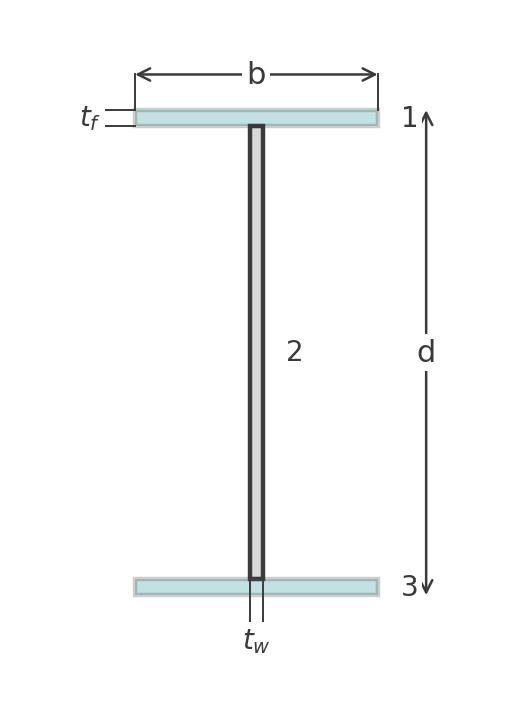
Three rectangles: two flanges and the web between them.
$$ A = 2 \, b \, t_f + (d - 2 t_f) \, t_w $$
where
\( b \) is the flange width
\( d \) is the overall depth
\( t_f \) is the flange thickness
\( t_w \) is the web thickness
For an unsymmetrical section, sum the three rectangles individually. Rolled sections also have root fillets at the web-to-flange junction, which add a small amount of area; tabulated values include it, hand formulas do not.
Circular hollow section, outer D and inner d
$$ A = \frac{\pi \left( D^2 - d^2 \right)}{4} $$
With wall thickness \( t \), \( d = D - 2t \), and the exact expression simplifies to \( A = \pi t (D - t) \). A 168.3 mm by 4.8 mm CHS has \( A = \pi \times 4.8 \times 163.5 = 2466 \text{ mm}^2 \), which is 19.4 kg/m.
Rectangular hollow section, B wide, H deep, thickness t
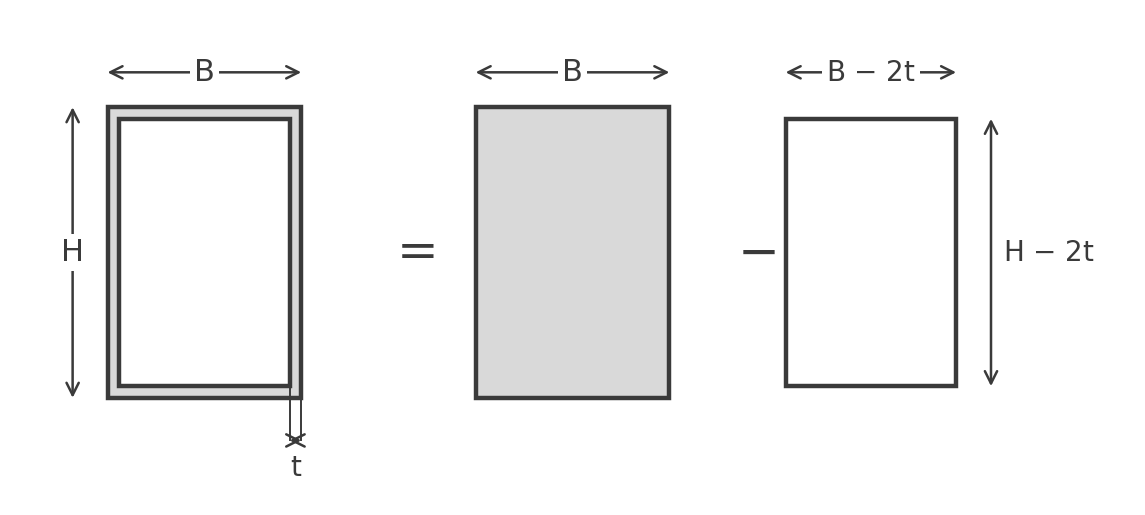
$$ A = B H - (B - 2t)(H - 2t) = 2t (B + H) - 4 t^2 $$
A 150 mm by 100 mm by 6 mm RHS has \( A = 15\,000 - 88 \times 138 = 2856 \text{ mm}^2 \). Rounded corners on a real cold-formed section trim this by a few percent, which is why the catalogue value is lower.
Channel or U section
Two flanges plus the web between them, exactly as for the I section:
$$ A = 2 \, b \, t_f + (d - 2 t_f) \, t_w $$
A 200 mm deep channel with 75 mm by 10 mm flanges and an 8 mm web has \( A = 2 \times 750 + 180 \times 8 = 2940 \text{ mm}^2 \).
T section
$$ A = b \, t_f + h_w \, t_w $$
with \( h_w \) the web depth below the flange. A 200 mm by 20 mm flange on a 180 mm by 20 mm web gives \( A = 4000 + 3600 = 7600 \text{ mm}^2 \).
Angle, legs a and b, thickness t
$$ A = t (a + b - t) $$
The \( -t \) removes the corner that both legs would otherwise count twice.
Built-up sections and holes
The composite section properties calculator sums up to three rectangles with their centroids, which covers a built-up I or T section.
Any section that can be drawn as rectangles, triangles and circles can be totalled by addition and subtraction. Add the pieces that are there, subtract the holes, and keep each piece's centroid noted if the centroid or moment of inertia is wanted next. Two cases that come up often:
- Cover plates. A 300 mm deep welded I section with \( b = 150 \), \( t_f = 10 \) and \( t_w = 8 \) has \( A = 2 \times 1500 + 280 \times 8 = 5240 \text{ mm}^2 \). Adding a 150 mm by 12 mm plate to each flange takes it to \( 5240 + 2 \times 1800 = 8840 \text{ mm}^2 \).
- Bolt holes. Two 22 mm holes through one 150 mm by 10 mm flange reduce that flange from \( 1500 \) to \( 1500 - 2 \times 22 \times 10 = 1060 \text{ mm}^2 \). Holes in both flanges on the same line take the net section to \( 5240 - 880 = 4360 \text{ mm}^2 \).
Curved and irregular outlines, such as cold-formed profiles with large corner radii, are better handled by polygon routines that sum over the outline. Our thin-walled section properties calculator does this for cold-formed shapes.
Worked example: 300 mm welded I section
Take the section above: \( d = 300 \) mm, \( b = 150 \) mm, \( t_f = 10 \) mm, \( t_w = 8 \) mm, Grade 300 steel with \( f_y = 300 \) MPa.
$$ A = 2 \times 150 \times 10 + (300 - 20) \times 8 = 3000 + 2240 = 5240 \text{ mm}^2 $$
Self-weight, as a line load for the beam analysis:
$$ m = 7850 \times 5240 \times 10^{-6} = 41.1 \text{ kg/m}, \qquad w = 41.1 \times 9.81 = 0.40 \text{ kN/m} $$
Average axial stress under a 400 kN tension:
$$ \sigma = \frac{400 \times 10^3}{5240} = 76.3 \text{ MPa} $$
which is a quarter of yield, so the section is working at about 25 percent utilisation before any capacity factor is applied.
Tension capacity
AS 4100 Clause 7.2 gives the nominal tension capacity as the lesser of yielding on the gross section, \( N_t = A_g f_y \), and fracture on the net section, \( N_t = 0.85 k_t A_n f_u \). On the gross section:
$$ N_t = 5240 \times 300 = 1572 \text{ kN}, \qquad \phi N_t = 0.9 \times 1572 = 1415 \text{ kN} $$
EN 1993-1-1 Clause 6.2.3 makes the same split: plastic resistance of the gross section \( N_{pl,Rd} = A f_y / \gamma_{M0} \) and ultimate resistance of the net section \( N_{u,Rd} = 0.9 A_{net} f_u / \gamma_{M2} \). With \( \gamma_{M0} = 1.0 \), \( N_{pl,Rd} = 1572 \) kN. The net-section check with the two-hole flange above uses \( A_n = 4360 \text{ mm}^2 \) in both codes, and whether it governs depends on \( f_u \) and the connection geometry.
Compression
Gross area again, but reduced where plate elements are slender. AS 4100 Clause 6.2 gives the section capacity \( N_s = k_f A_n f_y \), with the form factor \( k_f \) equal to 1.0 when every element is below its yield slenderness limit. EN 1993-1-1 Clause 6.2.4 uses \( N_{c,Rd} = A f_y / \gamma_{M0} \) for Class 1 to 3 sections and the effective area \( A_{eff} \) for Class 4. Member buckling then reduces this through the slenderness ratio \( L / r \), where \( r = \sqrt{I / A} \) is the radius of gyration, so \( A \) enters a second time.
Shear
Only the web counts. AS 4100 Clause 5.11 takes the web area as the web depth times its thickness: the clear depth between flanges for a welded section, the overall depth for a hot-rolled section. Here \( A_w = 280 \times 8 = 2240 \text{ mm}^2 \), and a stocky web has nominal shear capacity \( V_v = 0.6 f_y A_w = 403 \) kN. EN 1993-1-1 Clause 6.2.6 defines a shear area \( A_v \) for each section type; for a welded I section it is the web area \( h_w t_w \), with \( \eta \) applied in some national annexes. Either way the flanges are ignored, which is why area formulas keep the web term separate rather than merging it into a single number. Our steel member design to AS 4100 template carries all three checks through for a chosen section.
Run it in CalcTree
The section properties of common shapes calculator and the composite section properties calculator run these area formulas live. Area, self-weight, net section and the three capacity checks are a short chain of formulas with units, which is what a live, checkable CalcTree page is for: change a plate size and watch every downstream number update, with the working visible for whoever reviews it. The rectangular section geometric properties template is a starting point, and the template library has the hollow section, angle and member design calculators that follow from it.