
Calculate area, centroid, shear centre, warping and torsion constants for any open thin-walled section from a centreline table. Free online calculator.

This template is not available yet. You can sign up and create it yourself!
Or let us know if you'd like to be notified when it’s ready:
No items found.
No items found.
About this calculator
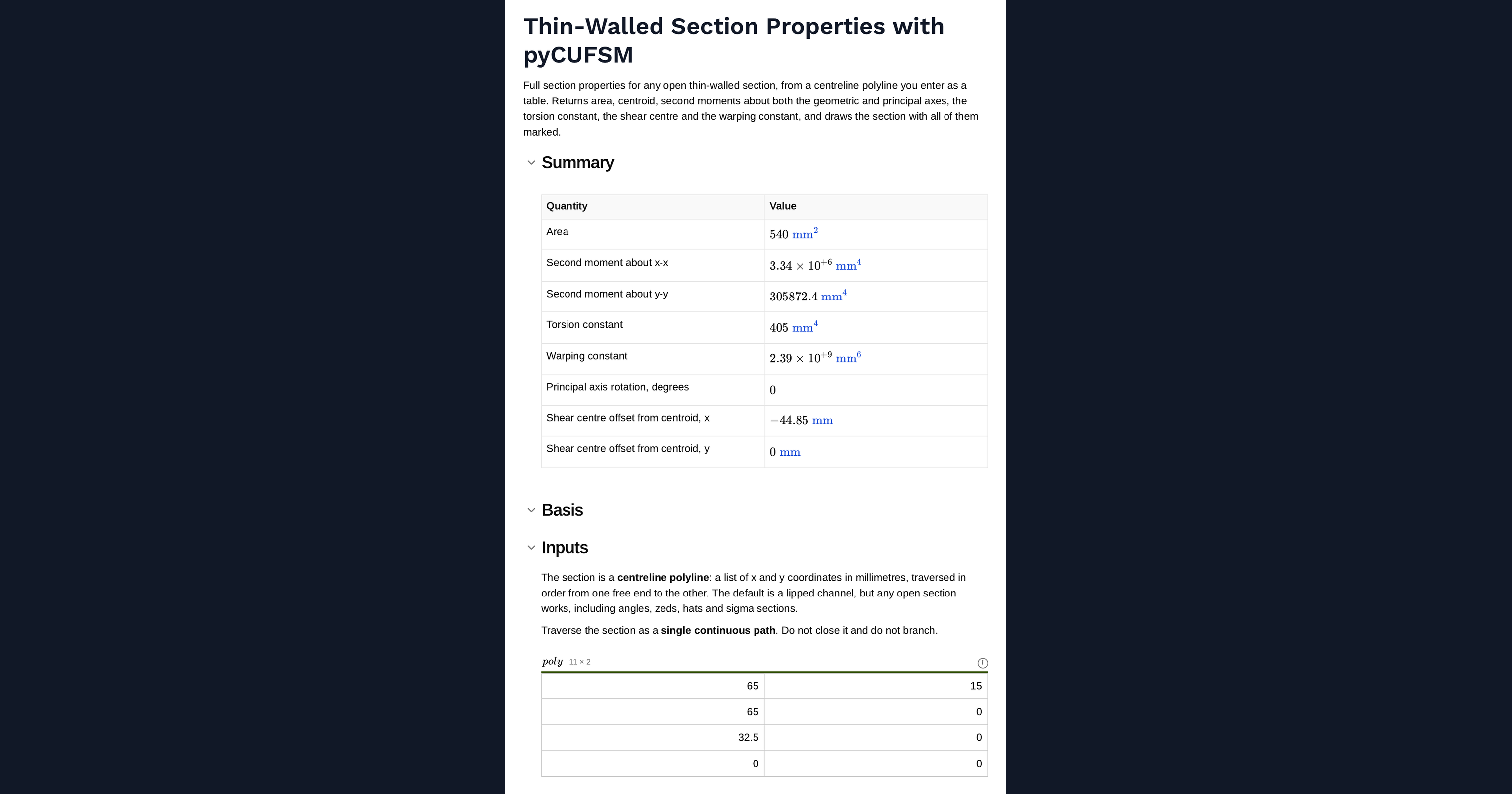
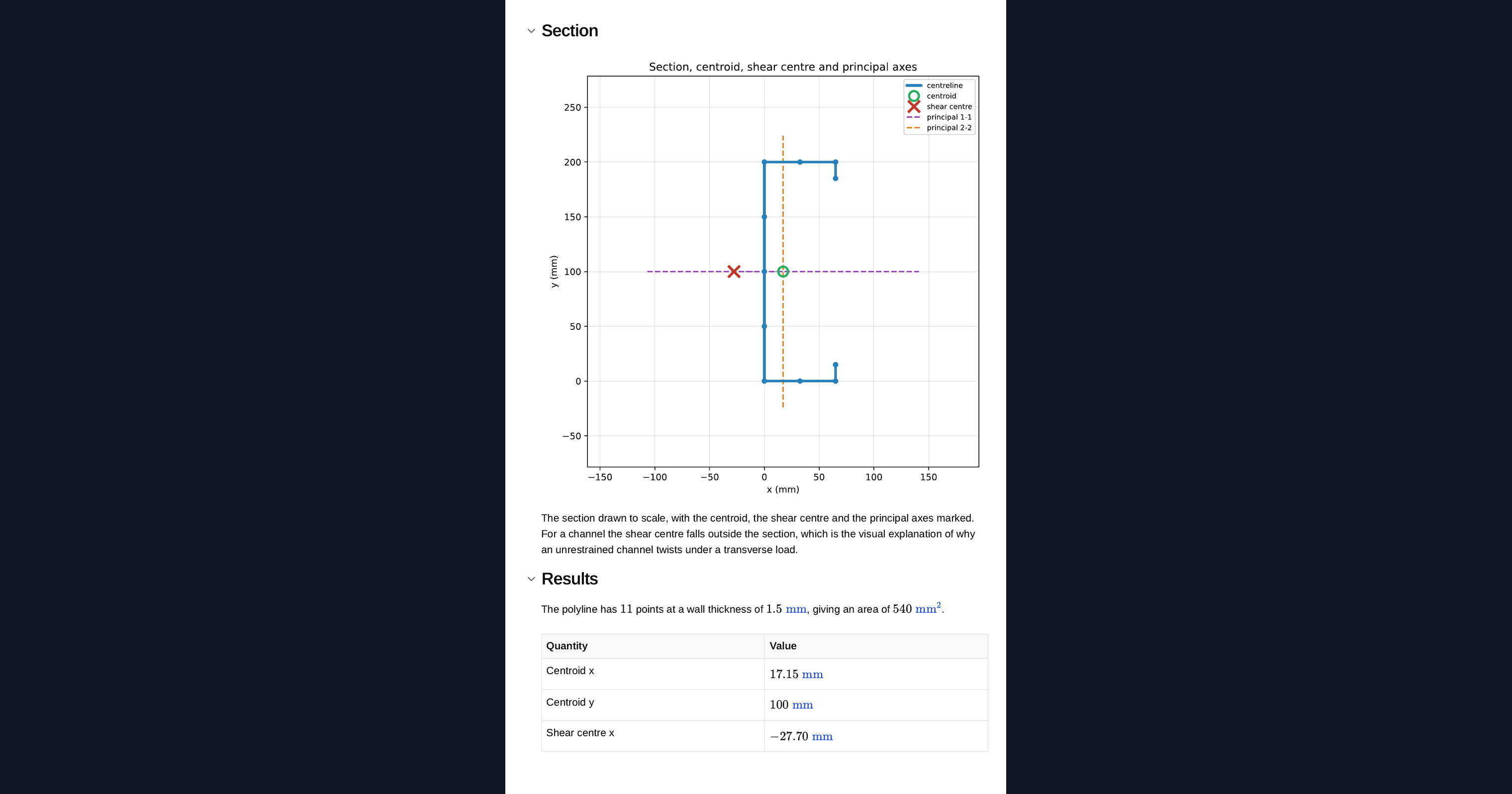
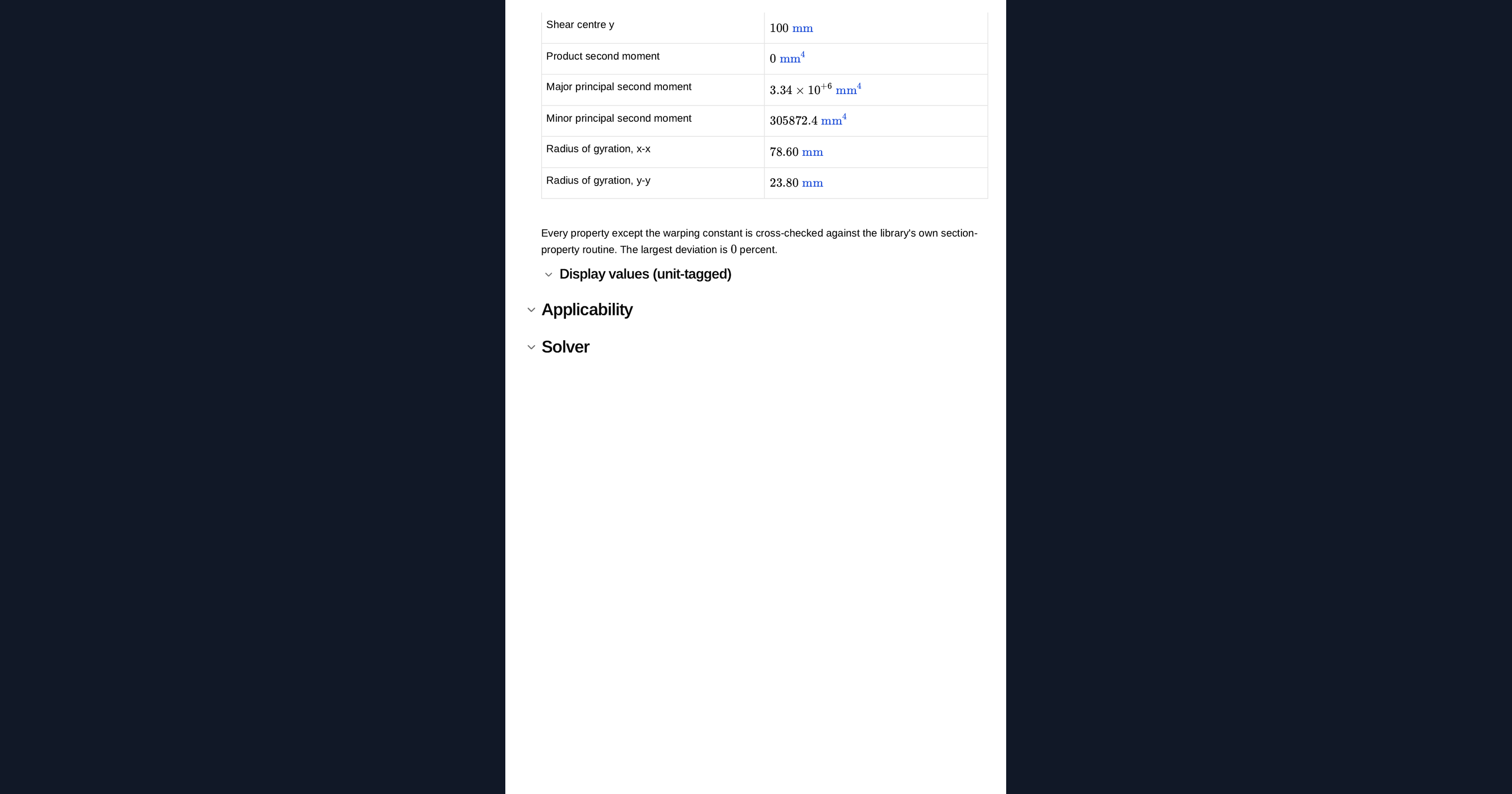
This calculator returns the full set of section properties for any open thin-walled section. You enter the centreline as a table of points with a wall thickness on each segment, and it computes the area, centroid, the second moments about both the geometric and the principal axes, the torsion constant, the shear centre and the warping constant. It also draws the section with each of these marked, so you can see where the shear centre falls relative to the material.
How it works
A thin-walled open section is idealised as a line: the polyline running through the middle of the plate, with a thickness attached to it. Every property follows from integrating along that line, and because the wall is thin the through-thickness variation can be neglected.
Area, centroid and the second moments are the familiar integrals. Two properties matter far more for thin-walled members than they do for solid ones:
- Shear centre. The point through which a transverse load must pass to cause no twist. In an open section it is generally not the centroid, and for a channel it sits outside the section entirely, on the far side of the web from the flanges. Load a channel through its centroid and it will twist.
- Warping constant (Cw). A measure of the section's resistance to non-uniform torsion. When an open section twists, the flanges bend in their own planes and the cross-section warps out of plane. For thin open sections this warping resistance dominates the pure torsional stiffness, so Cw controls torsional and flexural-torsional buckling.
Both come from the sectorial coordinate, the swept-area coordinate measured about the shear centre. It is accumulated along the polyline, normalised to have zero mean over the area, and then Cw is the integral of the normalised sectorial coordinate squared over the wall.
The calculation runs a real finite strip analysis in the page using pyCUFSM, so it handles arbitrary geometry entered as a table rather than a fixed standard case, and returns diagrams and contour plots alongside the numbers.
Limits and assumptions
- Sharp-corner centreline. The section is modelled as a sharp-corner polyline. Real cold-formed sections have bends of finite radius, which reduce the area slightly and shift the centroid a little. For the flat widths that govern local buckling the sharp-corner idealisation is the conventional and slightly conservative choice.
- Open sections only. The sectorial-area method assumes a single open branch with no closed cells. A closed or partly closed section has a fundamentally different torsional response, dominated by the enclosed area rather than by warping, and must not be entered here.
- Single branch. Branched open sections, such as an I with a stiffener, need the sectorial coordinate accumulated along each branch and are outside the scope of this template.
Engineering templates
Common calculators
Design guides



Frequently asked questions
What section properties does it return?
Area, centroid, the second moments of area about the geometric and principal axes, the torsion constant, the shear centre and the warping constant. The section is drawn with each of these marked.
How do I enter my section?
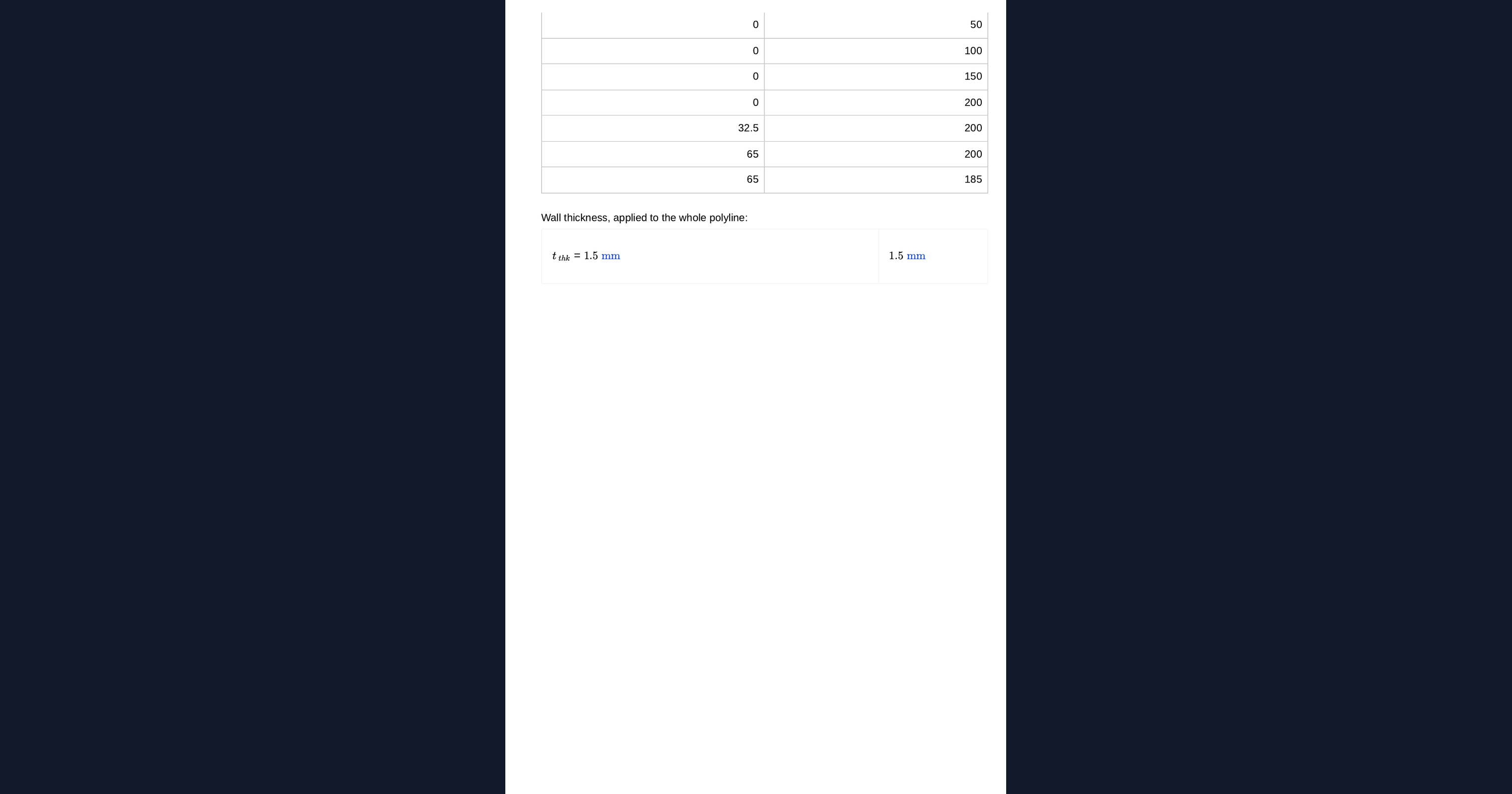
As a table of centreline points that trace the middle of the plate, with a wall thickness assigned to each segment. Any open shape you can draw as a single polyline can be entered, so you are not restricted to standard channels, angles or lipped sections.
Why is the shear centre not at the centroid?
For an open section the two points generally do not coincide. For a channel the shear centre sits outside the section, on the far side of the web from the flanges. A transverse load must pass through the shear centre to avoid twisting the member, so loading through the centroid will cause it to twist.
What is the warping constant used for?
The warping constant describes how the section resists non-uniform torsion. For thin open sections it dominates the pure torsional stiffness and controls torsional and flexural-torsional buckling, so it is needed for member buckling checks.
Can I enter a closed or hollow section?
No. The sectorial-area method used for the shear centre and warping constant assumes a single open branch with no closed cells. A closed section is dominated by its enclosed area rather than by warping and has a fundamentally different torsional response, so it must not be entered here.
Does it account for corner radii?
No. The section is modelled with sharp corners. Finite bend radii reduce the area slightly and move the centroid a little, but for the flat widths that govern local buckling the sharp-corner model is the conventional and slightly conservative choice.
What is running behind the page?
A real finite strip analysis using pyCUFSM, computed live in the page. That is why it handles arbitrary geometry entered as a table and returns diagrams and contour plots alongside the numbers.
Learn about the benefits of using CalcTree on engineering projects!