
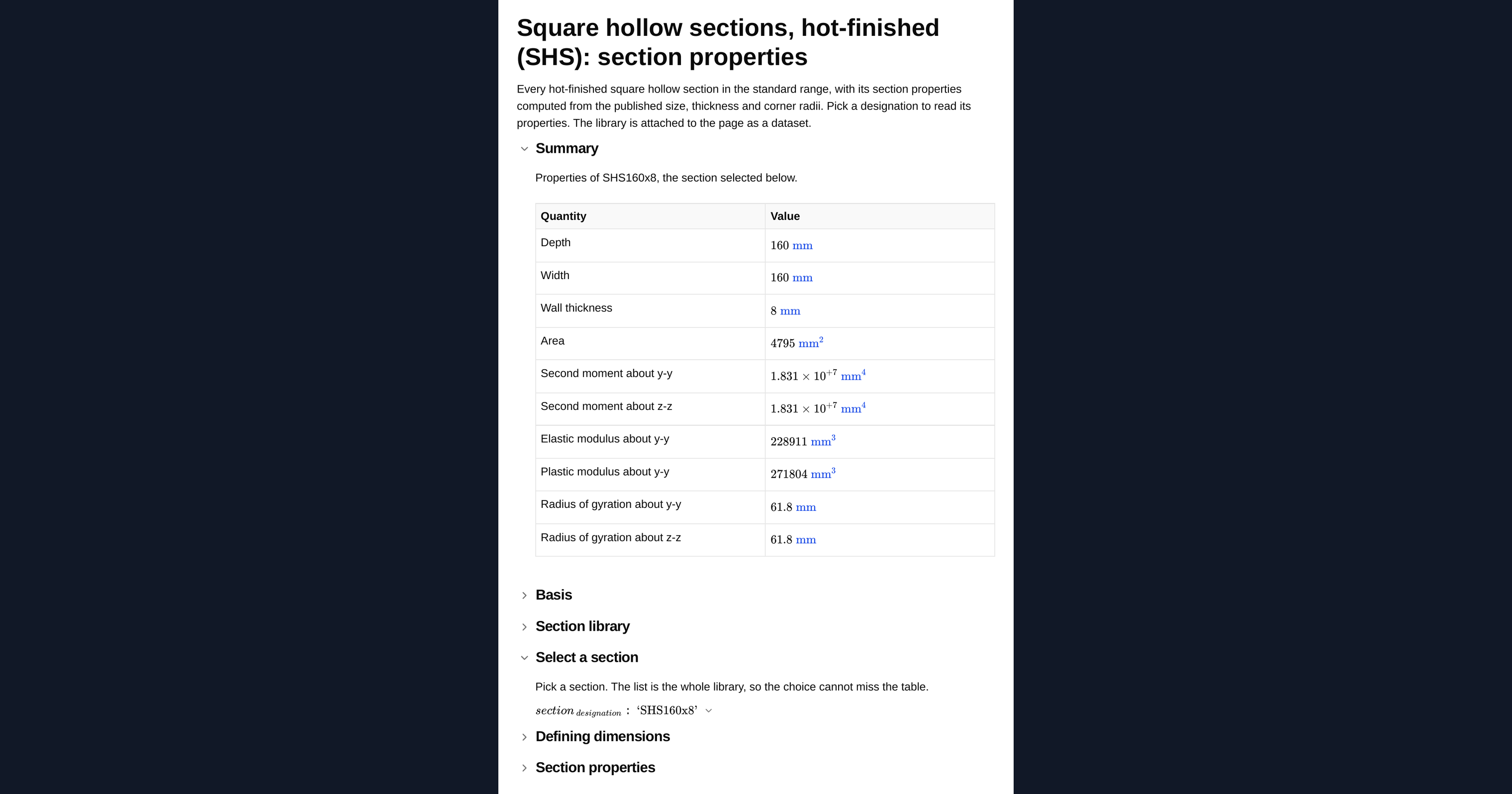
Hot-finished SHS section properties to EN 10210-2: area, second moment of area, moduli and radius of gyration. Pick a section and read the values.

This template is not available yet. You can sign up and create it yourself!
Or let us know if you'd like to be notified when it’s ready:
No items found.
No items found.
About this SHS Section Properties Calculator
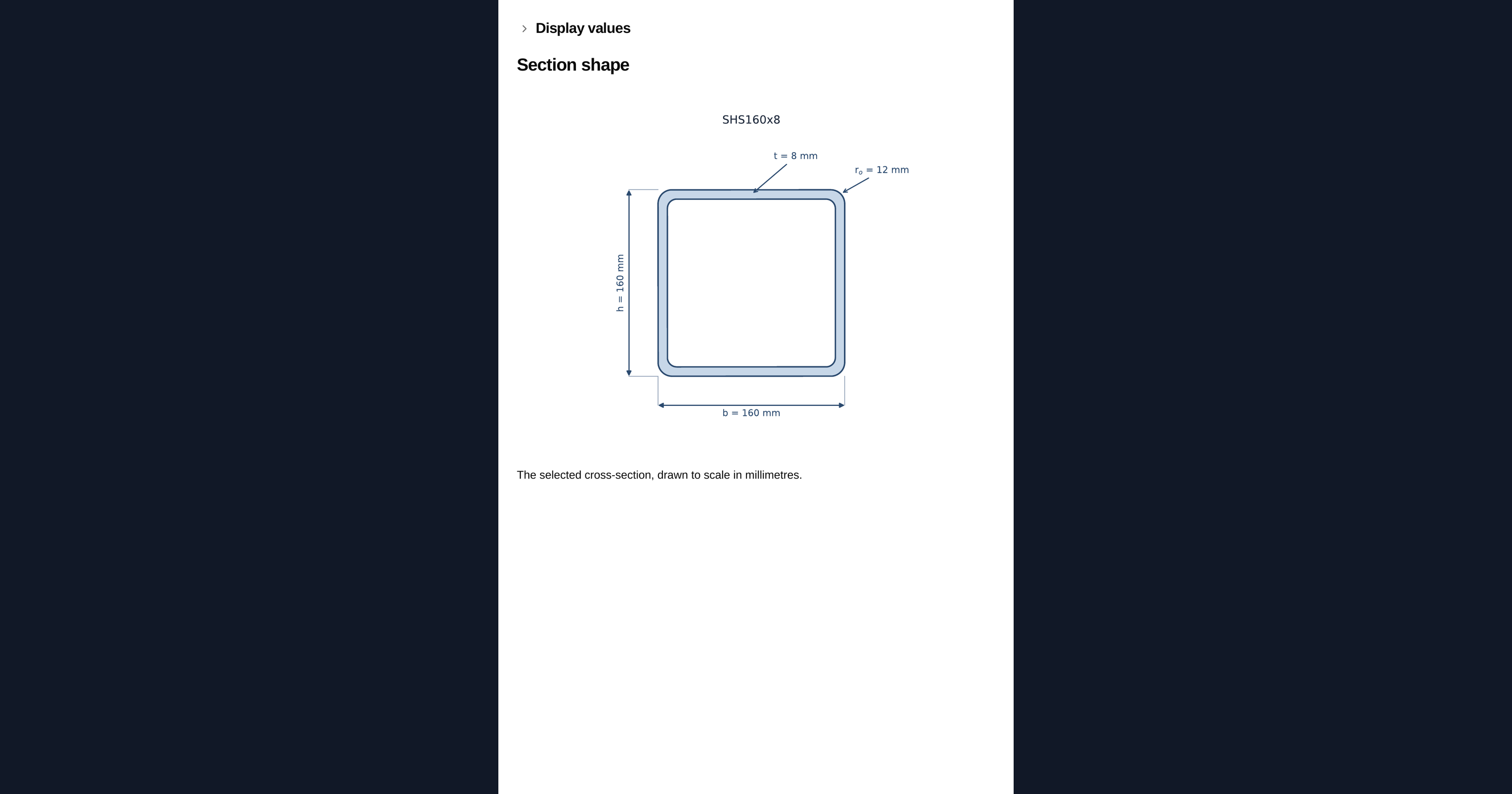
This calculator returns the section properties of any hot-finished square hollow section in the standard range, computed from the published size, wall thickness and corner radii. Pick a designation and it gives you the area, the second moment of area, the elastic and plastic section moduli and the radius of gyration, along with a scale drawing of the section.
- Structural engineer: take the properties of a candidate SHS into a column check, where the equal properties about both axes usually make it the efficient choice.
- Design engineer: compare sizes and wall thicknesses during concept sizing, with the section drawn to scale as you change it.
- Checker: confirm the properties used in a submitted calculation, with the corner geometry and every step of the derivation visible.
Every property is computed on the page in visible MathJS rather than read from a stored table, and each one is checked against an independent geometric integration of the same section before it ships. It is an engineering-grade calculator you can audit, duplicate and adapt in CalcTree.
More info on SHS Section Properties
What defines an SHS
Four published dimensions define the section: the size, the wall thickness, and the outer and inner corner radii. The radii matter most on smaller sections with thicker walls, where the corners are a real fraction of the cross-section.
How the properties are derived
The section is the outer rounded square less the inner one. Each rounded corner removes a corner piece, the square of side r minus the quarter disc inside it, so the properties are the plain square plus four corner corrections. The section is doubly symmetric, so the properties about both axes are equal and the plastic neutral axis is the centroidal axis.
Using the library in your own calculation
The section range is attached to the page as a dataset rather than pasted in as a table, so the same file can be inserted into any other calculation in your workspace. Duplicate the page and the data comes with it, which means a member check you build on top of it stays tied to one copy of the section range rather than a retyped subset of it.
Where the numbers are checked
Each section is verified against an independent numerical integration of the same geometry, carried out by a different method to the closed-form expressions used on the page. Both have to agree to four significant figures for every section in the range.
Common Calculation Errors to Avoid
- Mixing hot-finished and cold-formed sections: A hot-finished section and a cold-formed section of the same nominal size are not interchangeable. The cold-formed corner radii are larger, which removes more material and lowers the area and the second moment of area. Use the library that matches the standard you are specifying to.
- Ignoring the corner radii: Treating a hollow section as a sharp-cornered tube overstates both the area and the second moment of area, and the error grows as the wall gets thicker relative to the size. The radii are part of the section definition, not a detailing nicety.
- Using plastic properties without classifying the section: The plastic modulus only applies if the cross-section can reach and sustain its plastic moment. Classify the section for the relevant load case first; a Class 3 section is limited to its elastic modulus and a Class 4 section needs effective properties, not the gross ones given here.
- Confusing nominal and design thickness: The thickness in the product standard is the nominal wall thickness. Some cold-formed design rules work from a design thickness that deducts the zinc coating or a rolling tolerance, so check which one the clause you are applying expects.
- Treating gross properties as net properties: These are gross section properties. Bolt holes, cope cuts and corrosion allowances all reduce the section, and none of them are accounted for here.
Engineering templates
Common calculators
Design guides




FAQs
Are the properties the same about both axes?
Yes. An SHS is square and doubly symmetric, so the second moment of area, the section moduli and the radius of gyration are equal about both axes. That is why it is often the efficient choice for a column carrying similar moments in both directions.
What is the difference between hot-finished and cold-formed SHS?
Corner radii. Cold-formed sections of the same size have larger corners, which removes more material and lowers the area and the stiffness slightly. The cold-formed range has its own library.
When would I use an SHS over an RHS?
Where the load or the moment is similar about both axes, or where the connection detail suits a square face. An RHS is more efficient where bending is clearly dominant about one axis.
Can I use this inside my own calculation?
Yes. The section range is a dataset attached to the page, so duplicating the page brings the data with it and you can look up any section from your own maths.
Does it account for cross-section classification?
No. The properties given are the gross section. Classification, and any reduction to effective properties for a slender section, belong in the member check.
Learn about the benefits of using CalcTree on engineering projects!