.jpg)
Most engineers spend more time than they'd like building the calculation sheet itself, rather than doing the engineering. You set up the same variables, retype the same formulas, reformat the same layout, wire up the same references. Project after project. The actual judgement takes minutes. The scaffolding around it takes hours.
It doesn't have to. Here's where the time goes, and how to get it back.
Where the time disappears
Three things quietly eat the hours.
Rebuilding from scratch. Every new sheet starts as a blank page, even when it's the eightieth beam check you've done. The structure is nearly identical every time, but you rebuild it anyway, because there's no clean way to reuse the last one.
Retyping and re-referencing. Variables declared again, design guide references looked up again, the same standard clauses typed in again. None of it's hard. All of it's slow.
Reformatting for presentation. Once the maths is done, you spend real time making the sheet look like something you'd put in front of a reviewer or client. Alignment, units, layout, headings.
How to actually speed it up
The fix isn't working faster. It's removing the repeated work entirely.
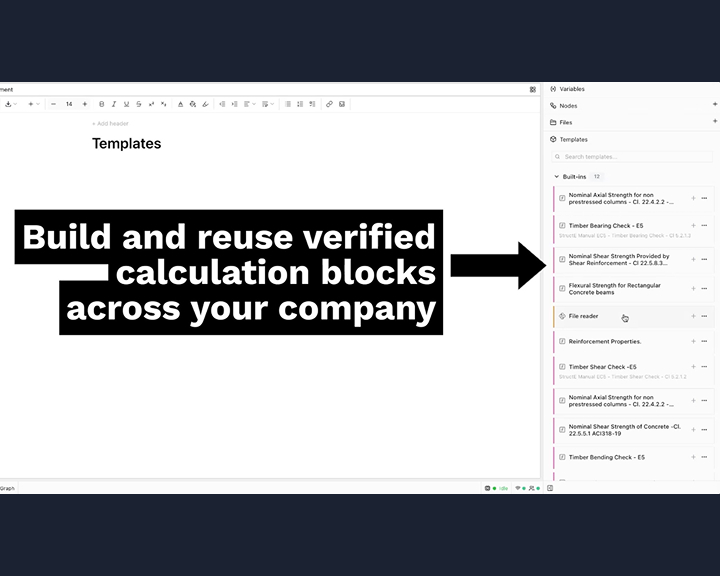
Build from templates, not blank pages. The single biggest time saver is starting from a reusable template that already has the structure, the standard references, and the layout. You drop in this project's inputs and you're most of the way there. Your firm's recurring calc types become a library you assemble from, instead of rebuilding.
Let the calculation carry its own formatting. If the tool gives you a clean, readable sheet as you work, you're not reformatting at the end. The presentation is a byproduct of doing the maths, not a separate job.
Use AI for the first pass. Generating the initial structure of a calc, the variables, the formula skeleton, a draft of the working, is something AI now does in seconds. You stay the one who checks and adjusts it, but you start from a draft instead of a blank page.
Speed without losing rigour
The catch with going faster is that speed can erode trust if you're not careful. A sheet you threw together in minutes still has to be one you can stand behind.
Which is why reuse and review matter as much as speed. A template only saves time if it's one you trust, which means it should be reviewed and versioned, not just copied around as loose files. And a fast first pass is only useful if it's easy to check.
That's what CalcTree is built for. Reusable templates turn your recurring calculations into a library your whole team can build from, AI gives you a fast first pass you stay in control of, and the output is clean and review-ready as you go, so there's no separate formatting step. The time you save is the repetitive scaffolding, not the engineering judgement. Which is exactly the right thing to cut.
If you're still building every design sheet from a blank page, that's the hour to get back first.
.jpg)
.png)