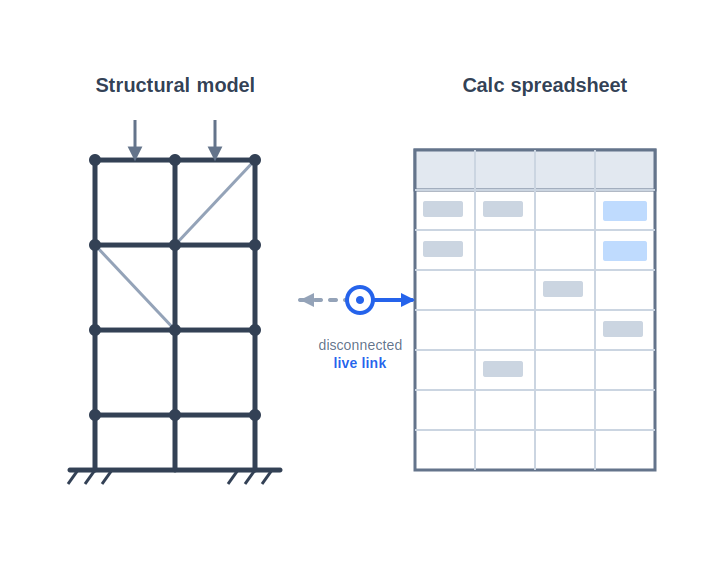
Engineering software does best-in-class work in silos that don't talk to each other. This post zooms in on a specific case that's especially painful: the structural-analysis-to-engineering-calc handoff.
If you do any structural work at any reasonable scale, you live this every week.
The setup
A typical structural-analysis-to-calc workflow:
- You build the structural model in ETABS. Geometry, sections, supports, loads, load combinations, all configured for your project.
- You run the analysis. ETABS does what it does brilliantly: thousands of members, hundreds of load cases, fast convergence.
- For each member that matters, you need engineering checks: capacity, deflection, stability, code compliance per AS 3600 / ACI 318 / Eurocode and so on. That work lives in Excel, in CalcTree, in Mathcad, or in your firm's internal calc templates.
- You produce a report listing the members that pass, the ones that don't, and the design changes you're recommending.
Steps 1 and 2 are clean. Steps 3 and 4 are where the day disappears.
Why these tools don't talk
Three specific reasons, all genuinely difficult.
Type systems don't match. ETABS' native data model is structural: members with end forces, story drifts, modal results, load case combinations, wrapped in tables that handle thousands of rows of structured output. Excel's native data model is a flat grid of values. CalcTree's is structured calculations with named parameters. There's no clean one-to-one mapping. Going from an ETABS member-force table to an Excel range loses the structure that made the table useful. Going the other way loses the relationships ETABS was tracking between members and load combinations.
Units need translation. ETABS carries units explicitly: kN, kNm, MPa, mm. Excel cells don't carry units. CalcTree calcs do. A number that comes out of ETABS as "240 kNm" gets pasted into an Excel cell as "240", and the unit becomes a comment in the cell next to it, if you remember. Cross-tool data exchange that doesn't track units is an error waiting to happen.
Dependency tracking across tools is a graph problem. Inside ETABS, the dependency between input and output is implicit: change a section, re-run the analysis, results update. Inside CalcTree, the calculation dependency graph is explicit. But across the two, nobody's keeping track. Re-run ETABS with a section change, and the calcs you exported last Tuesday are silently stale. There's no signal until somebody notices a results discrepancy three weeks later.
These aren't trivial to solve. A naive integration that ignores any of the three produces output that looks right and quietly isn't.
The workarounds, ranked
Engineers have tried most things. Here's the rough hierarchy.
Tier 1: manual copy-paste. Reliable in the sense that you can see the data move. Brittle in every other way. It becomes the limiting factor on how many design iterations you actually run, because each one costs human minutes.
Tier 2: ETABS-native export plus Excel template. Slightly better. ETABS exports member tables to a formatted Excel file. You wire that into a calc-check spreadsheet via VLOOKUP or named ranges. It works for one design pass. It falls apart when member naming changes, when the team member changes, or when the export format shifts in the next ETABS version.
Tier 3: custom scripts via ETABS' OAPI. A team member with coding chops writes a script that pulls results out of ETABS via its Open API and pushes them into a calc tool or database. It works well when it works. The maintenance burden is high, documentation is rarely sufficient, and ETABS updates break it.
Tier 4: file-based shared model plus separate calc workflow. Model handed off via SAFE export, IFC, or a structural model exchange format. Calcs done independently. Rejoined manually for the final report. The handoff is a one-way street, so any model change requires a full re-run.
Tier 5: a unified platform that holds the connection. Rare. The cases where it works are usually big firms that built it themselves with a dedicated digital team and a multi-year budget.
The pattern across all five tiers: engineers keep ending up in charge of integration that they shouldn't have to be in charge of.
What "actually talking" would mean
Setting aside specific implementations, here's what real integration between structural analysis and calculation tools should provide:
- Live data flow. Re-run ETABS with a section change, and the connected calcs reflect it. No re-export.
- Bidirectional updates. Change a design parameter in the calc layer (say, an allowable stress or capacity factor), and upstream model inputs can reflect it.
- Type-aware translation. ETABS member tables become structured calc inputs cleanly, with the structure preserved.
- Unit safety. Units travel with values. Mismatches surface as errors, not silent miscalculations.
- Dependency tracking across the tool boundary. When something upstream changes, downstream artefacts know they're stale.
- Auditable data lineage. For any number in the final report, you can trace back to which ETABS run and which member produced it.
A workflow with all six of those gives you something the current tier system can't: design-check loops short enough to actually use for design exploration, not just final-version sign-off.
What this changes about how you work
The honest answer: not the tools you use. ETABS stays ETABS. Excel stays Excel. CalcTree stays CalcTree. The change is what happens between them.
What it does change is the rhythm of design checking. Right now, "let me try one more section size" costs you 30 minutes. With live connections, it costs 30 seconds. That ratio matters more than it sounds. Most structural teams know they should be checking sensitivity to assumed loads, looking at multiple section options, and exploring more design iterations. In practice they don't, because design-check downstream of ETABS is expensive. Bring the cost down and the practice changes.
And the workflow itself becomes durable. Once you've built the ETABS-to-CalcTree-to-report flow once, it's not just yours. It's a reusable template the team can run on the next project, and the one after that. The shape of the work becomes a firm asset, not a personal habit. The senior engineer's clever process stops being a Python script that breaks the day they leave.
This is exactly the kind of connected workflow we're now deploying with enterprise teams. If you'd like to see the ETABS-to-CalcTree loop running against your own models, book a call.
.webp)
.jpg)