.jpg)
Design inputs change. A load gets revised, a material spec swapped, a dimension shifts late in the project. That's normal. What's not normal, but is far too common, is how much risk hides in updating the calculations afterwards.
When a single input changes, how confident are you that every calculation depending on it got updated, and nothing slipped through?
Why stale calculations are a real risk
This is one of the quieter dangers in engineering work, because the failure is invisible until it isn't.
Manual updates get missed. Change an input, and you have to remember every downstream calculation that depends on it. Miss one, and you've got a result that looks current but is silently wrong. Nobody notices until a reviewer catches it. Or until they don't.
Broken links between files. Calculations that pull from external spreadsheets are especially fragile. A link breaks, a reference moves, and the calc is now running on old or wrong data without flagging it.
Copies drift apart. When the same calculation lives in several places, a master file, a report, a colleague's version, updating one doesn't reach the others. Now there are multiple versions and no clear truth.
How to keep calculations live
The principle is simple. The dependencies between values should be understood by the tool, not held in your head.
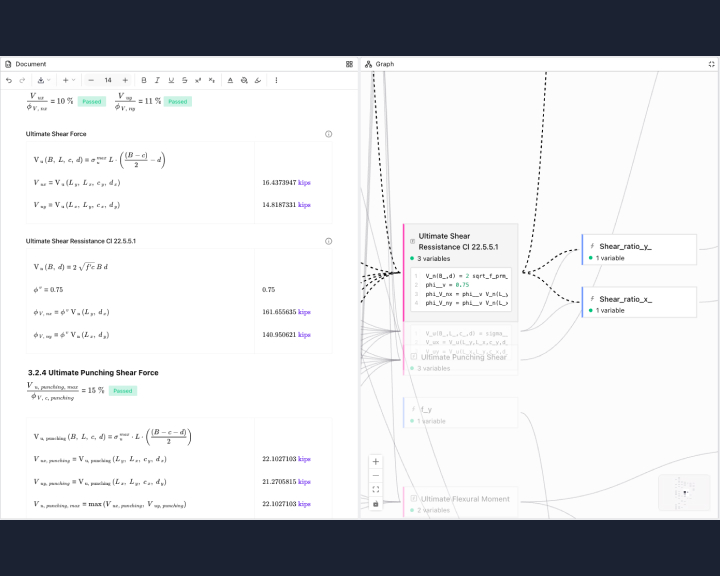
Changes should cascade automatically. Update an input, and every result and plot that depends on it should recalculate straight away. You change the number once, and the whole calculation updates, nothing left stale.
There should be one source of truth. A calculation should live in one place everyone works from, not get copied into separate files that drift. When it updates, everyone's looking at the current version.
You should be able to see the dependencies. The most defensible calculations make it visible how values connect, so you can trace what a change affects instead of guessing.
Up to date and trustworthy
Automatic updates are powerful, but they raise the stakes on trust. If a change cascades through your whole calculation instantly, you need to be confident the logic it cascaded through is right, and you need to see what changed.
That's where live calculation and traceability go together. It's not enough for results to update automatically. You need to follow how a value flows through the calculation and trust the logic it passes through on the way.
CalcTree is built around exactly this. Calculations are live, so a changed input cascades through every dependent result automatically, nothing left stale. The calculation lives in one place your team works from, so no drifting copies, and you can see how values connect, so a change is traceable rather than a leap of faith. When specs change late in a project, the calculations keep up, and you can prove they did.
If updating calculations after an input change is currently a manual, nervous process, that's a risk worth designing out of your workflow.