A graduate is asked to check a beam. They open the standard as a PDF, find the clause, retype the equation into a spreadsheet, and hope the reviewer reads the clause the same way. Increasingly, they also paste a screenshot of that clause into ChatGPT and take the number it gives them.
That last step comes up again and again when we talk to engineers, including at the Standards Australia and Engineers Australia roundtables we took part in. It worries the senior engineers who sign the work off far more than it worries the graduates. Their fear isn't AI replacing anyone. It's wrong designs going out faster.
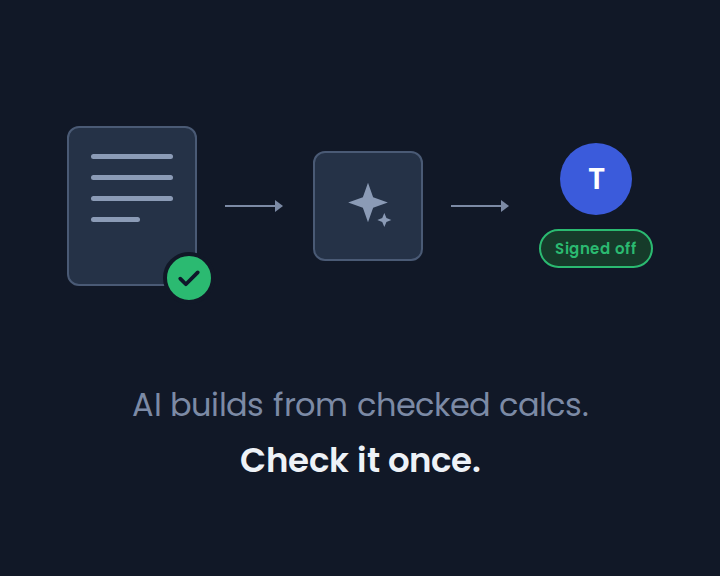
We think the answer isn't less AI. It's AI that builds from parts someone has already checked.
Software went through this first
AI made code cheap to write, and review became the bottleneck. Software teams coped because they already had the scaffolding: version control, pull requests, code review, a record of who approved what.
Structural and civil engineering is heading the same way, without that scaffolding. Calculations live in spreadsheets copied from the last job, standards live in PDFs, and the check is a signature on a printout. Speed up the drafting with AI and the weakest link is still the review.
Here's how we see it: a verified kit of parts
Everything we build at CalcTree comes back to one idea: engineers should get the speed of AI, with the confidence that every building block it uses has been checked by a professional.
That works as a loop:
- Verify a calc once. Your team builds a calculation and a colleague reviews it on the page. The approval, the date and the version sit on the page itself.
- Put it in the library. The checked calculation becomes a template in your workspace, alongside CalcTree's built-in templates. A template can be one clause or a whole system design.
- Reuse it, pinned. Any page can pull that template in as a live block, locked to the version that was reviewed.
- Let AI assemble. An engineer, or CalcTree AI, builds new calculations from those templates instead of generating the maths from scratch.
- Review only what's new. CalcTree AI can do a first pass against your design basis and reference documents. Then the reviewer sees which parts are already verified and spends their time on the rest. Every review stays on the page's history.
The engineer stays in charge at every step. The software does the assembly and the paperwork. The judgement and the sign-off stay with people.
Standards as infrastructure, not documents
The kit of parts gets stronger the closer it sits to the standard. A check linked to the exact clause it implements is easier to review, easier to trust, and easier to update when the clause changes. It was also the clearest ask at the Standards Australia roundtables: stop treating standards as static documents and start treating them as data that software can reference.
It also opens a feedback loop that doesn't exist today. If you can see which clauses actually turn up in real calculations, and which cause trouble, that's information a standards committee currently waits years to hear.
What comes next
Two things we're working on:
- A richer kit. Guidance notes, firm procedures and manufacturer data, packaged so AI can use them and so you can see which source informed an answer.
- Smarter AI review. AI review against your own documents is live today. Next, it will also flag the wrong template, an outdated code or new guidance before a human reviewer opens the page. It flags, it never approves.
The first half of this is live today: verified templates, template references, page reviews, AI review against your documents, and CalcTree AI that builds from your library. Book a call if you'd like to see it on one of your own calculations.