A design code is a calculation method wrapped in a document. ACI 318 tells you how to work out whether a reinforced concrete column has the capacity for the loads it carries: how to treat the concrete stress block, which strength-reduction factors apply, how axial load and bending moment interact. The method is precise and repeatable. It is, in other words, meant to be executable.
In most workflows it gets run in a spreadsheet that one engineer built, that another engineer half-trusts, with the code references sitting in a PDF on a different screen. The maths is buried in cell formulas you can't easily read, the assumptions are in someone's head, and when an input changes the whole thing is re-checked by hand. This post shows the same check rebuilt as living logic: transparent, auditable, re-runnable, and traceable from input to result.
The check, as a connected calculation
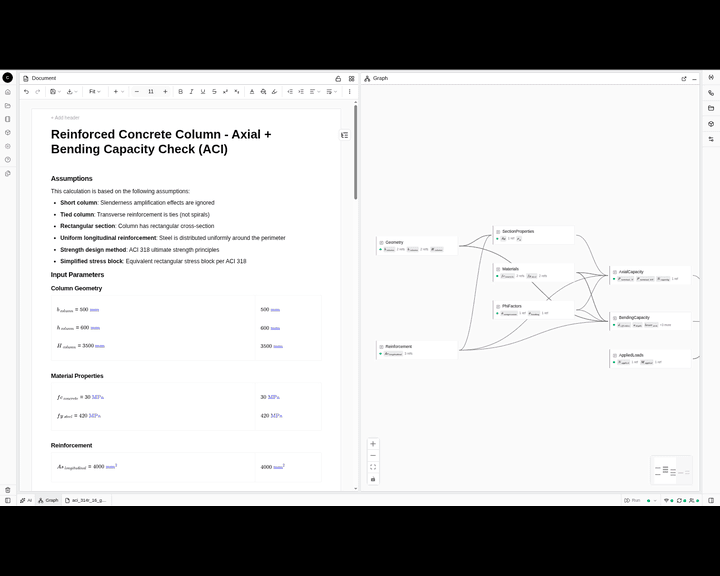
A column capacity check has a clear structure, and in CalcTree that structure is visible rather than hidden. The inputs are the column geometry, the material properties, the reinforcement layout, and the applied loads. Those feed the section properties. The section properties, the materials, and the strength-reduction factors feed the axial and bending capacities. The capacities are then checked against the applied actions. Each of those is its own step in a connected graph, so you can see the whole dependency chain at a glance, not just a final number.
That visibility is the point. When a reviewer opens the check, they can follow exactly how the axial capacity was reached, which strength-reduction factor was applied and why, and how the axial-moment interaction was evaluated. Nothing is taken on trust from a hidden engine. This is the difference between a result you have to believe and a result you can verify.
Encode the code once, run it many times
The clauses that are easy to get wrong by hand, the strength-reduction factors for tension- versus compression-controlled sections, the stress-block assumptions, the interaction between axial load and moment, are exactly the parts worth encoding once. Built as living logic, they apply the same way on every column, on every project, and they update everywhere if the basis changes. The firm's interpretation of the code stops living in one senior engineer's spreadsheet and becomes shared, reviewable logic the whole team runs.
Traceability, by default
Because the calculation is connected end to end, every figure in the result can be traced back through the capacity calculation, the section properties, and the original inputs. Change the bar size or a load case and the check re-runs, the result updates, and the report downstream updates with it. There's no version where the inputs moved and the check quietly didn't.
What this is, and isn't
To be straight: CalcTree gives you transparent, auditable calculation logic over live inputs, with the dependency graph and traceability shown above, available today. Building a specific code check into a fully maintained, templated workflow is work we do with the teams we partner with. The worked example here is a reinforced concrete column to ACI 318, but the same approach applies to Eurocode 2, AS 3600, or any other design standard. The principle is constant: take a computational standard, make it living logic, and you get checks that are transparent, consistent, and traceable instead of buried in a spreadsheet.
If you'd like to see one of your own standard checks rebuilt this way, book a call with our team.
.webp)

.jpg)