
Finite strip buckling analysis of a lipped Z-section under axial compression. See rotated principal axes and buckling modes with pyCUFSM in the page.

This template is not available yet. You can sign up and create it yourself!
Or let us know if you'd like to be notified when it’s ready:
No items found.
No items found.
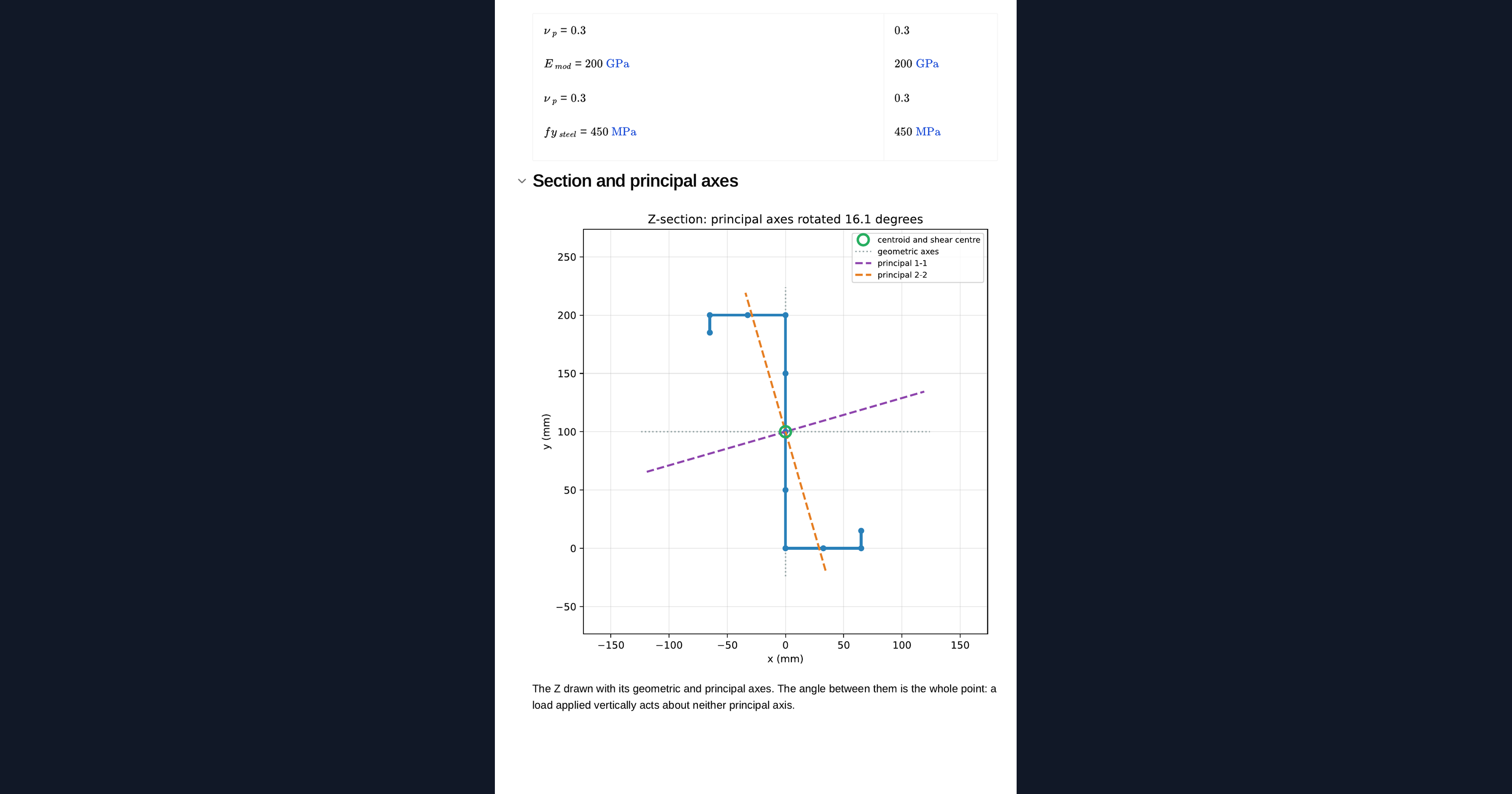
A lipped Z-section behaves differently from a channel in a way that catches people out. Its principal axes are rotated away from the web and flange directions, so bending applied about the geometric axes always produces biaxial bending. This page runs a finite strip analysis on a Z-section and reports both the rotated axes and the buckling behaviour that follows.
How it works
A Z-section is formed by turning the two flanges in opposite directions. That makes it point-symmetric about its centroid, which has two consequences that a channel does not share.
First, the shear centre coincides with the centroid. A Z therefore does not suffer the eccentric-load twisting that makes an unrestrained channel awkward, and there is no flexural-torsional coupling of the kind a singly-symmetric section has. The global modes are flexure about each principal axis and pure torsion.
Second, and much more important in practice, the product second moment of area is not zero. The principal axes are rotated away from the web and flange directions, typically by twenty to thirty degrees. A vertical load applied to a Z purlin does not bend it about a principal axis, so the section deflects sideways as well as downwards, and the stress distribution is not what a simple M/Z calculation about the geometric axes would suggest.
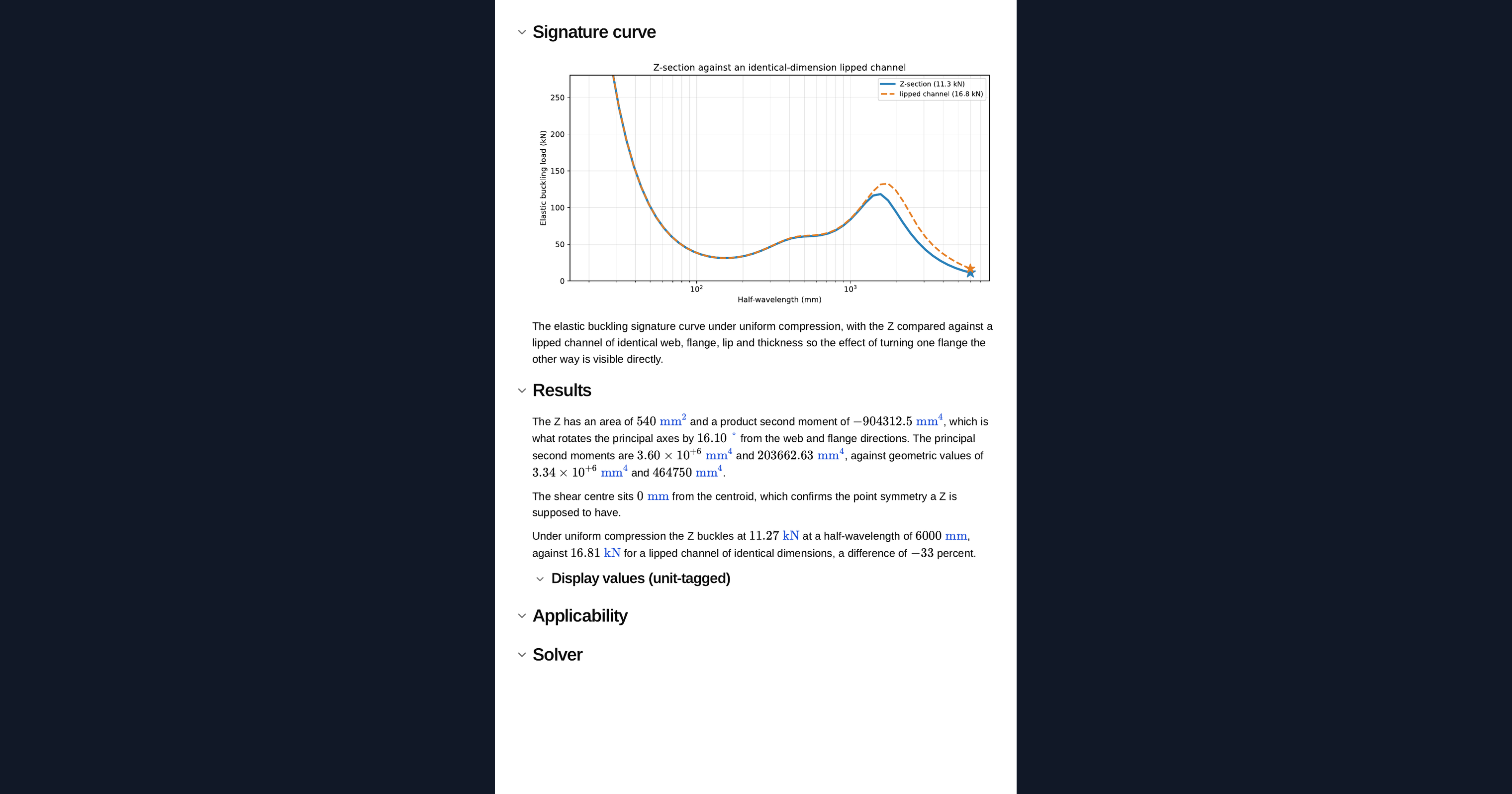
This matters directly for buckling, because the compressive stress distribution used in a finite strip analysis has to reflect the real biaxial bending, not an assumed uniaxial one. Under pure compression, which is what is analysed here, the stress is uniform and the skew affects only the global buckling branch, through the two different principal second moments.
What you get
The calculation runs a real finite strip analysis in the page using pyCUFSM. It handles arbitrary geometry entered as a table rather than a fixed standard case, and it returns diagrams and contour plots alongside the numbers, including the rotated principal axes and the signature curve of buckling load against half-wavelength.
Limits and caveats
The analysis here is uniform axial compression. The skewed principal axes have their largest practical effect in bending, where a vertical load produces biaxial bending and lateral deflection, and a bending analysis of a Z needs the stress distribution resolved onto the principal axes rather than assumed vertical. That case is not covered on this page.
Real Z purlins are almost always restrained by sheeting on one flange, which changes the problem fundamentally. It restrains lateral movement, restrains twist partially, and suppresses distortional buckling of the connected flange. An unrestrained analysis such as this one is a lower bound for a sheeted purlin and should not be used as the design case for one without modelling the restraint.
Continuous-span purlins with lapped connections at internal supports develop moment reversal and a different critical region again, which this single-span compression analysis does not represent.
Engineering templates
Common calculators
Design guides




Why does a Z-section always bend biaxially?
Because it is point-symmetric rather than symmetric about an axis, its product second moment of area is not zero. This rotates the principal axes away from the web and flange directions, usually by twenty to thirty degrees. A load applied vertically is therefore not aligned with a principal axis, so the section bends about both principal axes at once and deflects sideways as well as downwards.
Does a Z-section suffer flexural-torsional buckling like a channel?
No. Because the shear centre coincides with the centroid, there is no eccentric-load twisting and none of the flexural-torsional coupling that a singly-symmetric section such as a channel has. The global buckling modes are flexure about each principal axis and pure torsion.
What loading does this page analyse?
Uniform axial compression only. Under pure compression the stress is uniform, so the skewed principal axes affect only the global buckling branch through the two different principal second moments. Bending is not covered here.
Can I use this for a sheeted purlin?
Not directly. Real Z purlins are usually restrained by sheeting on one flange, which restrains lateral movement, partially restrains twist, and suppresses distortional buckling of the connected flange. This unrestrained analysis is a lower bound and should not be used as the design case for a sheeted purlin without modelling the restraint. Continuous, lapped spans introduce moment reversal that this single-span analysis also does not represent.
Can I enter my own section geometry?
Yes. The calculation runs a real finite strip analysis with pyCUFSM and accepts arbitrary geometry entered as a table, so you are not limited to a fixed standard case. It returns diagrams and contour plots alongside the numbers.
Learn about the benefits of using CalcTree on engineering projects!