
Calculate stack pressure across a stairwell and the force needed to open a pressurised door. Try the free calculator.

This template is not available yet. You can sign up and create it yourself!
Or let us know if you'd like to be notified when it’s ready:
No items found.
No items found.
About this Stairwell Pressurisation and Door Opening Force Calculator
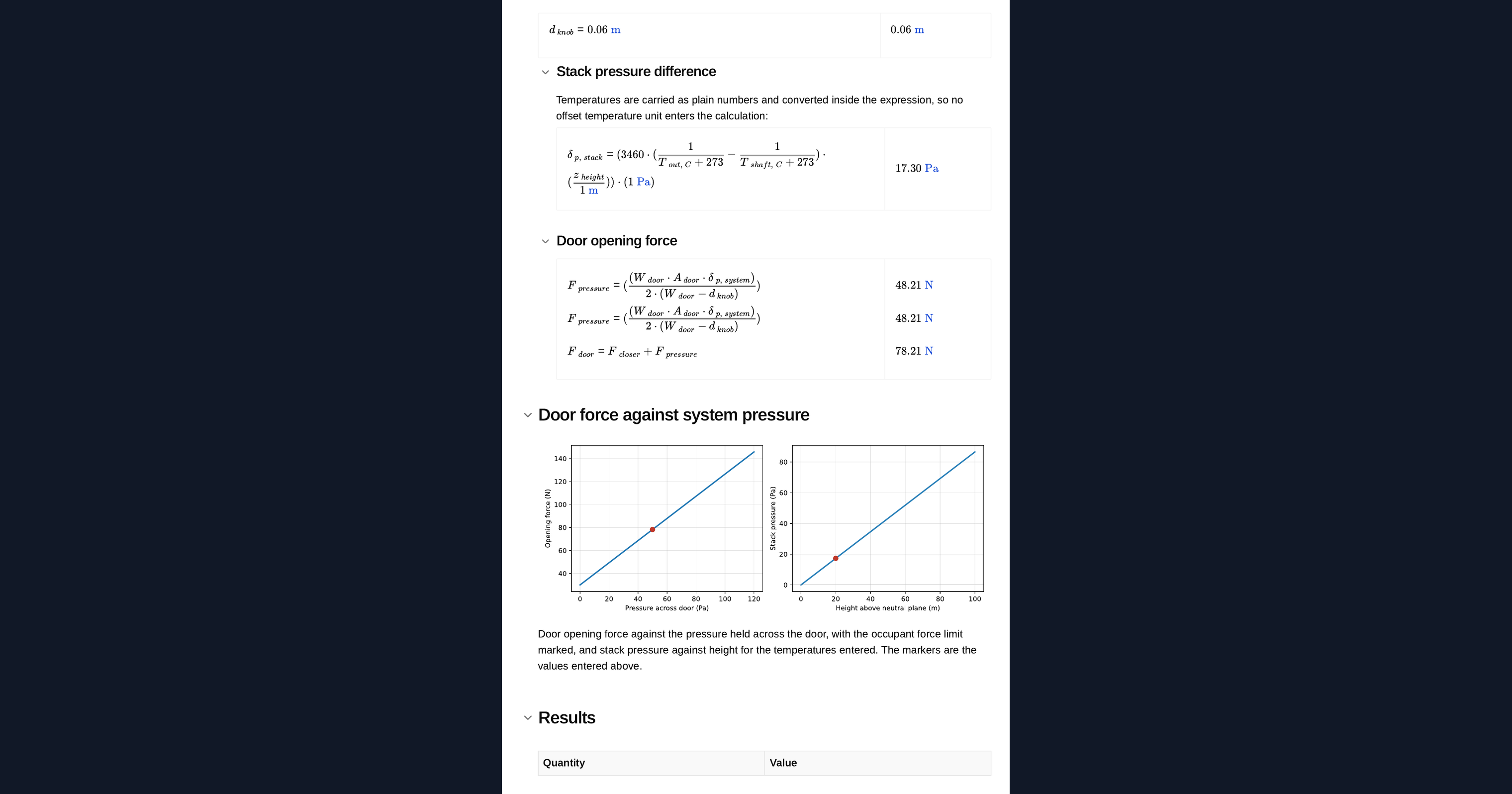
This calculator gives the pressure difference stack effect generates across a stairwell, and the force needed to open a door against a pressurisation system, using the expressions in SFPE Handbook Chapter 50. The two interact directly: the pressure that keeps smoke out of a stair is the same pressure an occupant must push against to get in. A chart plots opening force against system pressure alongside stack pressure against height.
- Fire engineer. Enter the temperatures and the height above the neutral plane, and read the stack pressure the system has to work against.
- Building services engineer. Check the opening force a chosen pressurisation level produces before it is commissioned.
- Engineer troubleshooting a commissioned system. Work out how much of a measured opening force comes from the closer and how much from the pressure.
Every expression is shown with its origin and units are carried through the calculation. It is an engineering-grade calculator you can audit, adapt and save to a project page in CalcTree.
More info on Stairwell Pressurisation and Door Opening Force
Inputs
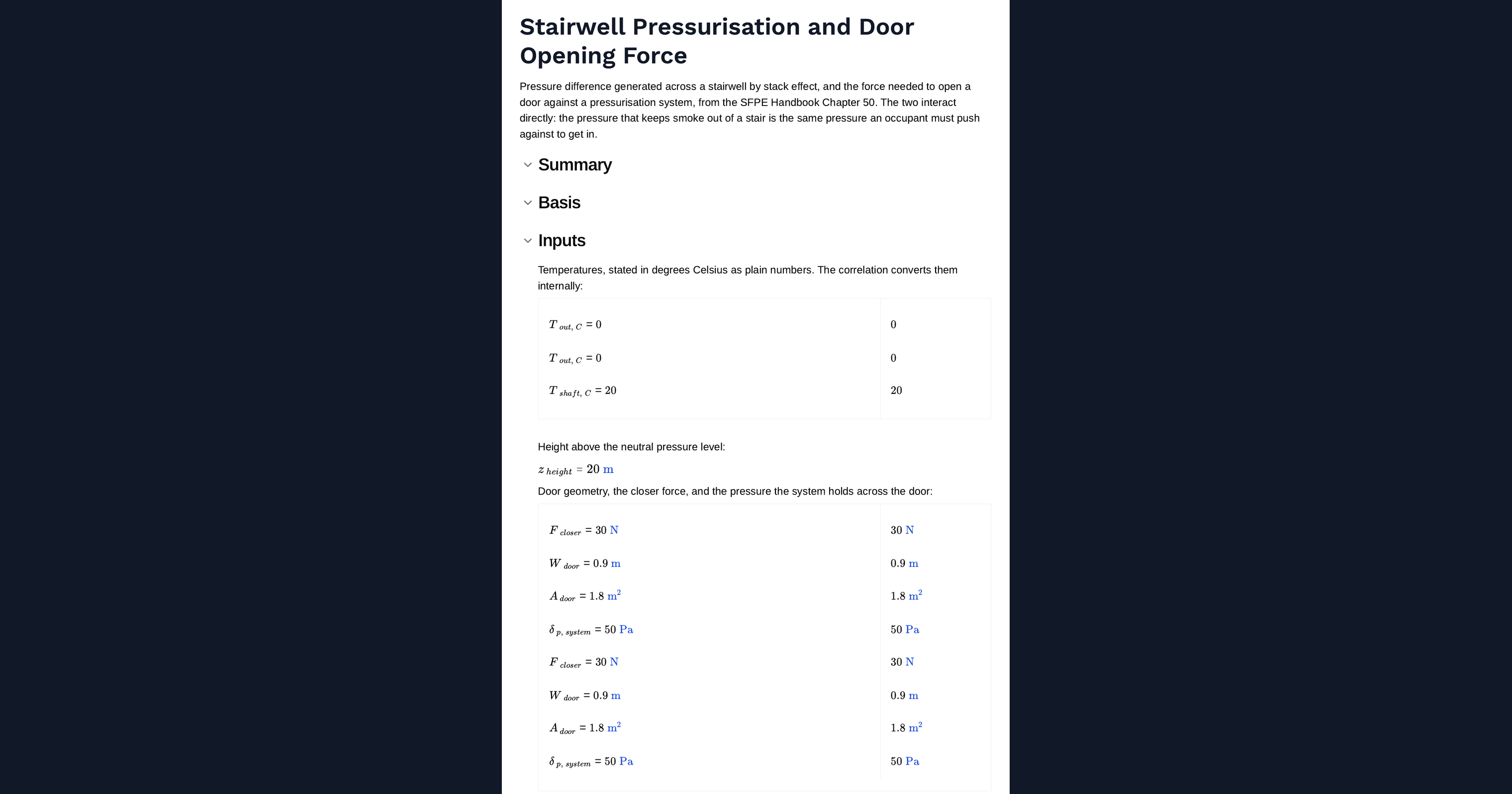
The outdoor and shaft temperatures, the height above the neutral pressure level, the door width, area and closer force, the distance from the handle to the leading edge, and the pressure the system holds across the door.
Stack effect
Where a shaft is warmer than outside, the air in it is less dense and rises, drawing air in low and pushing it out high. The pressure difference across the shaft wall grows with height above the neutral pressure level, and reverses sign when the outside is warmer than the shaft.
Door opening force
A door held shut by a pressure difference needs a force that rises with door area and with how far the handle sits from the leading edge. The closer contributes a fixed part, and the pressure contributes the rest. A handle close to the leading edge gives the best leverage.
Outputs
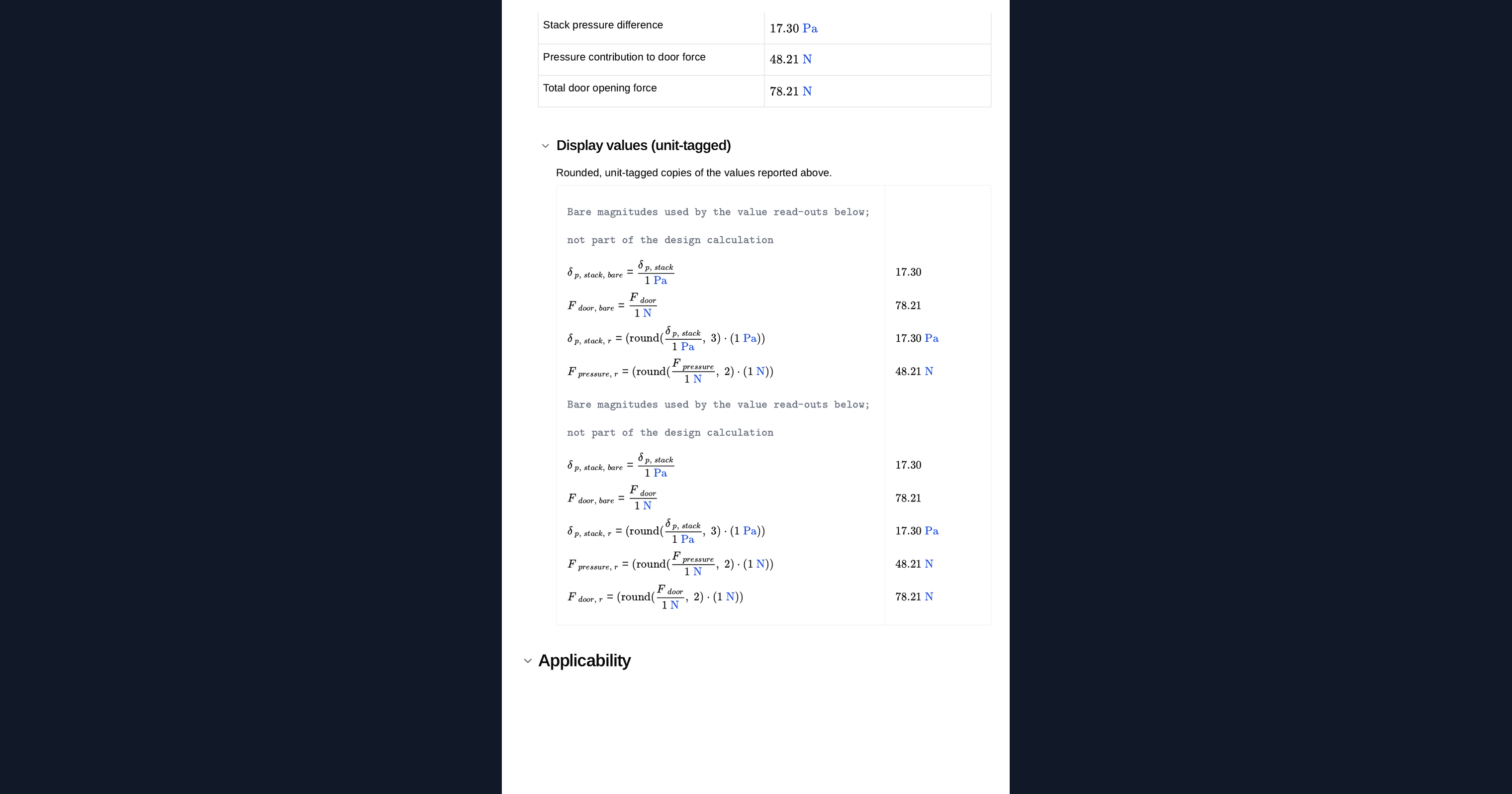
The stack pressure difference at the height entered, the pressure contribution to the door force, and the total opening force including the closer.
Common Calculation Errors to Avoid
- Assuming the neutral plane sits at mid-height. Its position depends on how leakage is distributed over the height of the building, and the sign of the stack pressure reverses below it.
- Ignoring the summer condition. When the outside is warmer than the shaft the flow reverses, and the winter case is not always the governing one.
- Using the design pressure for the door check. The pressure across a given door depends on which other doors are open, and the worst case for door force is usually not the worst case for smoke control.
- Treating the closer force as constant. A real closer varies through its swing, and the value that matters is the one at the start of opening.
- Measuring the handle distance from the hinge. The expression uses the distance from the handle to the leading edge, and getting it the wrong way round changes the leverage substantially.
- Forgetting the door swing. A door opening with the pressure needs no such force, but may be difficult to control instead.
Engineering templates
Common calculators
Design guides



FAQs
What is the neutral pressure level?
The height at which the pressure inside and outside are equal. Stack pressure grows with distance above it and reverses sign below it, so locating it is part of the analysis rather than an assumption.
Why does the handle position matter so much?
Because it sets the leverage. The closer the handle sits to the leading edge, the longer the lever arm against the hinge, and the force rises sharply as the handle moves toward the hinge line.
Does stack effect always push the same way?
No. When the shaft is warmer than outside the flow is upward, and when the outside is warmer the direction reverses. The summer condition is not always benign and should be checked.
How much of the opening force is the closer?
The calculator splits the total, so the closer contribution and the pressure contribution are shown separately. That is the quickest way to see whether reducing pressurisation would actually solve a heavy door.
What limit should the force be compared against?
That is set by the governing code for the building and the jurisdiction, and it differs between accessible doors and others. This calculator reports the force; the acceptance limit is a judgement for the fire strategy.
Learn about the benefits of using CalcTree on engineering projects!