
Size smoke exhaust by volume and check visibility through smoke, to CIBSE Guide E. Try the free calculator.

This template is not available yet. You can sign up and create it yourself!
Or let us know if you'd like to be notified when it’s ready:

No items found.
No items found.
About this Smoke Exhaust Flow Rate and Visibility Calculator
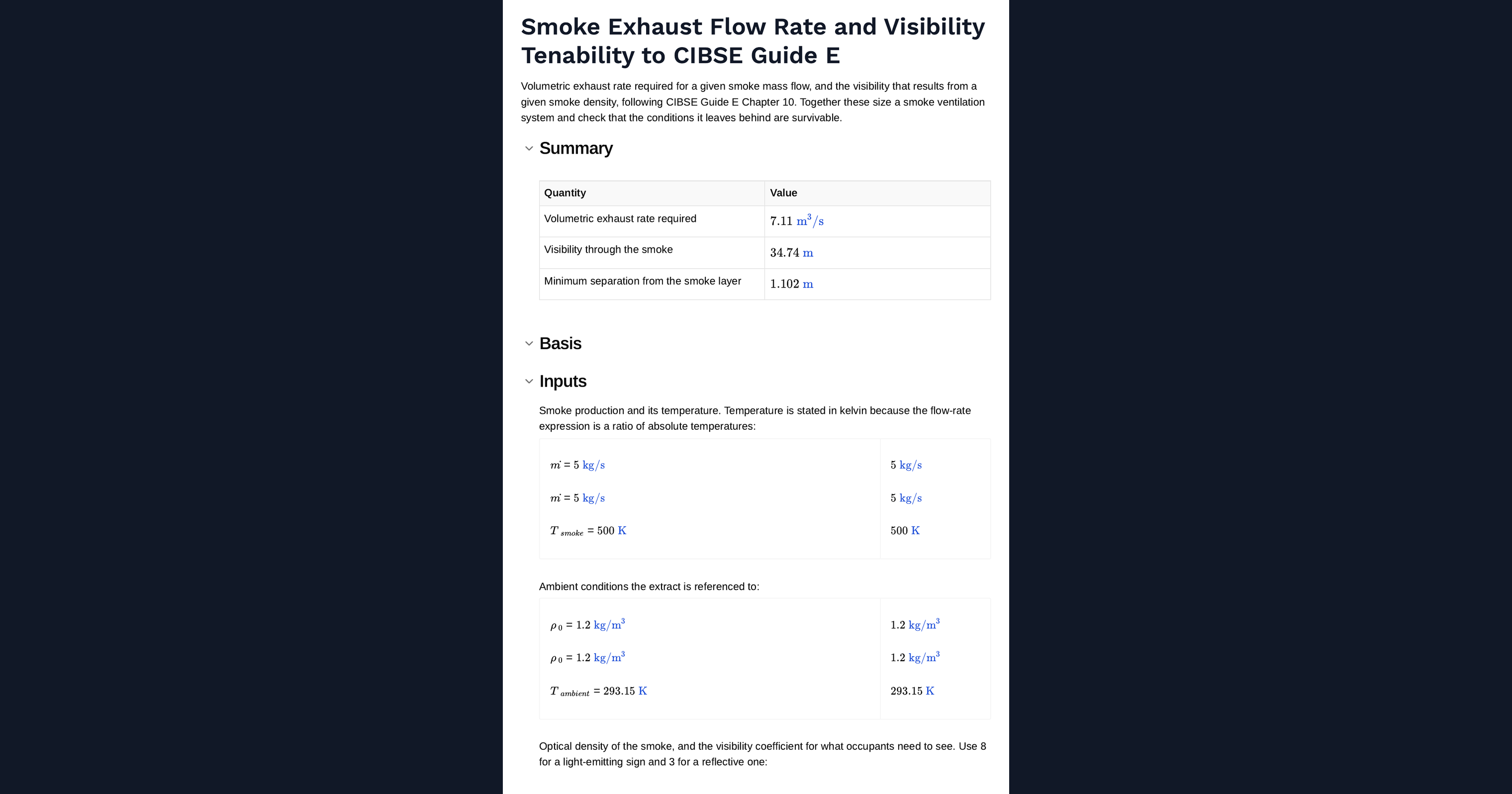
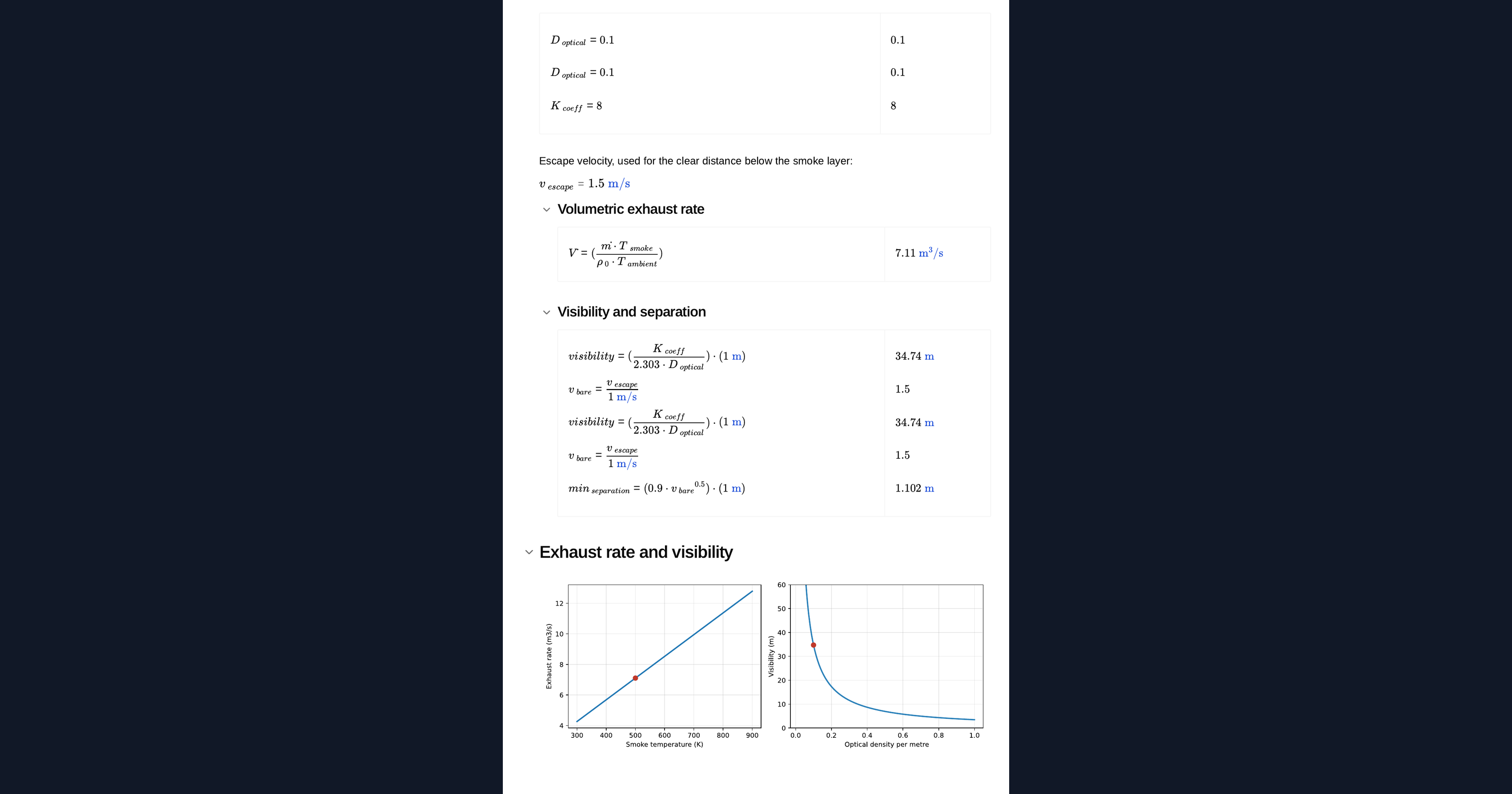
This calculator converts a smoke mass flow into the volumetric rate a ventilation system must handle, and gives the visibility that results from a given smoke density, using the expressions in CIBSE Guide E Chapter 10. Together they size a smoke ventilation system and describe the conditions it leaves behind. A chart plots exhaust rate against smoke temperature alongside visibility against optical density.
- Fire engineer. Enter the smoke mass flow and its temperature, and read the volumetric rate the fans must move.
- Building services engineer. Size extract plant on the volume actually produced rather than on mass flow alone.
- Engineer checking tenability. See how visibility falls as smoke thickens, and how much closer a reflective sign must be than a lit one.
Every expression is shown with its origin and units are carried through the calculation. It is an engineering-grade calculator you can audit, adapt and save to a project page in CalcTree.
More info on Smoke Exhaust Flow Rate and Visibility
Inputs
The smoke mass flow rate and its absolute temperature, the ambient density and temperature the extract is referenced to, the optical density of the smoke, the visibility coefficient for what occupants must see, and the escape velocity.
Why volume matters
Smoke is produced by mass but extracted by volume, and hot smoke occupies far more volume than the same mass of cool air. The volumetric rate therefore depends on the smoke temperature, and a system sized on mass flow alone will be undersized for hot smoke.
Visibility
Visibility falls as smoke obscures light. The distance at which an object can be perceived depends on the optical density and on a coefficient for what is being looked at, which differs substantially between a sign that emits light and one that only reflects it.
Outputs
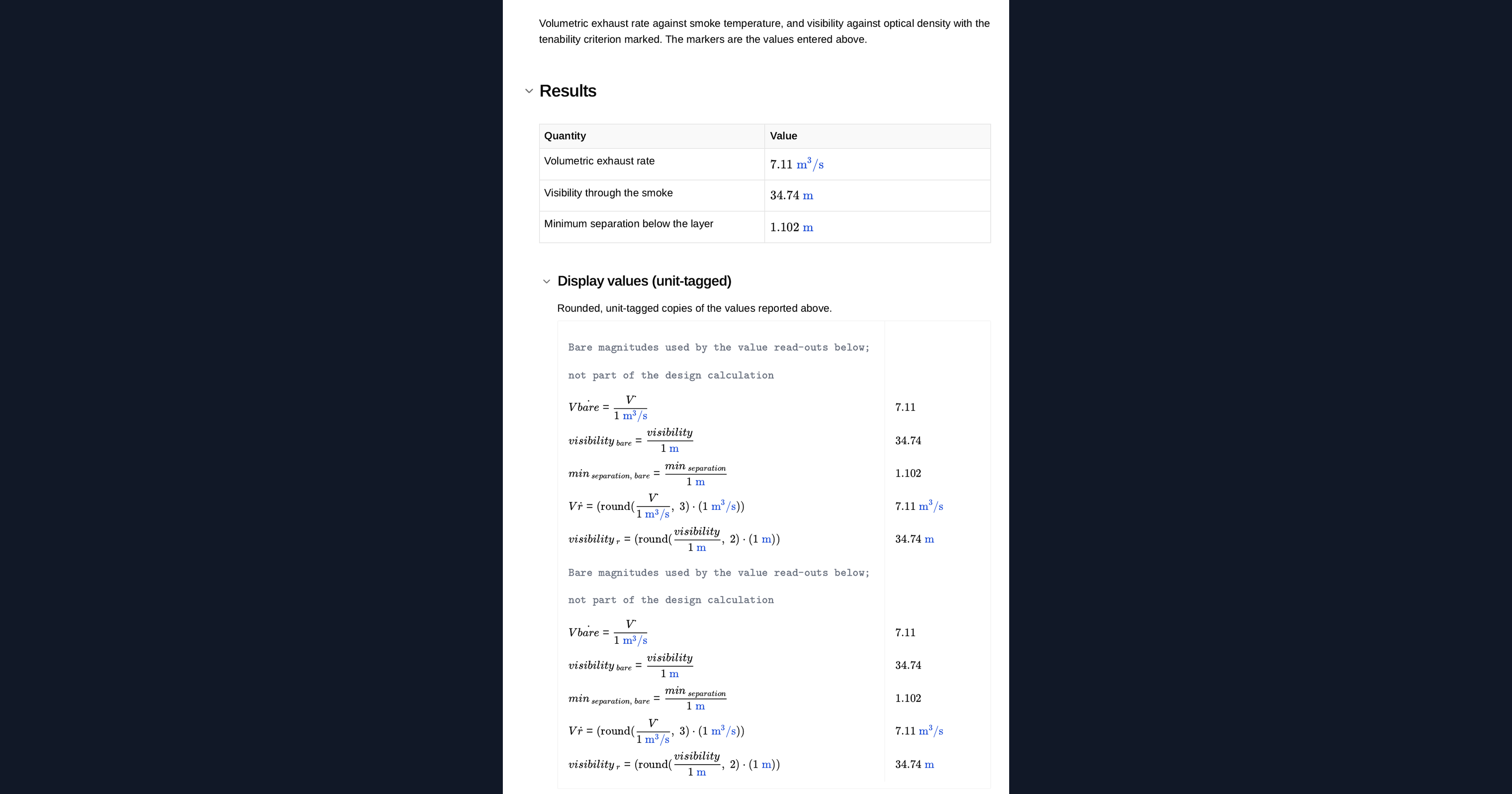
The volumetric exhaust rate, the visibility through the smoke, and the minimum clear distance to be maintained below a descending layer for the escape velocity entered.
Common Calculation Errors to Avoid
- Sizing extract on mass flow alone. Hot smoke occupies far more volume than the same mass of cool air, and ignoring the temperature undersizes the plant.
- Using the wrong visibility coefficient. A light-emitting sign and a reflective one differ by a large factor, and the value must match what occupants actually need to see.
- Treating the mass flow as an output of this page. It comes from a plume entrainment calculation for the design fire and the rise height, which is the larger source of uncertainty in sizing a system.
- Assuming a uniform smoke layer. Real layers are neither uniform nor steady, and visibility is calculated here for smoke of uniform optical density.
- Checking visibility alone. Temperature, radiant flux and the dose of toxic products are all tenability criteria, and any of them can govern before visibility does.
- Applying the layer expressions to a disturbed space. Strong air movement, a sloping ceiling or a plume close to a wall all break the stable horizontal layer assumed.
Engineering templates
Common calculators
Design guides




FAQs
Why does smoke temperature change the extract rate?
Because extract plant moves volume, not mass. Hot smoke is less dense, so the same mass occupies more volume and needs a higher volumetric rate. Sizing on mass flow alone will undersize the system.
What visibility coefficient should I use?
It depends on what occupants must see. A sign that emits light is perceived from much further away than one that only reflects light, and the two values differ by roughly a factor of three.
Where does the smoke mass flow come from?
From a plume entrainment calculation for the design fire and the height the plume rises before reaching the layer. It is an input here, and it carries more uncertainty than the conversion this page performs.
Does this tell me whether conditions are tenable?
It gives you the visibility. Whether that is acceptable depends on the space, the occupancy and the governing guidance, and temperature, radiant flux and toxicity all need checking as well.
Is the smoke layer assumed to be uniform?
Yes, for the visibility expression. Real layers vary in density and depth, so treat the result as representative rather than exact, particularly in a space with strong air movement.
Learn about the benefits of using CalcTree on engineering projects!