
Compute the elastic buckling signature curve of a cold-formed lipped channel with a real finite strip analysis. Get critical load, half-wavelength and modes.

This template is not available yet. You can sign up and create it yourself!
Or let us know if you'd like to be notified when it’s ready:
No items found.
No items found.
Signature curve of a lipped channel with pyCUFSM
This page computes the elastic buckling signature curve of a cold-formed lipped channel in compression, using a real finite strip analysis (pyCUFSM) that runs in the page. Enter the section dimensions and it returns the critical elastic buckling load, the half-wavelength at which it occurs, and the full curve showing every buckling mode the section possesses.
What the signature curve shows
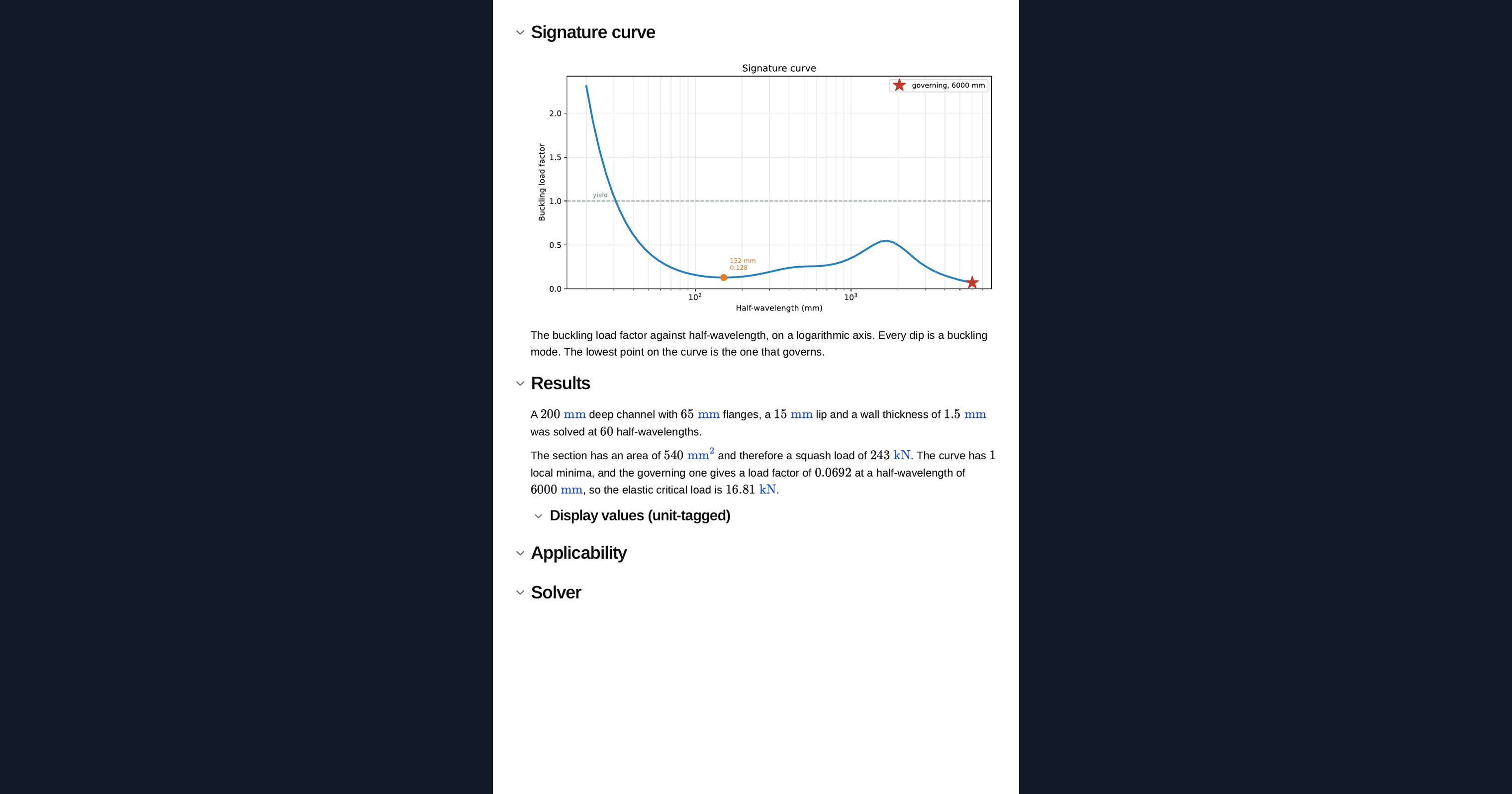
A cold-formed section is thin enough that it buckles long before it yields, and it can buckle in several different ways at once. The signature curve is the standard way to see all of them together. It plots the elastic buckling load factor against the half-wavelength of the buckle, so every mode shows up as a dip in a single curve. The load factor is a multiplier on the applied stress.
How the analysis works
The analysis is a finite strip analysis, the method behind CUFSM and the reference approach for cold-formed steel. The cross-section is divided into strips along its length, each carrying a displacement field that varies as a half sine wave along the member. Because the longitudinal variation is assumed rather than meshed, the problem collapses to a small eigenvalue problem in the cross-section alone, which is why a full buckling analysis runs in the time it takes to load this page.
The three mode families
Three families of mode appear, in order of increasing half-wavelength:
- Local buckling, at roughly the width of the widest flat element. The plates ripple but the fold lines between them stay put.
- Distortional buckling, at several times that. The flange and lip rotate about the web-flange junction, so the shape of the cross-section changes.
- Global buckling, at member length. The section moves as a rigid shape, in flexure, torsion, or both together.
Why a table-driven calculation
Because pyCUFSM runs a real finite strip analysis in the page, the geometry is entered as a table rather than picked from a fixed standard case. It handles arbitrary sections and returns diagrams and contour plots alongside the numbers.
Limits and caveats
This is an elastic buckling analysis. It returns the load at which the perfect section becomes unstable, not a design capacity. Real members have geometric imperfections, residual stresses and post-buckling reserve, and the gap between the elastic buckling load and the usable strength can be large in both directions. To turn these numbers into a capacity, use the Direct Strength Method of AS/NZS 4600 Section 7 or AISI S100 Appendix 1.
The section is modelled as a sharp-corner centreline polyline with no corner radii. Real cold-formed sections have bends with a finite radius, which slightly reduces the area and stiffens the corners. The difference is typically a couple of percent and is on the conservative side for the flat widths that drive local buckling.
Boundary conditions are simply supported at the loaded ends, the standard basis for a signature curve.
Engineering templates
Common calculators
Design guides




Frequently asked questions
What is a signature curve?
It is a plot of the elastic buckling load factor against the half-wavelength of the buckle. Because a cold-formed section can buckle in several ways at once, each mode appears as a dip in the curve, so you can read off the local, distortional and global buckling loads from a single graph.
What does the load factor mean?
The load factor is a multiplier on the applied stress. Multiply your reference stress by the factor at a given half-wavelength to get the elastic buckling stress for that mode.
Is this a design capacity?
No. This is an elastic buckling analysis of a perfect section, not a design capacity. Real members have geometric imperfections, residual stresses and post-buckling reserve. To convert these results into a member capacity, apply the Direct Strength Method of AS/NZS 4600 Section 7 or AISI S100 Appendix 1.
What are local, distortional and global buckling?
Local buckling occurs at roughly the width of the widest flat element, where the plates ripple but the fold lines stay put. Distortional buckling occurs at several times that half-wavelength, where the flange and lip rotate about the web-flange junction and the cross-section shape changes. Global buckling occurs at member length, where the section moves as a rigid shape in flexure, torsion, or both.
How does the finite strip method work?
The cross-section is divided into strips, each with a displacement field that varies as a half sine wave along the member. Assuming that longitudinal variation reduces the problem to a small eigenvalue problem in the cross-section alone, so a full buckling analysis solves almost instantly. It is the method behind CUFSM.
Does it account for corner radii?
No. The section is modelled as a sharp-corner centreline polyline. Real bends have a finite radius that slightly reduces the area and stiffens the corners, typically a couple of percent, and on the conservative side for the flat widths that drive local buckling.
What boundary conditions are assumed?
The member is simply supported at the loaded ends, the standard basis for a signature curve.
Can I analyse a section that is not a standard case?
Yes. The geometry is entered as a table, so the finite strip analysis handles arbitrary sections and returns diagrams and contour plots alongside the numbers.
Learn about the benefits of using CalcTree on engineering projects!