
Calculate radiant heat flux from a fire at a separation distance using the point source model. Try the free calculator.

This template is not available yet. You can sign up and create it yourself!
Or let us know if you'd like to be notified when it’s ready:
No items found.
No items found.
About this Point Source Thermal Radiation Calculator
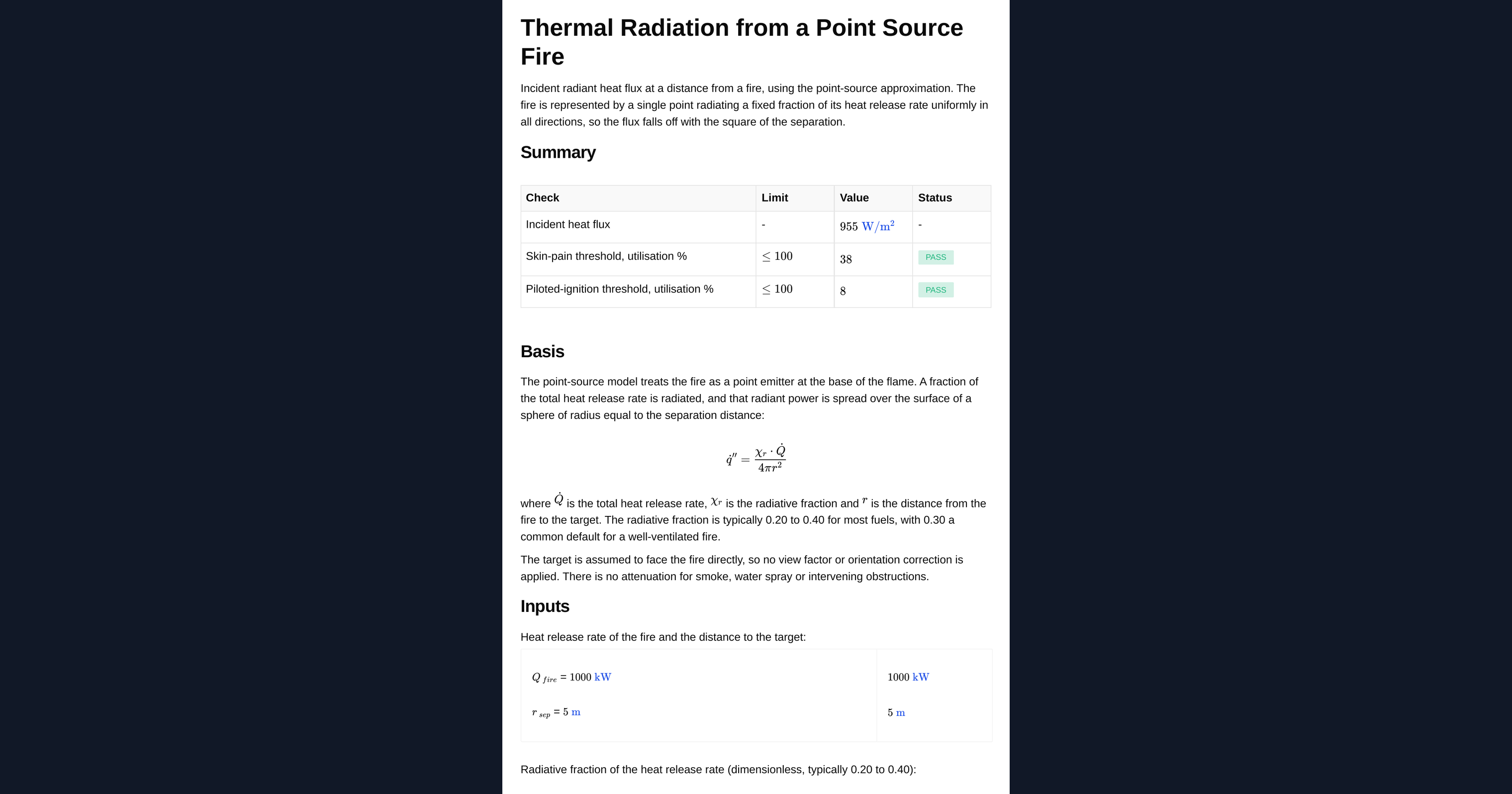
This calculator determines the radiant heat flux incident on a target at a separation distance from a fire, using the point source model. It takes the heat release rate and the fraction of that energy radiated, and returns the incident flux at the distance entered along with the separation distance at which common exposure thresholds are reached.
- Fire safety engineer. Establish the flux at a target, or the separation distance needed to stay below a criterion.
- Engineer setting out a site. Check how far apart a fire source and an exposed item need to be during layout, before the design is fixed.
- Design reviewer. Verify a stated separation distance against a flux criterion in a single step.
The model treats the fire as a single radiating point, which is a sound approximation where the separation is large relative to the fire size. It is an engineering-grade calculator you can audit, adapt and save to a project page in CalcTree.
More info on Point Source Thermal Radiation
Inputs
The heat release rate of the fire, the radiative fraction of that energy, and the separation distance from the fire to the target. The radiative fraction depends on the fuel and is the input most worth testing for sensitivity.
The point source model
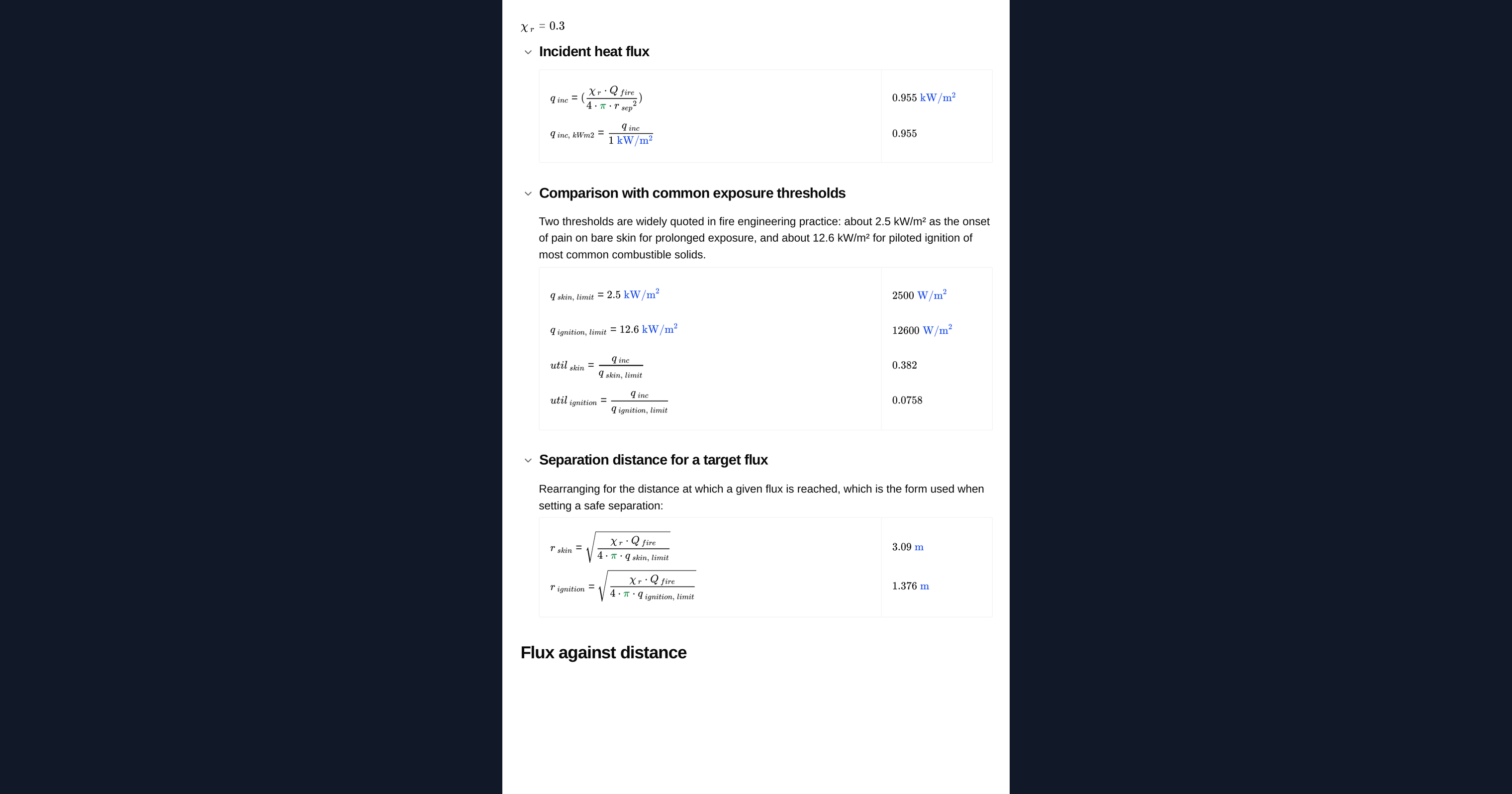
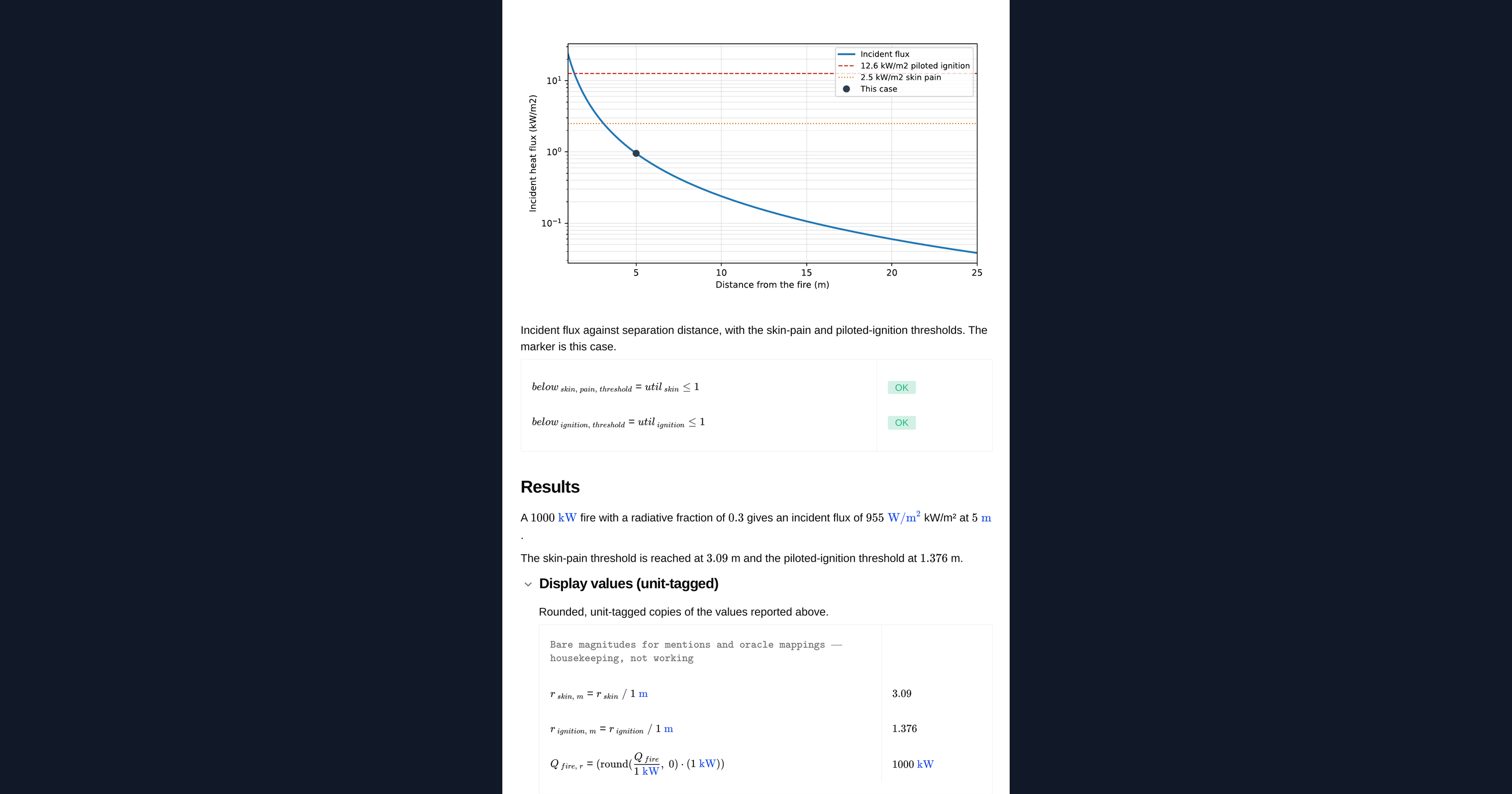
All radiant energy is assumed to leave a single point and spread over a sphere, so the flux falls with the square of the separation distance. That inverse square behaviour is what makes the model so quick to apply and also what limits it close to the fire.
Where it applies
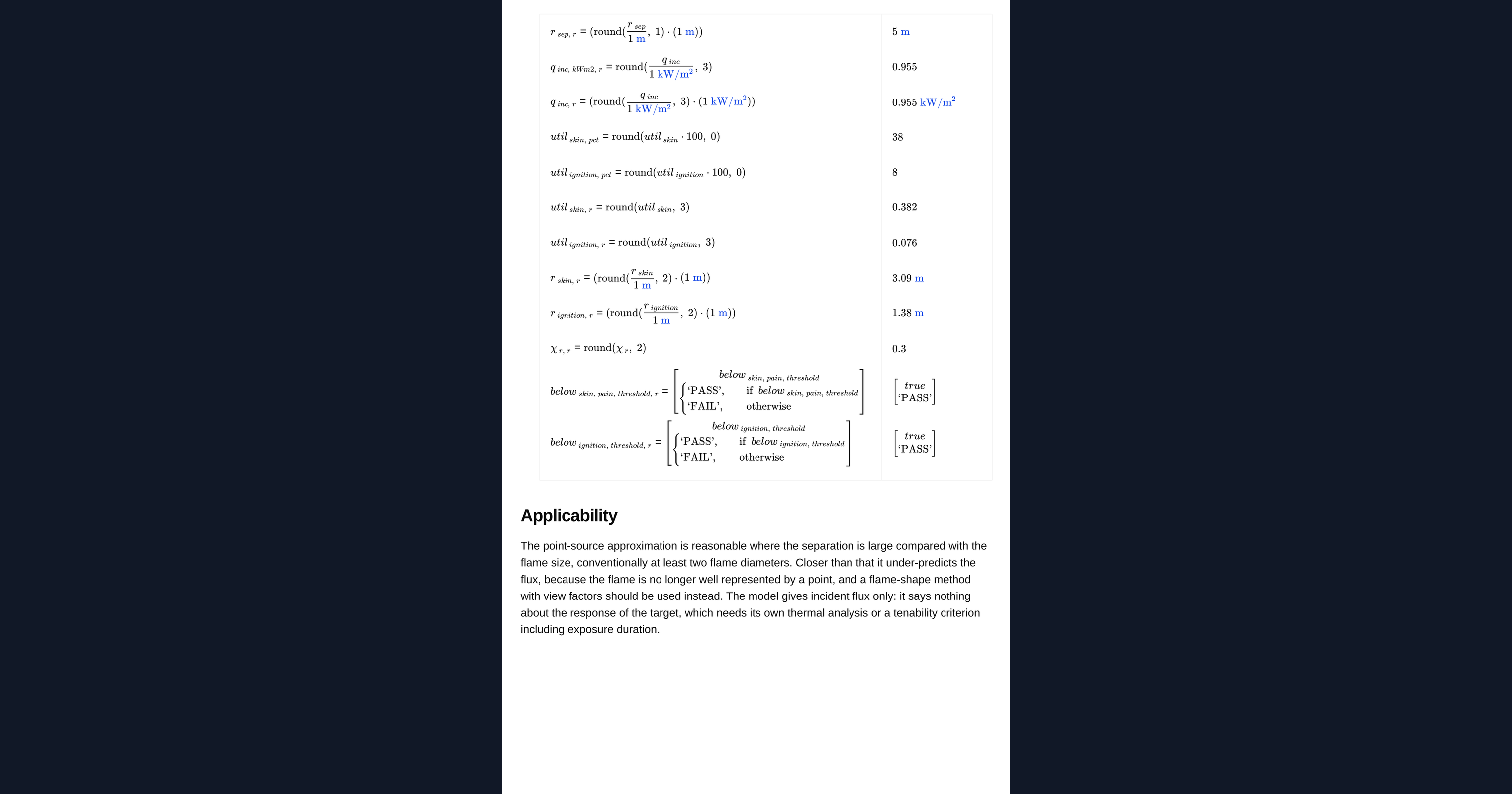
The approximation holds where the separation distance is large relative to the diameter of the fire. Close in, the fire is plainly not a point, and the model underpredicts the flux because it ignores the extent of the flame. A solid flame model with configuration factors is the alternative there.
Exposure thresholds
The calculator reports the separation distance at which common criteria are reached, covering exposure of people and piloted ignition of materials. Which criterion applies depends on the target and the acceptance criteria adopted for the assessment.
Common Calculation Errors to Avoid
- Applying the model close to a large fire. Where the separation is comparable to the fire diameter, the point source assumption breaks down and underpredicts the flux. Use a solid flame model instead.
- Guessing the radiative fraction. It varies substantially with fuel, and a clean burning fuel and a sooty one sit well apart. The result scales directly with it.
- Using the total heat release rate as radiated energy. Only a fraction of the energy leaves as radiation, and the rest is carried in the plume. Omitting the fraction overstates the flux several times over.
- Forgetting the target orientation. The flux calculated is that arriving at a surface normal to the line from the fire. A surface at an angle receives less, and a configuration factor should be applied.
- Assuming atmospheric attenuation helps. The model ignores attenuation, which is conservative. Relying on it to reduce the flux needs justification, particularly over short distances.
- Applying a people criterion to equipment. Exposure thresholds for people, for ignition of materials and for damage to equipment are all different, and the wrong one gives a misleading separation distance.
Engineering templates
Common calculators
Design guides




FAQs
What radiative fraction should I use?
It depends on the fuel and the fire size, with clean burning fuels at the low end and sooty ones higher. A mid range value is common for a general assessment, and because the result scales directly with it, the sensitivity is worth testing.
When is the point source model not appropriate?
When the target is close to the fire relative to its diameter. The model assumes all radiant energy leaves a single point, which underpredicts the flux near a large fire. A solid flame model with configuration factors is the alternative.
What flux levels matter?
Thresholds exist for exposure of people over a period, for piloted ignition of materials, and for damage to equipment, and they differ considerably. The applicable criterion comes from the target and the acceptance criteria for the assessment.
Does this account for the atmosphere?
No. The flux returned is the incident flux without atmospheric attenuation, which is conservative. Over long distances or in humid conditions the flux actually arriving is lower.
Does the orientation of the target matter?
Yes. The calculated flux is that arriving at a surface facing the fire. A surface at an angle to the line from the fire receives less, and a configuration factor should be applied to account for it.
Learn about the benefits of using CalcTree on engineering projects!