
Calculate gas temperature on the standard, external and hydrocarbon fire curves of EN 1991-1-2. Try the free calculator.

This template is not available yet. You can sign up and create it yourself!
Or let us know if you'd like to be notified when it’s ready:

No items found.
No items found.
About this EN 1991-1-2 Nominal Fire Curves Calculator
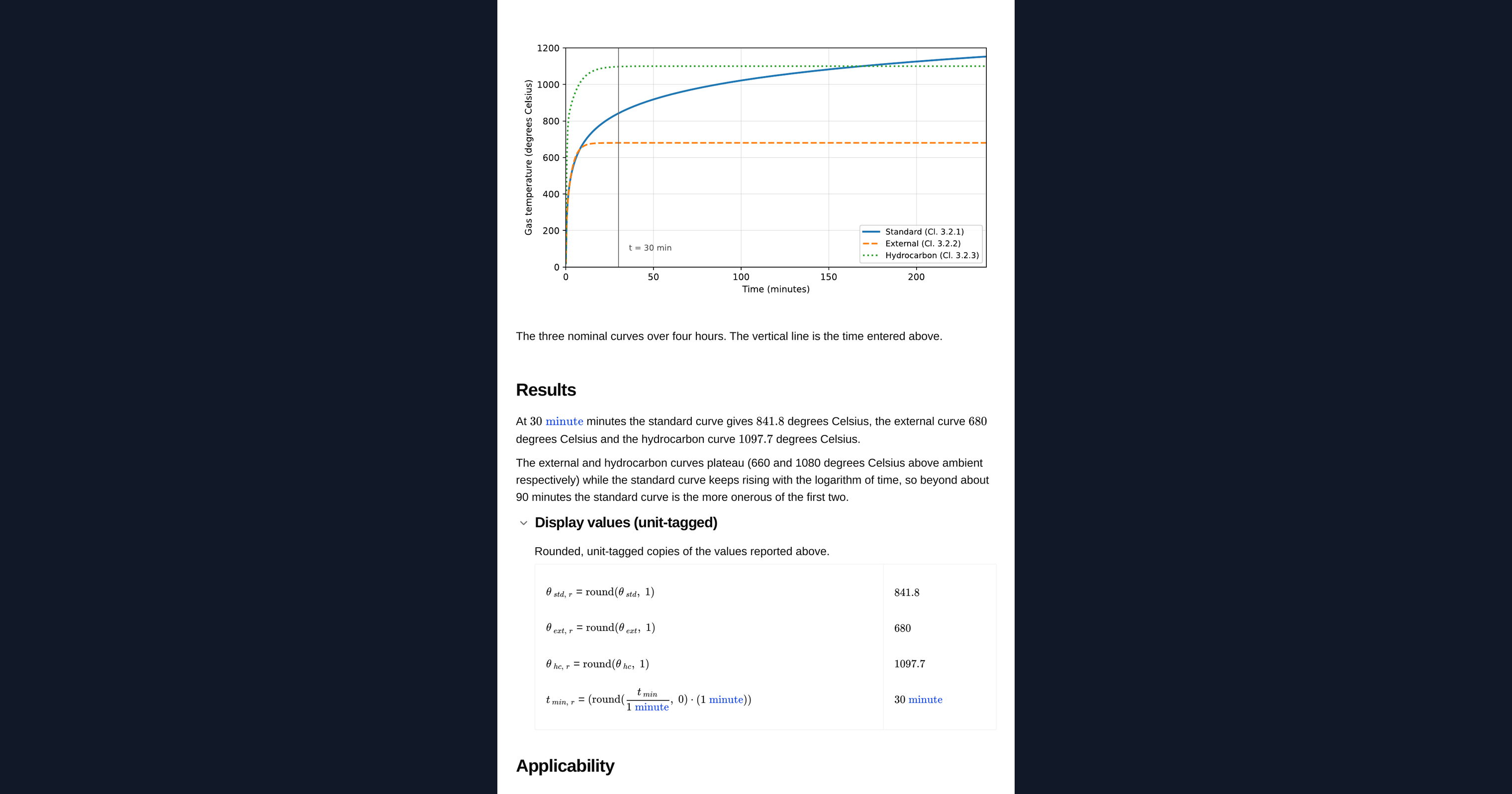
This calculator returns the gas temperature on each of the three nominal temperature-time curves of EN 1991-1-2 Clause 3.2 at any elapsed time: the standard curve, the external curve and the hydrocarbon curve. A chart plots all three over four hours with the entered time marked, and the standard curve is tabulated at the common fire resistance periods.
- Fire safety engineer. Read the exposure temperature at the time of interest for whichever curve the assessment calls for.
- Structural engineer. Establish the gas temperature that drives a member temperature calculation for a fire resistance check.
- Design reviewer. Confirm quickly that a submitted analysis used the right curve for the exposure and the right duration.
The curves are conventional design exposures rather than models of a real fire, and each is shown with the expression from the clause it comes from. It is an engineering-grade calculator you can audit, adapt and save to a project page in CalcTree.
More info on EN 1991-1-2 Nominal Fire Curves
Inputs
A single input, the elapsed time in minutes. Every curve is a function of time alone, with no dependence on fuel load, ventilation or compartment geometry, which is what makes them conventional rather than physical.
The three curves
The standard curve is logarithmic in time and applies to members in a fully developed compartment fire. It is the basis of standard fire resistance ratings. The external curve applies to the outside face of an external wall exposed through an opening. The hydrocarbon curve applies to pool fire exposures such as fuel storage, and rises far more sharply in the early minutes.
Reference points
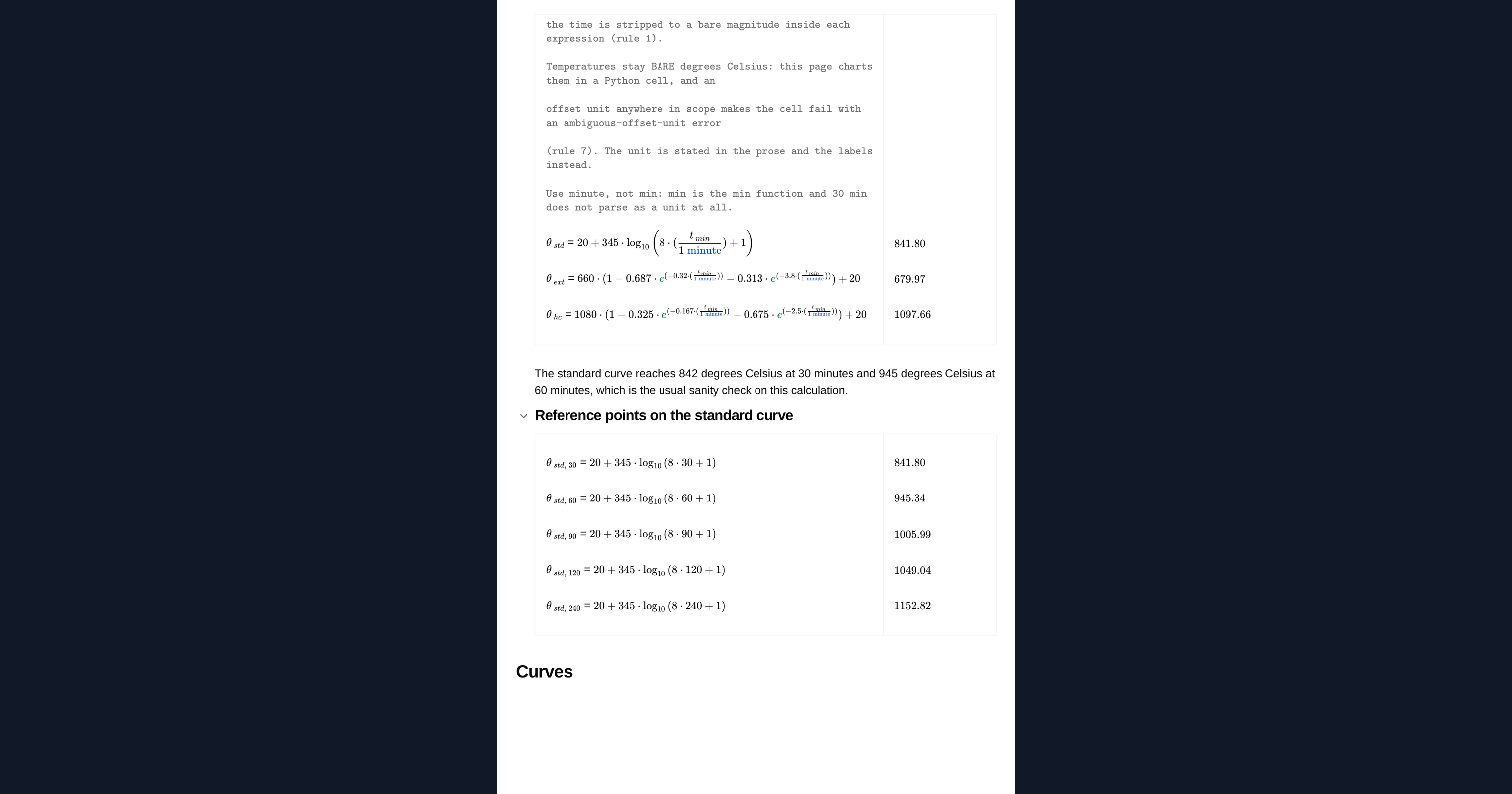
The standard curve is also evaluated at the common fire resistance periods, which gives an immediate sanity check against the values every fire engineer recognises and makes it obvious if an input has been misread.
Using the output
The gas temperature from these curves is the exposure boundary condition for a member temperature calculation. It is not itself a member temperature, and steel or concrete will lag the gas substantially depending on section factor and protection.
Common Calculation Errors to Avoid
- Confusing gas temperature with member temperature. These curves give the temperature of the fire gases. The member temperature depends on section factor, protection and exposure time, and is always lower.
- Using the standard curve for a hydrocarbon exposure. A pool fire develops far faster in the early minutes, and the standard curve badly understates the exposure over that period.
- Applying the external curve to internal members. It applies to the outside face of external walls exposed through an opening, not to members inside the compartment.
- Treating the curve as a real fire. These are conventional exposures with no decay phase. A performance-based assessment of an actual fire needs a parametric or zone model instead.
- Reading a required fire resistance period from the curve. The required period comes from the national building regulations for the occupancy and height, not from this calculation.
- Entering time in the wrong unit. The expressions are stated against time in minutes, and entering hours or seconds silently returns a plausible looking but wrong temperature.
Engineering templates
Common calculators
Design guides




FAQs
Which curve should I use?
The standard curve for members in a fully developed compartment fire, which underpins standard fire resistance ratings. The external curve for the outside face of external walls exposed through an opening. The hydrocarbon curve for pool fire type exposures such as fuel storage.
Why does the standard curve keep rising when the others level off?
Because it is logarithmic in time with no upper limit in the code. The external and hydrocarbon curves each approach a plateau, while the standard curve continues to climb for as long as the analysis runs.
Is this the temperature of the structure?
No. It is the temperature of the fire gases surrounding the member. The member temperature is derived from it through a heat transfer calculation that accounts for the section factor and any applied protection.
Does this tell me the fire resistance period I need?
No. The required period is set by the national building regulations for the occupancy, height and use of the building. This calculation gives the exposure temperature for whatever period applies.
Can I use these curves for a performance-based design?
Only as a comparison. Nominal curves have no decay phase and no dependence on fuel or ventilation. A performance-based assessment normally uses a parametric fire curve or a zone or field model.
Learn about the benefits of using CalcTree on engineering projects!