
Sweep the lip length on a cold-formed channel and run a finite strip analysis at each step to find where a longer lip stops improving distortional buckling.

This template is not available yet. You can sign up and create it yourself!
Or let us know if you'd like to be notified when it’s ready:
No items found.
No items found.
How much does the lip actually buy you?
The lip is what makes a lipped channel worth using. Without it, the flange is an unstiffened element with a free edge, and it buckles at a very low stress. Adding a lip turns that free edge into a stiffened one: the flange now has to carry the lip with it in order to buckle, and the load rises sharply.
That benefit does not continue indefinitely. As the lip gets longer, two things happen at once:
- The distortional buckling load rises, because the lip stiffens the flange edge.
- The lip itself becomes a slender unstiffened element, and eventually it buckles on its own, which caps the benefit and can even reverse it.
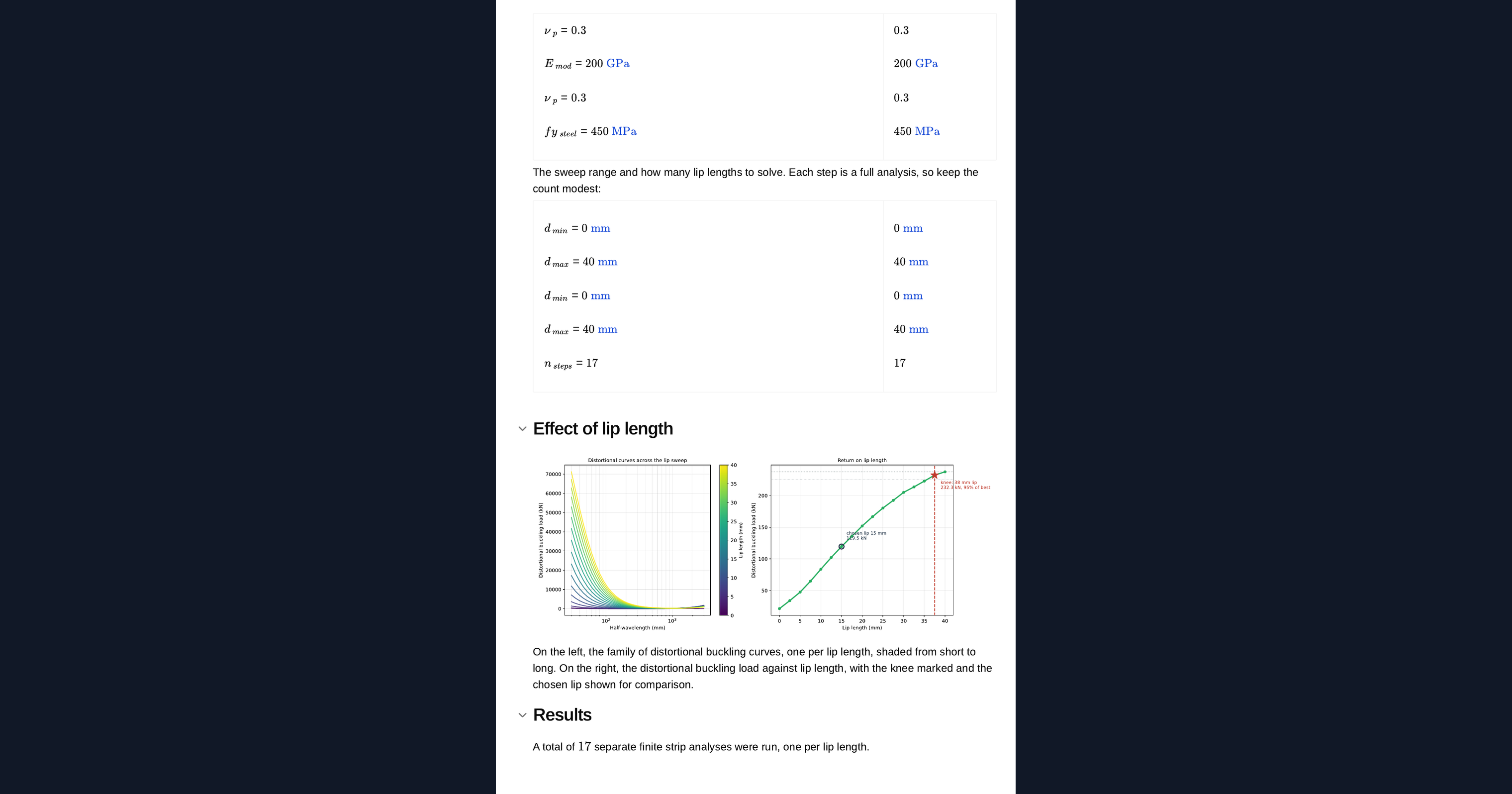
Between those two effects there is a lip length beyond which extra material buys almost nothing. This page finds it by running a separate finite strip analysis at every lip length in the sweep, extracting the distortional buckling load from a constrained analysis each time, and locating the knee in the resulting curve.
How the sweep works
The calculation runs a real finite strip analysis in the page using pyCUFSM. It handles arbitrary geometry entered as a table rather than a fixed standard case, and returns diagrams and contour plots alongside the numbers. At each step in the sweep it varies the lip length, solves the section, and reads the distortional buckling load from a constrained (cFSM) analysis so the mode is isolated cleanly.
The knee is identified as the shortest lip that reaches 95% of the best distortional load found in the sweep. That is a practical definition of where extra lip stops paying, chosen for engineering judgement rather than taken from a code.
What you get
- A distortional buckling load plotted against lip length across the full sweep.
- The knee point marked, giving the shortest lip that captures the bulk of the available distortional capacity.
- Buckling mode diagrams and contour plots for the section at each analysed lip length.
Limits and caveats
The knee here is the shortest lip reaching 95% of the best distortional load in the sweep. It is a practical criterion for judging where extra lip stops paying, not a code requirement. AS/NZS 4600 and AISI S100 impose their own limits on lip proportions for prequalification, and those must be satisfied independently.
Only distortional buckling is swept. A longer lip also changes the local and global buckling loads, and a very long lip becomes a slender unstiffened element that buckles on its own. The governing mode may therefore switch away from distortional at either end of the sweep, so read the result alongside a full analysis of the section you settle on.
The zero-lip case is a plain channel, which is a genuinely different section: the flange has a free edge, and the mode the solver labels distortional is closer to flange local buckling. Treat the left-hand end of the sweep with that in mind.
Engineering templates
Common calculators
Design guides




What does this page calculate?
It sweeps the lip length on a cold-formed lipped channel, runs a finite strip analysis at every lip length, extracts the distortional buckling load from a constrained analysis each time, and finds the knee in the resulting curve, the point beyond which a longer lip buys almost nothing.
How is the knee defined?
The knee is the shortest lip that reaches 95% of the best distortional buckling load found across the sweep. This is a practical criterion for judging where extra lip stops paying, not a code requirement.
Why does adding a lip help so much at first?
Without a lip, the flange is an unstiffened element with a free edge and buckles at a very low stress. The lip turns that free edge into a stiffened one, so the flange has to carry the lip with it in order to buckle. That raises the load sharply.
Why does a longer lip eventually stop helping?
As the lip gets longer it becomes a slender unstiffened element in its own right, and eventually it buckles on its own. That caps the distortional benefit and can even reverse it, which is why there is a lip length beyond which extra material adds little.
Does this replace a code check?
No. AS/NZS 4600 and AISI S100 impose their own limits on lip proportions for prequalification, and those must be satisfied independently. Only distortional buckling is swept here, so the governing mode may switch to local or global at either end of the sweep. Read the result alongside a full analysis of the section you settle on.
What about the zero-lip case?
The zero-lip case is a plain channel, a genuinely different section. The flange has a free edge, and the mode the solver labels distortional is closer to flange local buckling, so treat the left-hand end of the sweep with care.
Can I use my own geometry?
Yes. The page runs a real finite strip analysis with pyCUFSM and takes arbitrary geometry entered as a table rather than a fixed standard case. It returns diagrams and contour plots alongside the numbers.
Learn about the benefits of using CalcTree on engineering projects!