
Calculate flame height for wall, line and corner fires to NUREG-1805. Compare all three configurations. Try the free calculator.

This template is not available yet. You can sign up and create it yourself!
Or let us know if you'd like to be notified when it’s ready:
No items found.
No items found.
About this Flame Height for Wall, Line and Corner Fires Calculator
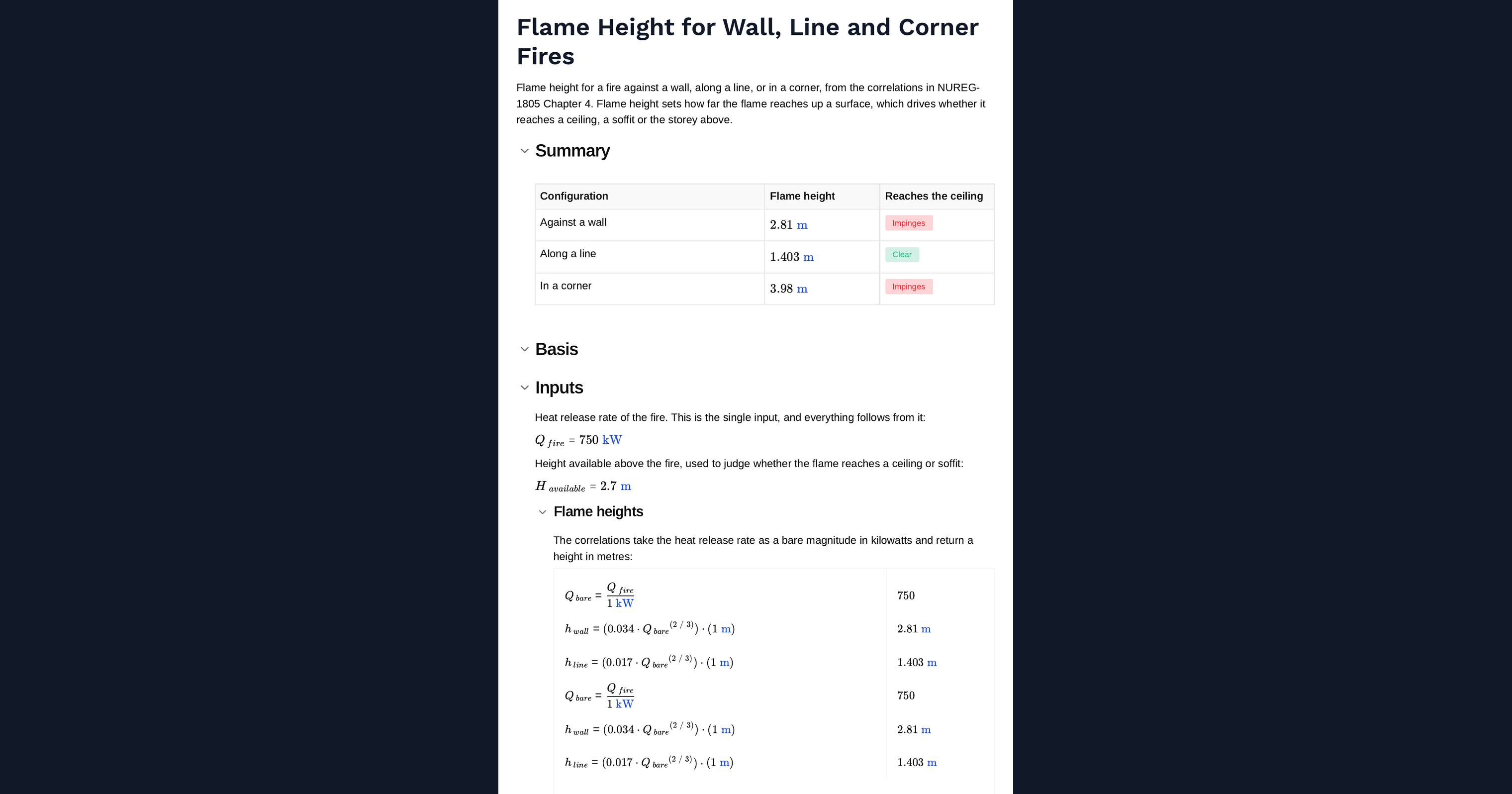
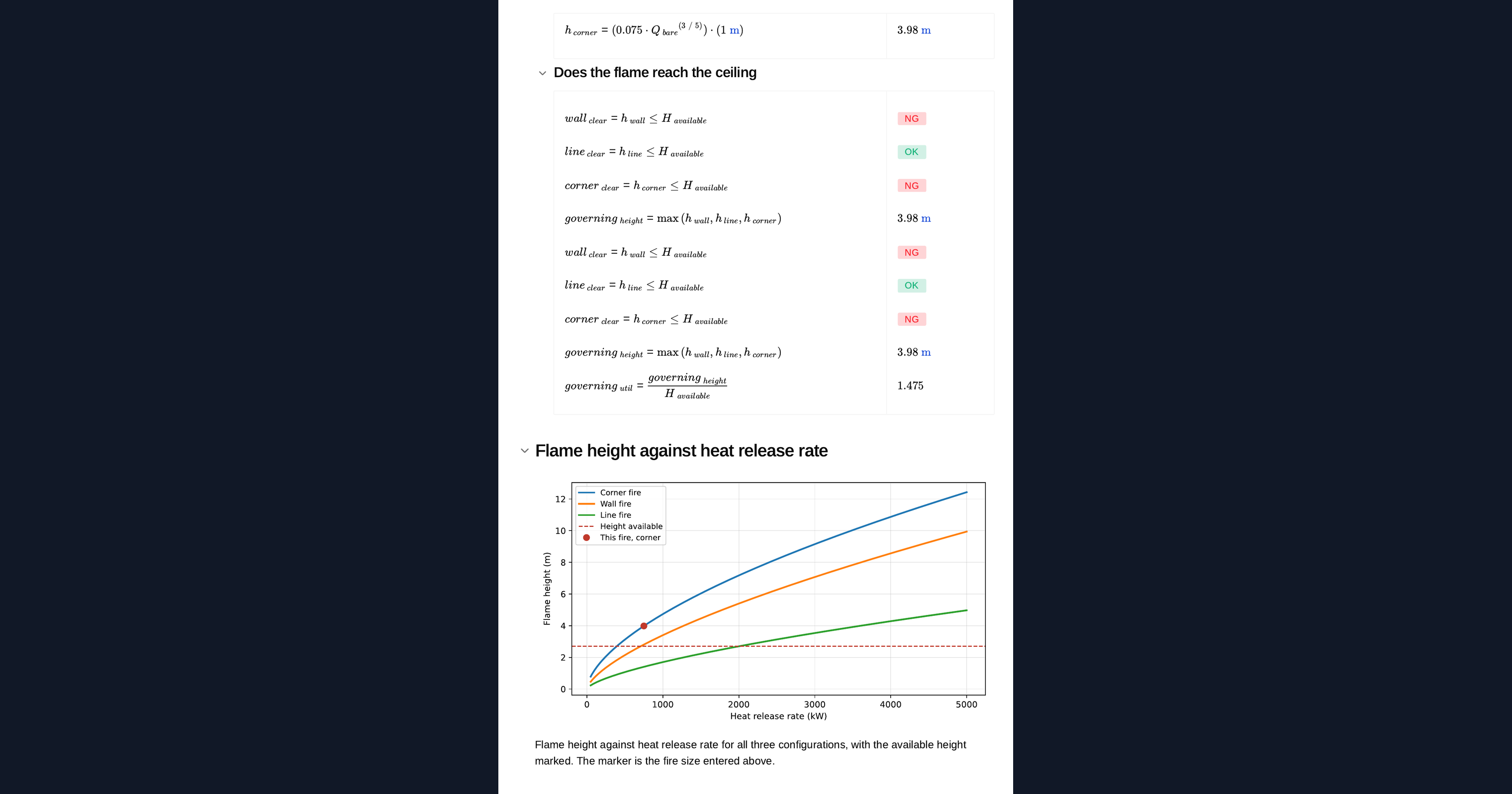
This calculator gives the flame height for a fire against a wall, along a line, or in a corner, using the correlations in NUREG-1805 Chapter 4. Flame height sets how far the flame reaches up a surface, which drives whether it reaches a ceiling, a soffit or the storey above. All three configurations are reported together so the effect of the surrounding surfaces is visible, with a chart across a range of heat release rate.
- Fire engineer. Enter the heat release rate and read the flame height for each configuration against the height available.
- Engineer assessing a lining. See why a corner is the worst place to site a combustible item and how much taller the flame becomes there.
- Risk assessor. Judge quickly whether a credible fire in a given location would reach a ceiling or an opening above.
Every expression is shown with its origin and units are carried through the calculation. It is an engineering-grade calculator you can audit, adapt and save to a project page in CalcTree.
More info on Flame Height for Wall, Line and Corner Fires
Inputs
The heat release rate of the fire, and the height available above it. Heat release rate is the single quantity the correlations depend on, and everything else follows from it.
Why configuration matters
Flame height depends on how much air the flame can entrain. A fire in the open draws air from all sides. Putting it against a wall halves that, and putting it in a corner restricts it further, so the same fire produces a taller flame as the surroundings close in.
The correlations
The wall and line cases share the exponent of an axisymmetric plume, while the corner case uses a different one that reflects how two confining surfaces change the entrainment. The corner case gives the tallest flame at any realistic fire size.
Outputs
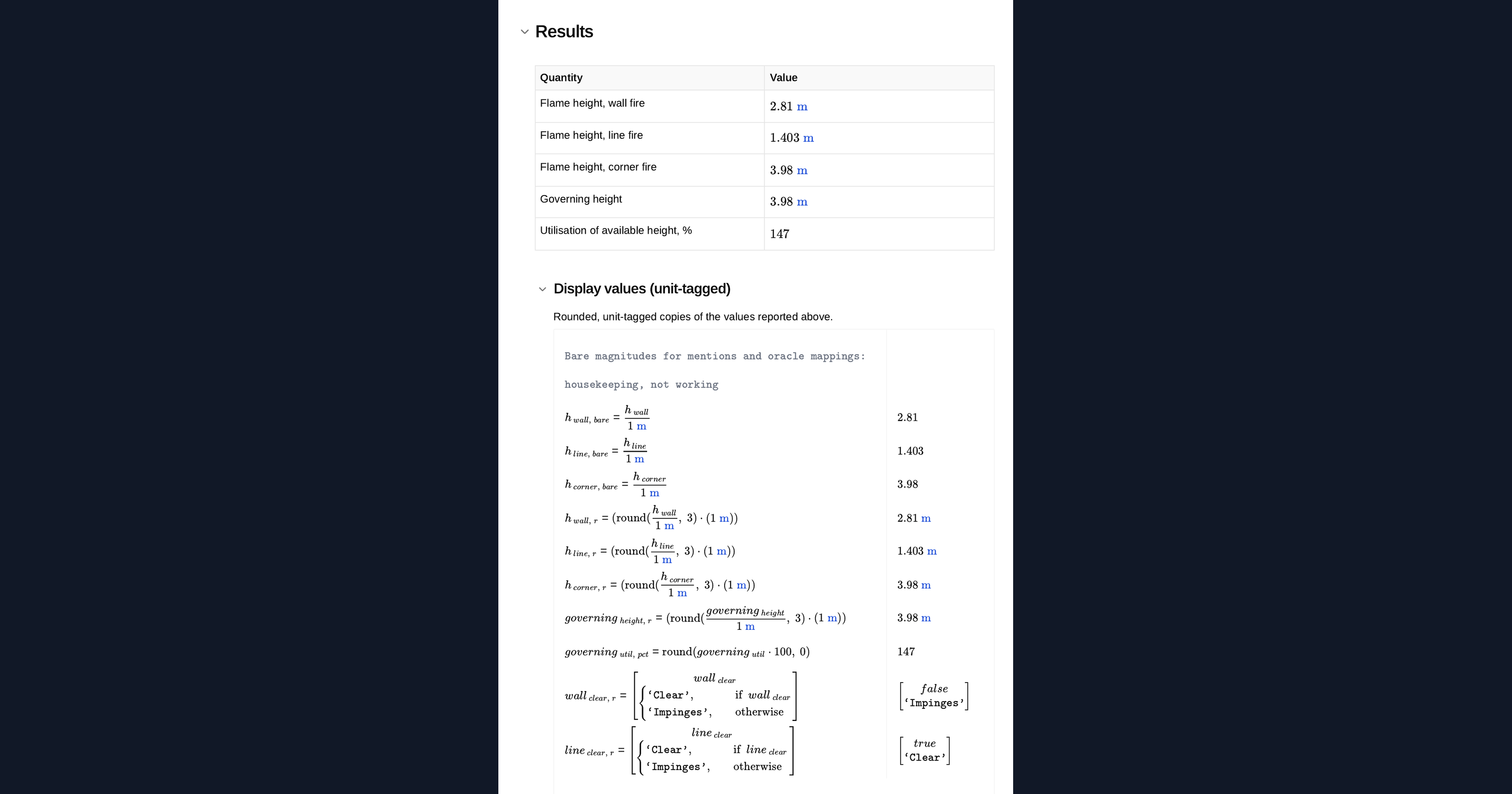
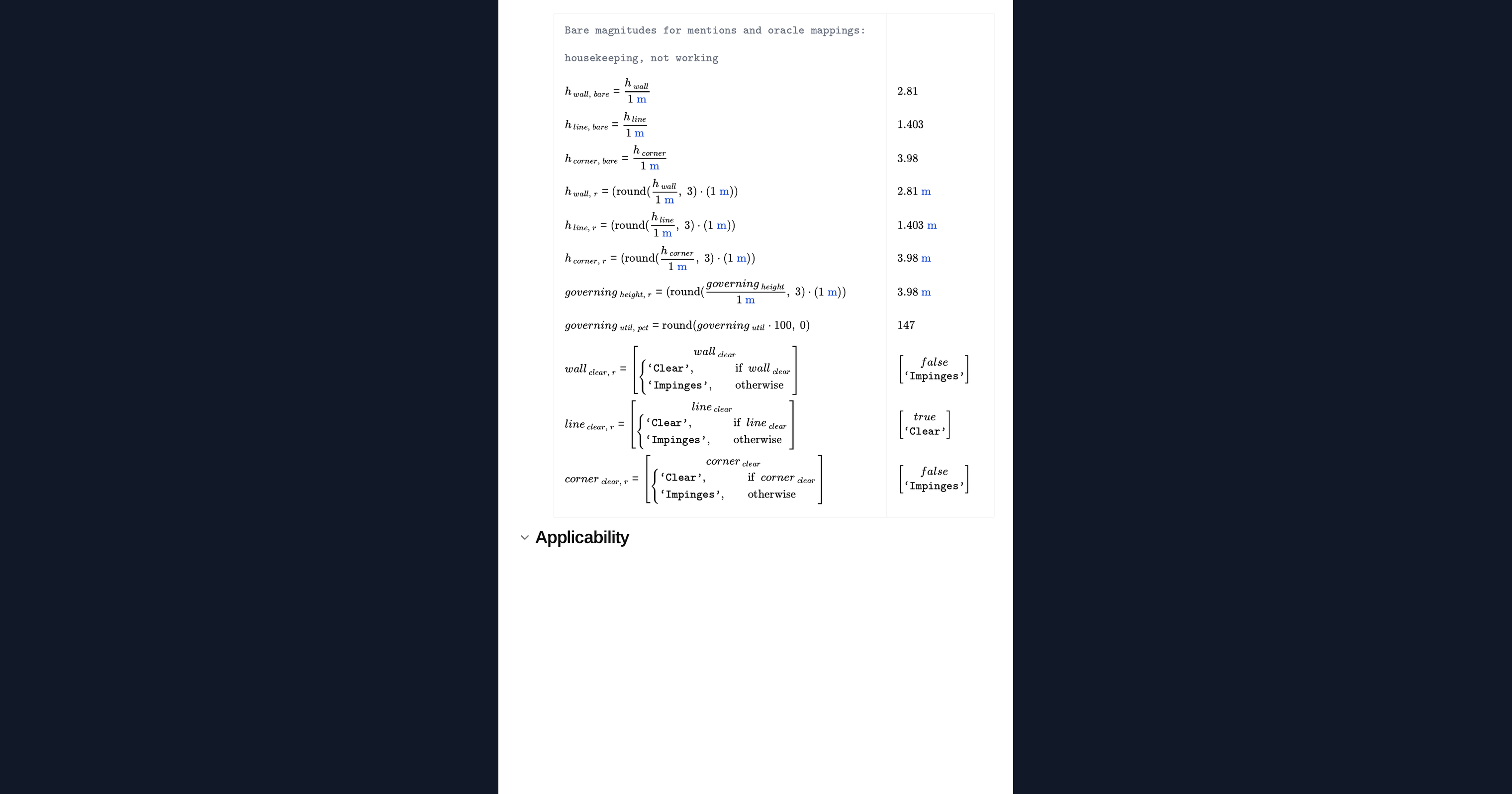
Flame height for each of the three configurations, the governing height among them, and a comparison against the height available above the fire.
Common Calculation Errors to Avoid
- Using the wall correlation for a fire set away from the wall. A fire clear of the surface behaves as an open plume and gives a shorter flame.
- Applying it to a combustible lining. Where the surface itself burns, the lining contributes to the heat release rate the correlation takes as an input, and the problem is no longer this one.
- Treating heat release rate as an output. It is an assumption and must come from test data, a design fire for the occupancy, or a ventilation-limited estimate.
- Reading the mean height as the maximum. The flame tip fluctuates well above the mean luminous height, and intermittency matters when asking whether flame touches a specific surface.
- Stopping at the ceiling. Where the flame reaches a ceiling it turns and travels beneath it as a ceiling jet, which is a separate calculation.
- Assuming a flat surface. The correlations assume effectively flat, non-combustible surfaces with the fuel at floor level.
Engineering templates
Common calculators
Design guides




FAQs
Why is a corner fire the worst case?
Two confining surfaces restrict how much air the flame can entrain, so the flame has to grow taller to burn the same fuel. At any realistic fire size the corner correlation gives the tallest flame of the three.
Where do I get the heat release rate?
From test data for the fuel, a design fire chosen for the occupancy, or a ventilation-limited estimate. It is an input to this calculation, not an output, and it governs the answer.
Is this the maximum flame height?
No. It is the mean luminous height. The flame tip fluctuates above it, so where the question is whether flame touches a particular surface, the intermittent height matters too.
What if the wall itself is combustible?
Then the lining contributes to the fire and the heat release rate is no longer an independent input. That is a different and harder problem than these correlations address.
What happens when the flame reaches the ceiling?
It turns and travels horizontally beneath it as a ceiling jet. Neither the reach nor the temperature of that jet is covered here, and both need separate treatment.
Learn about the benefits of using CalcTree on engineering projects!