
Check punching shear at an internal rectangular column to EN 1992-1-1 6.4, for a flat slab or a foundation base. Duplicate the calc and run your column.

Tell us what you need, or sign up and build it yourself in minutes.
Leave your email and we'll tell you when a template for it is ready:


No items found.
No items found.
About this Punching Shear, Internal Rectangular Column Calculator
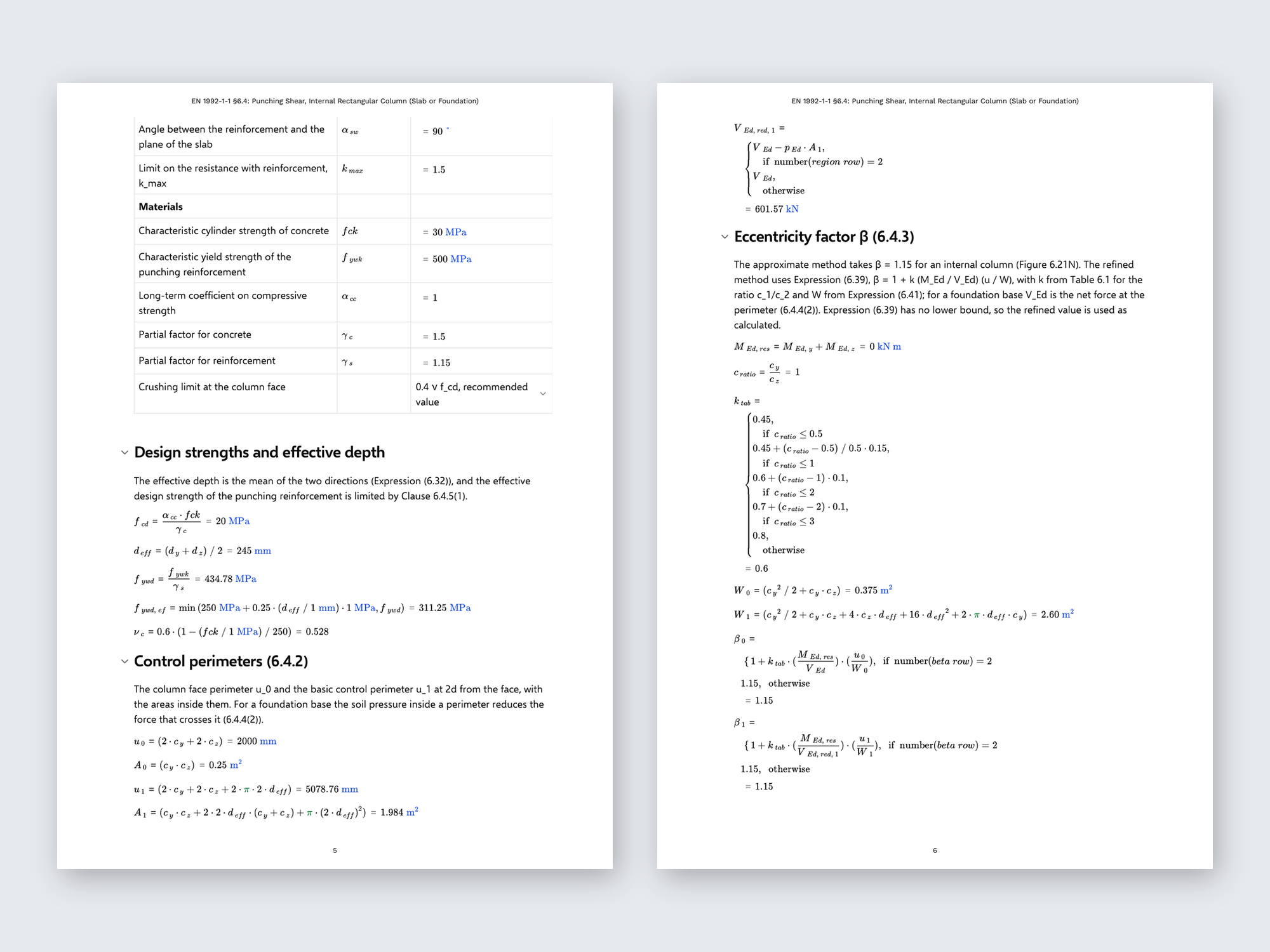
This calculator checks punching shear at an internal rectangular column to EN 1992-1-1 Clause 6.4, for either a flat slab supported on the column or a foundation base under it. It works the eccentricity factor β, the crushing limit at the column face, the resistance of the concrete alone and, where that is not enough, the punching reinforcement per perimeter, the k_max effectiveness limit and the outer perimeter u_out beyond which no reinforcement is needed.
- Flat slab designer check the column heads of a flat plate, then size links or bent-down bars and the number of perimeters when the concrete alone does not carry the load.
- Foundation engineer check a pad base against punching, with the net soil pressure inside each perimeter deducted and the critical perimeter found within 2d of the column face.
- Design checker confirm a submitted punching calculation, with every intermediate value and clause reference laid out to compare against.
The whole method is visible on the page, from the control perimeters to the detailing limits, so it can be read and signed off like a hand calculation. It is an engineering-grade calculation on CalcTree that you can duplicate, adapt and keep with the rest of your project.
More info on Punching Shear at a Rectangular Column
Inputs
You enter the column dimensions c_y and c_z, the effective depths and tension reinforcement in each direction, the design punching force V_Ed, the design moments about each axis, the net upward soil pressure for a base, and the mean normal stresses in the slab. Selections set the region (slab or foundation base), the eccentricity method, the type of punching reinforcement (multiple perimeters of links, a single perimeter of bent-down bars, or none) and the crushing limit option for the national annex. Concrete and reinforcement strengths and the partial factors complete the inputs.
Control perimeters and eccentricity
The column face perimeter u_0 and the basic control perimeter u_1 at 2d are built from the column sides and the mean effective depth of Expression (6.32). The eccentricity factor β uses either the approximate value for an internal column from Figure 6.21N or the refined Expression (6.39), with k from Table 6.1 for the column side ratio and W_1 from Expression (6.41).
Slab and foundation resistance
For a slab, the resistance without punching reinforcement follows Expression (6.47) with the mean reinforcement ratio of the two directions, the lower bound v_min of Expression (6.3N) and the k_1 σ_cp term for in-plane compression. For a foundation base, the page steps through perimeters between 0.5d and 2d from the column face, works the net force, β, the stress and the enhanced resistance of Expression (6.50) on each, and reports the one with the highest utilisation.
Punching reinforcement and detailing
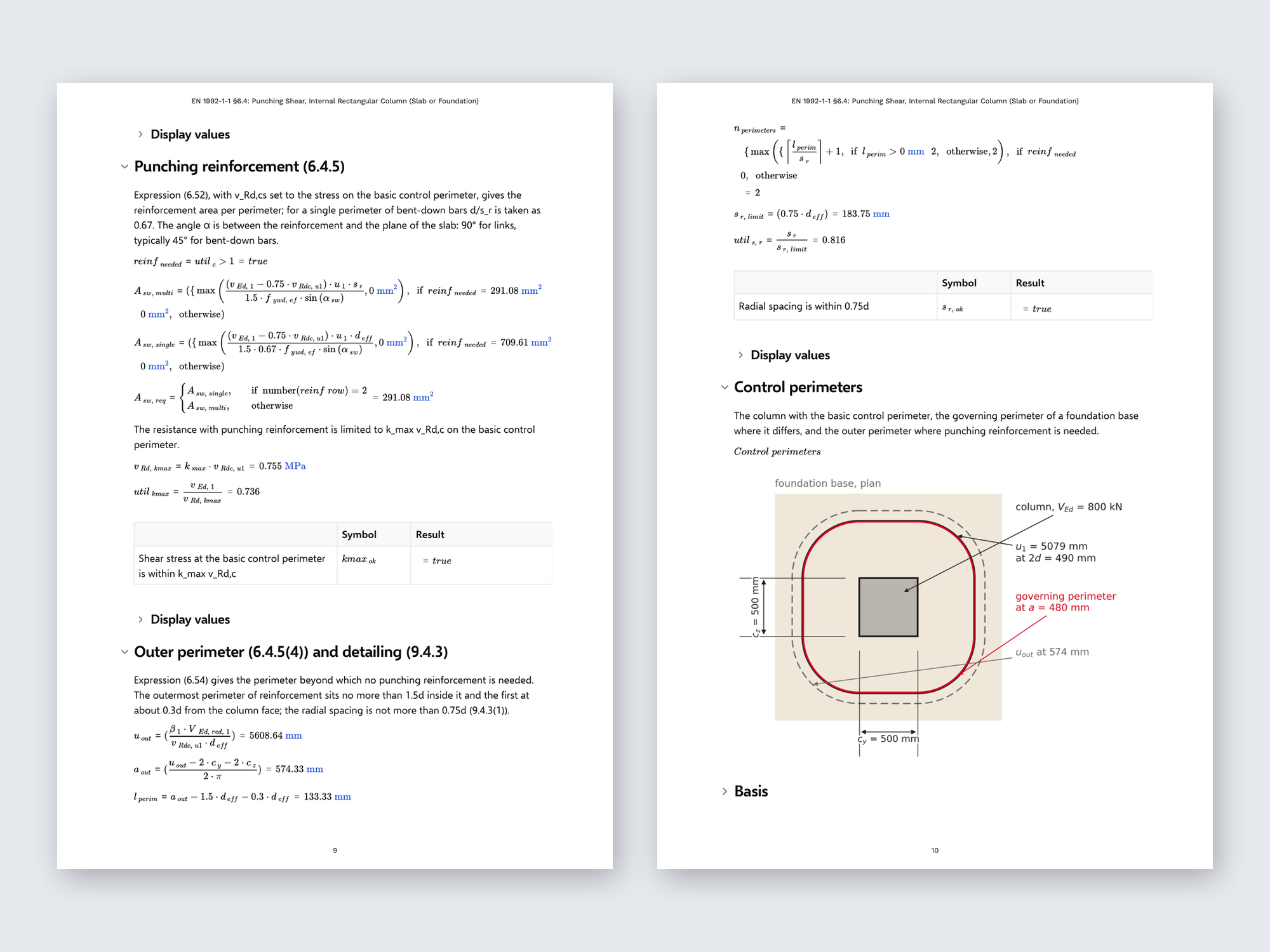
Where reinforcement is needed, Expression (6.52) gives the area per perimeter, with the effective design strength f_ywd,ef of Clause 6.4.5(1). The page checks the k_max limit, the crushing limit of Expression (6.53) at the column face, the outer perimeter of Expression (6.54) and the radial spacing limit of Clause 9.4.3, and draws the perimeters on plan.
Common Calculation Errors to Avoid
- Reducing the column face force for soil pressure the deduction of Clause 6.4.4(2) applies to the control perimeters of a base, not to the crushing check at the column face, which uses the full column force.
- Checking a base only at 2d for a foundation the critical perimeter is often closer to the column than 2d, and the resistance there is enhanced by 2d/a, so checking only u_1 can miss the governing case.
- Treating a slab like a base the k_1 σ_cp term belongs to the slab expression; a foundation base uses Expression (6.50) with no axial term.
- Using one effective depth d is the mean of the two directions, and the reinforcement ratio is the geometric mean of the two ratios, each capped.
- Spacing perimeters too far apart radial spacing of link perimeters is limited by Clause 9.4.3(1), and the outermost perimeter must sit close enough to u_out.
- Ignoring biaxial moments in the refined β the page combines both moments about one axis and does not apply Expression (6.43), so check strongly biaxial cases separately.
Engineering templates
Common calculators
Design guides




FAQs
When can I use β = 1.15 for an internal column?
Figure 6.21N gives approximate values of β for structures where lateral stability does not depend on frame action between slabs and columns and adjacent spans do not differ much. Outside those conditions, or when you want a less conservative value, use the refined option, which applies Expression (6.39) with the actual moment.
How does the check differ between a flat slab and a foundation base?
For a slab the check is on the basic control perimeter at 2d with Expression (6.47). For a base the soil pressure inside each perimeter reduces the punching force, and the page searches perimeters within 2d of the column face for the most critical one, using Expression (6.50).
What happens when the concrete alone is not enough?
The page sizes the punching reinforcement per perimeter from Expression (6.52) for your chosen type, checks that the stress at u_1 stays within k_max times the concrete resistance, and gives the outer perimeter u_out and the number of reinforcement perimeters needed.
Can I set the crushing limit to suit my national annex?
Yes. The crushing limit at the column face can be set to the recommended 0.4 ν f_cd or to 0.5 ν f_cd where the national annex adopts it. The partial factors, α_cc and k_max are also inputs.
What does the page not cover?
Openings near the column, column heads, prestressed slabs beyond the k_1 σ_cp term and the minimum area of a link leg of Clause 9.4.3(2) are outside its scope. For a circular column use the circular version of this calculation.
Learn about the benefits of using CalcTree on engineering projects!