
Wind force on circular cylinders to EN 1991-1-4 Section 7.9.2: Reynolds number, surface roughness, end effect and Eq. 5.3. Open the free template.

Tell us what you need, or sign up and build it yourself in minutes.
Leave your email and we'll tell you when a template for it is ready:

No items found.
No items found.
About this Circular Cylinder Wind Force Calculator
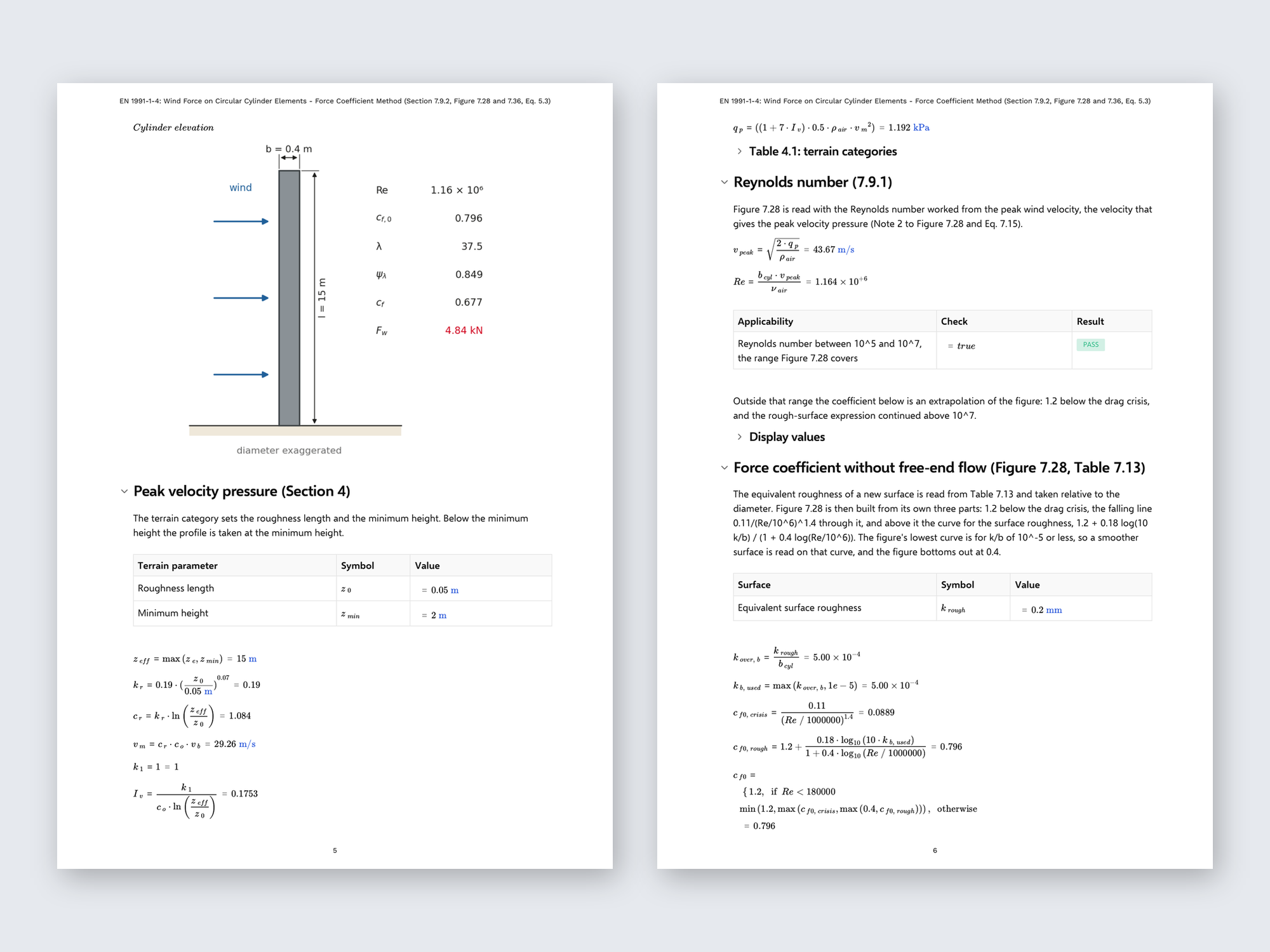
This calculator gives the total wind force on an isolated circular cylinder, such as a pole, a pipe or a round column, by the force coefficient method of EN 1991-1-4 Section 7.9.2 and Eq. 5.3, using the recommended values with no National Annex. It works the Reynolds number from the peak wind velocity, builds the coefficient without free-end flow from Figure 7.28 for the surface roughness, and applies the end-effect factor from Figure 7.36 at the element's effective slenderness.
- Lighting and pole designer checks light poles, flagpoles and CCTV masts for base shear and the force to resist at the footing.
- Pipe support engineer finds the wind force on exposed pipes and pipe racks, with the surface finish chosen from Table 7.13.
- Structural engineer sizes round columns, circular hollow section members and stacks where the Reynolds number changes the drag.
The force, force coefficient, Reynolds number and end-effect factor are reported together with a check on the Reynolds number range. It is an engineering-grade calculation you can duplicate and adapt in a CalcTree workspace.
More info on Circular Cylinder Wind Force
Reference height, area and Reynolds number
The reference height is the maximum height of the element above ground, and the reference area is the length times the diameter (7.9.1, Eq. 7.18). The Reynolds number is worked from the diameter, the peak wind velocity that gives the peak velocity pressure, and the kinematic viscosity of air (Eq. 7.15).
Figure 7.28 and surface roughness
The equivalent roughness of a new surface is selected from Table 7.13, from glass to brickwork, and taken relative to the diameter. Figure 7.28 is built from its own expressions: a plateau below the drag crisis, a falling line through it, and above it a curve that depends on the surface roughness, with the floor the figure draws. A check confirms the Reynolds number lies within the range the figure covers.
Effective slenderness and end effect
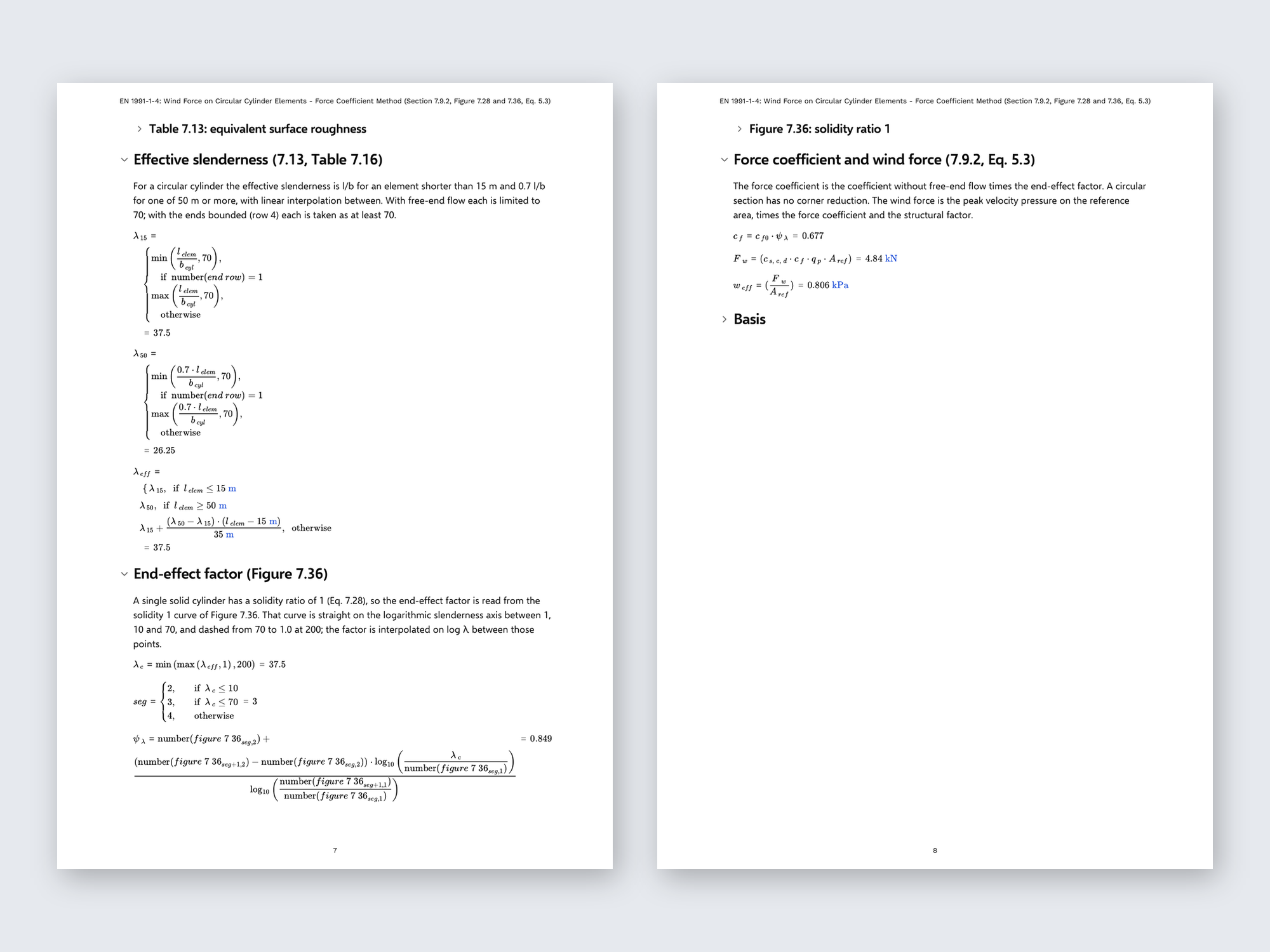
Table 7.16 gives the effective slenderness from the length and diameter, with linear interpolation between short and long elements. The end condition sets whether the slenderness is capped (free-end flow) or taken as a minimum (ends bounded by plates or a surface). The end-effect factor is then read from the solidity 1 curve of Figure 7.36, interpolated on the logarithm of slenderness.
Force coefficient and wind force
The force coefficient is the coefficient without free-end flow times the end-effect factor (Eq. 7.19); a circular section has no corner reduction. The total force is the structural factor times the force coefficient, the peak velocity pressure and the reference area (Eq. 5.3). Results are characteristic.
Common Calculation Errors to Avoid
- Assuming a constant drag coefficient The force coefficient of a cylinder drops sharply through the drag crisis and depends on surface roughness above it. A fixed value can be well off in either direction.
- Working Reynolds number from the mean velocity Figure 7.28 is read with the Reynolds number from the peak wind velocity. Using the mean or basic velocity puts the reading at the wrong point on the curve.
- Using new-surface roughness for an aged element Table 7.13 gives roughness for new surfaces. Rusted or weathered surfaces are rougher, and the National Annex may give other values.
- Picking the wrong end condition A pole with a free top has free-end flow. Only a cylinder closed off by a plate or surface wide enough to stop the flow round the end takes the bounded row.
- Ignoring vortex shedding The force coefficient method gives the along-wind force. Slender poles and stacks can also respond across the wind, which needs Annex E.
Engineering templates
Common calculators
Design guides




FAQs
Why does the Reynolds number matter for a cylinder?
The flow round a circular section changes character as the Reynolds number rises, and the drag falls sharply through the drag crisis. Figure 7.28 captures this, so the force coefficient depends on the diameter, the wind speed and the surface roughness together.
Which velocity is used for the Reynolds number?
The peak wind velocity, the velocity that gives the peak velocity pressure, as Note 2 to Figure 7.28 and Eq. 7.15 require.
What happens outside the Reynolds number range of Figure 7.28?
The page extrapolates the figure: the plateau below the drag crisis and the rough-surface expression continued above the top of the range. The Reynolds number check fails so the extrapolation is visible.
What is the end-effect factor?
It reduces the force coefficient to allow for flow round a free end. It is read from Figure 7.36 against the effective slenderness, using the solidity 1 curve for a single solid cylinder.
Does the page check vortex shedding?
No. It gives the along-wind force by the force coefficient method. Check Annex E for vortex shedding on slender or dynamically sensitive elements.
Learn about the benefits of using CalcTree on engineering projects!