
Calculate snow drift on a roof abutting a taller building to EN 1991-1-3. Drift length and shape coefficients. Try the free calculator.

This template is not available yet. You can sign up and create it yourself!
Or let us know if you'd like to be notified when it’s ready:
No items found.
No items found.
About this EN 1991-1-3 Snow Drift on a Lower Roof Calculator
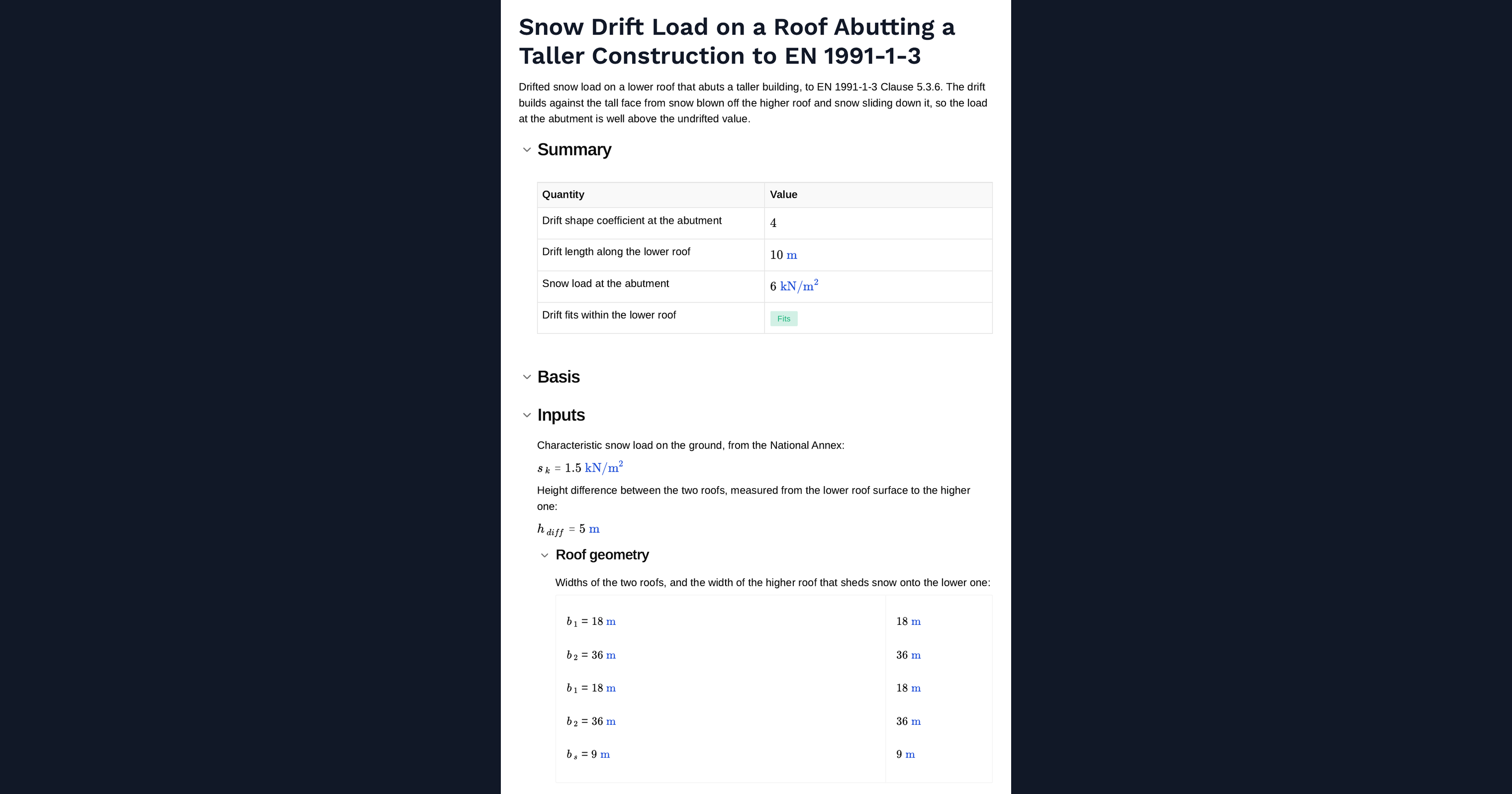
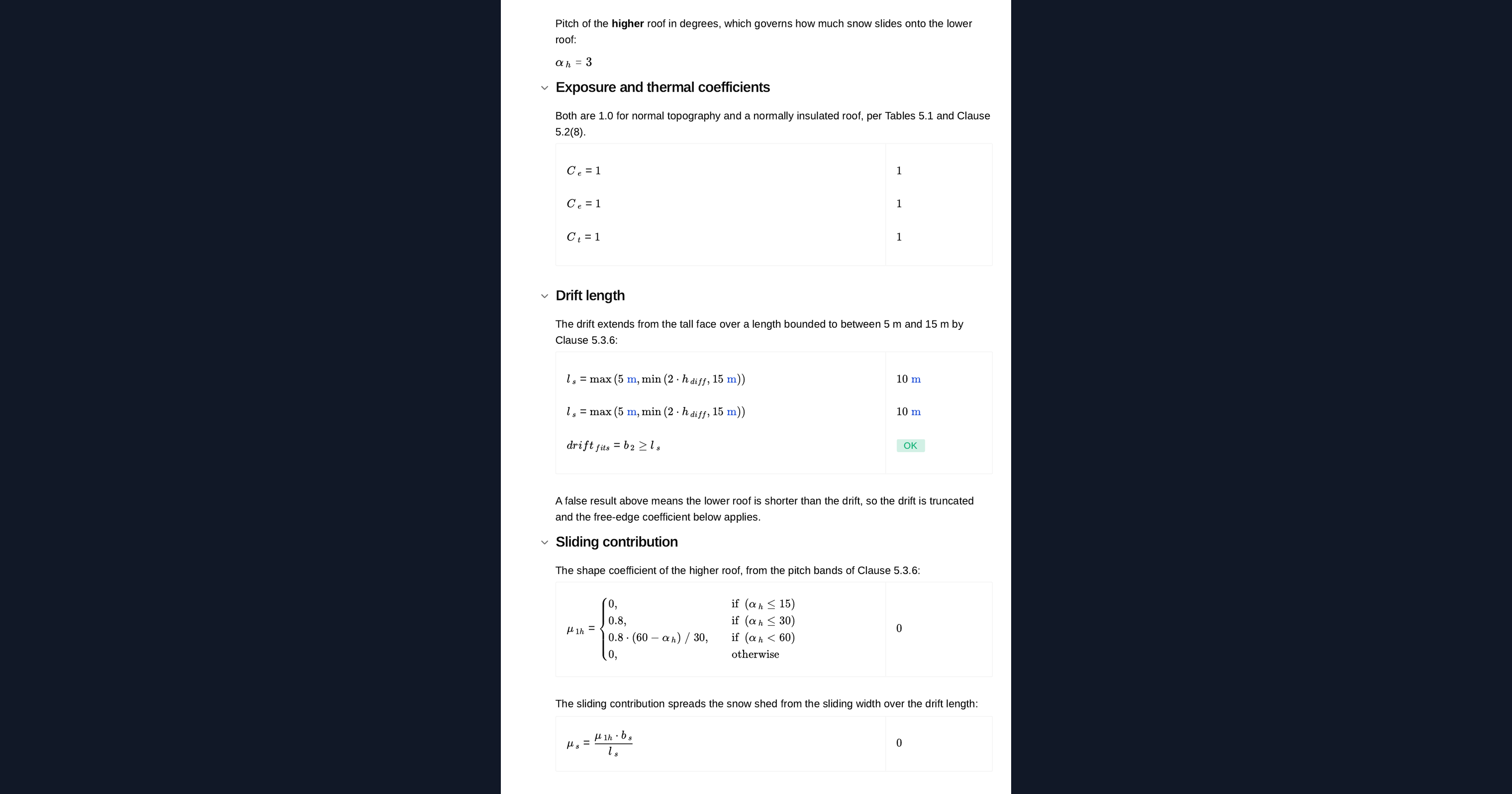
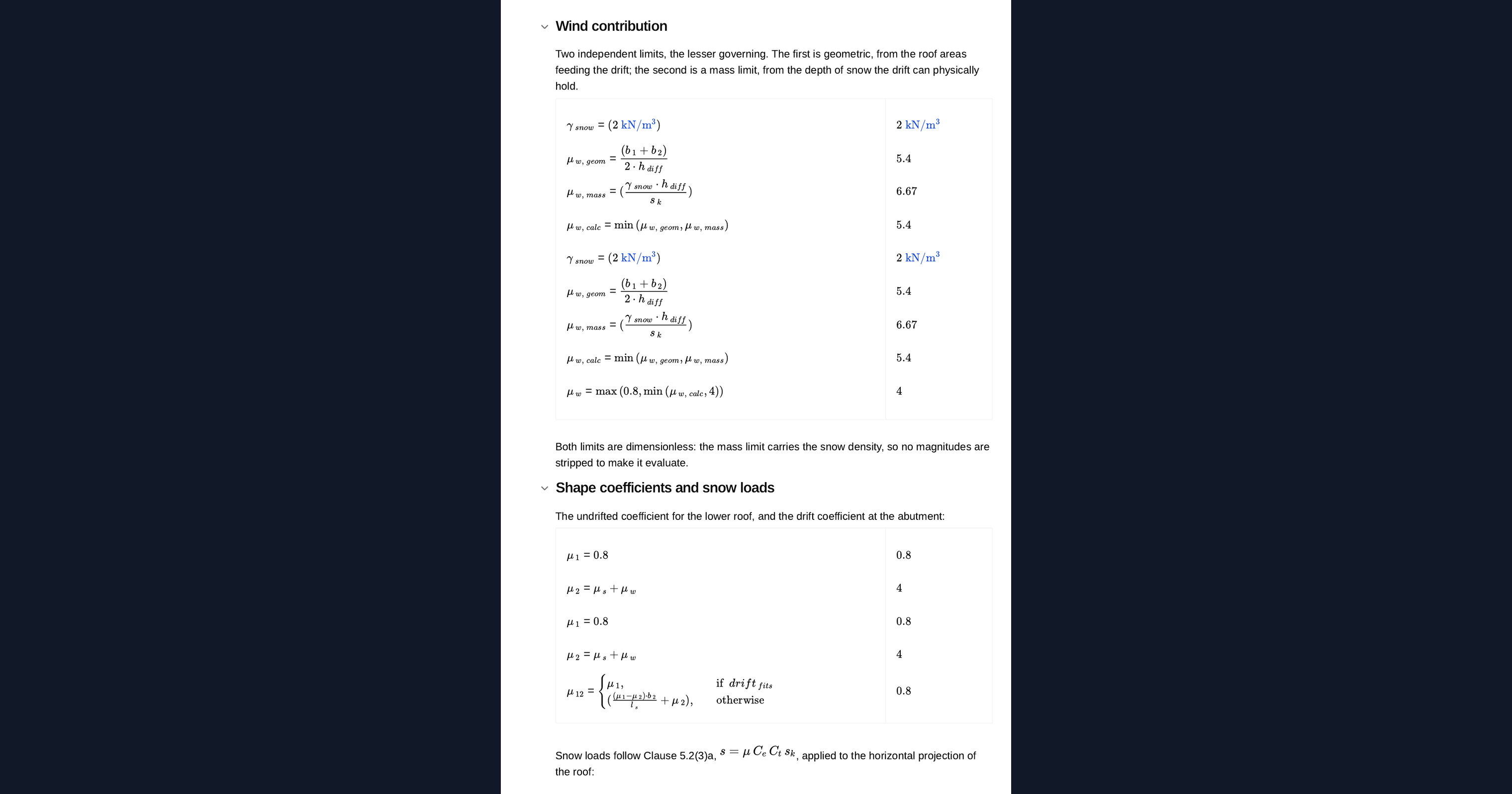
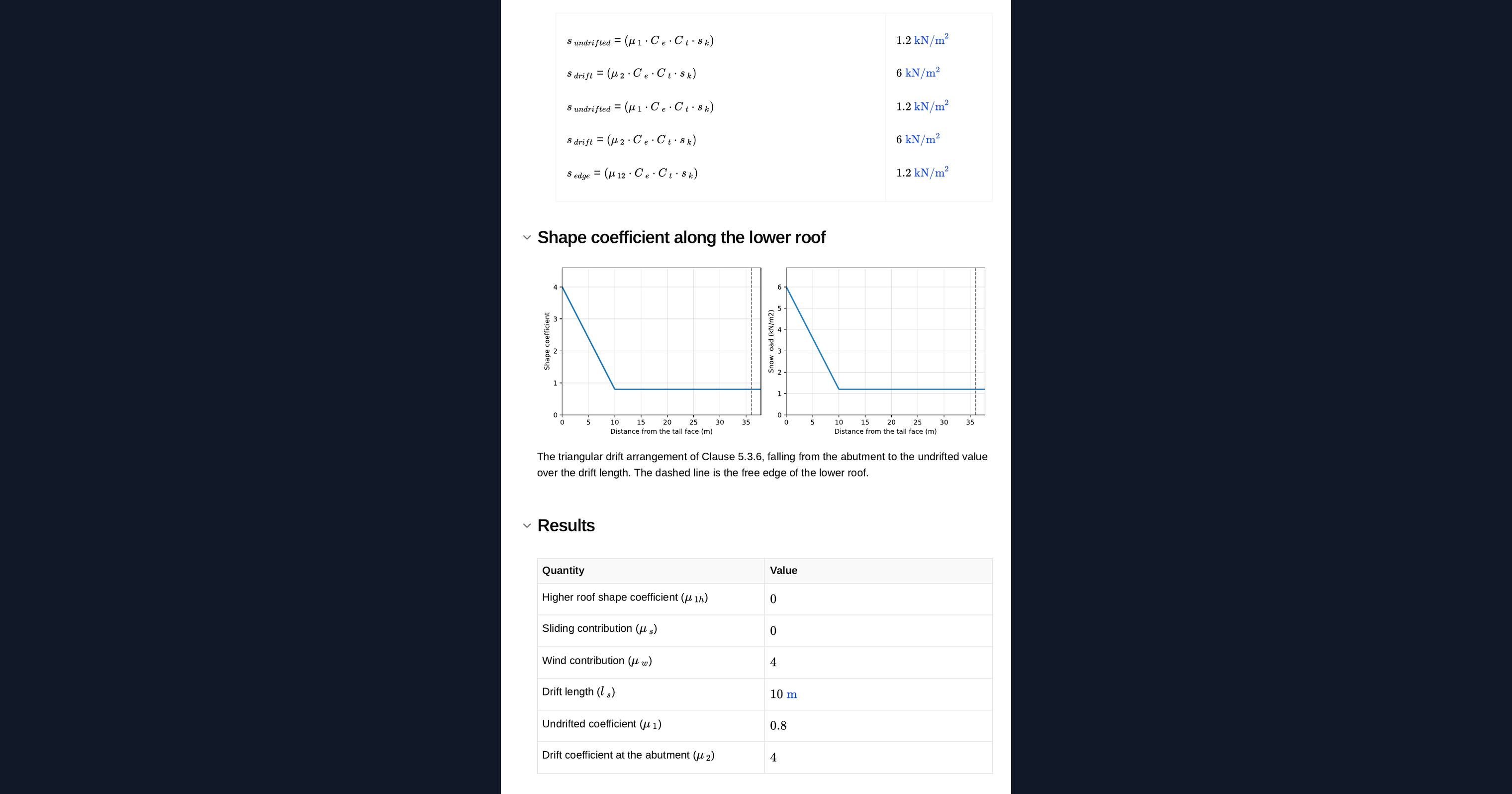
This calculator determines the drifted snow load on a lower roof that abuts a taller construction, to EN 1991-1-3 Clause 5.3.6. It works out the drift length, the sliding and wind contributions to the shape coefficient at the abutment, and the coefficient at the free edge where the lower roof is too short to contain the drift. A chart plots the triangular drift arrangement along the roof so the shape of the load is visible at a glance.
- Structural engineer. Enter the two roof widths, the height difference and the pitch of the higher roof, and read the drift coefficient and load at the abutment.
- Design reviewer. See which pitch band the sliding contribution came from and whether the geometric or the mass limit governed the wind contribution.
- Engineer sizing a roof structure. Read off the chart how far the elevated load extends across the lower roof before it falls back to the undrifted value.
Every coefficient is shown with the clause behind it and units are carried through the calculation. It is an engineering-grade calculator you can audit, adapt and save to a project page in CalcTree.
More info on EN 1991-1-3 Snow Drift on a Lower Roof
Inputs
The characteristic ground snow load for the site, the widths of the higher and lower roofs, the width of the higher roof that sheds snow, the height difference between the two, and the pitch of the higher roof. The ground snow load must come from the National Annex for the country, zone and altitude.
Drift length
The drift extends from the tall face over a length that follows from the height difference, bounded top and bottom by the clause itself. That length sets how far the elevated load reaches across the lower roof and is the first thing to check against the roof geometry.
Sliding and wind contributions
The coefficient at the abutment is the sum of two independent effects. Sliding depends on the pitch of the higher roof, and contributes nothing where that roof is too shallow to shed snow. The wind contribution takes the lesser of a geometric limit from the roof areas feeding the drift and a mass limit from the depth of snow the drift can physically hold.
Outputs
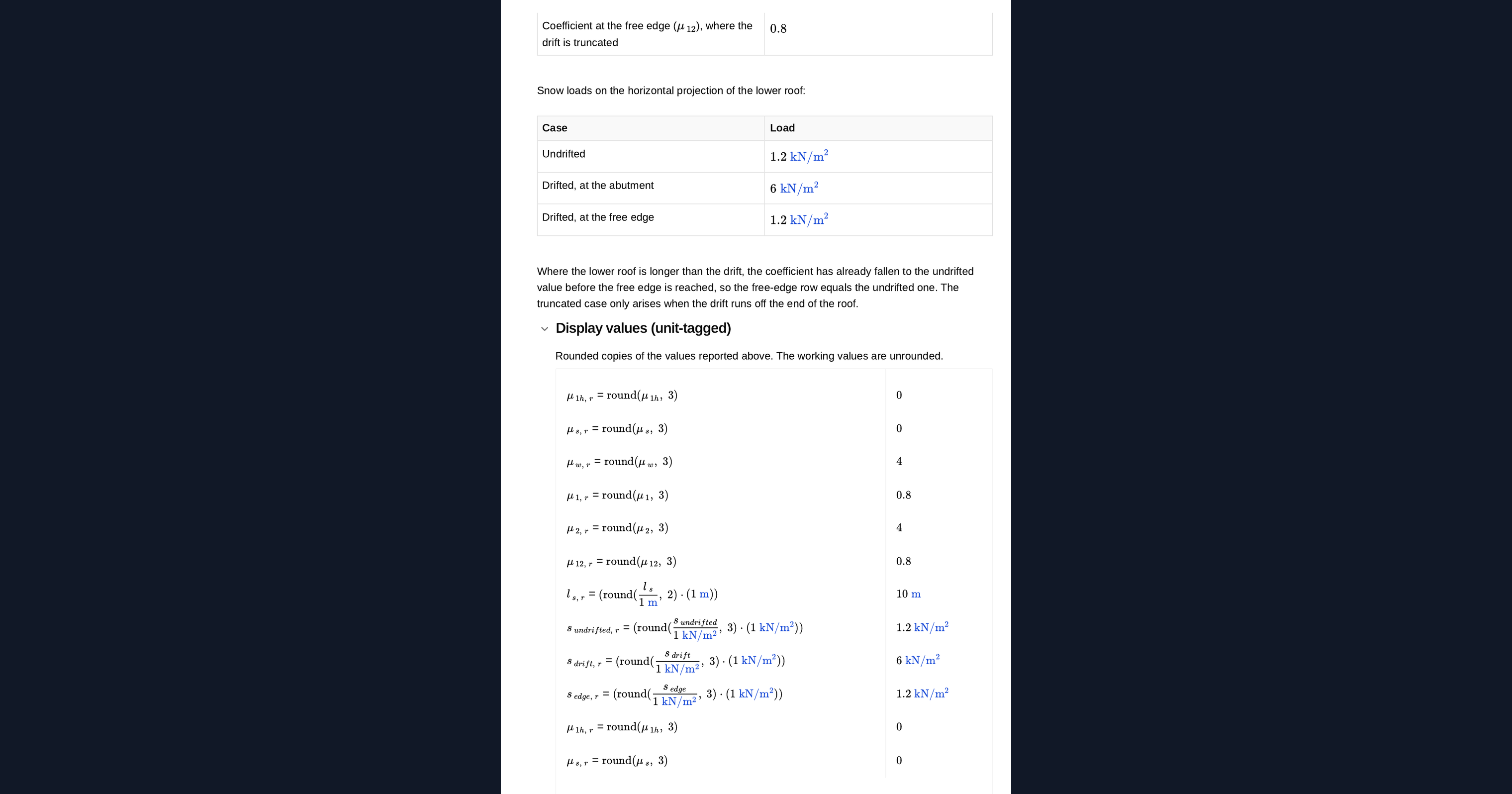
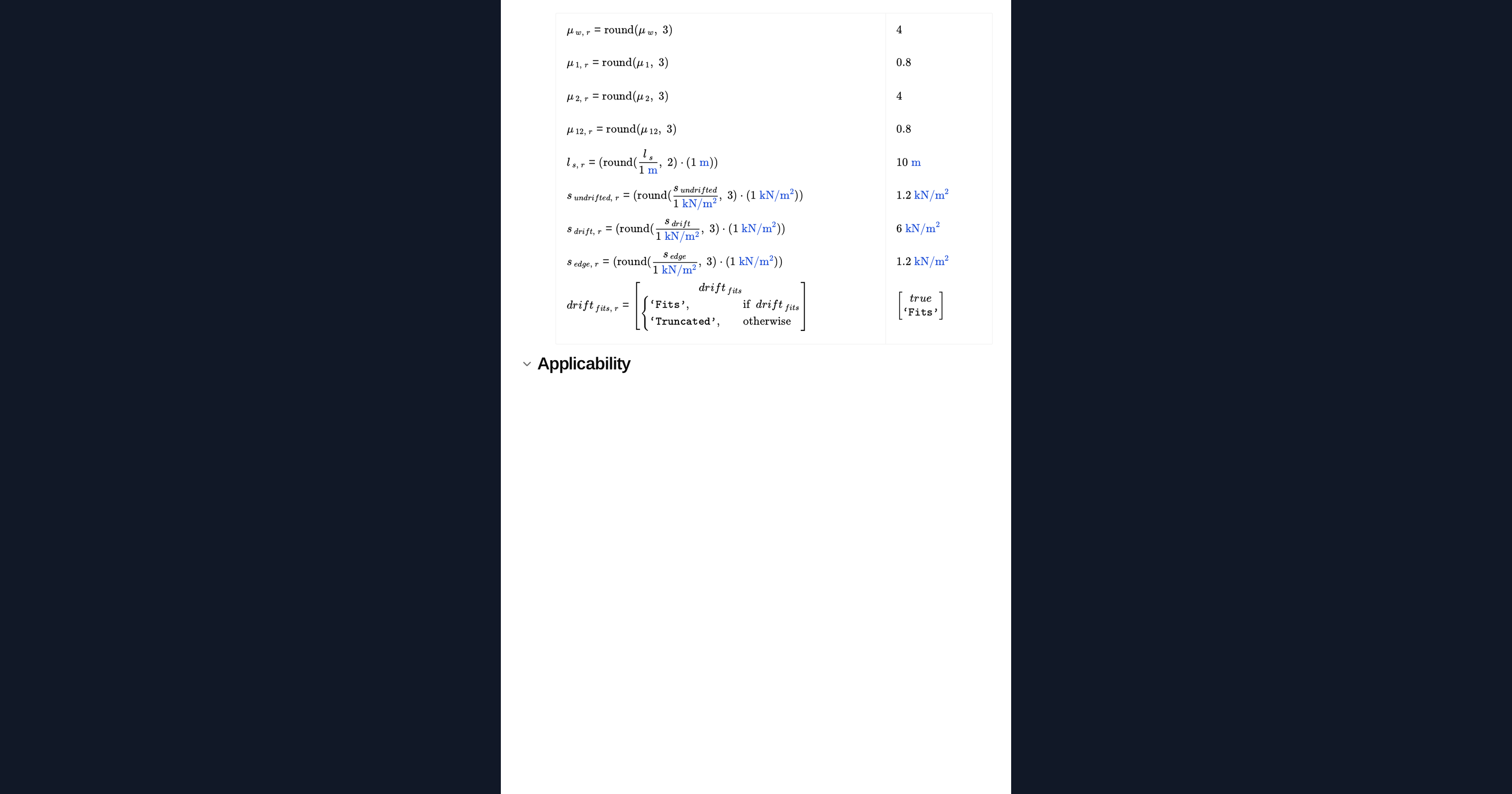
The drift length, the shape coefficients at the abutment and at the free edge, and the corresponding snow loads on the horizontal projection of the lower roof. A status shows whether the drift fits within the lower roof or is truncated at the edge.
Common Calculation Errors to Avoid
- Using the pitch of the lower roof. The sliding contribution depends on the pitch of the higher roof, since that is the surface shedding snow onto the lower one.
- Treating the drift as the only snow case. This is an additional arrangement. The undrifted case of Clause 5.3.1 must also be checked, and either can govern a given member.
- Ignoring a short lower roof. Where the lower roof is shorter than the drift length, the drift is truncated at the free edge and the coefficient there is higher than the undrifted value.
- Assuming the wind contribution always governs geometrically. The mass limit takes over for a heavy ground snow load, and which one governs changes with the site.
- Applying it to the wrong geometry. The arrangement assumes a single tall face with the lower roof running away from it. Drifting against parapets, in valleys and around obstructions is covered separately.
- Forgetting local effects. Snow overhanging an eave and loads on snow guards are additional to this and are covered by Section 6.
Engineering templates
Common calculators
Design guides



FAQs
Why is the drift load so much higher than the undrifted load?
Snow blown off the higher roof and snow sliding down it both accumulate against the tall face, so the depth against the abutment is far greater than on an open roof. The coefficient at the abutment can be several times the undrifted value.
Does the pitch of the lower roof matter?
Not for this arrangement. The sliding contribution depends on the pitch of the higher roof, because that is the surface shedding snow. The lower roof is treated as the surface receiving it.
What happens if the lower roof is shorter than the drift?
The drift runs off the free edge and is truncated, so the coefficient at that edge is higher than the undrifted value rather than falling back to it. The calculator reports that case separately and flags it.
Where does the characteristic ground snow load come from?
From the National Annex for the country, using the zone map and the altitude of the site. It is not something this calculation can derive, and it is the input that most affects the result.
Do I still need to check the undrifted case?
Yes. The drift arrangement is additional to the undrifted arrangement of Clause 5.3.1, not a replacement for it, and either can govern depending on the member being designed.
Learn about the benefits of using CalcTree on engineering projects!