
Calculate concrete shear resistance without links to Eurocode 2, with size effect and minimum resistance. Try the free calculator.

This template is not available yet. You can sign up and create it yourself!
Or let us know if you'd like to be notified when it’s ready:
No items found.
No items found.
About this EC2 Shear Resistance Without Shear Reinforcement Calculator
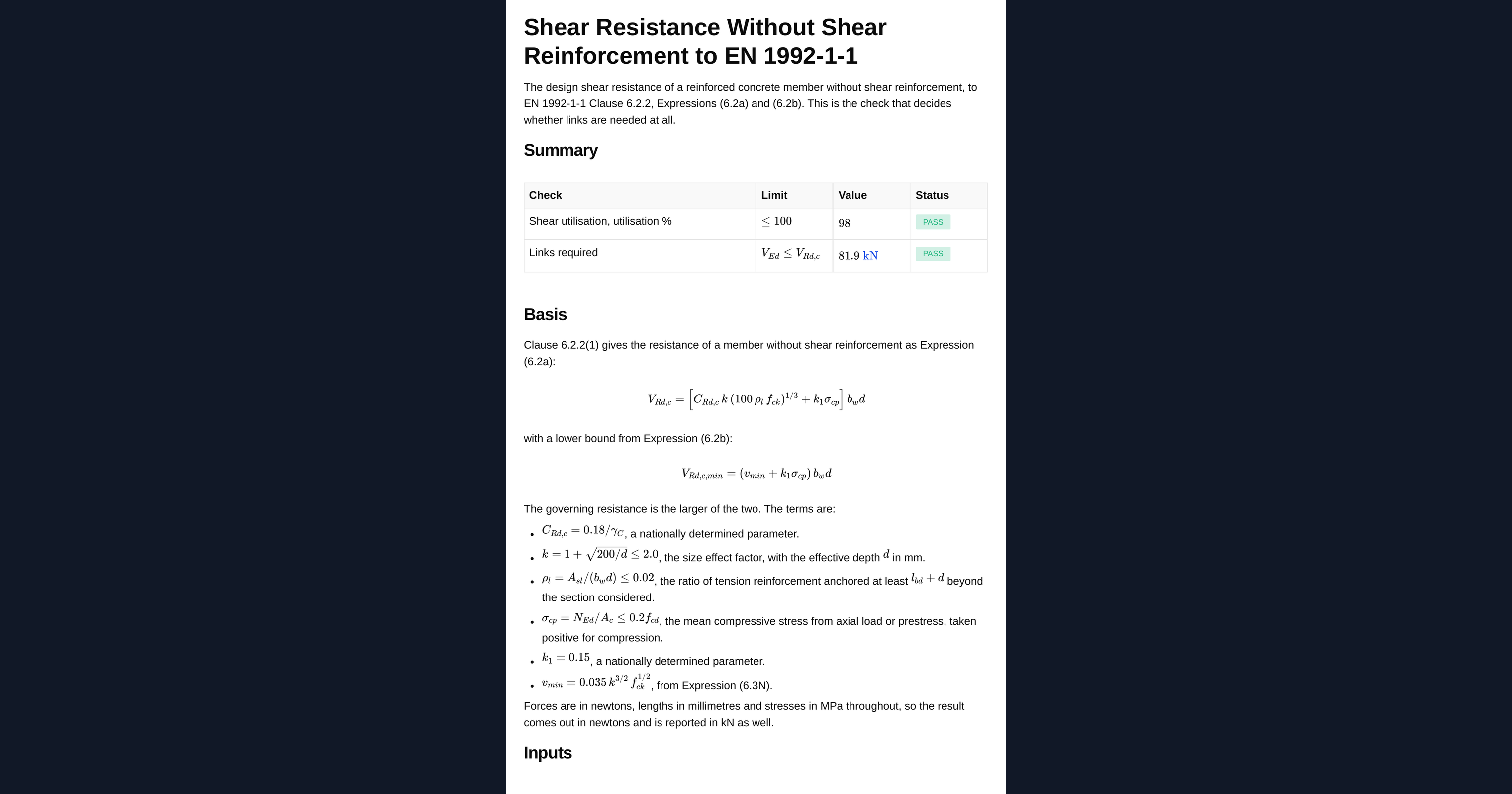
This calculator determines the shear resistance of a reinforced concrete member without shear reinforcement to Eurocode 2 (EN 1992-1-1) Clause 6.2.2. It applies the size effect factor, the longitudinal reinforcement ratio and any axial stress on the section, then compares the result against the minimum resistance the clause sets, reporting the greater of the two as the resistance available.
- Structural engineer. Establish whether a slab or shallow member needs shear links at all before detailing them.
- Design reviewer. See whether the main expression or the minimum expression governs, which changes with depth and reinforcement ratio.
- Engineer assessing existing structures. Determine the shear capacity of a member that was built without links.
Each factor is shown as calculated with units carried through, so the result traces directly back to the clause. It is an engineering-grade calculator you can audit, adapt and save to a project page in CalcTree.
More info on EC2 Shear Resistance Without Shear Reinforcement
Inputs
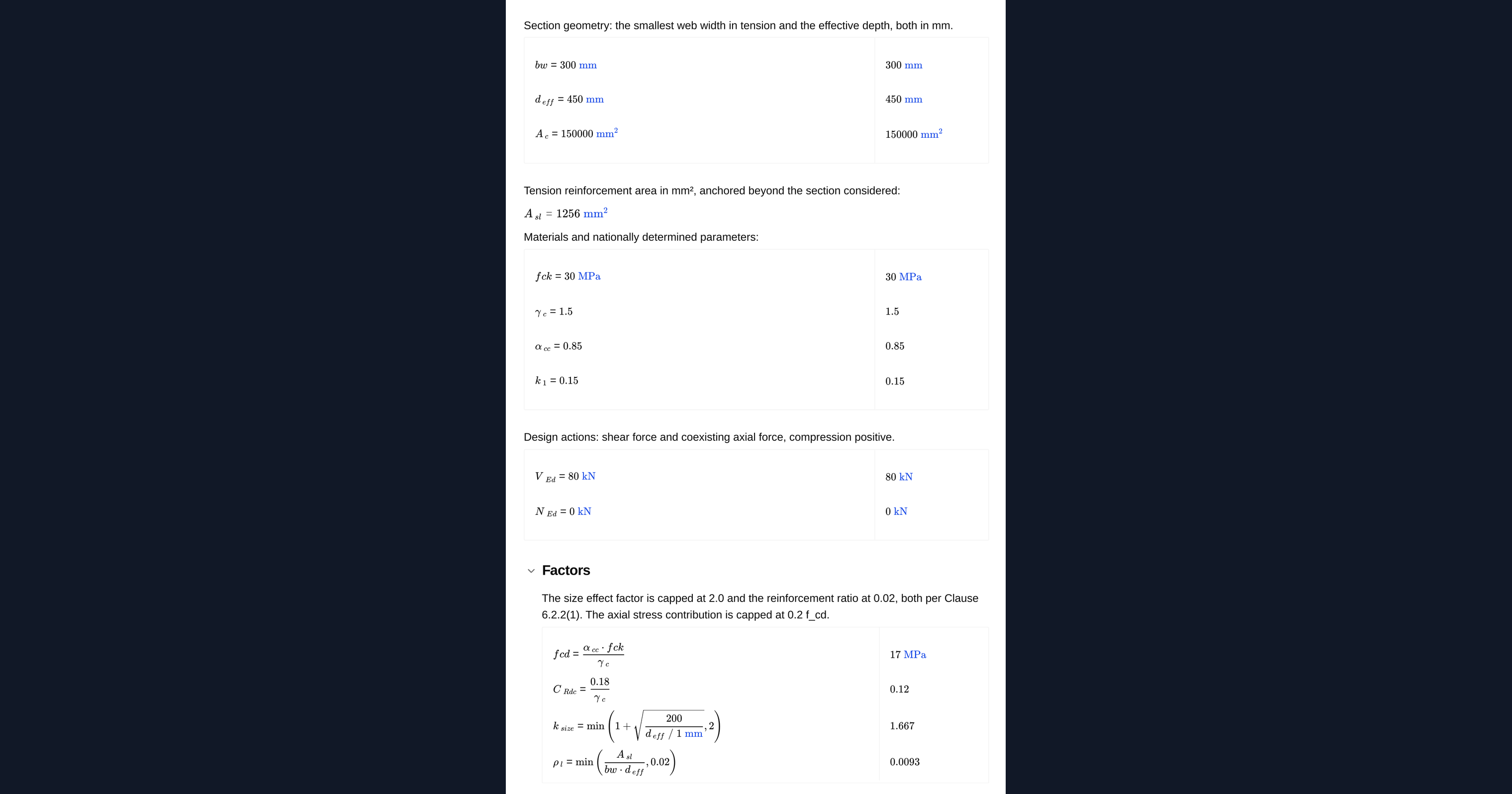
The web width and effective depth of the section, the concrete grade, the area of properly anchored longitudinal tension reinforcement, and any axial force acting on the section. Compression is entered as a positive stress and tension as negative.
Size effect
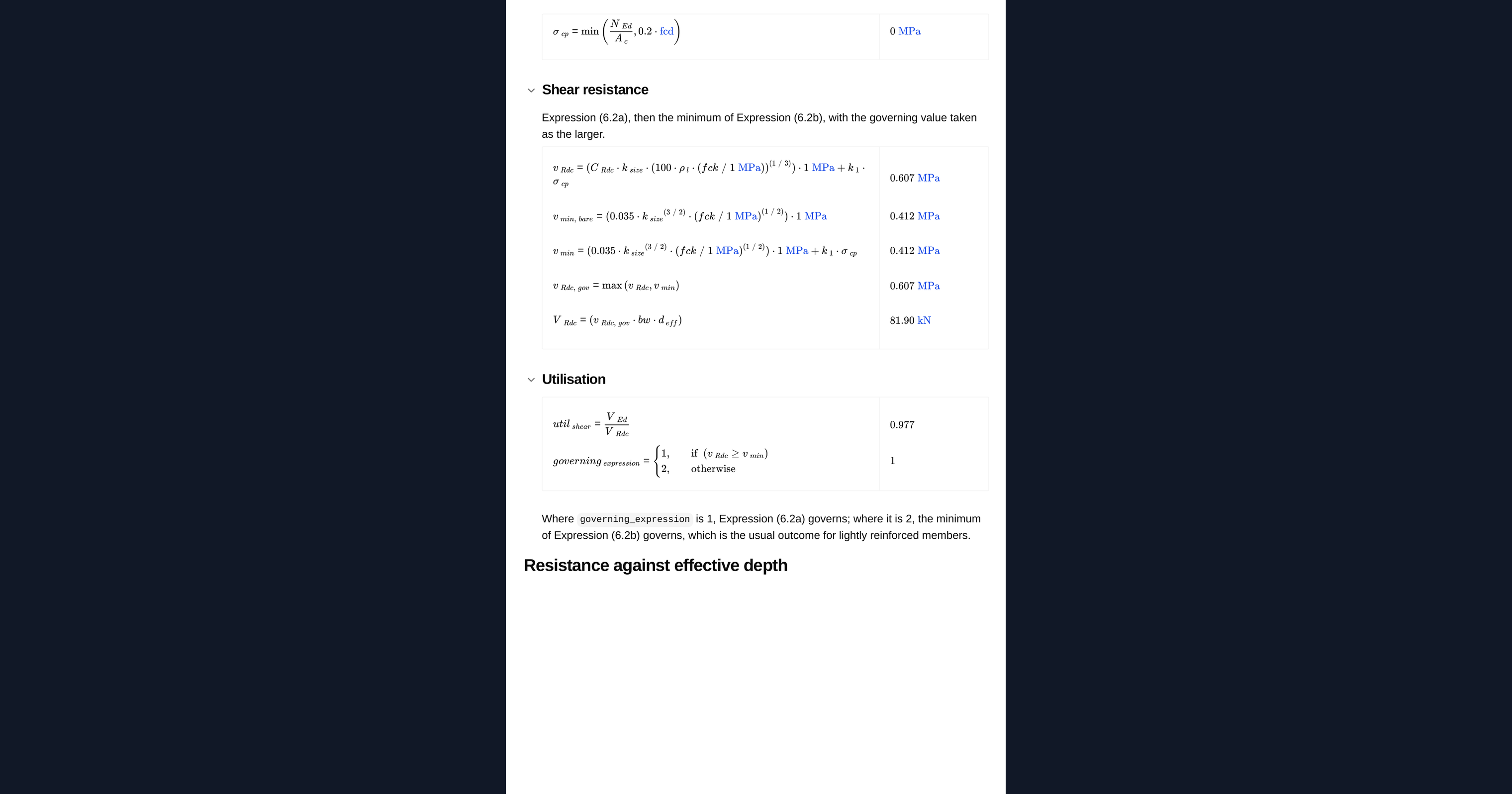
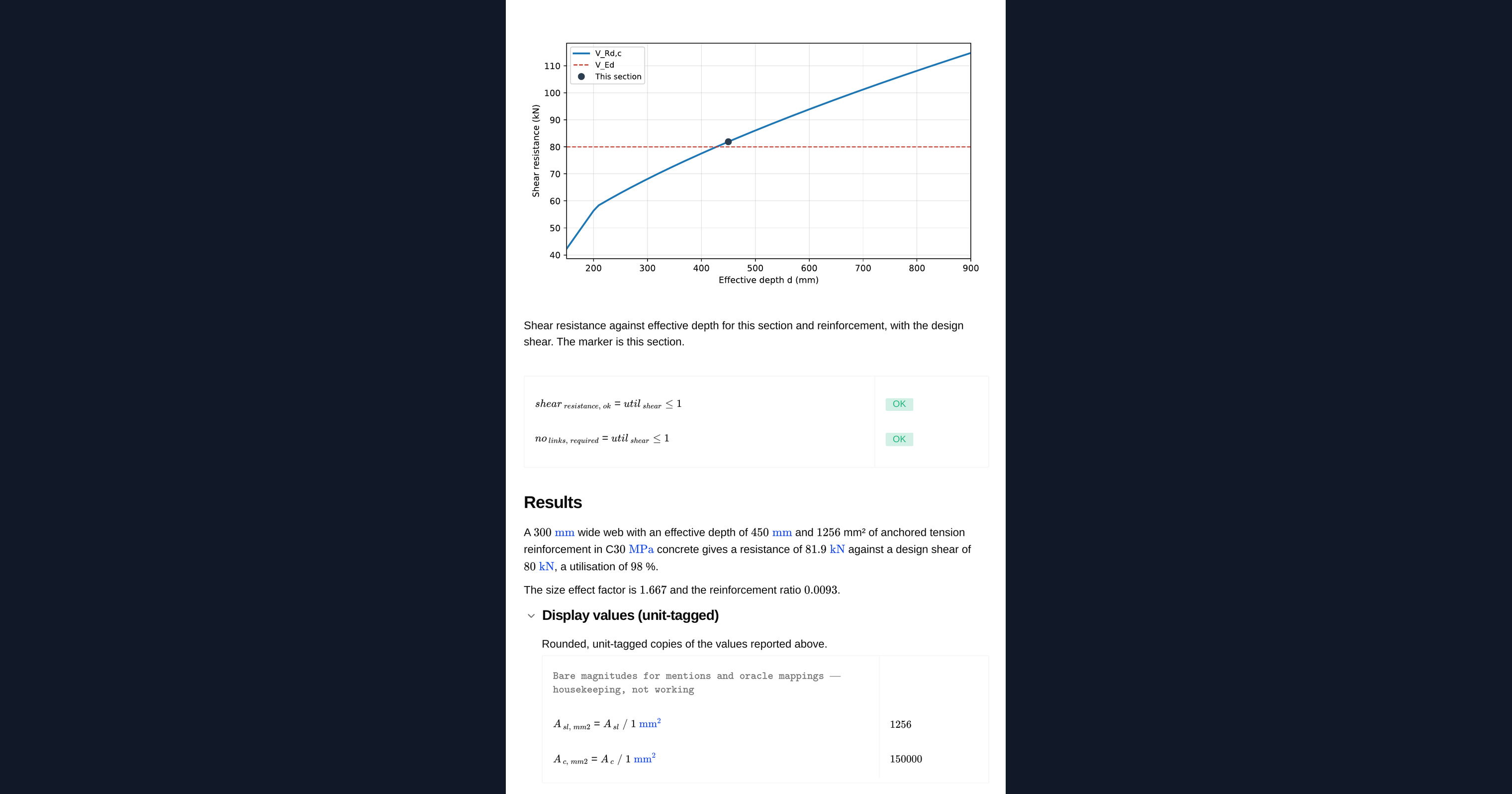
Shallow members carry more shear per unit area than deep ones, because a smaller aggregate interlock crack develops. The size effect factor captures this. It decreases with increasing effective depth and the code caps it, so shallow slabs all take the same maximum value.
Main and minimum expressions
The main expression combines the size effect, the reinforcement ratio and the concrete strength. For lightly reinforced members it can return a very low value, so the clause also gives a minimum expression that depends only on the size effect and the concrete strength. The resistance available is the greater of the two.
Axial stress
Axial compression closes shear cracks and increases the resistance, while tension opens them and reduces it. The contribution is added to both expressions, subject to the upper limit the clause places on the compressive stress that may be counted.
Common Calculation Errors to Avoid
- Counting reinforcement that is not anchored. Only tension reinforcement that extends a full anchorage length beyond the section counts towards the ratio. Curtailed bars at the section being checked do not.
- Missing the cap on the reinforcement ratio. The clause limits the ratio that may be used. Applying an uncapped ratio for a heavily reinforced section overstates the resistance.
- Forgetting the minimum expression. For lightly reinforced members the main expression falls below the minimum, and taking it alone understates the true resistance.
- Applying the size effect factor beyond its cap. For shallow members the factor is capped, and extrapolating it upward for a very thin slab is not what the clause allows.
- Treating axial tension as beneficial. Tension reduces the shear resistance. Entering it with the wrong sign turns a reduction into an increase.
- Using the flange width for a flanged member. Shear is carried by the web, so the web width applies, not the full effective flange width.
Engineering templates
Common calculators
Design guides




FAQs
What is the size effect factor?
Shallow members carry more shear per unit area than deep ones. The factor captures that, decreasing as the effective depth grows, and the code caps it so that members below a certain depth all take the same maximum value.
Why is there a minimum resistance?
The main expression scales with the reinforcement ratio and can return a very low value for a lightly reinforced member. The minimum expression sets a floor based on the concrete strength and the size effect, and the available resistance is the greater of the two.
What reinforcement ratio should I enter?
The ratio of properly anchored tension reinforcement to the effective concrete area. The bars must extend a full anchorage length beyond the section considered, and the code caps the ratio that may be used.
Does axial load help?
Compression increases the resistance and tension reduces it. Enter the axial stress with the correct sign, and note that the clause limits how much compressive stress may be counted.
What happens if the applied shear exceeds this resistance?
Shear reinforcement is required, and the member should then be designed with the variable angle truss model rather than assessed against this clause.
Learn about the benefits of using CalcTree on engineering projects!