
Design shear links for a rectangular RC section to Eurocode 2, with strut angle and spacing. Try the free calculator.

This template is not available yet. You can sign up and create it yourself!
Or let us know if you'd like to be notified when it’s ready:
No items found.
No items found.
About this EC2 Shear Design of a Rectangular Section Calculator
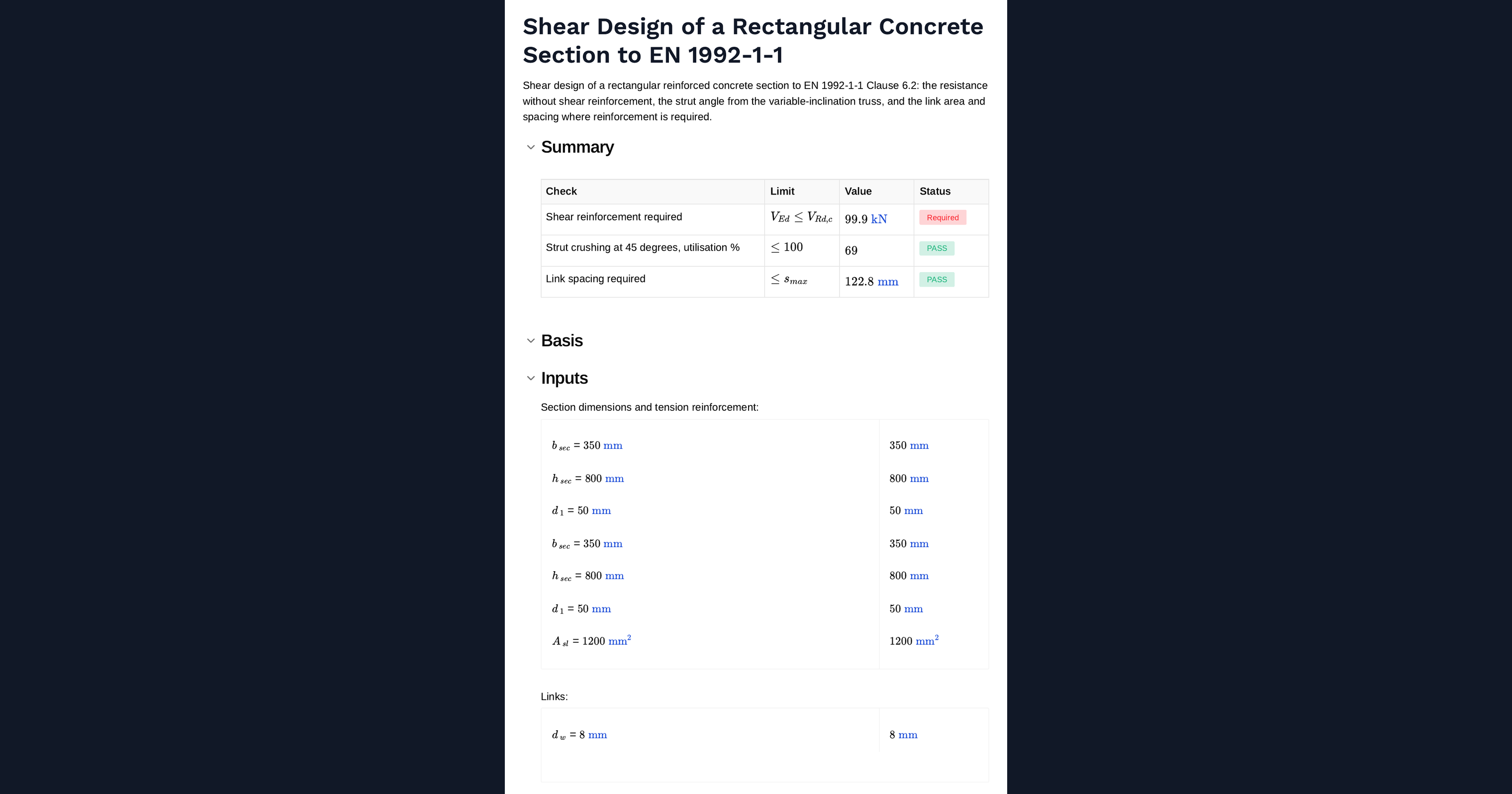
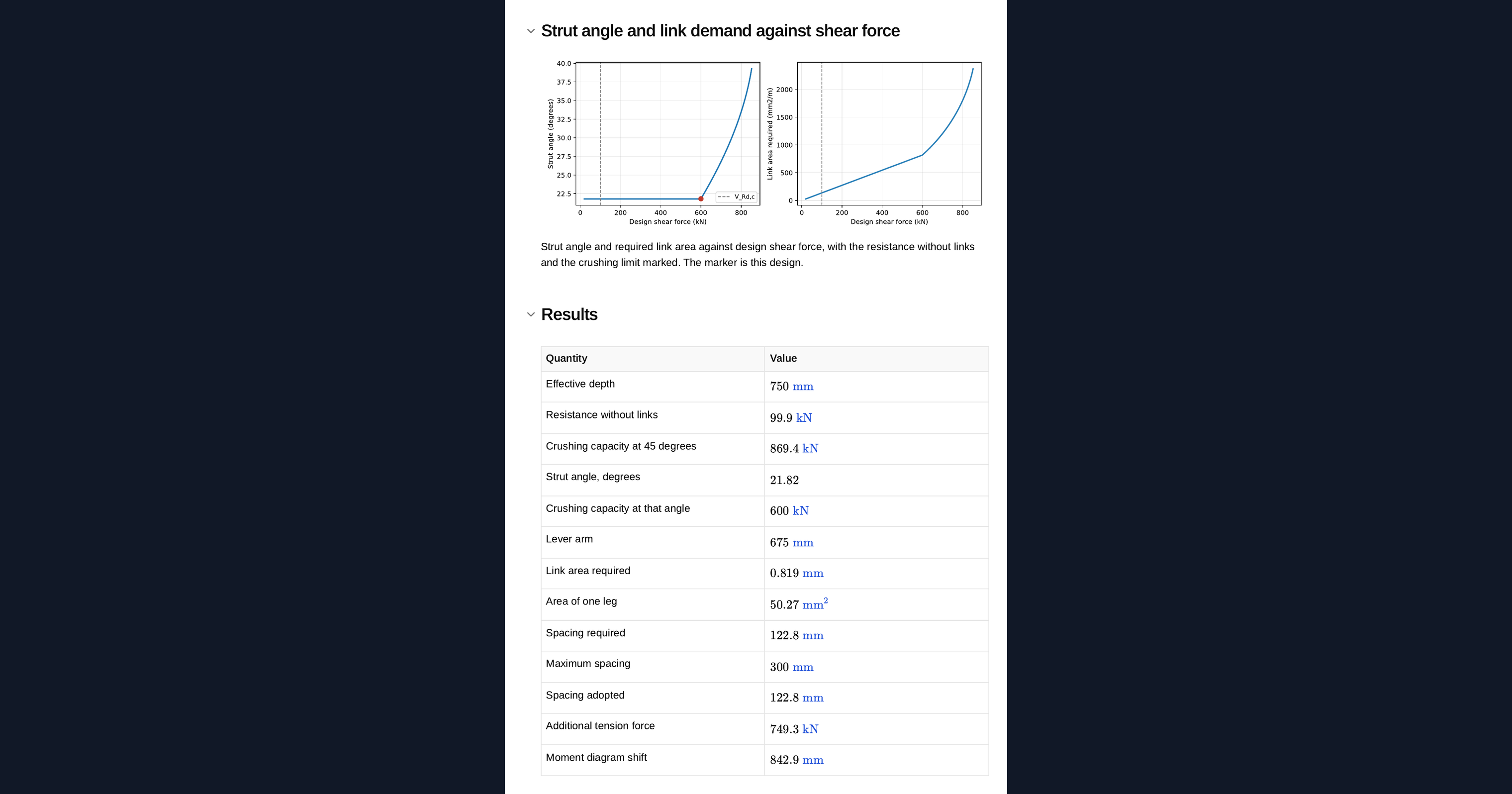
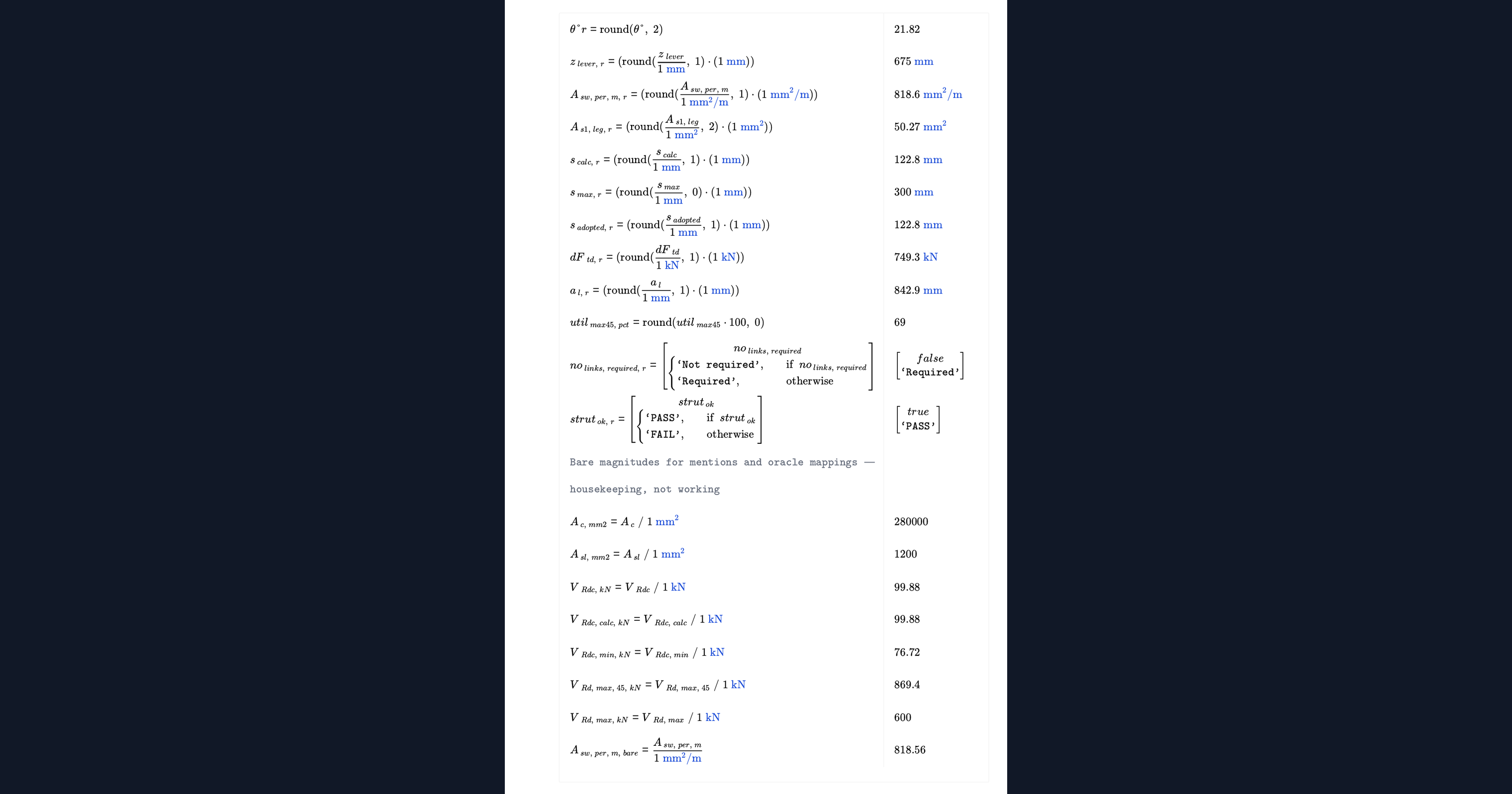
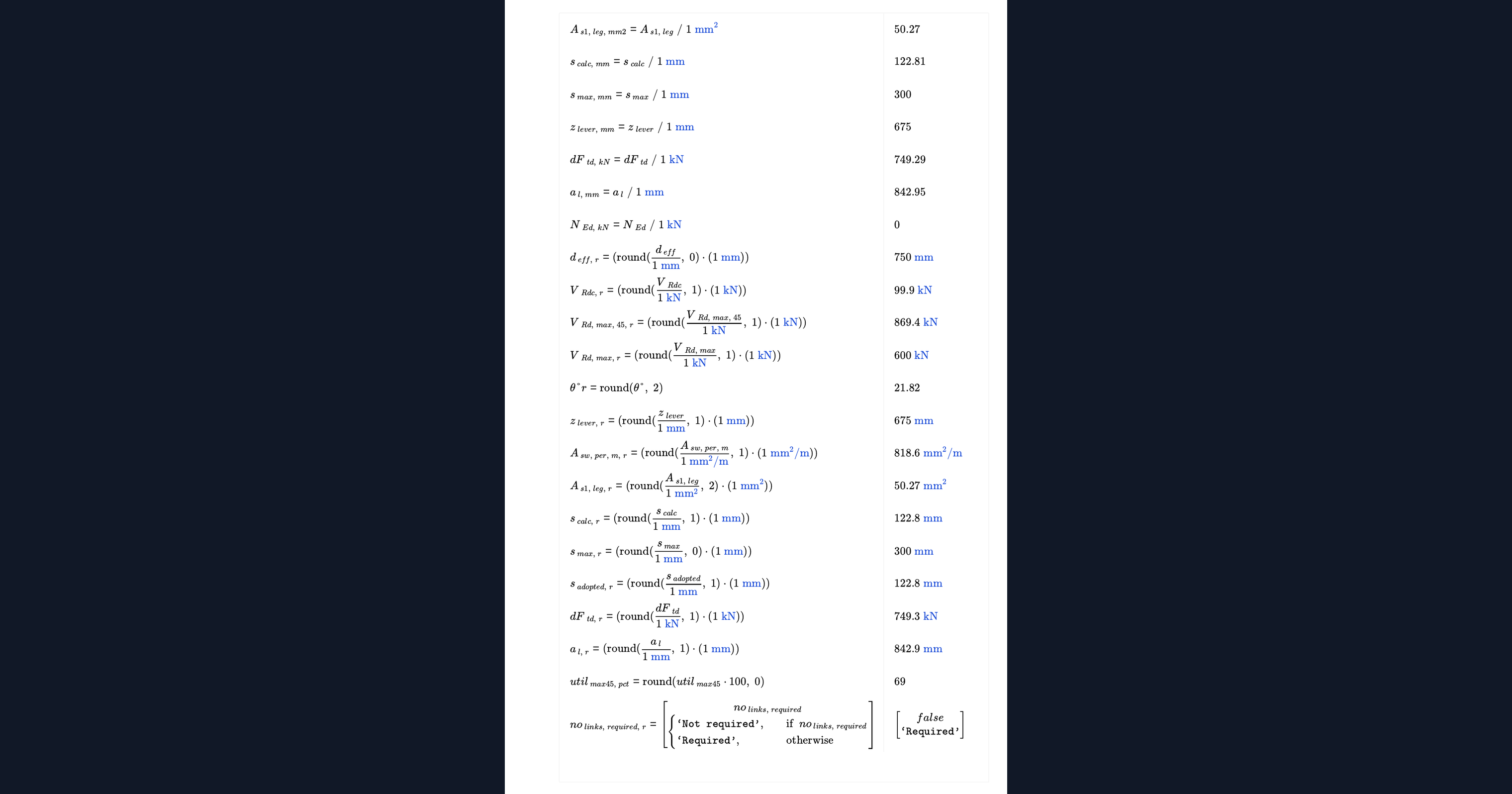
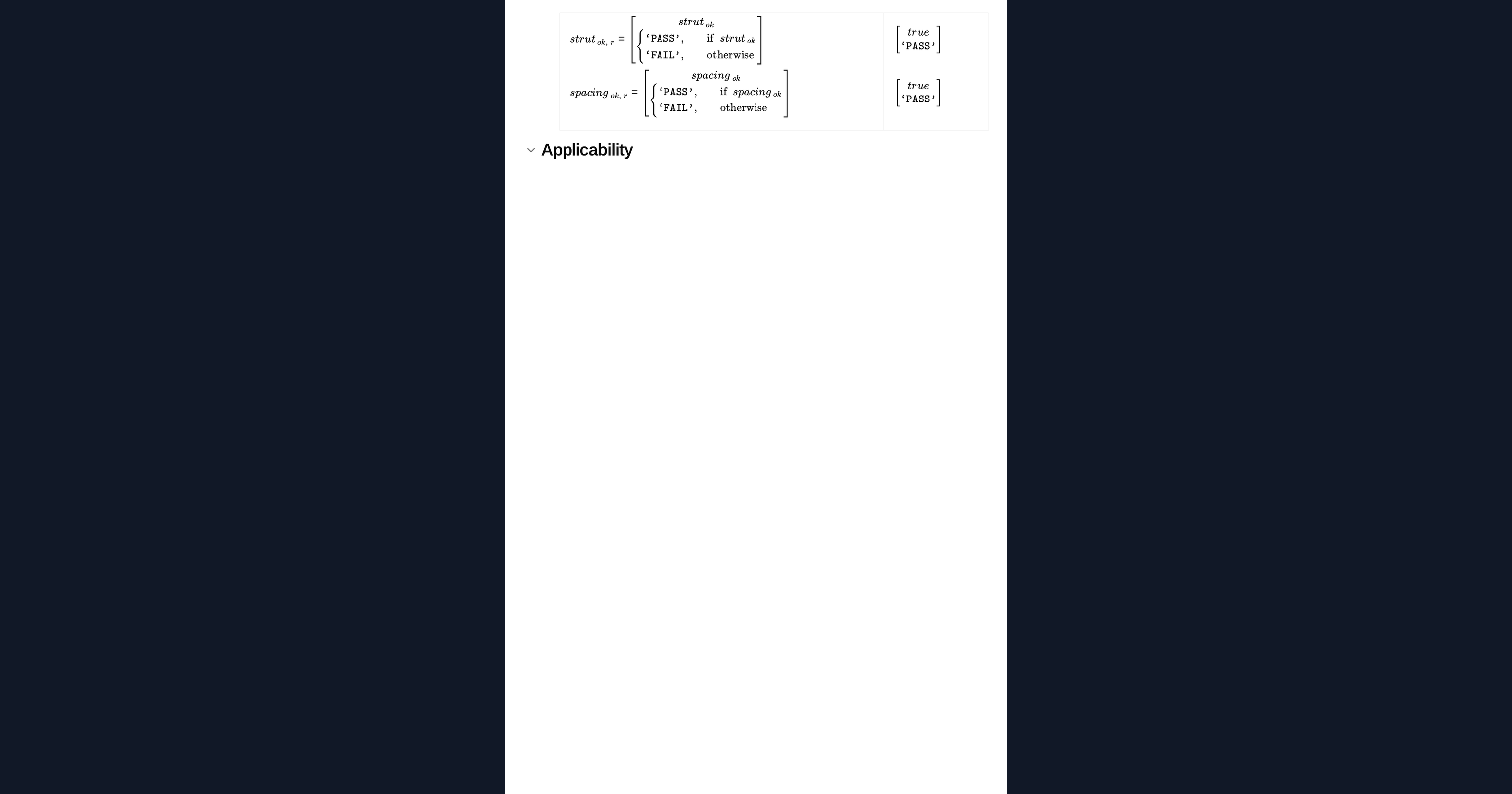
This calculator designs shear reinforcement for a rectangular reinforced concrete section to EN 1992-1-1 Clause 6.2. It works out the resistance without links, and where links are needed, chooses the strut angle from the variable-inclination truss, checks the concrete against crushing, and gives the link area and spacing with the code limits applied. Axial compression is taken into account in both the resistance and the crushing check. A chart plots the strut angle and the link demand across a range of shear force.
- Structural engineer. Enter the section, materials and design shear, and read whether links are needed and at what diameter and spacing.
- Design reviewer. See the strut angle chosen and whether it was clamped at either end of its permitted range, which is where shear designs most often differ between engineers.
- Engineer checking an existing member. Enter the links provided as a spacing and see how much shear the section can carry before crushing governs.
Every expression is shown with the clause behind it and units are carried through the calculation. It is an engineering-grade calculator you can audit, adapt and save to a project page in CalcTree.
More info on EC2 Shear Design of a Rectangular Section
Inputs
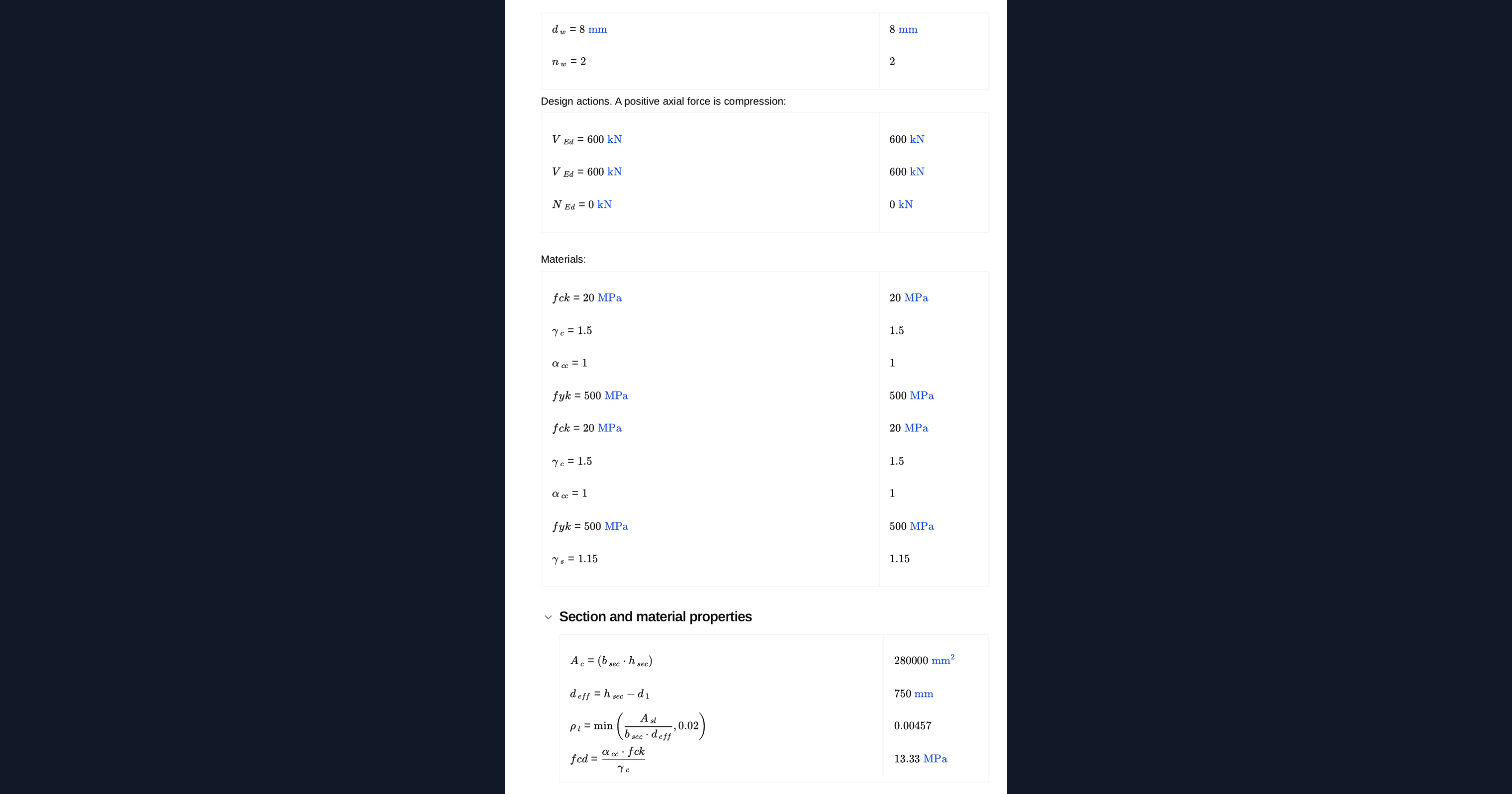
Section width and depth, the tension reinforcement area, link diameter and number of legs, the design shear force, any axial force, and the concrete and steel grades. A positive axial force is taken as compression.
Resistance without links
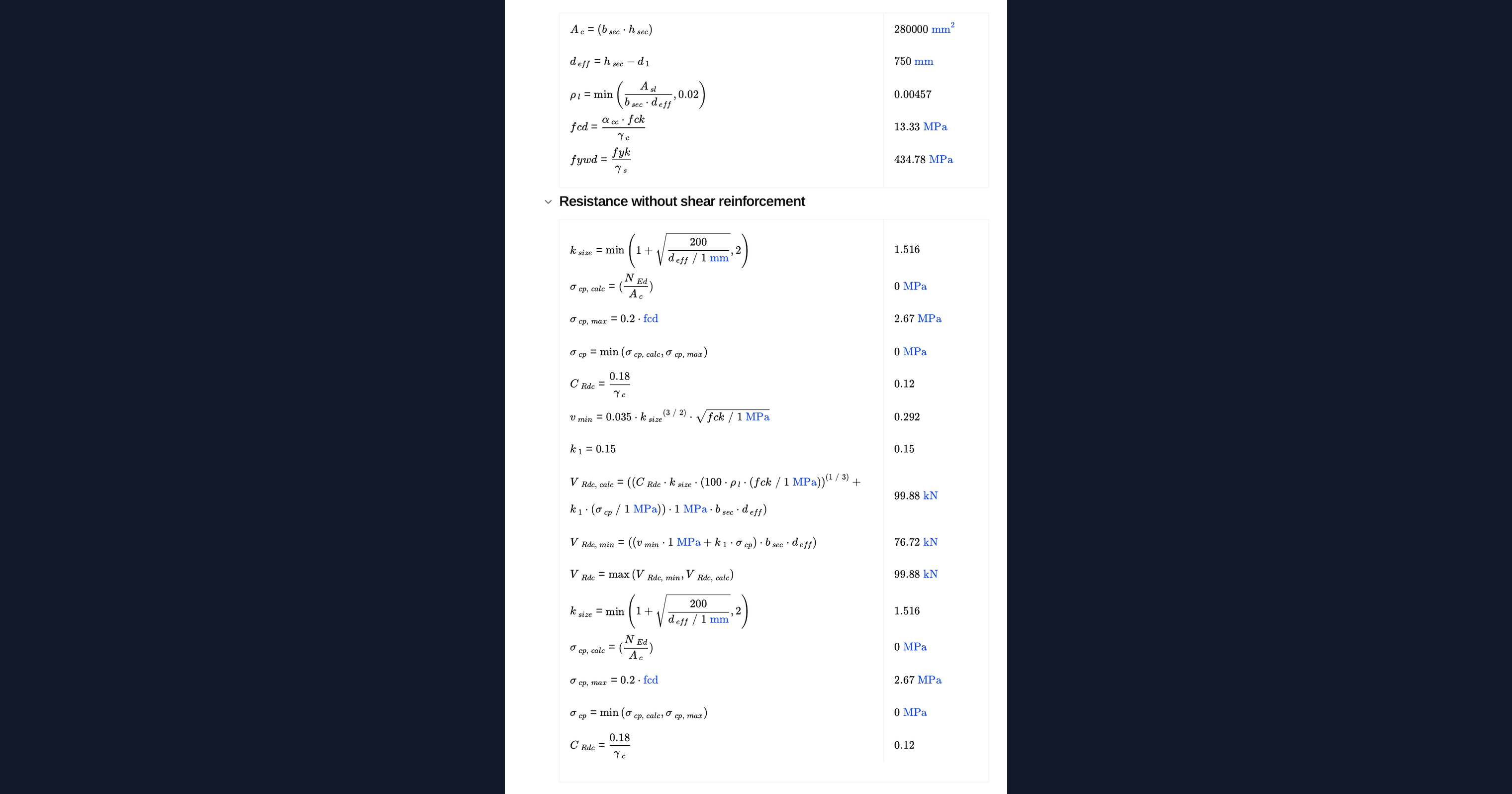
The resistance of the member without shear reinforcement follows from the size effect factor, the longitudinal reinforcement ratio and the concrete strength, with a lower bound that governs for lightly reinforced sections. Axial compression raises both.
Strut angle
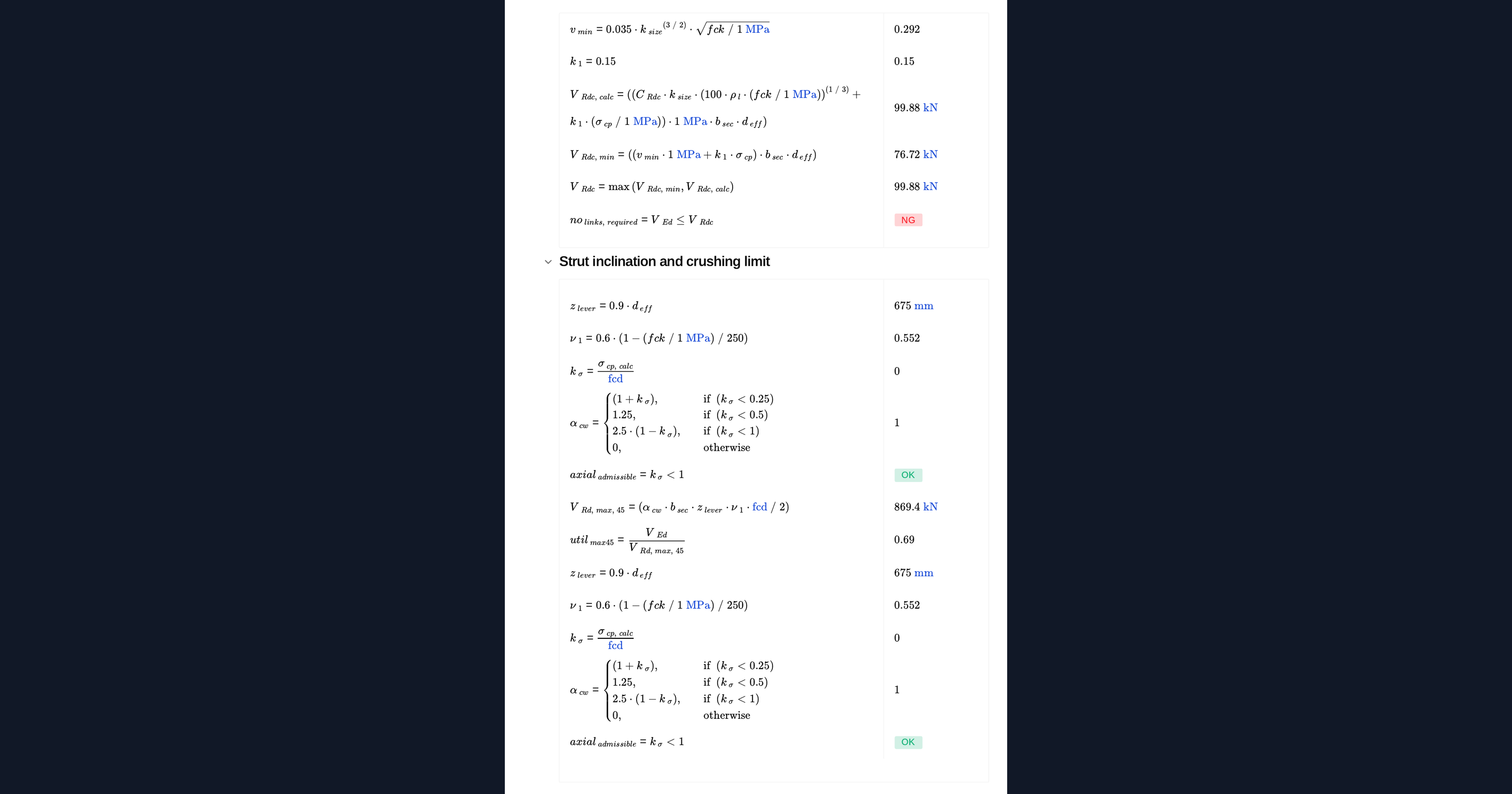
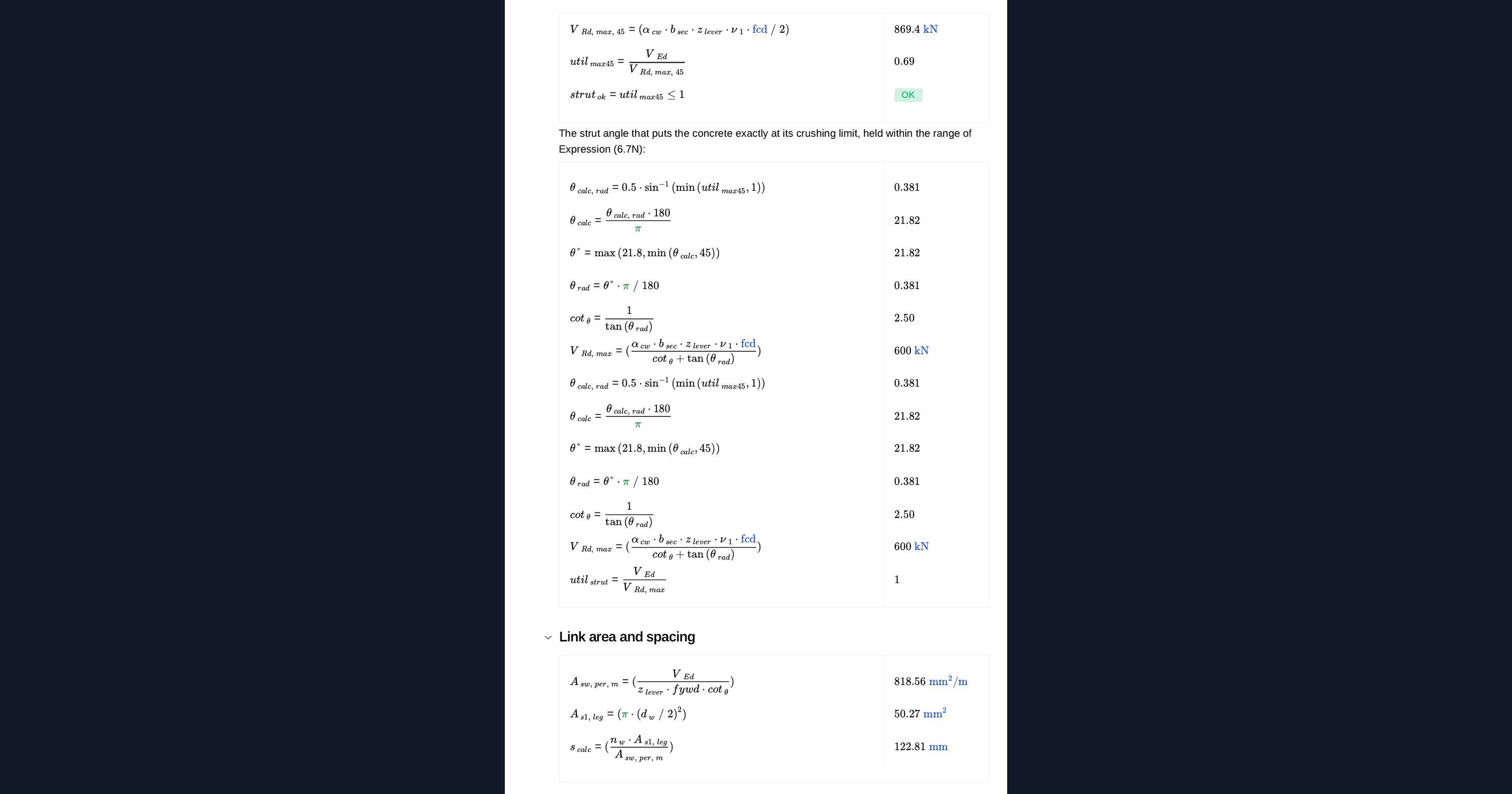
Where links are needed, the strut angle is chosen so the concrete is exactly at its crushing limit, then held within the range the code permits. A flatter strut needs less link steel but puts more force into the longitudinal reinforcement, and the calculator reports that additional force and the shift it implies for the moment diagram.
Link area and spacing
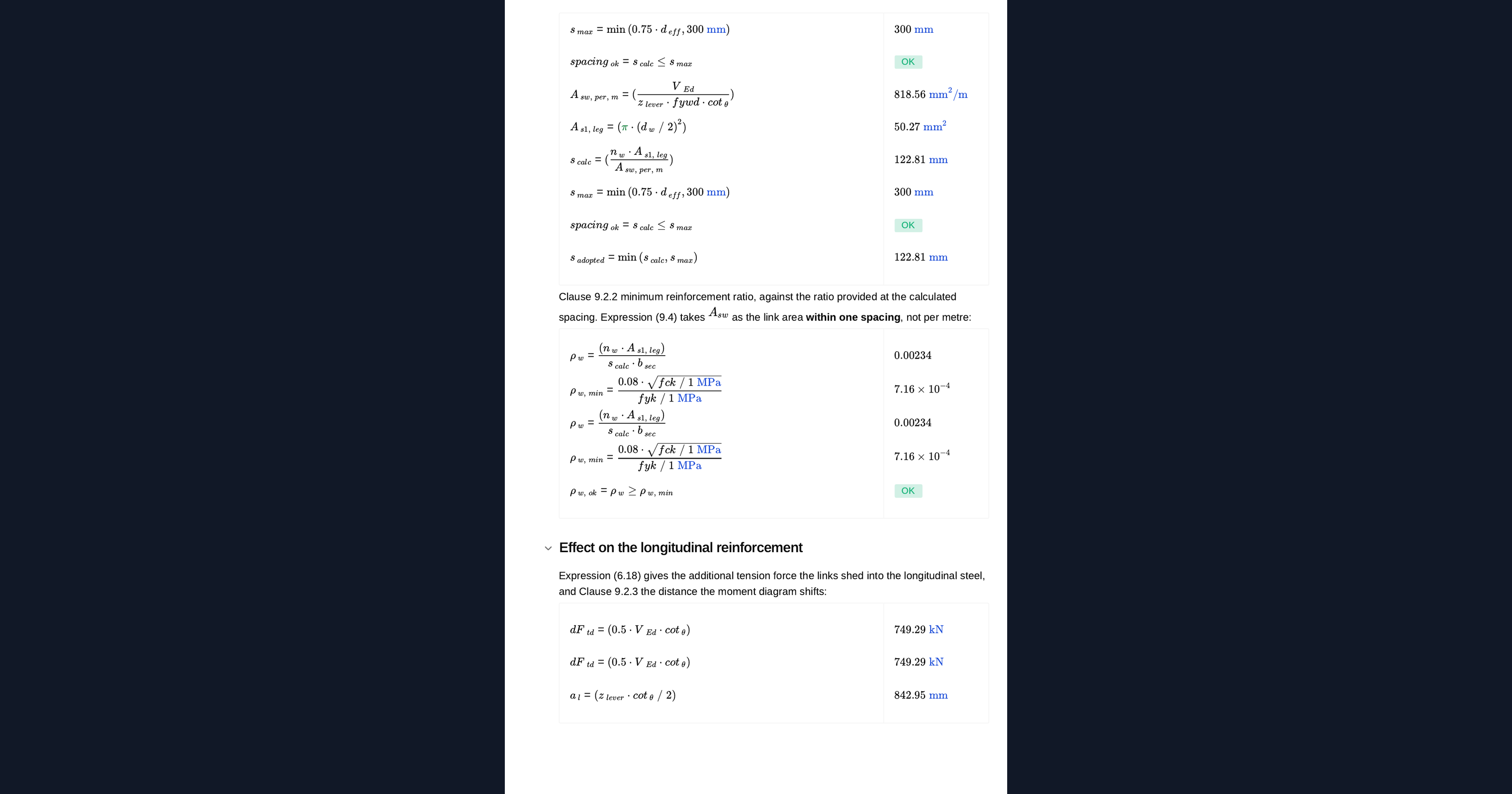
The link area follows from the strut angle and the lever arm. The calculator converts it to a spacing for the link diameter and leg count entered, applies the maximum spacing rules, and checks the reinforcement ratio against the minimum.
Common Calculation Errors to Avoid
- Taking the strut angle as forty five degrees by default. The angle is chosen within a permitted range, and a flatter strut reduces the link steel considerably at the cost of more longitudinal reinforcement.
- Ignoring the additional tension force. A flatter strut sheds force into the longitudinal steel, and the curtailment must be shifted to suit.
- Missing the crushing check. Where the shear exceeds what the concrete strut can carry, no amount of link steel helps and the section or grade must change.
- Applying axial tension as if it were compression. Compression raises the resistance and tension reduces it, and the two are not interchangeable.
- Leaving the spacing uncapped. Maximum spacing rules apply, and links at a wider spacing than allowed do not act as a truss.
- Forgetting the minimum reinforcement ratio. A section needing little shear steel by calculation still needs the minimum where links are required at all.
Engineering templates
Common calculators
Design guides




FAQs
How is the strut angle chosen?
The calculator takes the angle that puts the concrete exactly at its crushing limit for the applied shear, which minimises the link steel, then holds it within the range the code permits. A flatter angle is sometimes chosen deliberately for detailing reasons.
Why does a flatter strut need more longitudinal steel?
The truss sheds part of the shear into the tension chord. The flatter the strut, the larger that additional force, and the further the moment diagram must be shifted when curtailing bars.
What happens if the crushing check fails?
More links will not help. The check limits the concrete strut, so the section must be deeper or wider, or the concrete grade higher.
Does axial force change the result?
Yes. Axial compression raises both the resistance without links and the crushing limit, and the calculator accounts for it in both. Axial tension reduces the resistance and is not covered here.
Can I use this for inclined links or bent-up bars?
No. The expressions assume vertical links. Inclined reinforcement changes both the link area required and the crushing limit.
Learn about the benefits of using CalcTree on engineering projects!