
Calculate design crack width in a reinforced concrete section to Eurocode 2, with spacing and strain shown. Try the free calculator.

This template is not available yet. You can sign up and create it yourself!
Or let us know if you'd like to be notified when it’s ready:
No items found.
No items found.
About this EC2 Crack Width Control Calculator
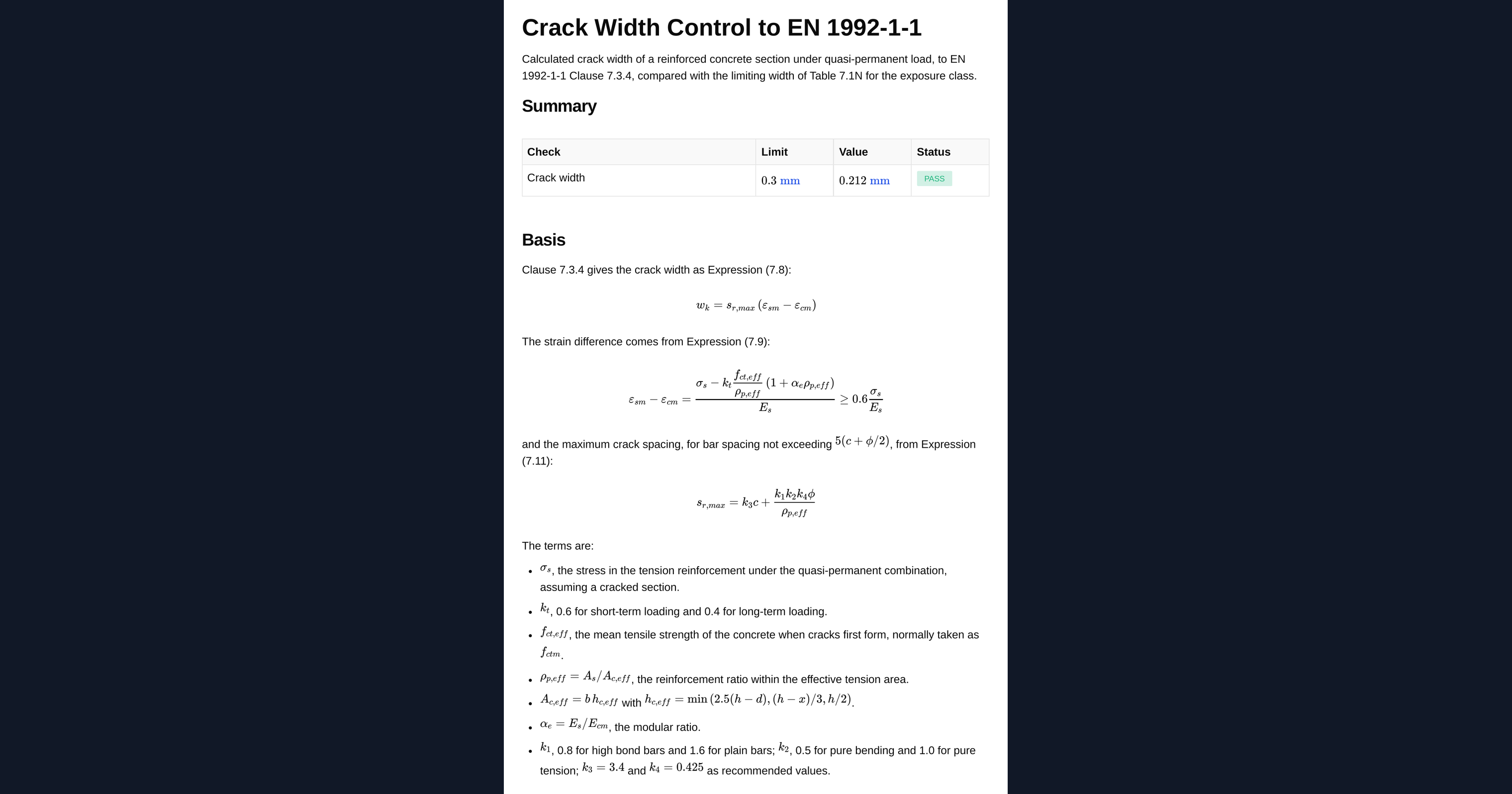
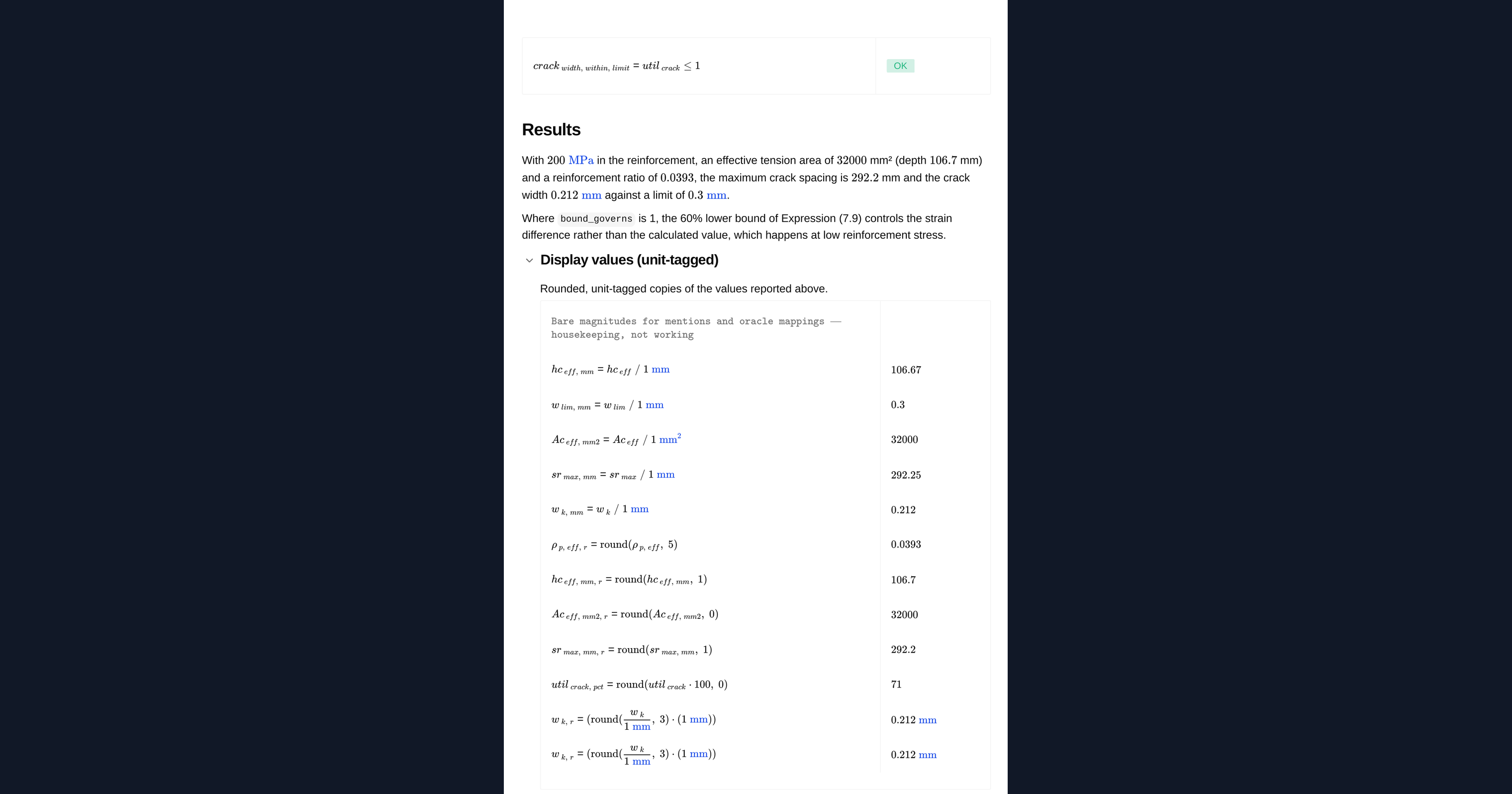
This calculator determines the design crack width of a reinforced concrete section under a serviceability moment to Eurocode 2 (EN 1992-1-1) Clause 7.3.4. It works through the effective tension area, the reinforcement ratio within it, the maximum crack spacing and the difference between the mean strain in the reinforcement and in the concrete between cracks, then reports the crack width for comparison against the limit for the exposure class.
- Structural engineer. Check serviceability by entering the section, reinforcement and service moment, and read the crack width directly.
- Design reviewer. See which term governs the crack spacing, which is where most of the variation between implementations sits.
- Engineer detailing for durability. Test bar diameter and spacing combinations quickly to meet a target width without changing the section.
Every intermediate quantity is shown with units carried through, so the result traces back to the clause behind it. It is an engineering-grade calculator you can audit, adapt and save to a project page in CalcTree.
More info on EC2 Crack Width Control
Inputs
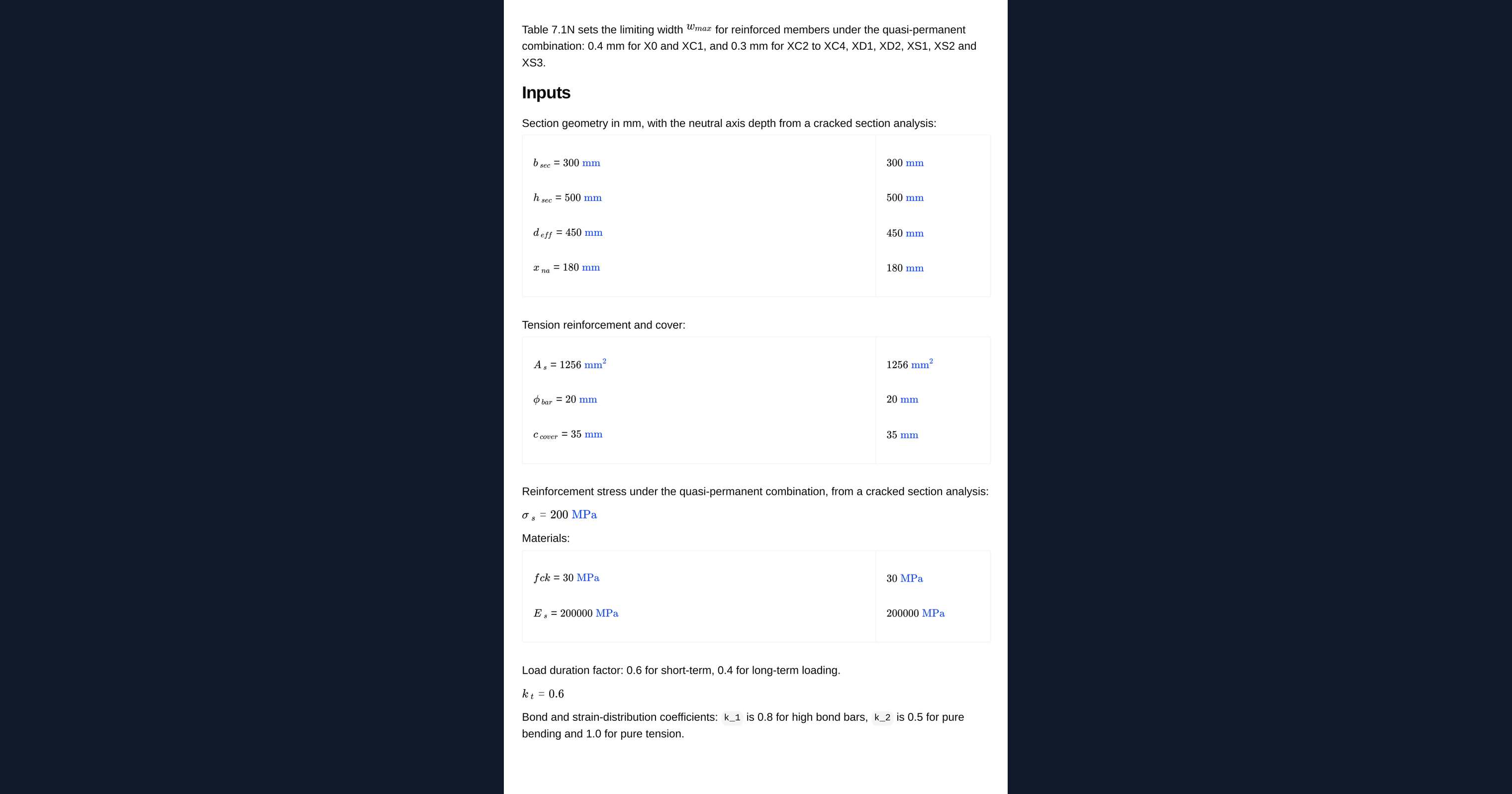
The section geometry and the reinforcement provided, given as bar diameter and spacing, together with the cover to the reinforcement. Material inputs are the concrete grade and the steel modulus. The action is the bending moment for the relevant serviceability load combination.
Effective tension area
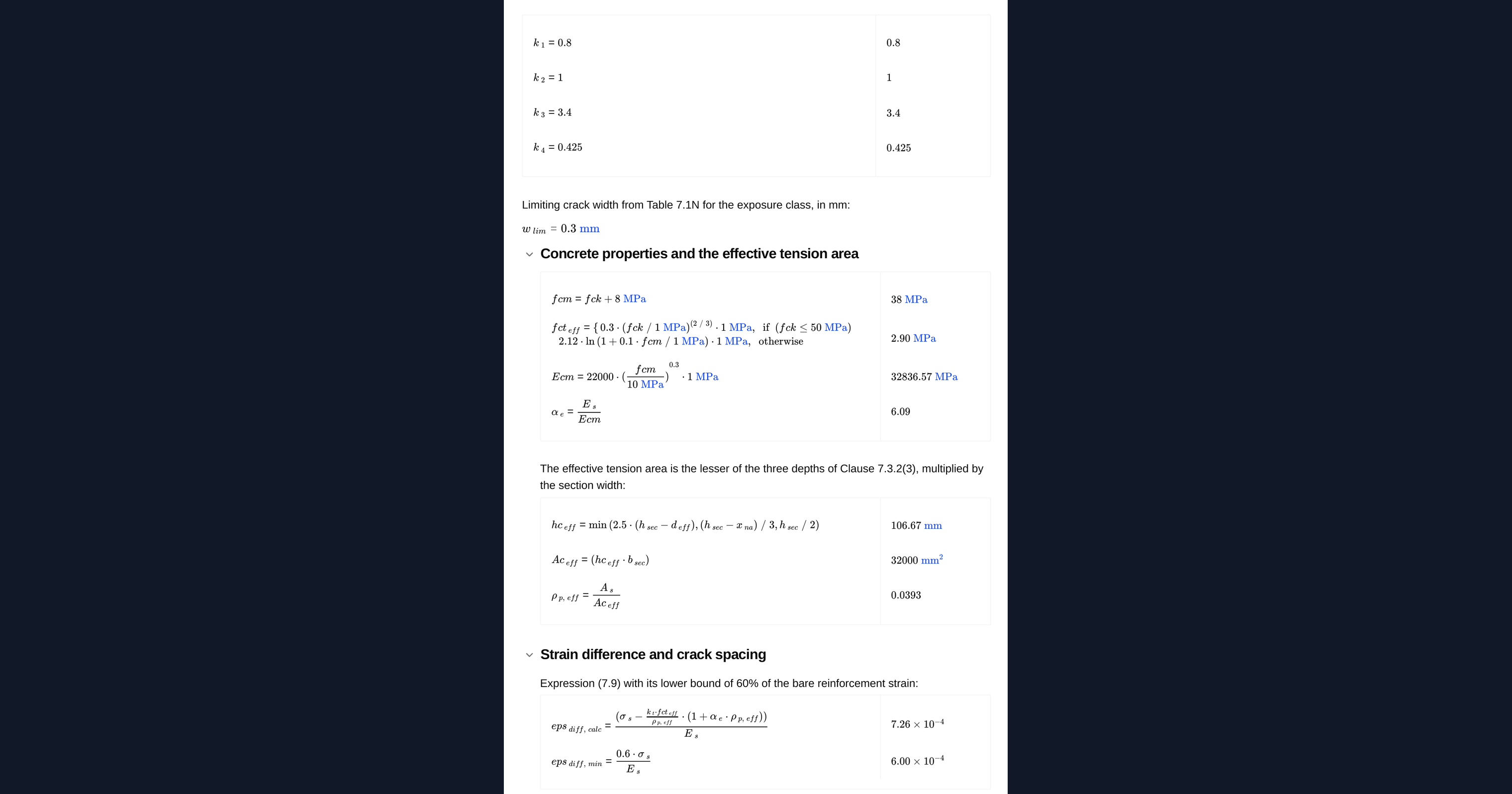
The zone of concrete around the reinforcement that carries tension between cracks is established from the section depth, the neutral axis position and the cover, following Clause 7.3.2. The reinforcement ratio within that zone is what drives the crack spacing, so this step controls the result more than any other.
Crack spacing
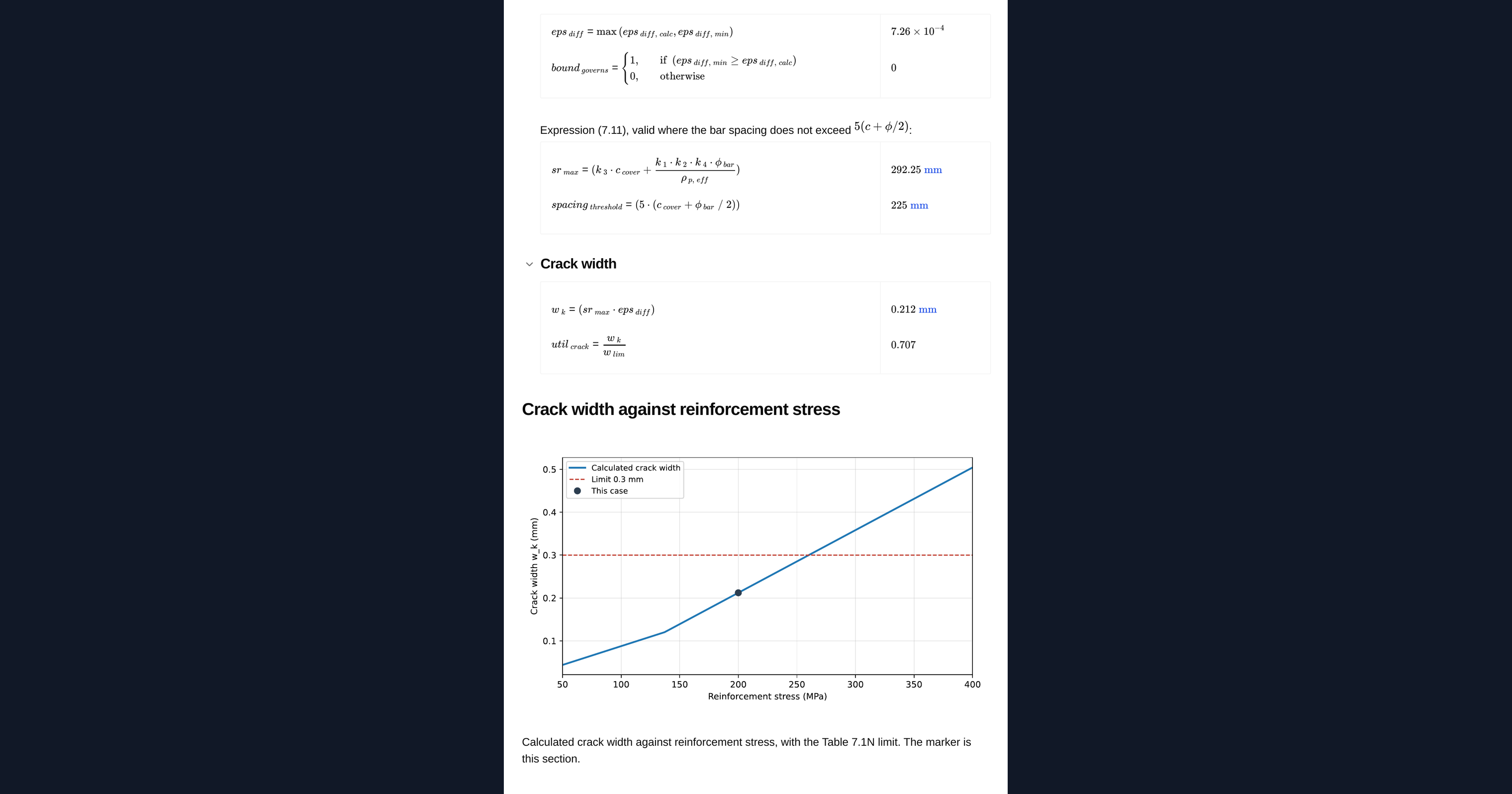
The maximum crack spacing is taken as the greater of a bond-controlled term, which depends on bar diameter, cover and the effective reinforcement ratio, and a term that applies where bars are widely spaced relative to the section depth. The calculator reports both so the governing case is visible.
Strain difference and crack width
The difference between the mean reinforcement strain and the mean concrete strain accounts for tension stiffening between cracks, subject to a lower bound. Multiplying it by the maximum crack spacing gives the design crack width.
Common Calculation Errors to Avoid
- Entering the ultimate limit state moment. Crack width is a serviceability check. The quasi-permanent or frequent combination applies depending on what is being controlled, and an ultimate moment gives a meaningless width.
- Getting the effective tension area wrong. It is not the full tension zone. Its depth is bounded by three separate expressions in Clause 7.3.2, and using the whole tension zone understates the reinforcement ratio and overstates the crack width.
- Missing the widely spaced bar case. Where bar spacing is large relative to the section depth, the alternative spacing expression governs and the bond-controlled term alone is unconservative.
- Forgetting the lower bound on the strain difference. The code sets a floor on the strain difference. Omitting it can return an unrealistically small crack width for lightly stressed sections.
- Comparing against the wrong limit. The recommended limits vary by exposure class, and a project specification or a water retaining design will often set something tighter.
- Assuming more steel always helps. Total area matters less than distribution. Several smaller bars at closer spacing usually control cracking better than fewer large bars of the same area.
Engineering templates
Common calculators
Design guides




FAQs
What crack width limit should I compare against?
Table 7.1N gives recommended values by exposure class, and for reinforced members in most classes that is a familiar single figure. Check the National Annex and the project specification, since water retaining and liquid containing structures are commonly held to tighter limits.
What exactly is the effective tension area?
It is the concrete around the reinforcement that participates in tension stiffening between cracks. Its depth is the least of three expressions based on the section depth, the neutral axis position and the cover to the bars, all set out in Clause 7.3.2.
Which load combination should I use?
The combination appropriate to what is being controlled. Appearance and durability are normally assessed under the quasi-permanent combination. Do not use the ultimate limit state combination.
Does bar diameter or bar spacing matter more?
Both appear in the crack spacing expression, and which dominates depends on the arrangement. Where bars are closely spaced the bond-controlled term governs and diameter matters most. Where they are widely spaced the spacing term takes over.
Can I use this for a section in pure tension?
The calculation is set up for a section in bending. A member in pure or near-pure tension has a different effective tension area and is better handled through the direct tension provisions of the same clause.
Learn about the benefits of using CalcTree on engineering projects!