
Derive Eurocode 2 concrete properties from the grade: strengths, elastic modulus and design values. Try the free calculator.

This template is not available yet. You can sign up and create it yourself!
Or let us know if you'd like to be notified when it’s ready:
No items found.
No items found.
About this EC2 Concrete Design Properties Calculator
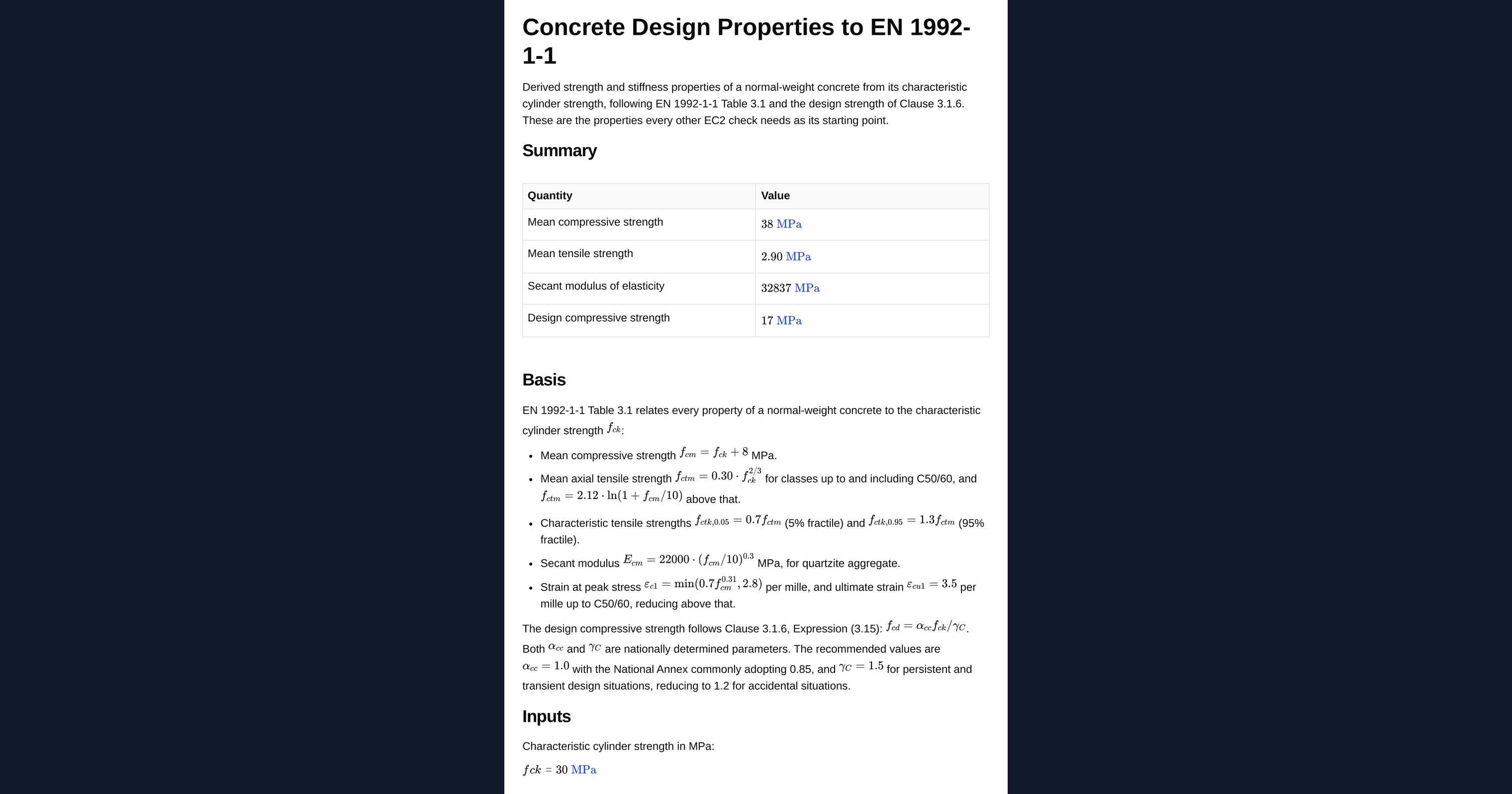
This calculator derives the full set of concrete material properties used throughout Eurocode 2 (EN 1992-1-1) from a single input, the characteristic cylinder strength. It returns the mean compressive strength, the mean and characteristic axial tensile strengths at both fractiles, the secant modulus of elasticity, and the design compressive and tensile strengths, following Clause 3.1 and Table 3.1.
- Structural engineer. Get a consistent property set to feed into bending, shear, cracking and deflection checks without re-deriving it each time.
- Design reviewer. Confirm which fractile and which partial factor produced a value used elsewhere in a submission.
- Engineer building a model or spreadsheet. Use it as a live reference for the relationships in Table 3.1 rather than transcribing them.
Every property is shown with the expression that produced it, so the derivation is visible rather than tabulated. It is an engineering-grade calculator you can audit, adapt and save to a project page in CalcTree.
More info on EC2 Concrete Design Properties
Inputs
The characteristic cylinder compressive strength at twenty-eight days, plus the partial factor for concrete and the long-term coefficient. The partial factor and coefficient default to the recommended values and can be overridden where a National Annex differs.
Strength relationships
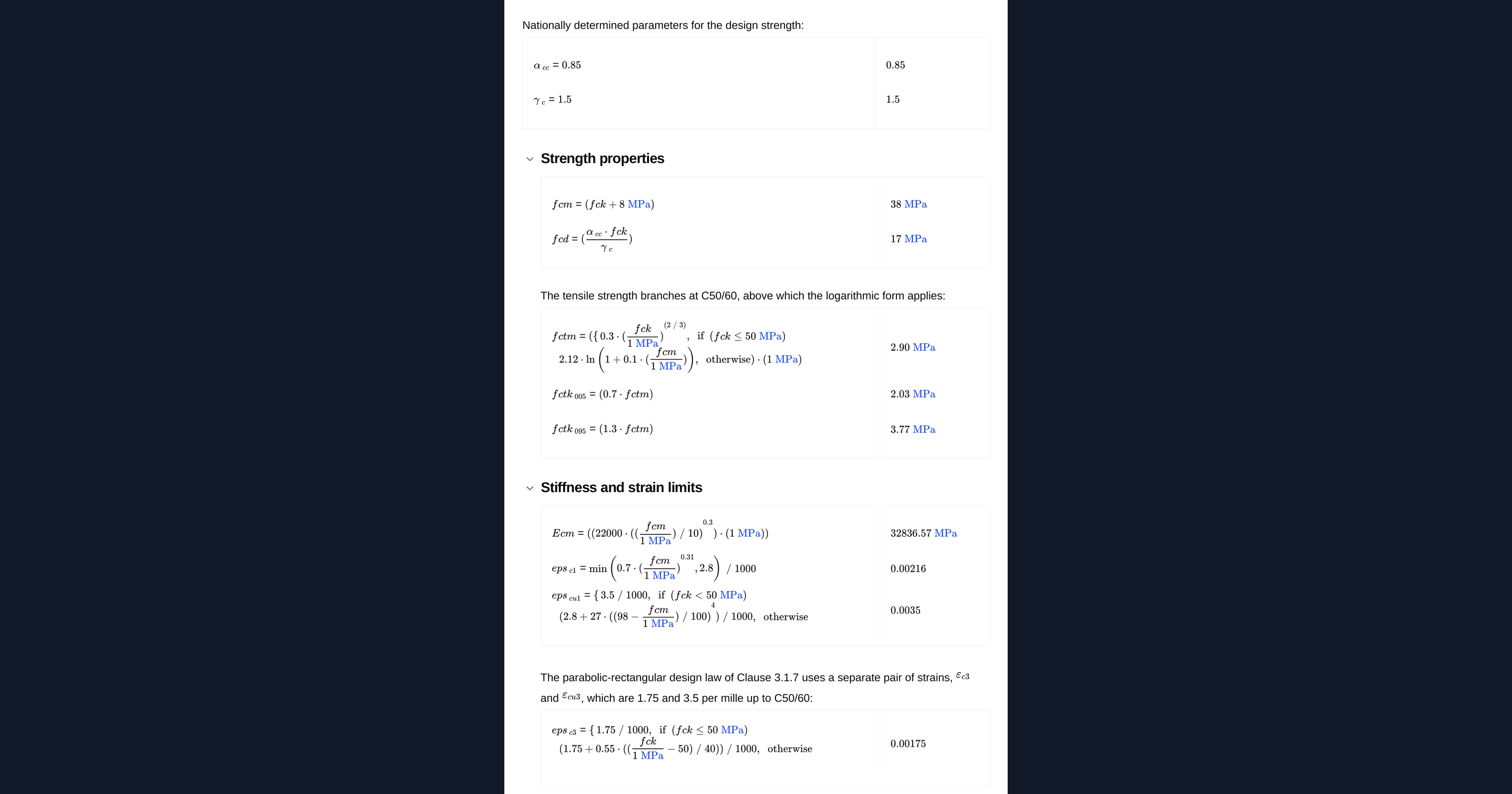
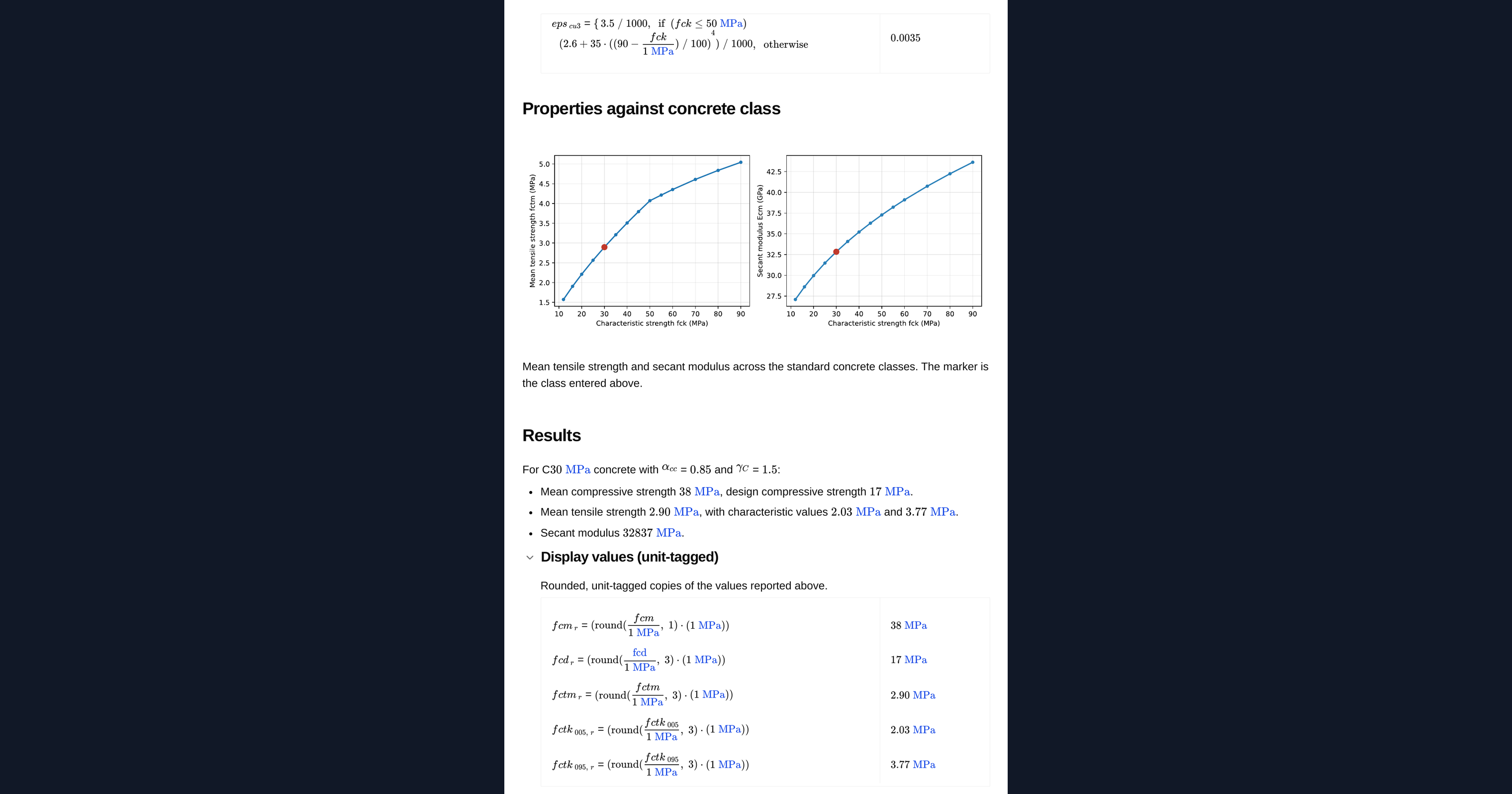
The mean compressive strength is offset from the characteristic value by a fixed margin. The mean axial tensile strength follows from the compressive strength, with a different relationship above the transition grade. The characteristic tensile strengths at the lower and upper fractiles are then taken as fixed proportions of the mean.
Elastic modulus
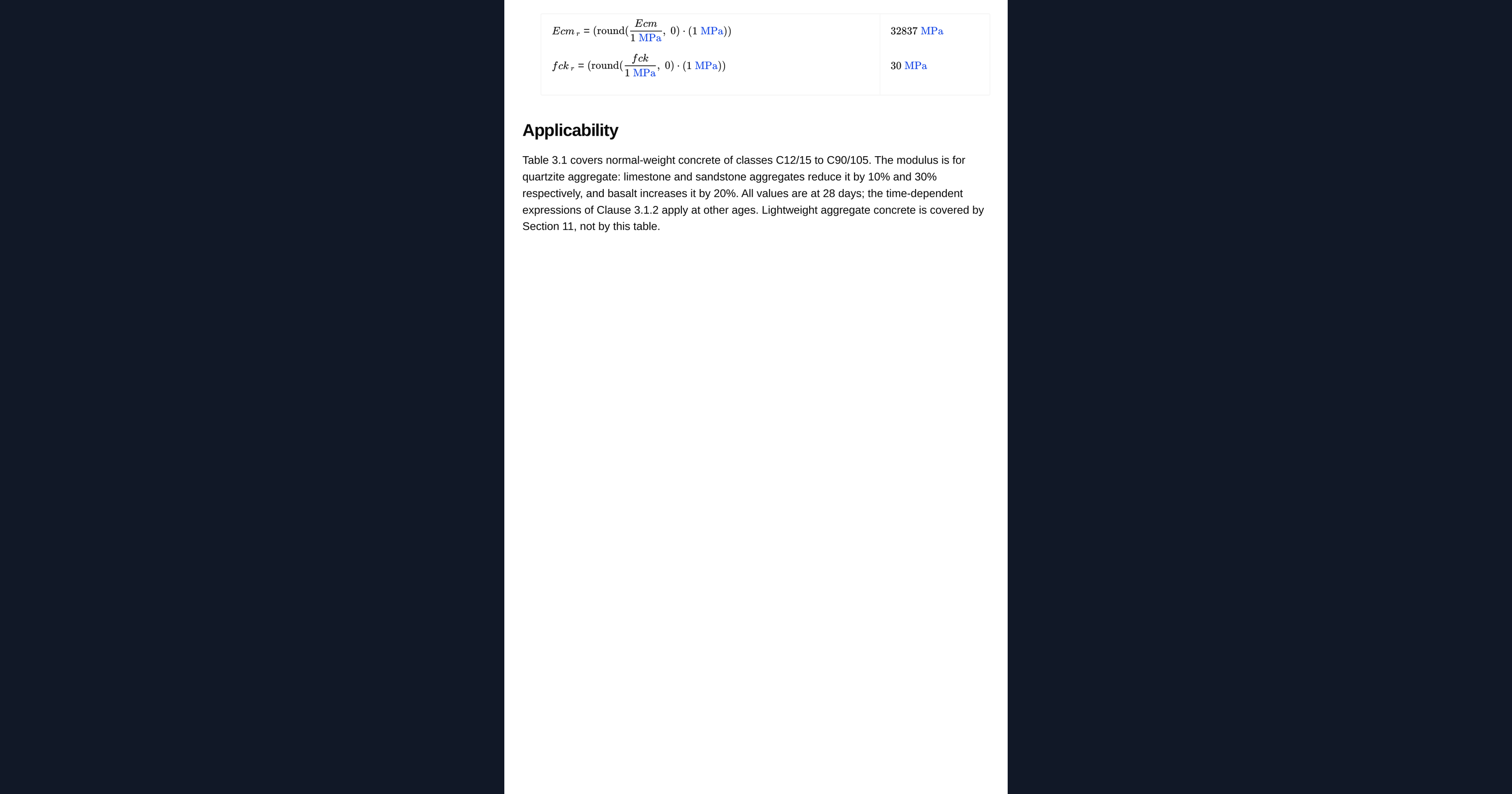
The secant modulus is derived from the mean compressive strength as a power relationship, and applies to quartzite aggregates. For limestone, sandstone or basalt aggregates the code gives adjustment factors that should be applied to the value returned.
Design strengths
The design compressive strength applies both the partial factor and the long-term coefficient to the characteristic value. The design tensile strength applies the partial factor to the lower fractile characteristic tensile strength, since a low tensile strength is the unfavourable case.
Common Calculation Errors to Avoid
- Entering the cube strength. The grade designation carries both cylinder and cube strengths. Every expression in Table 3.1 takes the cylinder value, which is the first number.
- Using the mean tensile strength for a shear or cracking check. Those checks want the lower fractile characteristic value, because a low tensile strength is unfavourable. The mean value is unconservative there.
- Forgetting the long-term coefficient. The design compressive strength is not simply the characteristic strength divided by the partial factor. Omitting the coefficient overstates capacity.
- Applying the normal strength relationships above the transition grade. The tensile strength relationship changes for high strength concrete, and using the lower grade form gives the wrong answer.
- Ignoring aggregate type for the elastic modulus. The tabulated modulus assumes quartzite. Other aggregates need the code adjustment, which matters for deflection and cracking.
- Mixing National Annex values with recommended values. Partial factors and the long-term coefficient can both be modified nationally, and the set must be internally consistent.
Engineering templates
Common calculators
Design guides




FAQs
Which strength do I enter?
The characteristic cylinder strength at twenty-eight days. For a C30/37 concrete that is the thirty, not the thirty-seven. The cube strength appears in the designation for identification and is not used by the code expressions.
What is the difference between the lower and upper fractile tensile strengths?
The mean is the expected value. The lower fractile is used where a low tensile strength is unfavourable, such as shear and crack control. The upper fractile is used where a high tensile strength is the unfavourable case, for example when assessing the force released at cracking.
Why is the design compressive strength lower than the characteristic value divided by the partial factor?
Because the long-term coefficient is applied as well. It accounts for the reduction in strength under sustained loading and for unfavourable effects arising from the way the load is applied.
Does this cover high strength concrete?
Yes. Several of the relationships change above the transition grade, and the calculator applies the correct branch for the grade entered rather than extrapolating the normal strength form.
Can I use the elastic modulus directly for a deflection check?
Only as a starting point. The value returned is the short-term secant modulus for quartzite aggregate. A deflection check normally needs an effective modulus that accounts for creep, and an aggregate adjustment where relevant.
Learn about the benefits of using CalcTree on engineering projects!