
Design a rectangular RC section in bending to Eurocode 2. Get the steel area required, with every step shown. Try the free calculator.

This template is not available yet. You can sign up and create it yourself!
Or let us know if you'd like to be notified when it’s ready:
No items found.
No items found.
About this EC2 Bending Design of a Rectangular RC Section Calculator
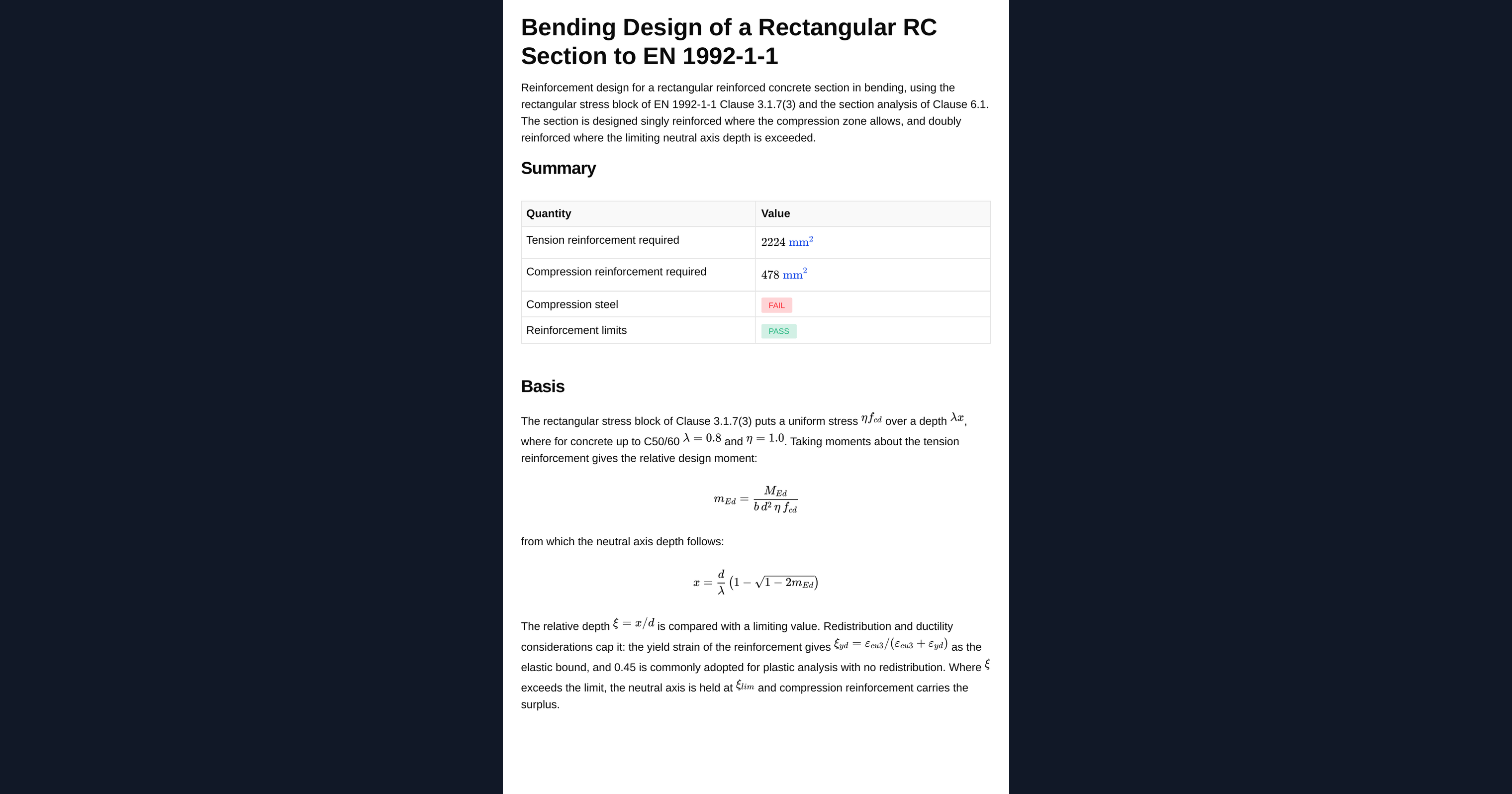
This calculator designs a rectangular reinforced concrete section for an applied bending moment to Eurocode 2 (EN 1992-1-1), using the rectangular stress block. It works through the dimensionless moment, the neutral axis depth, the lever arm and the tension steel required, and adds compression reinforcement automatically where the section cannot balance the moment as singly reinforced.
- Structural engineer. Size beams and slabs by entering the section, materials and design moment, and read the reinforcement area required.
- Design reviewer. Follow every intermediate quantity rather than accepting a single output, which makes an independent check quick.
- Graduate engineer. See the stress block method laid out in the order the code presents it, with each step named.
Every expression is visible on the page and units are carried through the calculation, so any result can be traced back to the clause it came from. It is an engineering-grade calculator you can audit, adapt and save to a project page in CalcTree.
More info on EC2 Bending Design of a Rectangular RC Section
Inputs
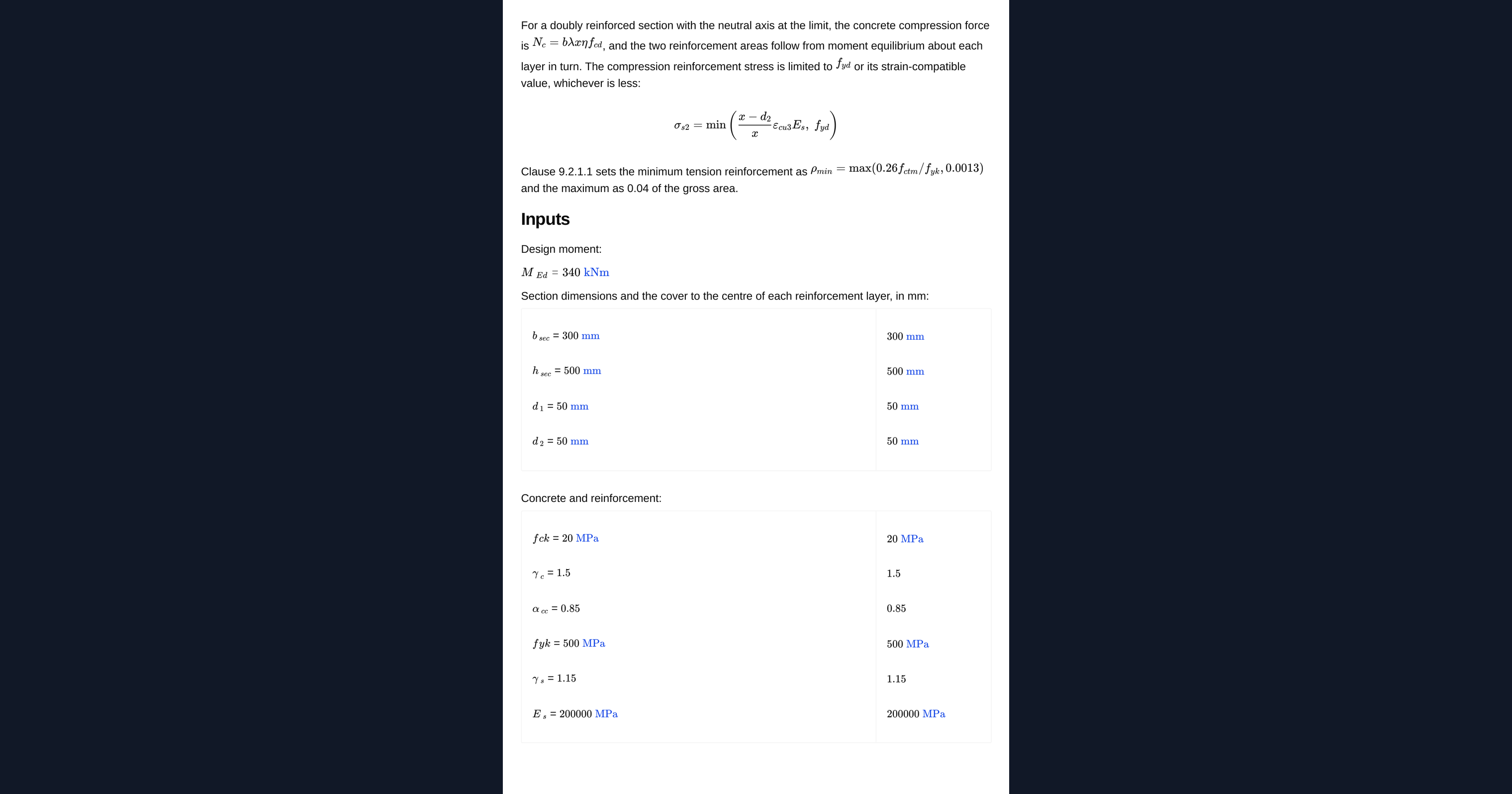
Section width and overall depth, the distance from the concrete face to the centroid of the tension reinforcement, and where relevant the same for compression reinforcement. Material inputs are the concrete grade and the reinforcement yield strength, together with the partial factors. The action is the design bending moment at the ultimate limit state.
Method
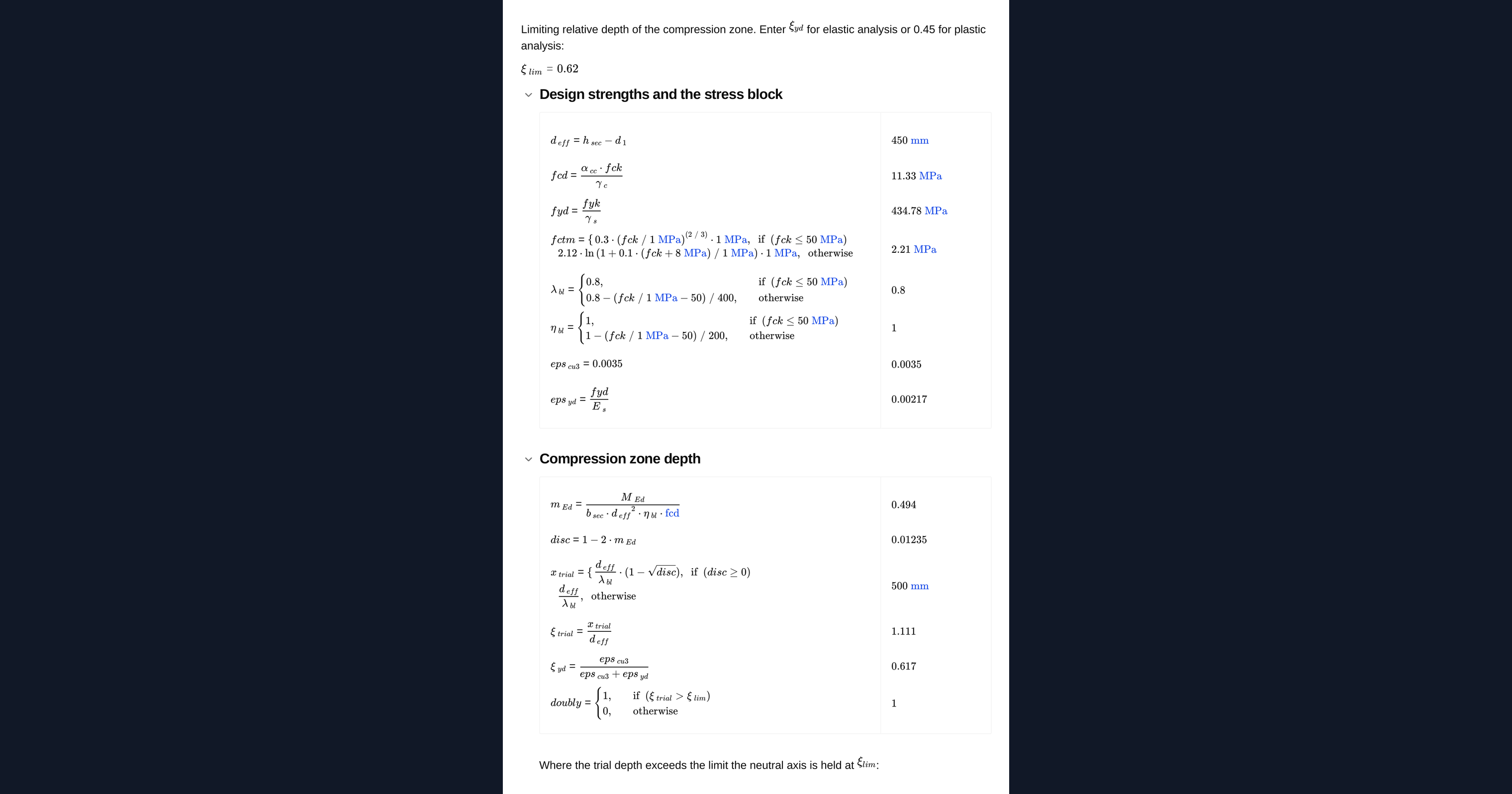
The applied moment is converted to a dimensionless form against the section and concrete strength. From that, the neutral axis depth and the lever arm follow directly. The stress block height and strength factors are taken from Clause 3.1.7 and adjust automatically above the grade at which they cease to be constant.
Design checks
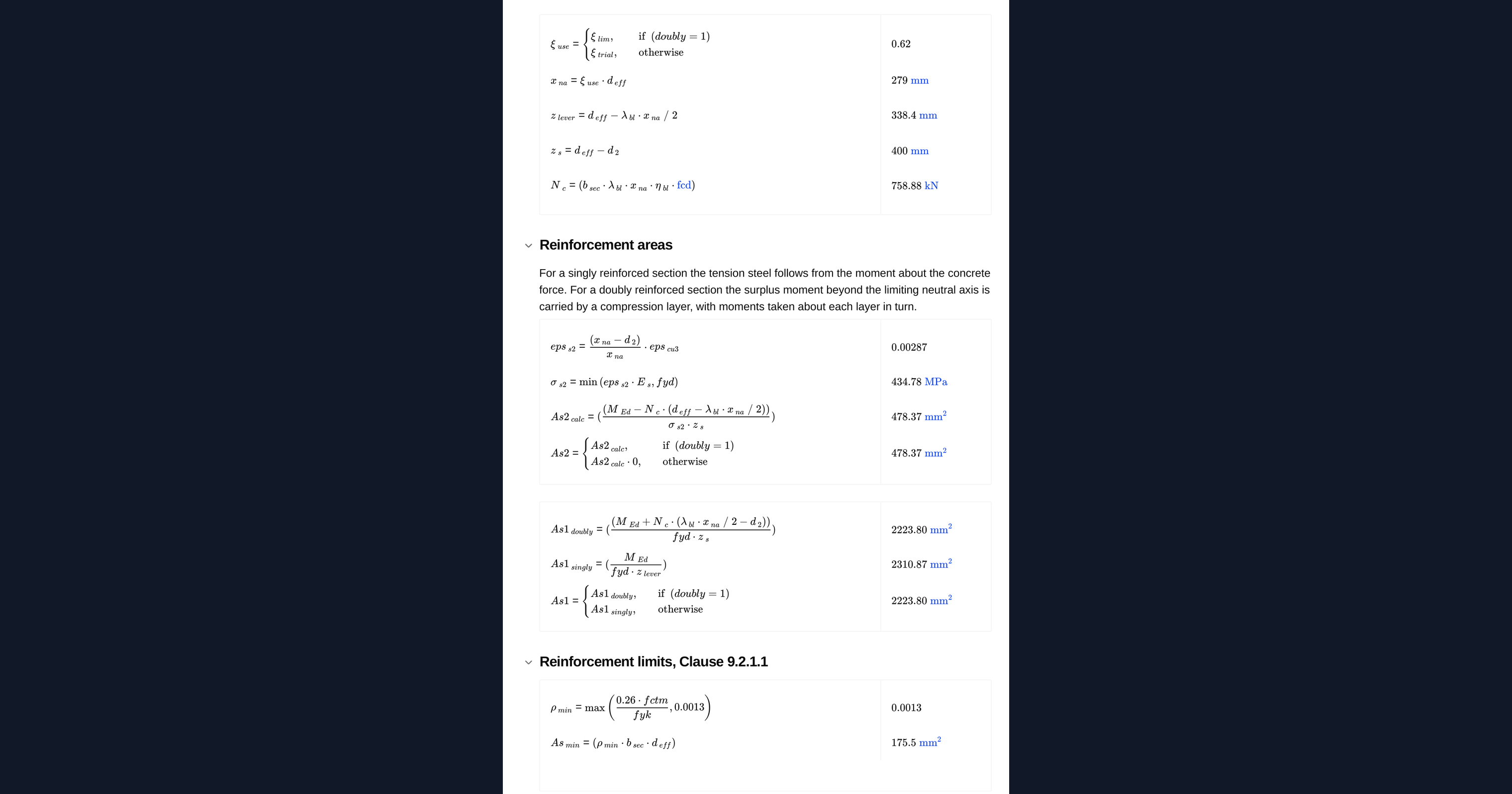
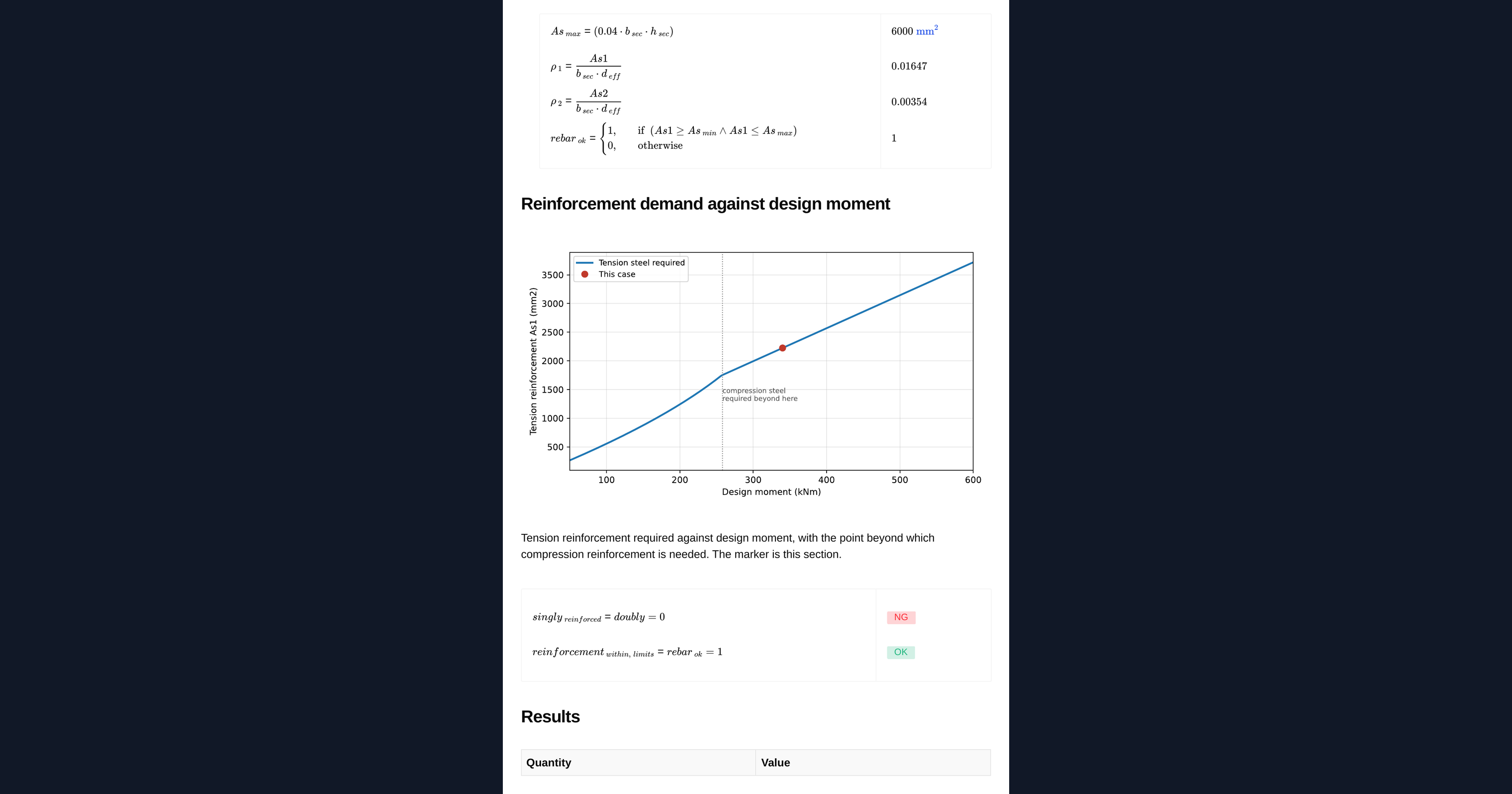
The neutral axis depth is held within the limit that keeps the section ductile. Where the applied moment would push it deeper, compression reinforcement is introduced and the steel areas are recalculated. The tension steel is then compared against the minimum area of Clause 9.2.1.1 and the maximum of Clause 9.2.1.3.
Outputs
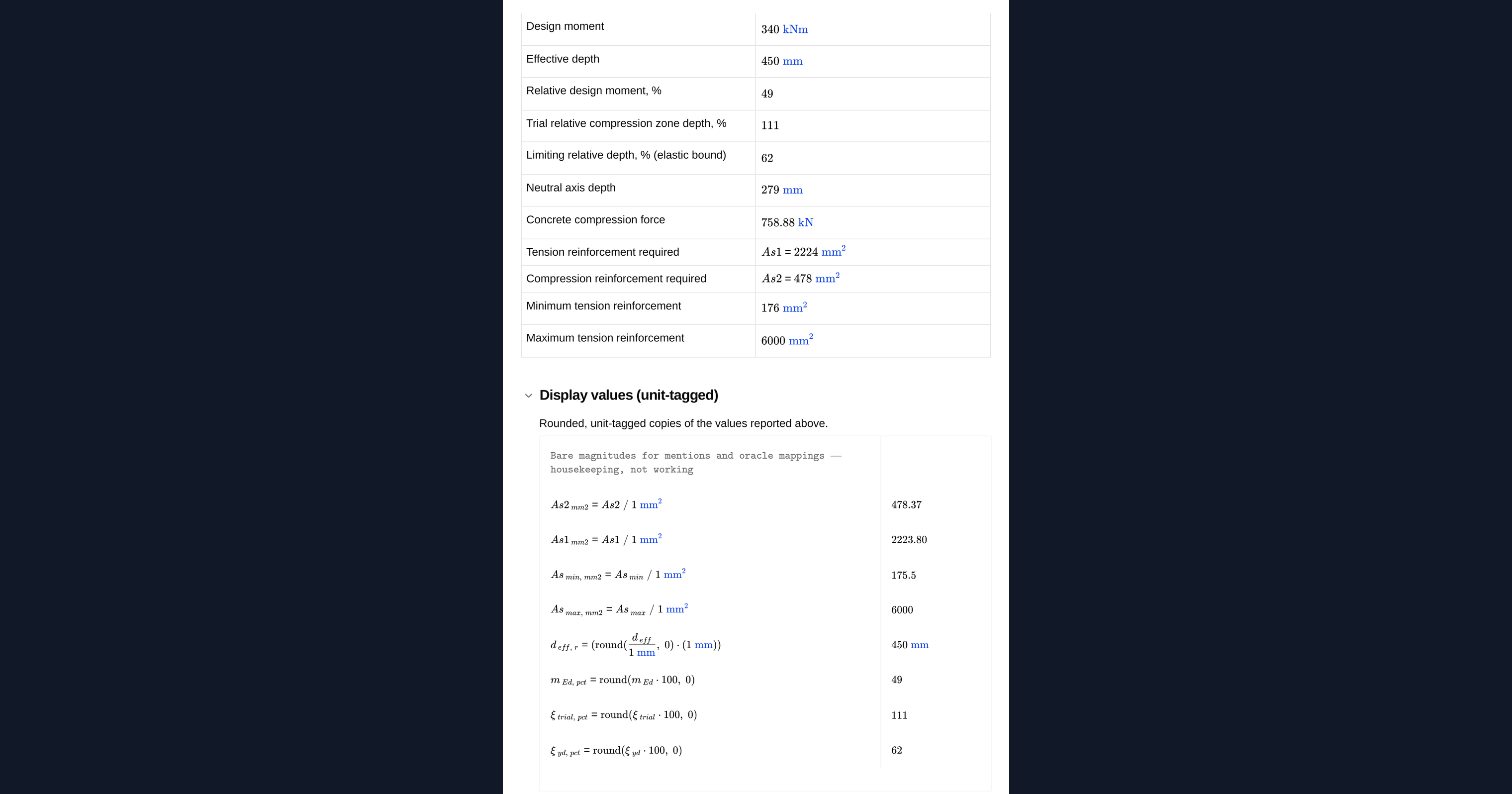
The areas of tension and, where required, compression reinforcement, alongside the lever arm, the neutral axis depth and the governing reinforcement limit. Results carry their units so they can be taken straight into detailing.
Common Calculation Errors to Avoid
- Entering nominal cover instead of the effective depth offset. The calculation needs the distance to the centroid of the bars, not the cover to the link. Using cover overstates the effective depth and understates the steel required.
- Ignoring the ductility limit on neutral axis depth. A section that balances the moment arithmetically can still be over-reinforced. If the limit is passed, compression steel is required, not a larger tension area.
- Using the cube strength. The code expressions take the characteristic cylinder strength. The second number in the grade designation is the cube strength and is not the input.
- Skipping the minimum reinforcement check. For lightly loaded members the minimum area governs, and designing to the calculated bending requirement alone leaves the section short.
- Applying constant stress block factors at high strength. Above the transition grade the height and strength factors reduce, and holding them constant is unconservative.
- Mixing serviceability and ultimate moments. This is an ultimate limit state design. A serviceability moment entered here returns an unsafe steel area.
Engineering templates
Common calculators
Design guides




FAQs
When does the section need compression reinforcement?
When the applied moment exceeds what the section can develop while keeping the neutral axis within the ductility limit. Rather than allowing a deeper neutral axis, the calculation adds compression steel and rebalances, which is how the code intends the case to be handled.
Which stress block does this use?
The rectangular stress block of Clause 3.1.7, with the effective height and strength factors that apply to the concrete grade entered. They take their familiar constant values up to the transition grade and reduce above it.
Does it check minimum and maximum reinforcement?
Yes. The area required for bending is compared against the minimum of Clause 9.2.1.1 and the maximum of Clause 9.2.1.3, and the governing value is reported so you can see which one controls.
What cover should I enter?
The distance from the concrete face to the centroid of the reinforcement, which is the nominal cover plus the link diameter plus half the main bar diameter. The calculation derives the effective depth from it.
Can I use it for slabs as well as beams?
Yes. Enter a one metre width and the slab depth, and the steel area returned is per metre width, which is the form used for slab detailing.
Learn about the benefits of using CalcTree on engineering projects!