
Design compression capacity of cold-formed sections by the Direct Strength Method, with elastic buckling from a finite strip analysis run in the page.

This template is not available yet. You can sign up and create it yourself!
Or let us know if you'd like to be notified when it’s ready:
No items found.
No items found.
About this calculation
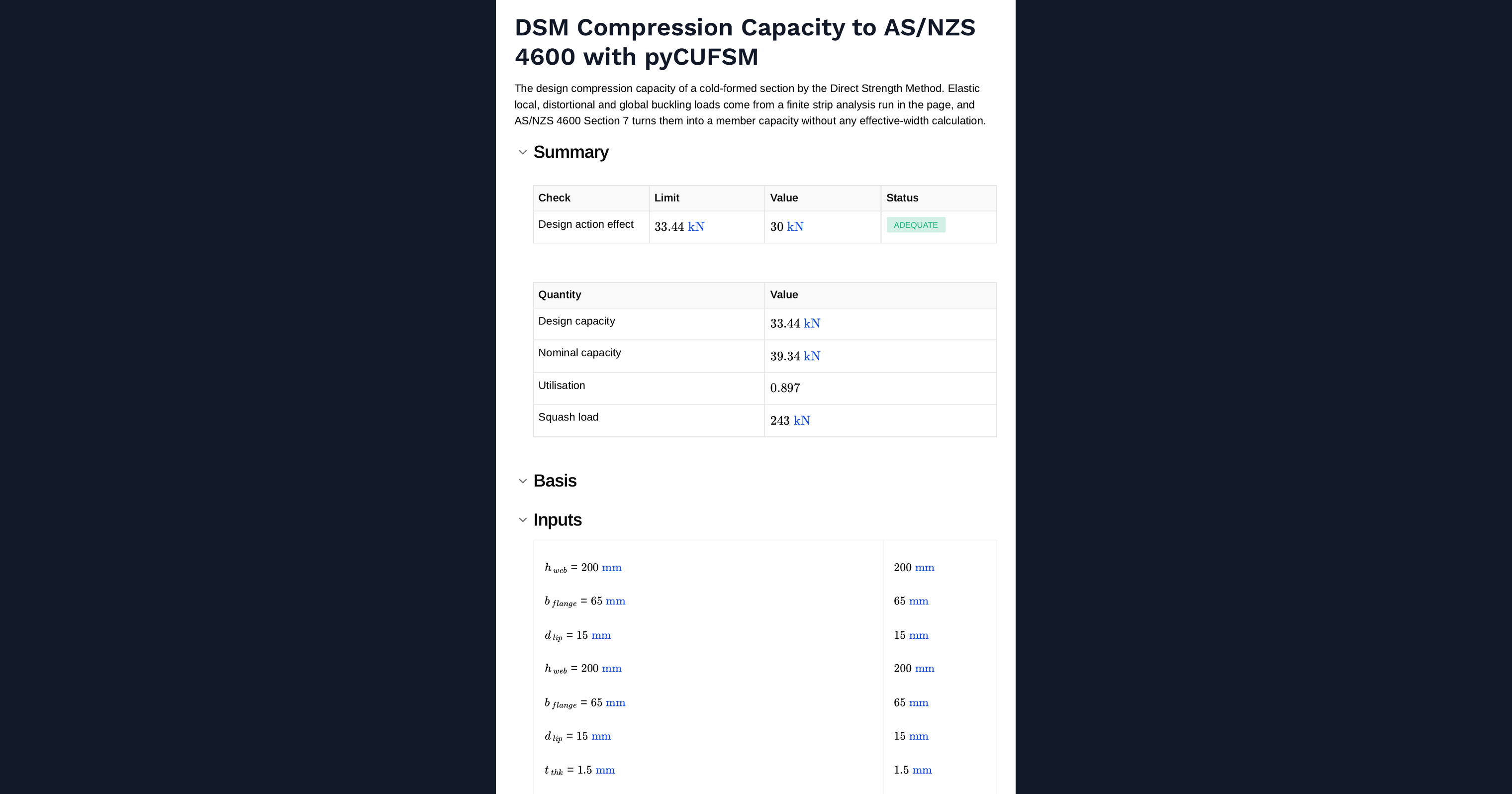
This page computes the design compression capacity of a cold-formed section using the Direct Strength Method (DSM). The elastic local, distortional and global buckling loads come from a finite strip analysis run in the page with pyCUFSM, and AS/NZS 4600 Section 7 turns those loads into a member capacity without any effective-width calculation.
How it works
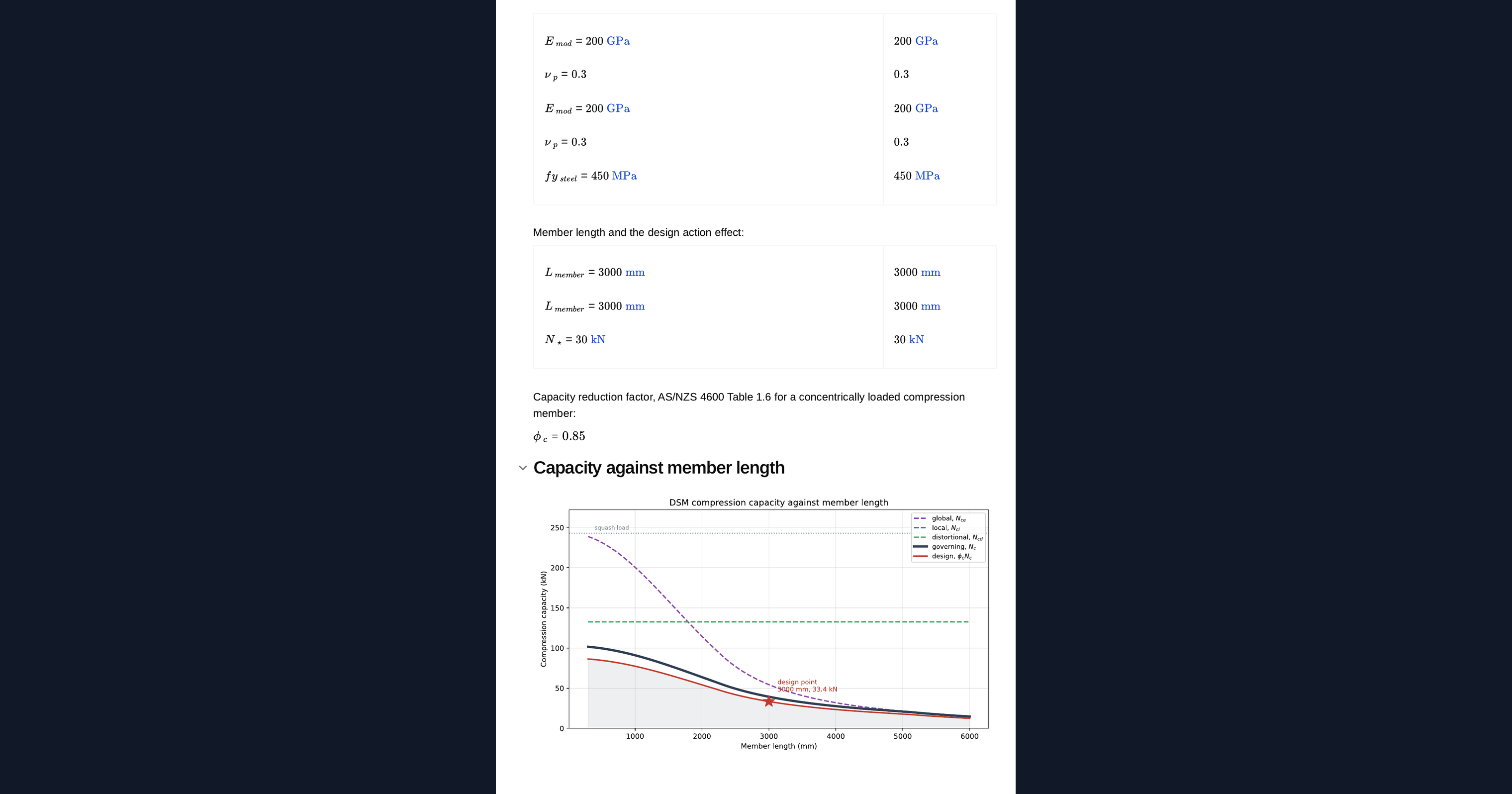
The Direct Strength Method replaces the effective-width calculation that cold-formed design used to require. Instead of reducing each plate element in turn and reassembling an effective section, it takes the elastic buckling load of the whole section in each mode and reads a strength directly from a calibrated curve. The hard part becomes the elastic buckling analysis, which is exactly what finite strip analysis provides.
Three capacities are computed, one for each mode family, per AS/NZS 4600 Section 7:
Global buckling
From the slenderness λc = √(Ny / Noc):
- Nce = 0.658(λc²) Ny when λc ≤ 1.5
- Nce = (0.877 / λc²) Ny otherwise
Local buckling
From λl = √(Nce / Nol). Note that it reduces the global capacity rather than the squash load, which is how local-global interaction is captured:
- Ncl = Nce when λl ≤ 0.776
- Ncl = [1 − 0.15 (Nol / Nce)0.4] (Nol / Nce)0.4 Nce otherwise
Distortional buckling
From λd = √(Ny / Nod), which reduces the squash load directly:
- Ncd = Ny when λd ≤ 0.561
- Ncd = [1 − 0.25 (Nod / Ny)0.6] (Nod / Ny)0.6 Ny otherwise
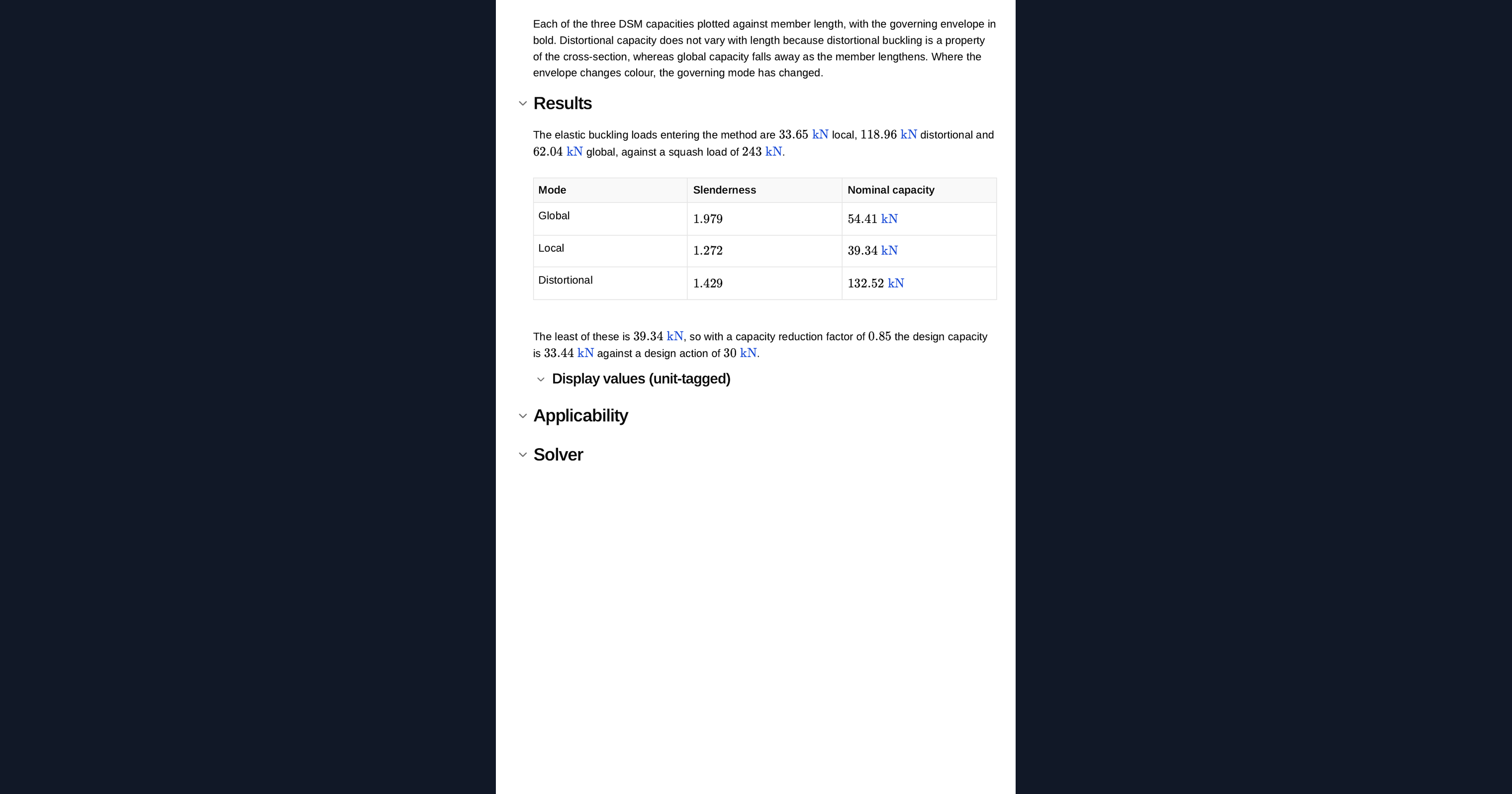
The nominal capacity is the least of the three, and the design capacity is φc Nc with φc = 0.85. The same expressions appear in AISI S100 Appendix 1 in P notation.
Because the finite strip analysis runs live in the page, the calculation handles arbitrary geometry entered as a table rather than a fixed standard case, and it returns buckling diagrams and contour plots alongside the numbers.
Engineering templates
Common calculators
Design guides




Frequently asked questions
What is the Direct Strength Method?
The Direct Strength Method determines a cold-formed member's capacity from the elastic buckling loads of the whole section, read against calibrated strength curves. It removes the need to compute an effective width for each plate element and reassemble an effective section.
Where do the elastic buckling loads come from?
They come from a finite strip analysis run in the page with pyCUFSM. The analysis returns the elastic local (Nol), distortional (Nod) and global (Noc) buckling loads that Section 7 needs.
Which capacity governs?
The nominal capacity is the least of the global, local and distortional results. The design capacity is φc Nc with the capacity factor φc = 0.85.
Does this calculation check prequalification?
No. AS/NZS 4600 Section 7 applies the method with its tabulated capacity factors only to sections within the geometric and material ranges listed there, covering web and flange slenderness, lip proportions, and the ratio of web to flange. A section outside those limits may still be assessed, but with a reduced capacity factor and rational-analysis justification. This template does not check prequalification, so confirm the section falls within the limits before using the capacity.
What end conditions does the global buckling load assume?
Pinned ends with warping free, effective length equal to the member length, and no intermediate restraint. Real members are usually braced, often differently about each axis and differently against twist. Where that is the case the three effective lengths differ and must be substituted individually.
Can it handle non-standard geometry?
Yes. The section is entered as a table of nodes and elements, so arbitrary cold-formed geometry can be analysed rather than only fixed standard shapes.
Learn about the benefits of using CalcTree on engineering projects!