
Calculate radiation to a boundary to BR 187 using configuration factors. Check separation distance. Try the free calculator.

This template is not available yet. You can sign up and create it yourself!
Or let us know if you'd like to be notified when it’s ready:
No items found.
No items found.
About this BR 187 External Fire Spread and Boundary Distance Calculator
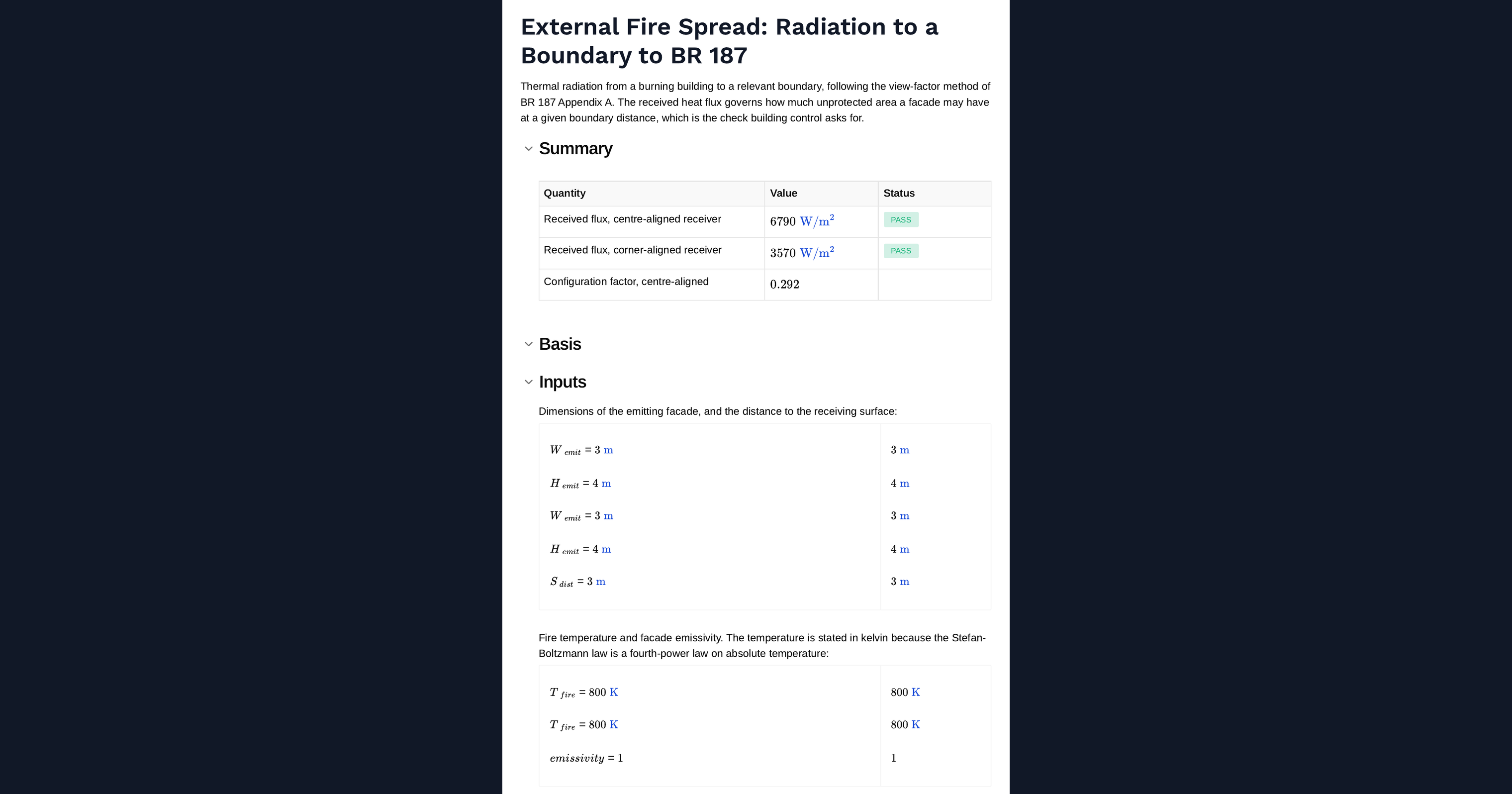
This calculator works out the thermal radiation arriving at a relevant boundary from a burning building, using the configuration factor method of BR 187 Appendix A. The received flux is what governs how much unprotected area a facade may have at a given boundary distance, which is the check building control asks for. The calculator gives the source intensity, the configuration factors for both receiver arrangements, and the resulting flux, with a chart of flux against separation distance.
- Fire engineer. Enter the facade dimensions and the separation, and read the received flux for both the centre and corner receiver arrangements.
- Building control officer. Check a submitted separation distance against the radiation the facade actually produces, with the configuration factor shown.
- Architect testing a layout. Use the chart to see how far a building must sit from the boundary before the flux falls to an acceptable level.
Every expression is shown with its origin and units are carried through the calculation. It is an engineering-grade calculator you can audit, adapt and save to a project page in CalcTree.
More info on BR 187 External Fire Spread and Boundary Distance
Inputs
The width and height of the emitting facade, the distance to the receiving surface, the fire temperature and the facade emissivity. Temperature is entered in kelvin because the radiation law is a fourth-power law on absolute temperature.
Configuration factors
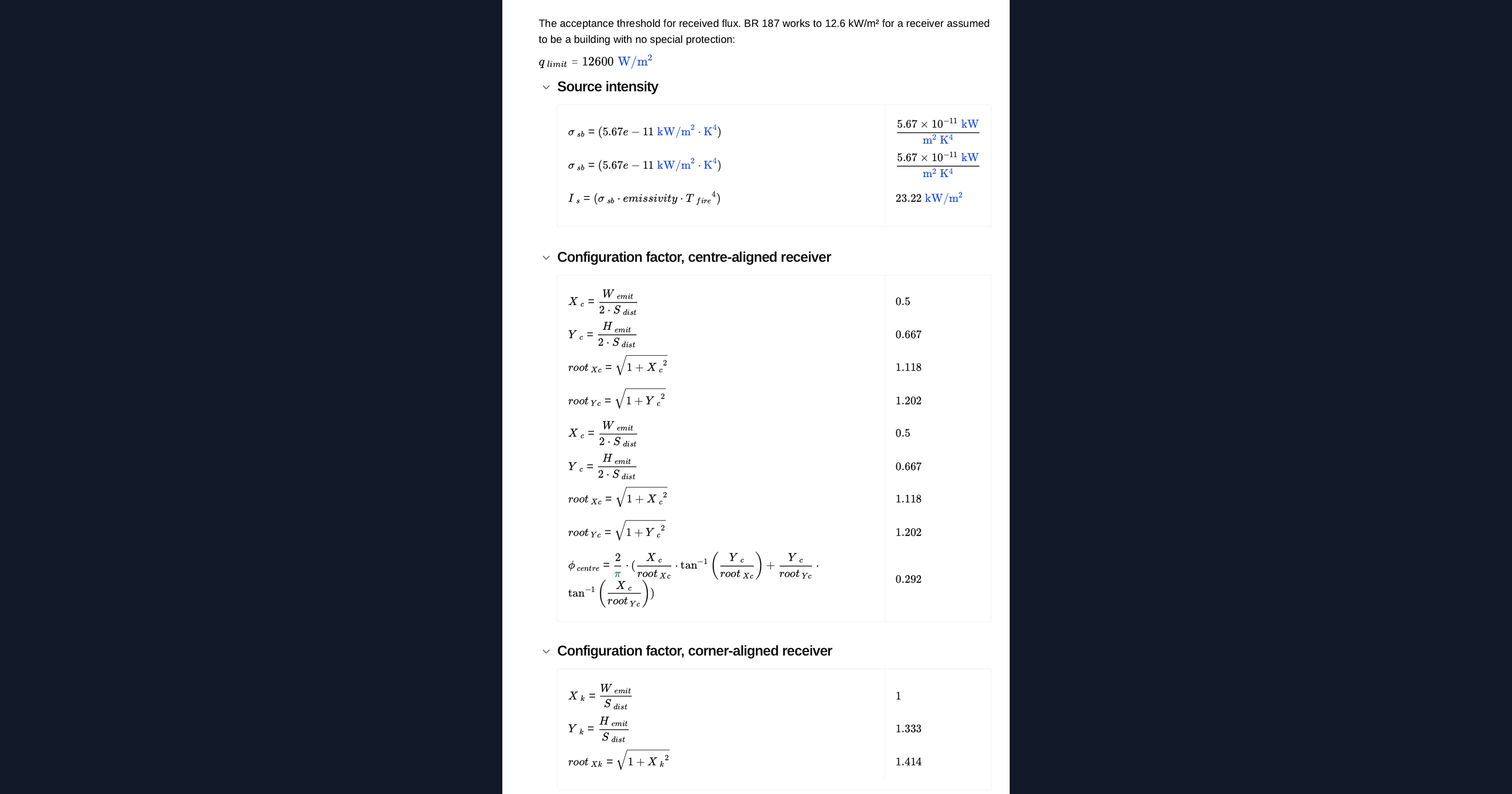
The configuration factor is purely geometric and depends on where the receiver sits relative to the emitter. A receiver opposite the middle of the rectangle sees more of it than one opposite a corner, so the two arrangements give different factors and the centre case governs for a receiver facing the facade squarely.
Received flux
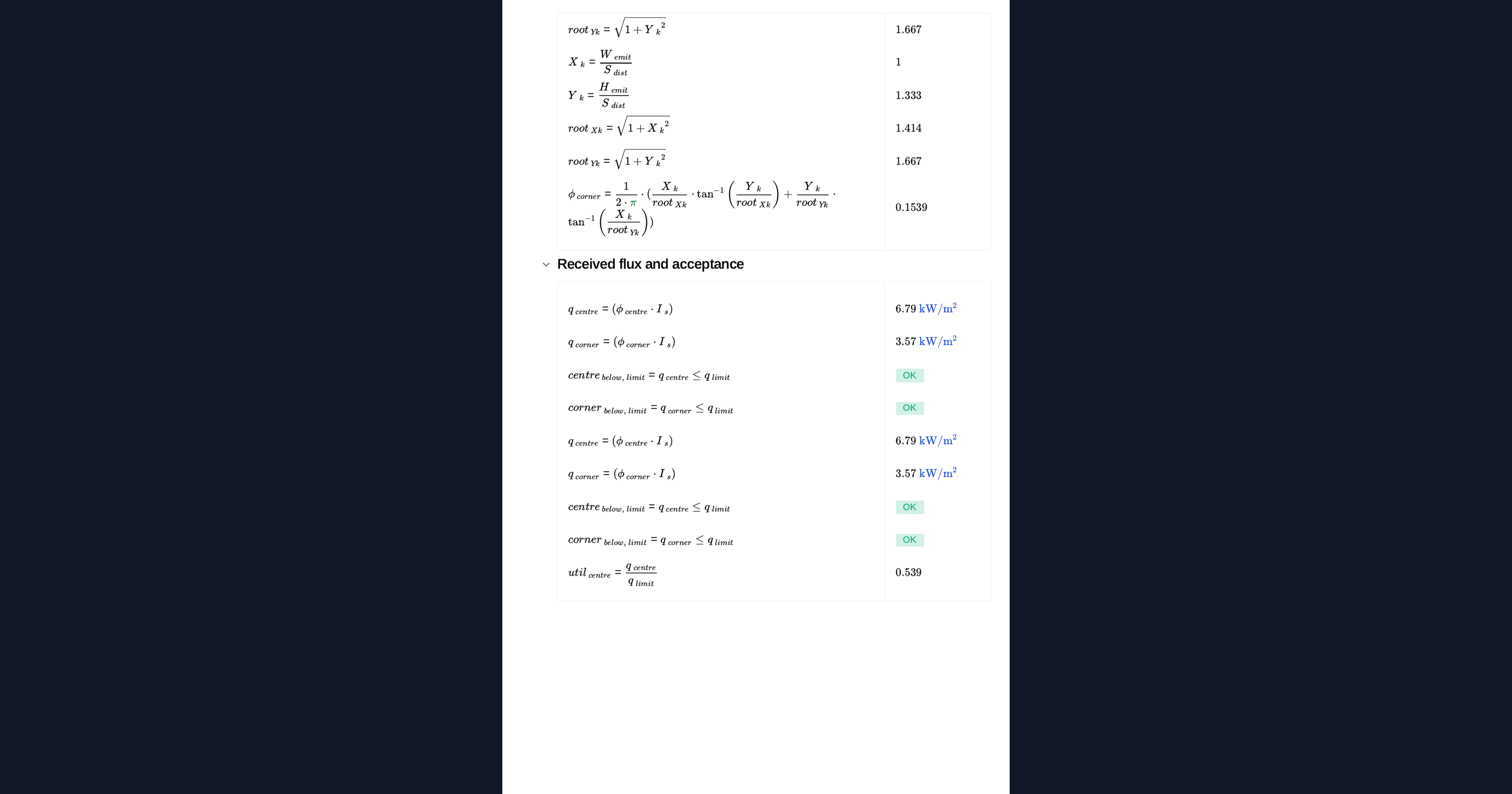
The intensity leaving the facade follows from its temperature and emissivity, and the flux arriving at the receiver is that intensity reduced by the configuration factor. Both arrangements are reported so the governing one is visible.
Outputs
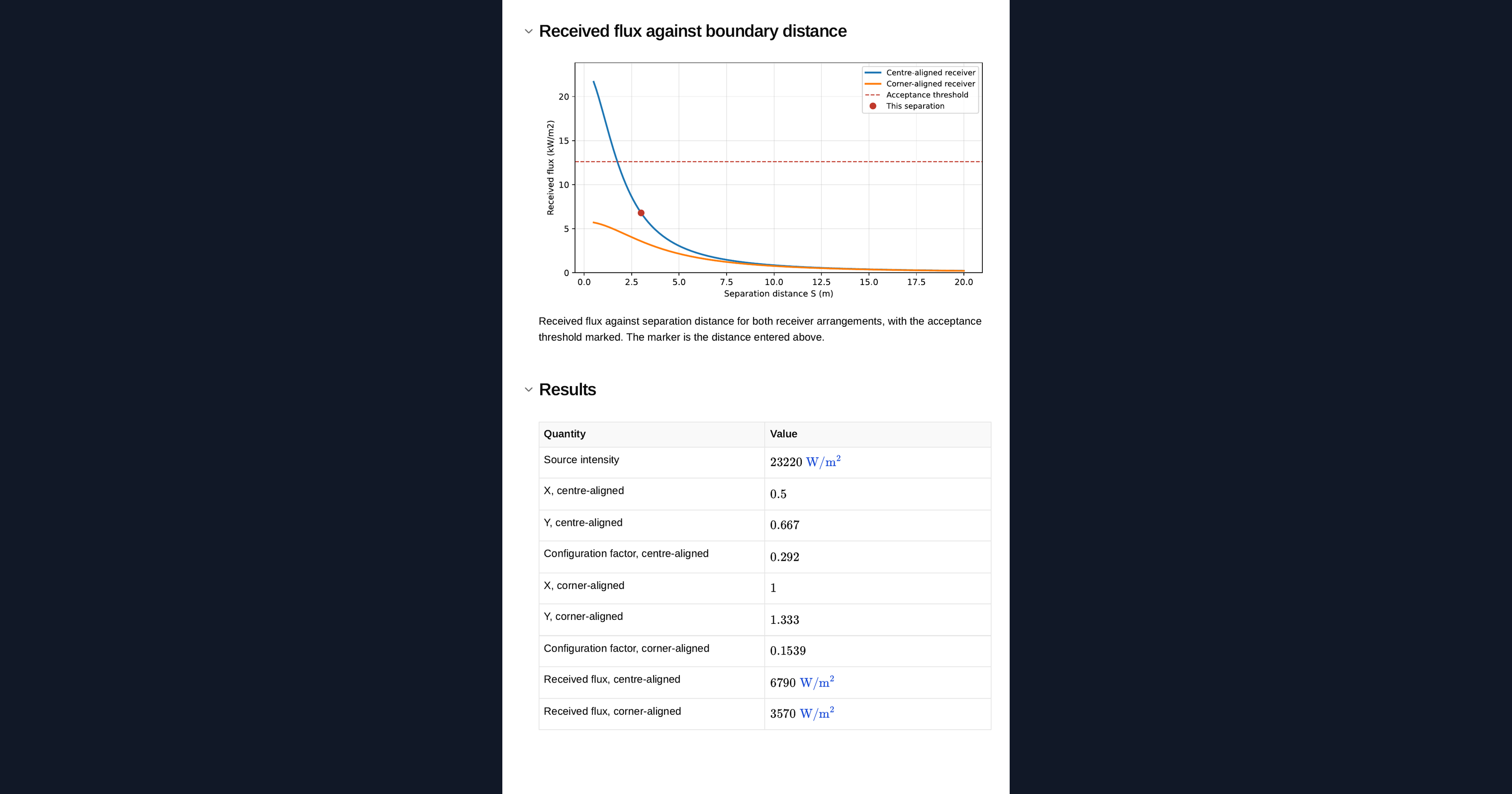
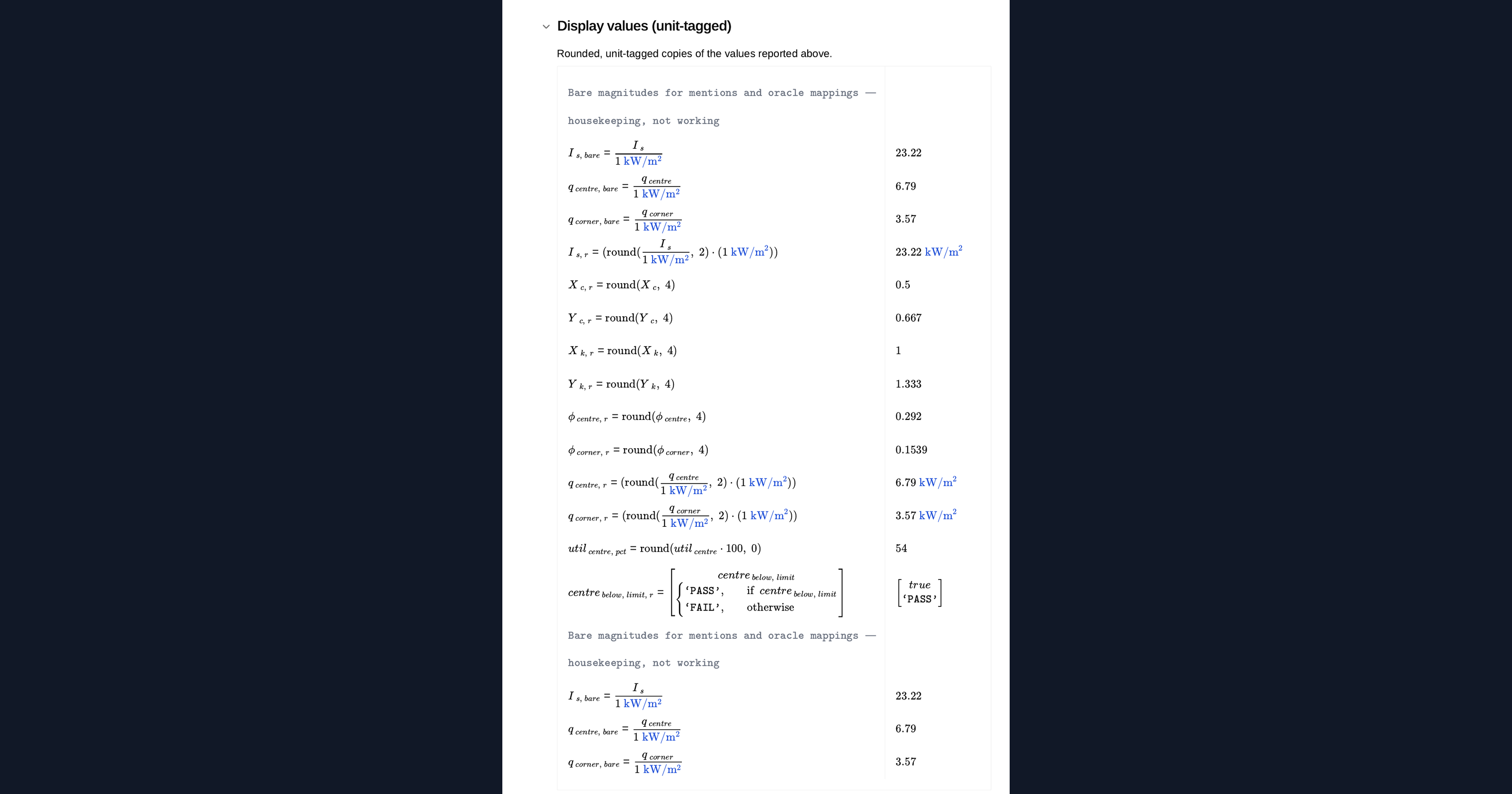
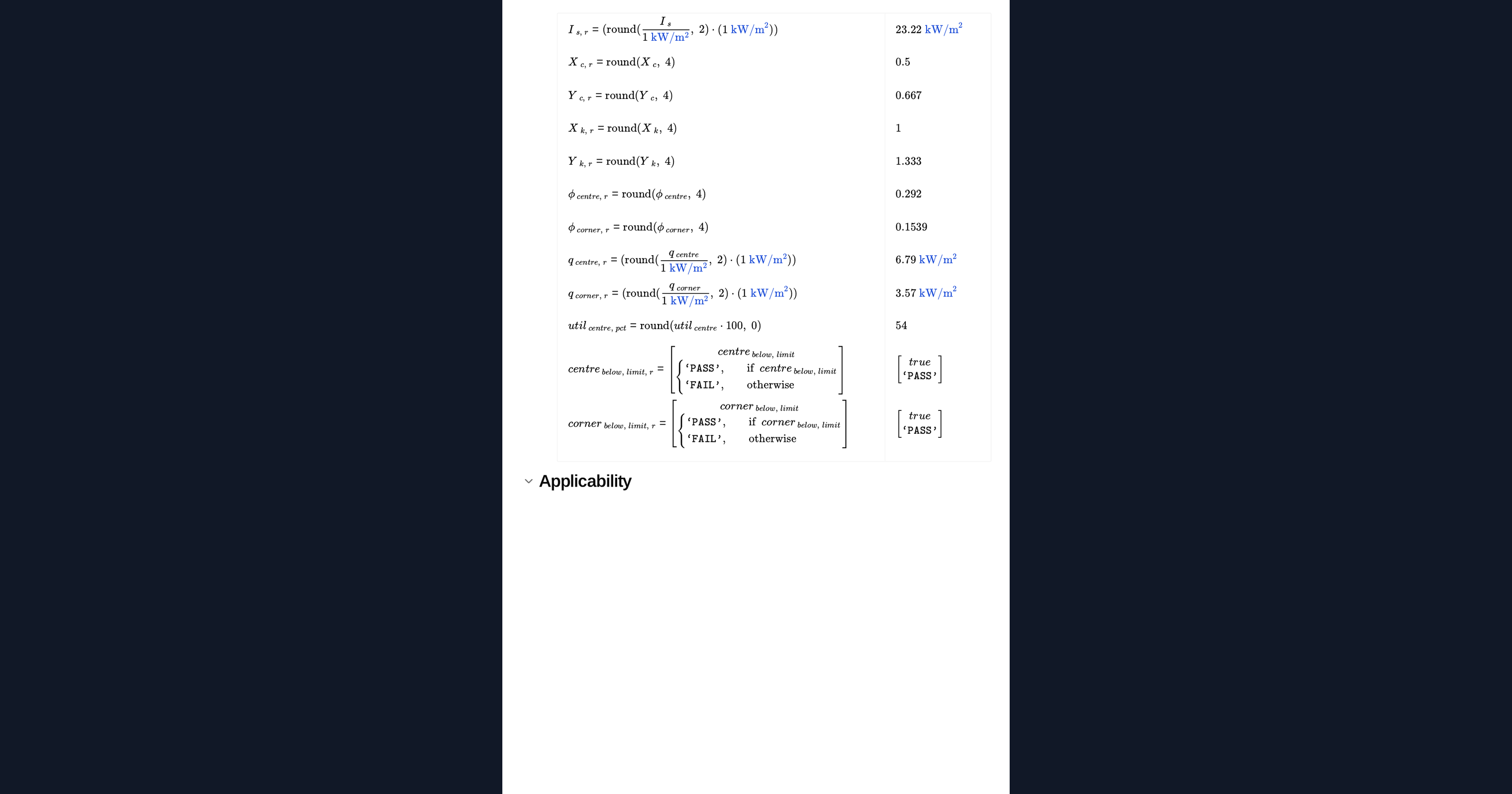
The source intensity, the dimensionless parameters and configuration factor for each arrangement, and the received flux at the separation entered, together with a chart of flux against distance.
Common Calculation Errors to Avoid
- Using the corner factor where the centre case governs. A receiver opposite the middle of the facade sees a larger configuration factor, and taking the corner value understates the flux.
- Entering temperature in degrees Celsius. The radiation law works on absolute temperature, and a fourth-power law makes that mistake very large.
- Treating the whole facade as one rectangle. Where the receiver sits opposite neither the centre nor a corner, the emitter must be divided into rectangles that do align and the factors combined.
- Forgetting how sensitive the result is to temperature. Temperature enters to the fourth power, so a modest error in the assumed fire temperature is a large error in the flux.
- Skipping the rest of the assessment. Locating the relevant boundary and choosing the enclosing rectangle sit around this calculation, not inside it.
- Assuming a receiver at an angle sees the same flux. It sees less, so treating the receiver as parallel to the emitter is the conservative assumption.
Engineering templates
Common calculators
Design guides



FAQs
What is a configuration factor?
A purely geometric quantity between zero and one that says how much of the emitting surface the receiver can see. It depends only on the size of the emitter and how far away the receiver is, not on temperature or material.
Which receiver arrangement should I use?
The centre-aligned case for a receiver directly opposite the middle of the facade, and the corner-aligned case for one opposite a corner. The centre case gives the larger factor and governs where the receiver faces the facade squarely.
What if my geometry fits neither arrangement?
Divide the emitting facade into rectangles that each do fit, and add or subtract their configuration factors as the geometry requires. That is the standard approach and it is exact.
Why does the fire temperature matter so much?
Radiation follows a fourth-power law on absolute temperature, so a ten per cent error in the assumed temperature is roughly a forty five per cent error in the emitted intensity.
Does this size the unprotected areas for me?
No. This is the radiation calculation. Establishing an acceptable unprotected area also needs the relevant boundary located, the enclosing rectangle chosen and the appropriate method selected for the building use.
Learn about the benefits of using CalcTree on engineering projects!