
Timber Deflection Check to EC5 - Table 7.2 Calculation: verify w_inst & w_final limits instantly. Supports all timber grades & service classes. Try it free.

Tell us what you need, or sign up and build it yourself in minutes.
Leave your email and we'll tell you when a template for it is ready:
No items found.
No items found.
About this EC5 Timber Beam Check Calculator
This calculator sets up a Eurocode 5 timber member with selectable strength class and service conditions, then derives the key design material properties and modification factors used in ULS/SLS checks. It also supports notched beam geometry inputs so the notch-related shear and bearing modifiers can be applied consistently alongside standard section properties.
- Structural engineer — define timber grade, service class, load duration, and beam geometry, then run traceable checks using EC5 factors without manually flipping between tables.
- Timber designer — assess notched beam sensitivity by changing notch geometry inputs and seeing the resulting notch factor and effective section depth update.
- Design checker / reviewer — audit the chain of factors (k_mod, k_def, γ_M, k_h, k_sys, k_cr, k_n, k_c,90) and confirm the calculation uses consistent assumptions and units.
This is an engineering-grade calculator built on CalcTree: inputs are explicit, intermediate factors are exposed, and the workflow is structured so you can review, reuse, and adapt it as a template.
More info on EC5 Timber Beam Check
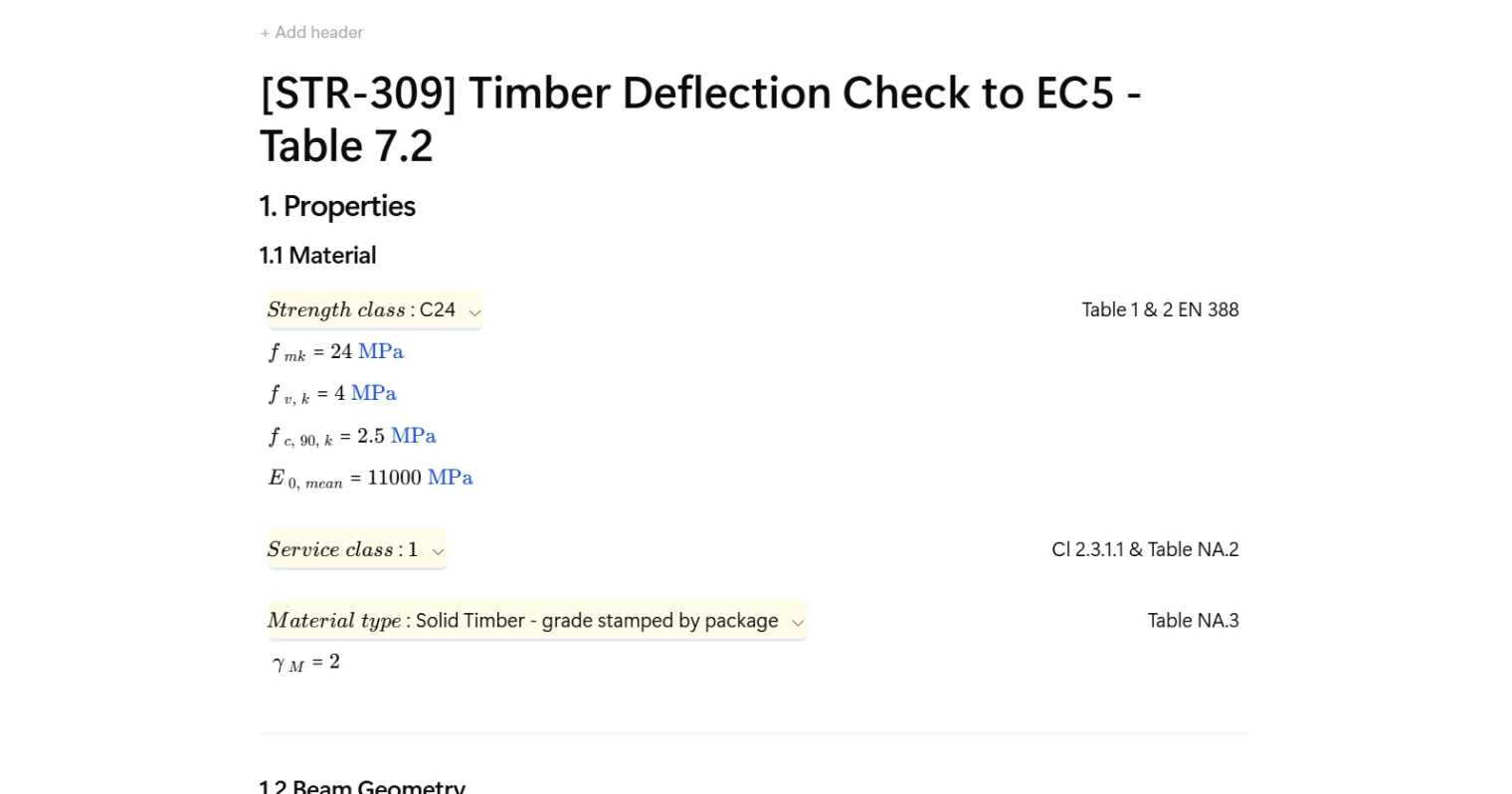
Material selection and characteristic properties
The calculator lets you select a timber strength class and pulls characteristic strengths and stiffness parameters into variables used downstream (for example bending strength, shear strength, compression perpendicular to grain, and mean modulus). This keeps material property selection consistent with the chosen grade and avoids mixing properties from different sources.
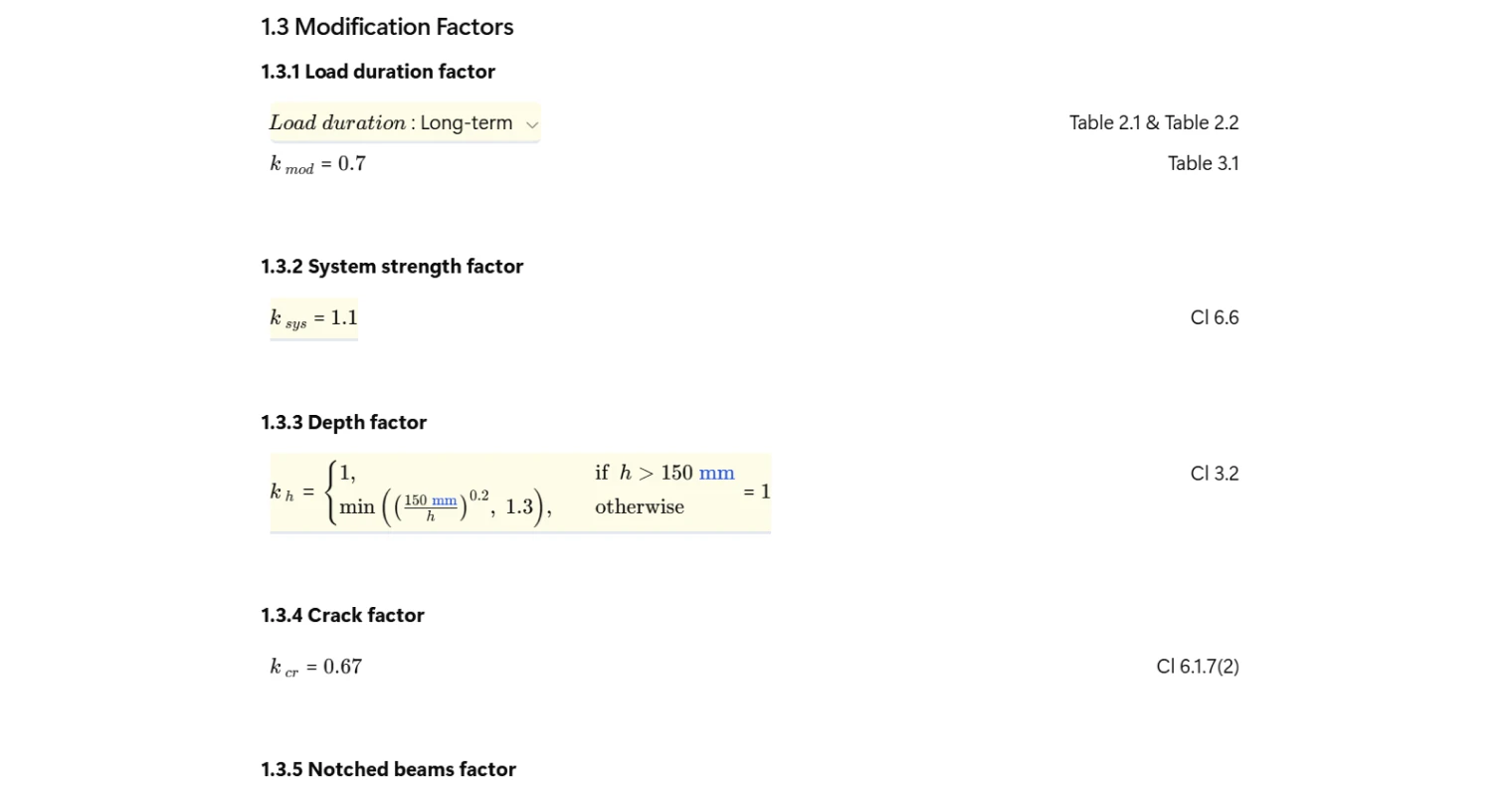
Service class, load duration, and modification factors
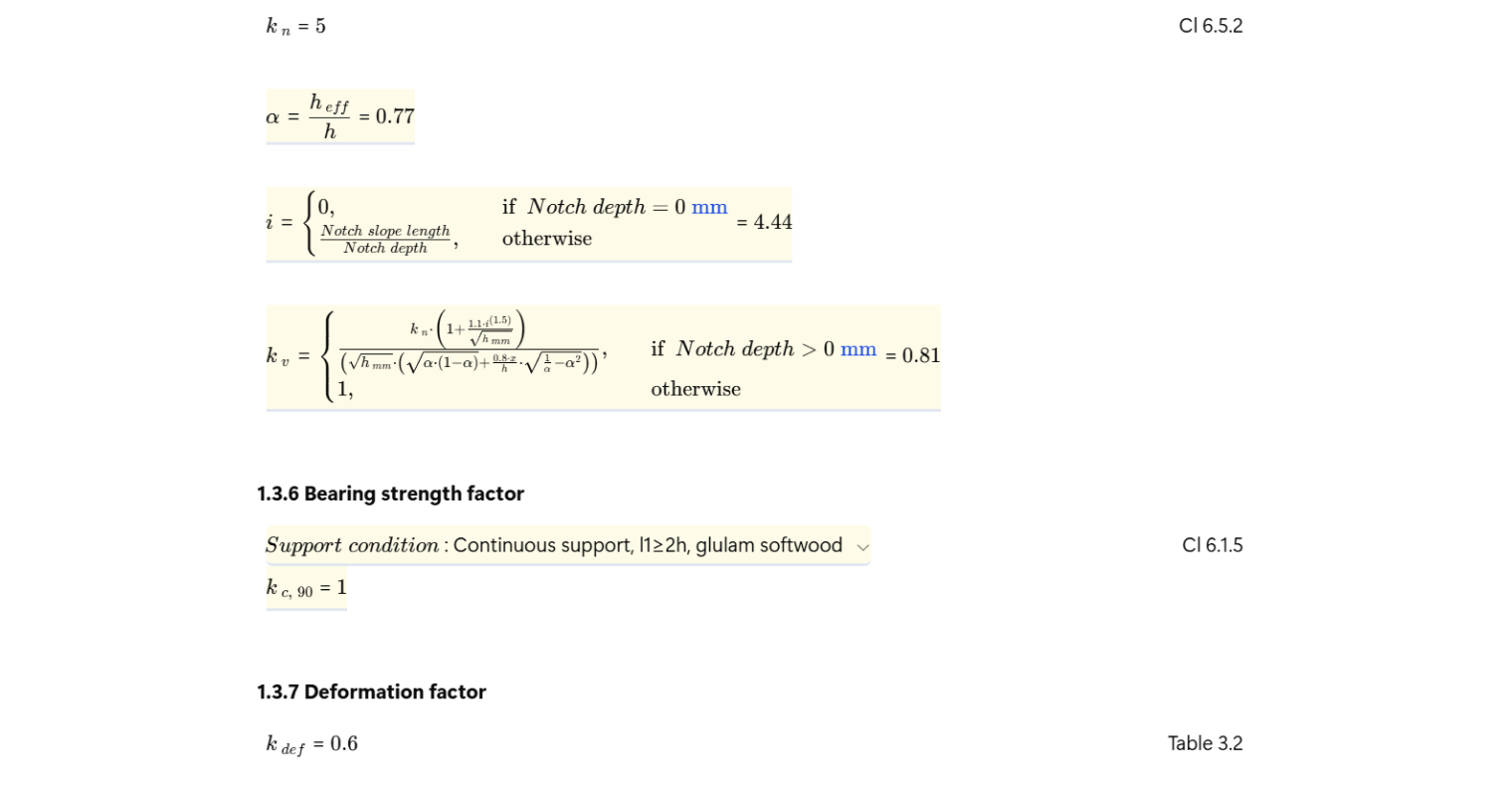
Eurocode 5 strength and deformation adjustments are handled through selectable service class and load-duration inputs, which drive k_mod and k_def. The calculator also includes common EC5 modifiers such as system strength and depth effects, and brings in the material partial factor γ_M based on the selected timber product category so the design values stay aligned with the intended material standard.
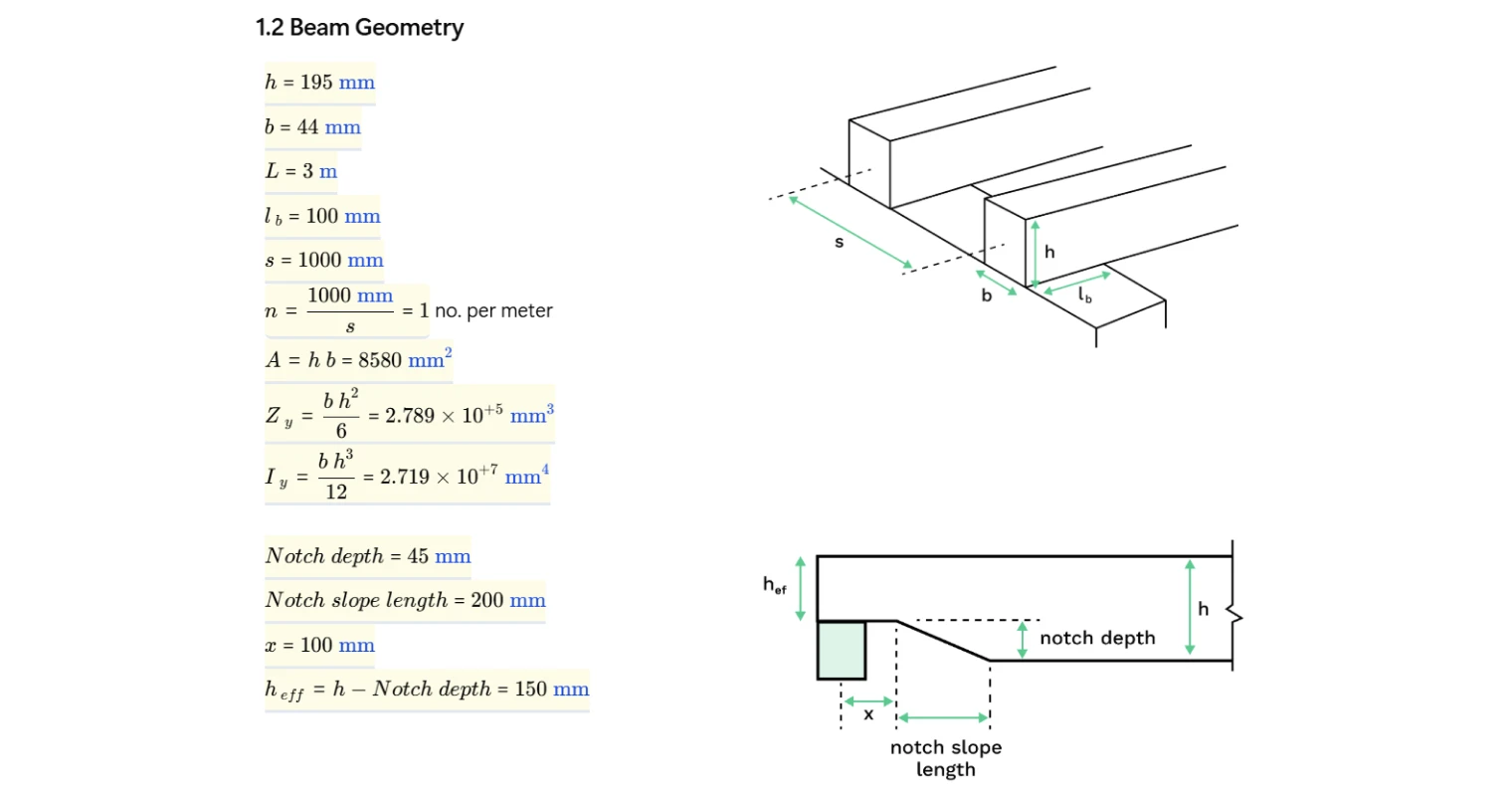
Geometry and derived section properties
Beam geometry inputs define the section dimensions and span, and the calculator derives section properties (area, section modulus, second moment of area) in consistent units for use in stress and deflection equations. Where notching is present, it computes effective depth and notch geometry ratios so notch-related checks use the reduced section and correct geometric parameters.
SLS deflection check workflow
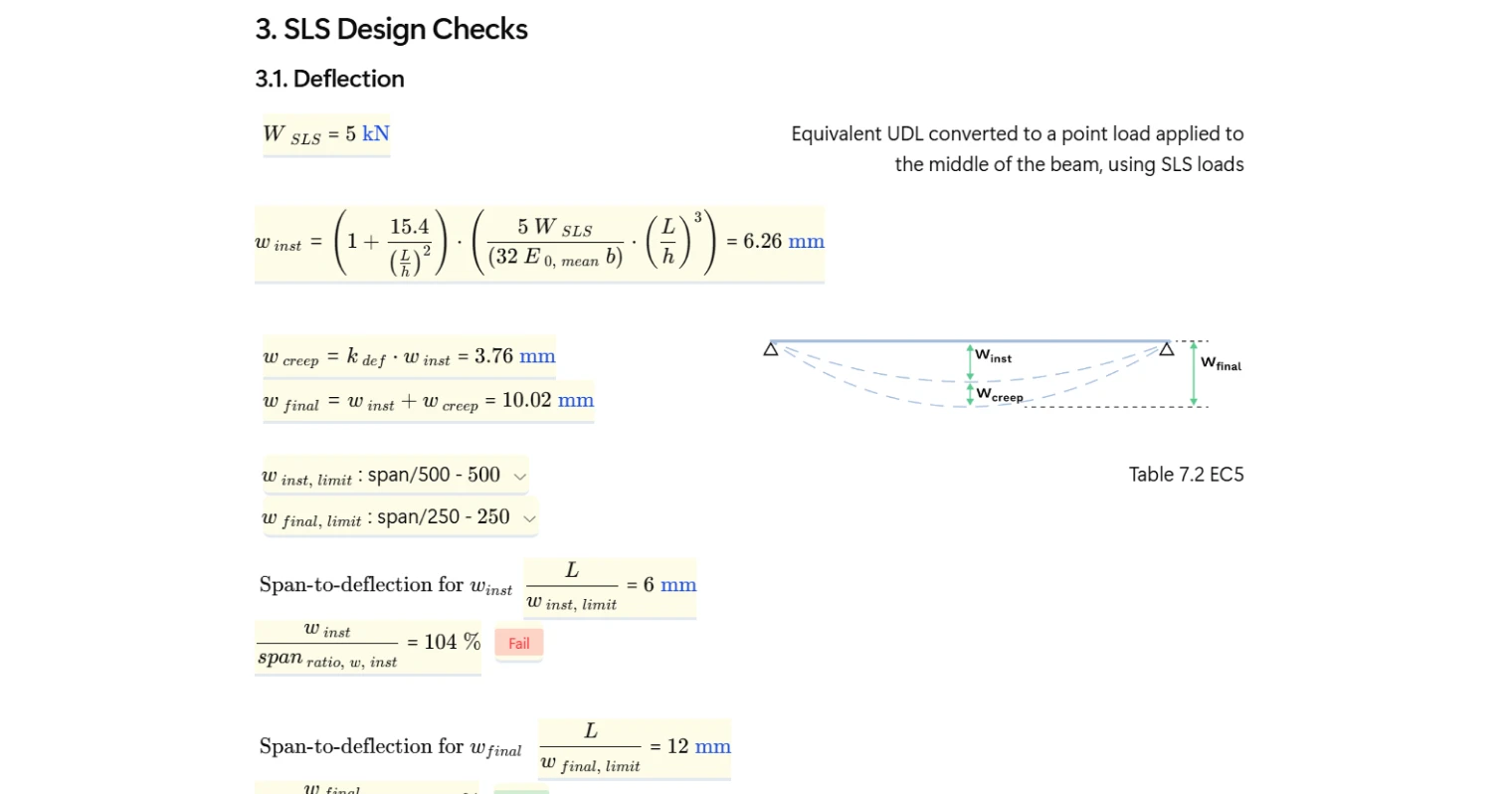
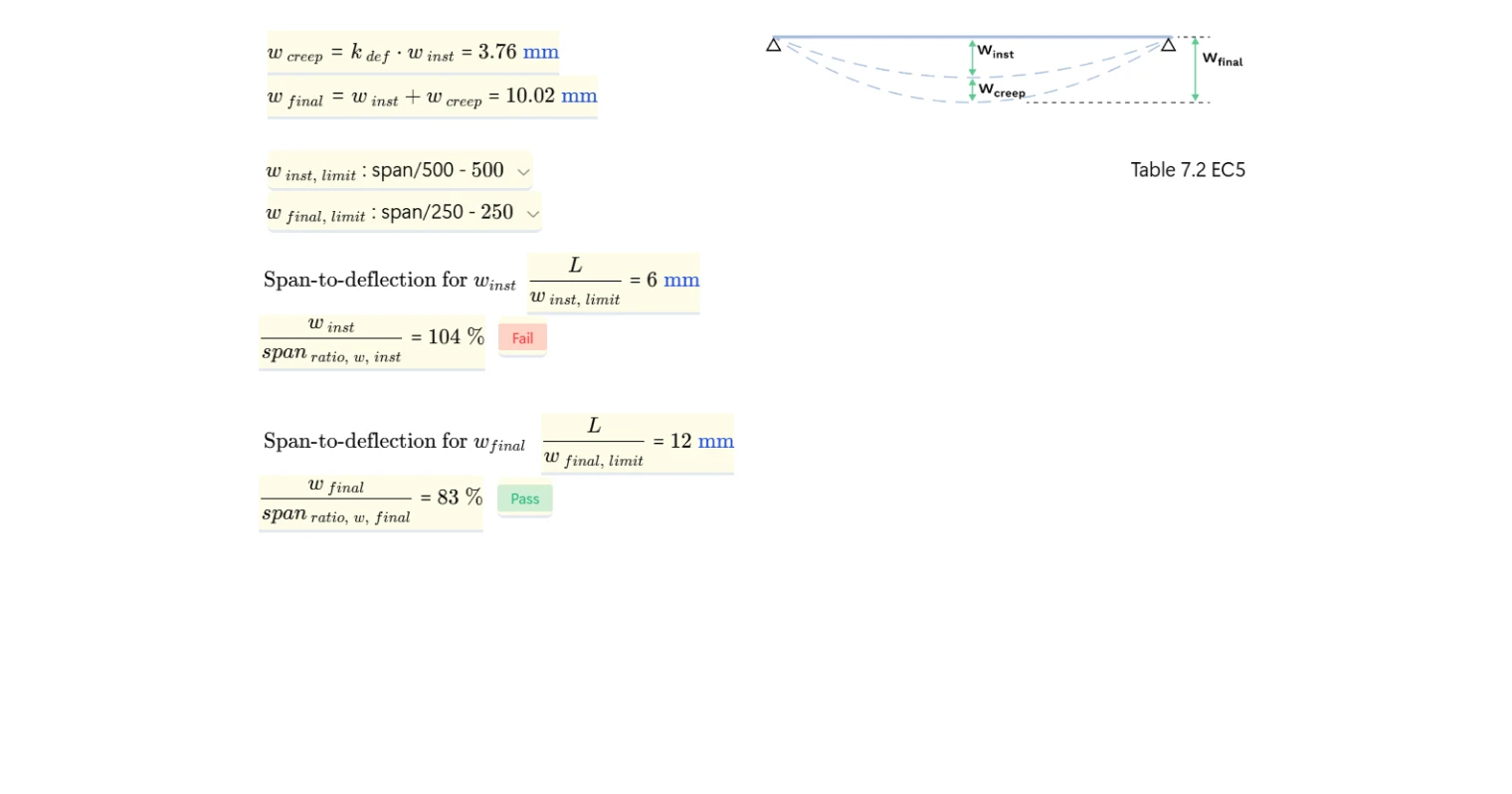
The SLS section computes instantaneous deflection and creep-amplified final deflection using the selected deformation factor and stiffness inputs. It then compares calculated deflections to selectable span/limit criteria and presents a clear pass/fail outcome, making it easy to align the check with project-specific deflection limits while keeping the calculation traceable.
Common Calculation Errors to Avoid
- Mixing service class and load duration assumptions — ensure the service environment and load-duration category match the governing action; k_mod and k_def must be taken from the same EC5 context.
- Inconsistent material category selection — γ_M and related factors depend on product type (solid timber, glulam, LVL, panels); choosing the wrong category shifts the design values.
- Notch geometry defined but not used in checks — when a notch exists, use effective depth and the notch factor consistently in the shear/bearing verification rather than the gross section.
- Unit handling errors in derived properties — section properties and deflection equations are unit-sensitive; keep geometry, stiffness, loads, and conversions consistent throughout.
- Using limit ratios incorrectly — span/limit selections should be applied to the correct deflection component (instantaneous vs final) and compared against the matching calculated result.
- Hidden defaults in table lookups — if a lookup fails and a fallback value is used, it can mask an input mismatch; ensure material names and duration labels align with the lookup tables.
Engineering templates
Common calculators
Design guides




FAQs
What does this calculation check according to EC5 Table 7.2?
This template checks instantaneous deflection (w_inst) and final deflection (w_final) of a timber beam against span-to-deflection limits taken from Table 7.2 of EC5. Instantaneous deflection is calculated from elastic bending under SLS loads, including a shear deflection correction factor. Final deflection adds creep deformation using k_def. Both results are compared against user-selected span ratios such as span/300 or span/500.
How does the k_def factor affect the deflection result?
k_def is the deformation factor from EC5 Table 3.2. It scales the instantaneous deflection to account for long-term creep. Creep deflection is calculated as w_creep = k_def × w_inst, and final deflection is w_final = w_inst + w_creep. The value of k_def depends on both material type and service class, so a solid timber beam in service class 3 will accumulate significantly more creep than the same beam in service class 1.
What is service class and how do I choose the right one?
Service class defines the moisture exposure condition of the timber, per EC5 clause 2.3.1.1. Service class 1 covers heated interior environments with low humidity. Service class 2 applies to covered exterior or occasionally humid indoor conditions. Service class 3 covers fully exposed exterior conditions. The choice directly affects k_mod and k_def, so selecting the wrong class will give unconservative results.
How should I enter the applied load for the deflection check?
The template takes a single equivalent point load W_SLS applied at midspan, representing the SLS load on the beam. If your beam carries a UDL, convert it to an equivalent midspan point load that produces the same midspan deflection. For a simply supported beam under a UDL of w per unit length, the equivalent point load is W = (5/8) × w × L. Use SLS unfactored load combinations, not ULS.
What deflection limits should I select for w_inst and w_final?
EC5 Table 7.2 gives recommended limits but notes these are indicative. National annexes or project specifications may override them. As a starting point, span/300 to span/500 for w_inst and span/150 to span/300 for w_final are common. Tighter limits are typically needed where finishes or partitions are sensitive to movement. The template lets you select from these options directly, so match the limit to your project specification.
How does the shear deflection correction work in this template?
The w_inst formula includes a term (1 + 15.4 / (L/h)²) that corrects for shear deformation in addition to bending. This correction becomes significant when the span-to-depth ratio L/h is low, typically below about 10 for solid timber. For slender beams with high L/h ratios, the correction approaches 1 and shear deflection is negligible. This avoids underestimating deflection in deep, short-span members.
Learn about the benefits of using CalcTree on engineering projects!