
Check plain concrete flexural strength per ACI 318-19 14.5.2.1. Instantly computes governing Mn and Pass/Fail. Try the free CalcTree template.

Tell us what you need, or sign up and build it yourself in minutes.
Leave your email and we'll tell you when a template for it is ready:


No items found.
No items found.
About this ACI 318-19: Plain Concrete – Flexure Nominal Strength Limit (14.5.2.1) Calculator
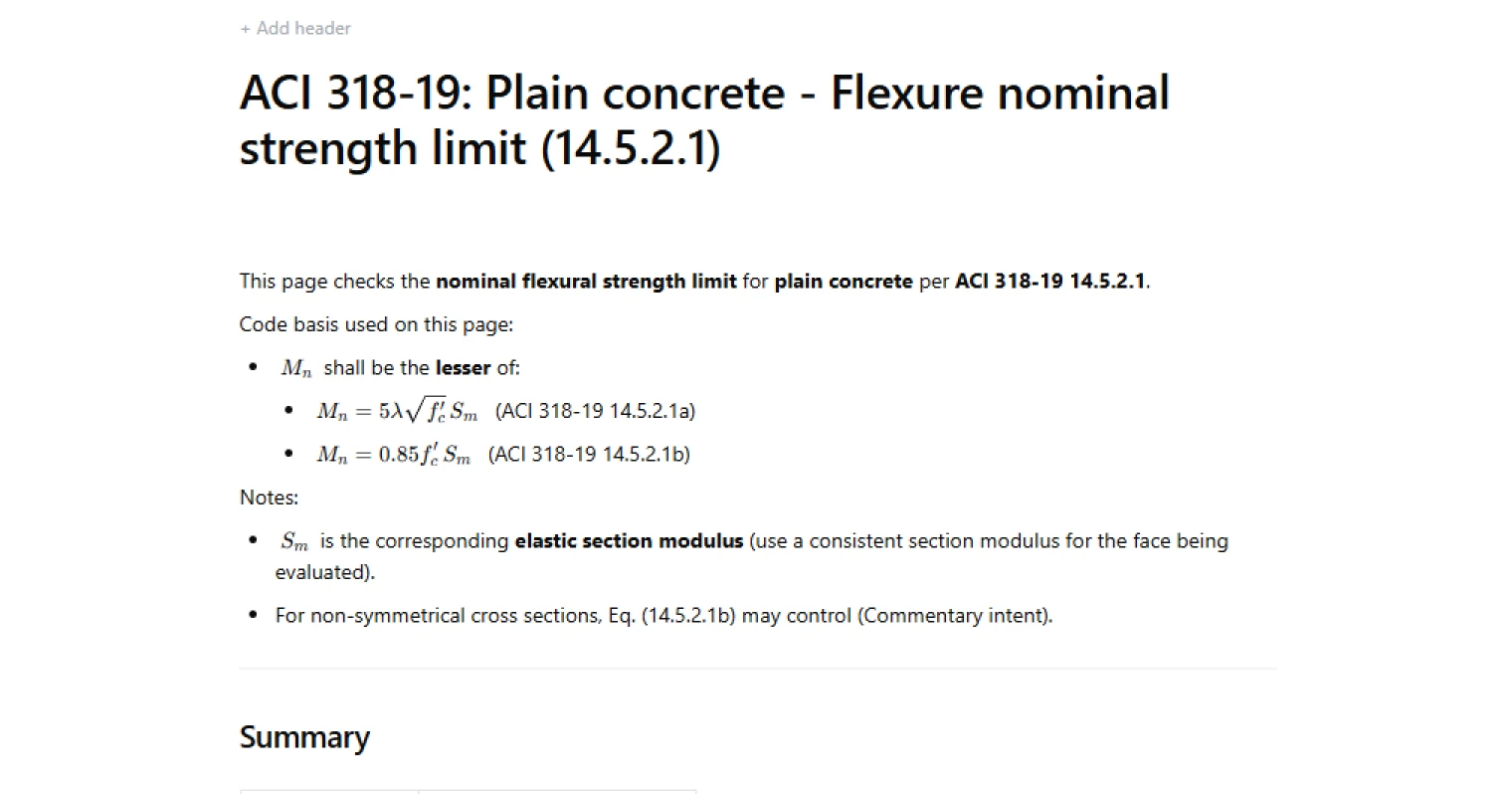
This calculator checks the nominal flexural strength limit for plain concrete structural members per ACI 318-19 Section 14.5.2.1. It evaluates both code expressions, identifies the governing limit, and compares the result against the factored moment demand to confirm adequacy.
- Structural engineer — verify plain concrete walls, footings, or slabs against the flexural strength limit without manually tracking which equation governs.
- Foundation designer — check moment capacity for unreinforced concrete elements during preliminary or detailed design, with lightweight concrete accounted for through the lambda factor.
- Plan checker or reviewer — trace every input and intermediate result in one place to confirm compliance with ACI 318-19 requirements.
This is an engineering-grade calculator on CalcTree that applies the code equations directly, flags pass/fail automatically, and can be saved, shared, and audited as part of a project calculation set.
More Info on ACI 318-19: Plain Concrete – Flexure Nominal Strength Limit (14.5.2.1)
Inputs
The calculator requires four engineering inputs. The factored moment demand is the applied moment at the face of the section being evaluated, consistent with the load combinations used in design. The elastic section modulus must correspond to the same face, which is especially important for non-symmetrical cross sections where tension and compression faces have different section moduli. Concrete compressive strength and the lightweight concrete modification factor round out the inputs. The lambda factor defaults to one for normal-weight concrete and takes a reduced value for lightweight or sand-lightweight concrete per ACI 318-19 Table 19.2.4.2.
Code Equations and Method
ACI 318-19 Section 14.5.2.1 defines nominal flexural strength using two expressions. The first is based on the modulus of rupture, scaled by the lightweight factor and the square root of the specified compressive strength, then multiplied by the elastic section modulus. The second is a compression-controlled limit, using a fixed fraction of the compressive strength multiplied by the elastic section modulus. The lesser of the two values governs. This dual-equation approach exists because for non-symmetrical sections, the compression-controlled expression can become the binding limit depending on cross-sectional geometry and concrete strength. The calculator evaluates both expressions independently before selecting the governing value.
Outputs and Design Check
The calculator reports the nominal flexural strength from each equation separately, then identifies the governing value as the lesser of the two. A strength check compares the factored moment demand against the governing nominal strength. The check returns a clear pass or fail result. An option to suppress checks is included for cases where the template is being used purely to compute capacity without evaluating a specific demand.
Applicability and Limitations
This template applies specifically to plain concrete members as defined in ACI 318-19 Chapter 14. It does not apply to reinforced or prestressed concrete elements, and it does not include the strength reduction factor phi, which must be applied separately in accordance with ACI 318-19 Table 21.2.2 before comparing factored demand to design strength. The elastic section modulus used must reflect the gross uncracked section, consistent with the plain concrete provisions.
Common Calculation Errors to Avoid
- Using the reinforced concrete phi factor — plain concrete members use a different strength reduction factor per ACI 318-19 Table 21.2.2; applying the reinforced concrete value will give an unconservative result.
- Using the wrong section modulus for non-symmetrical sections — for sections where the neutral axis is not centred, the tension and compression faces have different section moduli; using the wrong one can overstate the governing nominal strength.
- Skipping the comparison between both equations — ACI 318-19 14.5.2.1 requires taking the lesser value; only computing one expression and assuming it controls is a non-conservative shortcut.
- Applying lambda incorrectly — lightweight and sand-lightweight concrete require reduced lambda values per ACI 318-19 Table 19.2.4.2; defaulting to one for all concrete types is unconservative for lightweight mixes.
- Confusing nominal strength with design strength — this calculator outputs nominal moment capacity; phi must still be applied before the strength check is formally complete in a design context.
- Inconsistent units in the square root term — the expression under the square root takes compressive strength in psi; using MPa or ksi without conversion will produce an incorrect modulus of rupture and an erroneous capacity.
Engineering templates
Common calculators
Design guides




FAQs
What is the nominal flexural strength limit for plain concrete per ACI 318-19 14.5.2.1?
ACI 318-19 Section 14.5.2.1 limits the nominal flexural strength of plain concrete to the lesser of two expressions: Mn = 5λ√f'c · Sm (tension-governed, based on modulus of rupture) and Mn = 0.85f'c · Sm (compression-governed). The lesser value controls because plain concrete has no reinforcement to redistribute stress after cracking, so the code caps capacity at whichever failure mode governs first.
Why does ACI 318-19 provide two separate equations for plain concrete flexure?
The two-equation framework accounts for both tension and compression failure modes. Equation 14.5.2.1a is based on the modulus of rupture and governs when the tension face is critical. Equation 14.5.2.1b caps capacity at the compression side. For non-symmetrical sections, the two faces have different section moduli, so the compression equation can govern at the shallow face even when the tension face is the design focus. The commentary explicitly flags this for non-symmetrical cross sections.
Which elastic section modulus should I enter for Sm?
Use the section modulus corresponding to the face being checked, not a generic value for the cross section. For a symmetrical section, both faces give the same Sm. For a non-symmetrical section, the tension face and compression face have different Sm values, and you should run separate checks for each face. This calculation checks one face at a time, so re-run with the appropriate Sm if you need to verify both faces.
What value should I use for the lightweight concrete factor lambda?
Lambda accounts for reduced tensile strength in lightweight concrete. Use λ = 1.0 for normalweight concrete, λ = 0.75 for lightweight concrete, or an intermediate value based on sand-lightweight blends per ACI 318-19 Table 19.2.4.2. The factor only appears in Eq. 14.5.2.1a since that equation is derived from the modulus of rupture, which is a tensile property sensitive to aggregate type.
What is Mu in this calculation and how should it be determined?
Mu is the factored moment demand at the face being checked, calculated from your structural load analysis using ACI 318-19 load combinations. It must be consistent with the face and section modulus you are checking. This template does not calculate Mu; it is a user input. Ensure your Mu reflects the critical load combination before entering it.
How do I interpret a Fail result on the flexure check?
A Fail means Mu exceeds the governing Mn, indicating the plain concrete section lacks sufficient flexural capacity under the factored loading. You should increase the section depth or width to raise Sm, increase f'c, or reconsider whether a reinforced concrete design is more appropriate for the loading demands.
Learn about the benefits of using CalcTree on engineering projects!