
Calculate ACI 318-19 λ_a for lightweight concrete anchor design per Table 17.2.4.1. Supports tested alternate values. Run the free calc on CalcTree.

Tell us what you need, or sign up and build it yourself in minutes.
Leave your email and we'll tell you when a template for it is ready:

No items found.
No items found.
About this Lightweight Concrete Anchor λa Calculator
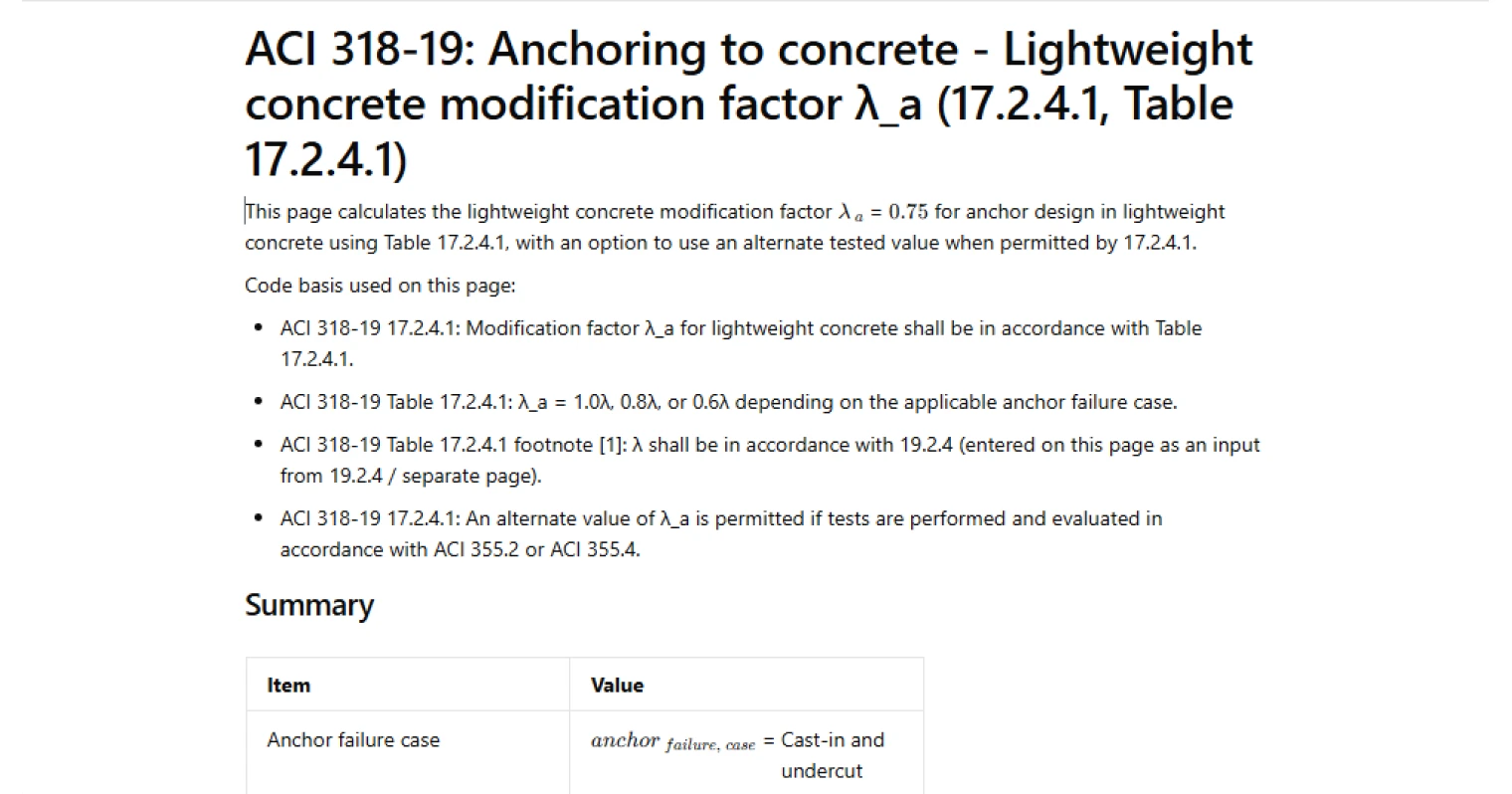
This calculator determines the lightweight concrete modification factor λa for anchor design per ACI 318-19 Table 17.2.4.1. It selects the appropriate table multiplier based on the governing anchor failure case and applies it to λ (taken from ACI 318-19 19.2.4). Where permitted by ACI 318-19 17.2.4.1, it also supports using an alternate λa derived from testing evaluated to ACI 355.2 or ACI 355.4.
- Structural engineer — selects the correct λa for anchor design checks (breakout, pullout, bond) and keeps the factor traceable back to the failure mode assumption.
- Connection / façade engineer — standardises lightweight-concrete reductions across multiple anchor conditions and clearly documents when test-based values are being used.
- Quality / compliance engineer — verifies that any alternate λa is only applied when test qualification requirements are explicitly satisfied.
This is an engineering-grade CalcTree calculator: it makes the code basis explicit, shows the intermediate multiplier and table λa, and provides pass/fail checks so the chosen factor is auditable in a design workflow.
More info on Lightweight Concrete Anchor λa
Inputs
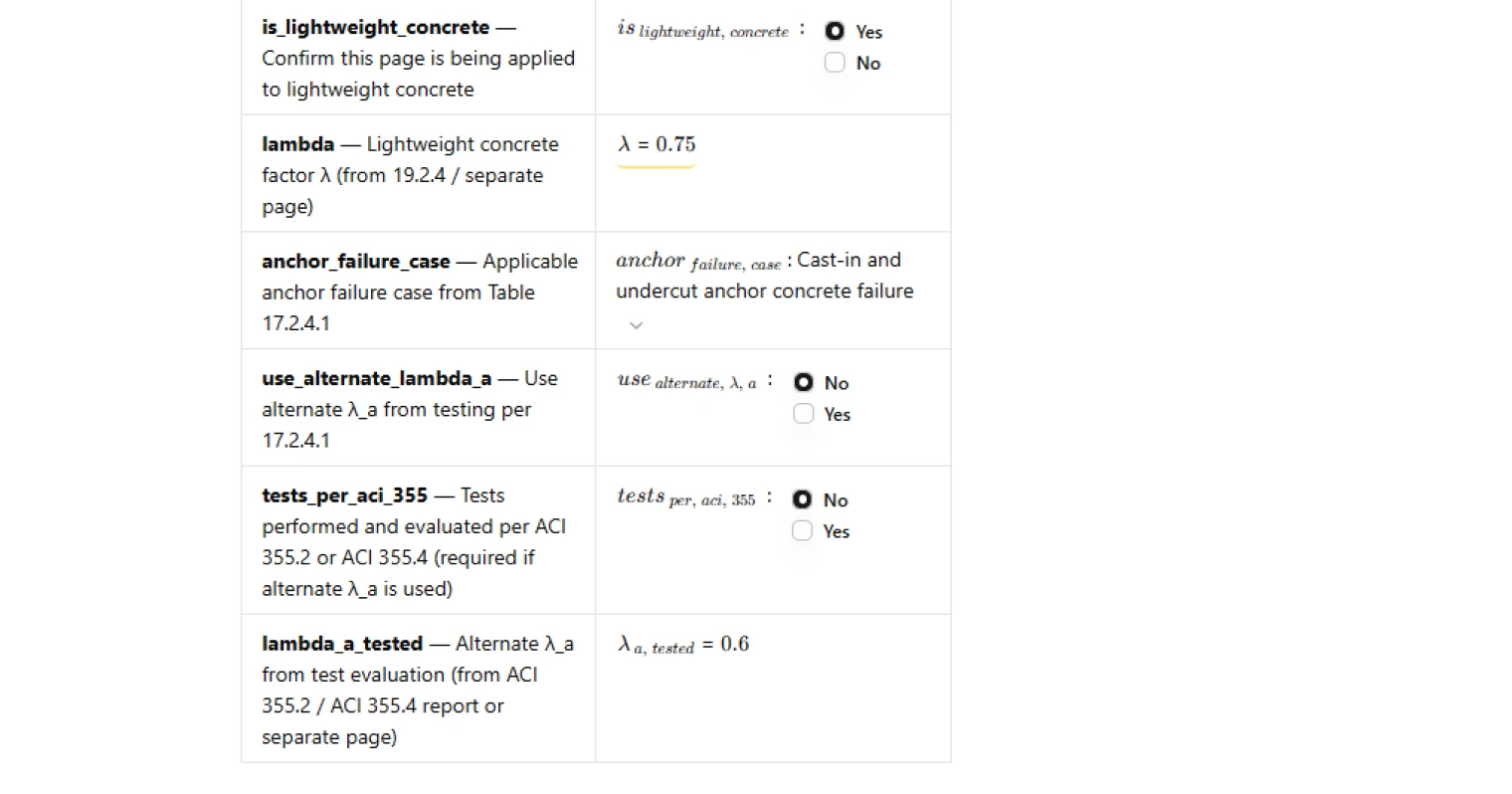
The page is driven by a small set of inputs that map directly to ACI 318-19 17.2.4.1 and Table 17.2.4.1:
- A scope confirmation that the design is for lightweight concrete.
- The lightweight concrete factor λ from ACI 318-19 19.2.4 (typically maintained on a separate page and referenced here).
- The applicable anchor failure case selection from Table 17.2.4.1.
- An option to use an alternate tested λa, plus a confirmation that testing was performed and evaluated per ACI 355.2 or ACI 355.4, and the tested λa value.
Table 17.2.4.1 mapping
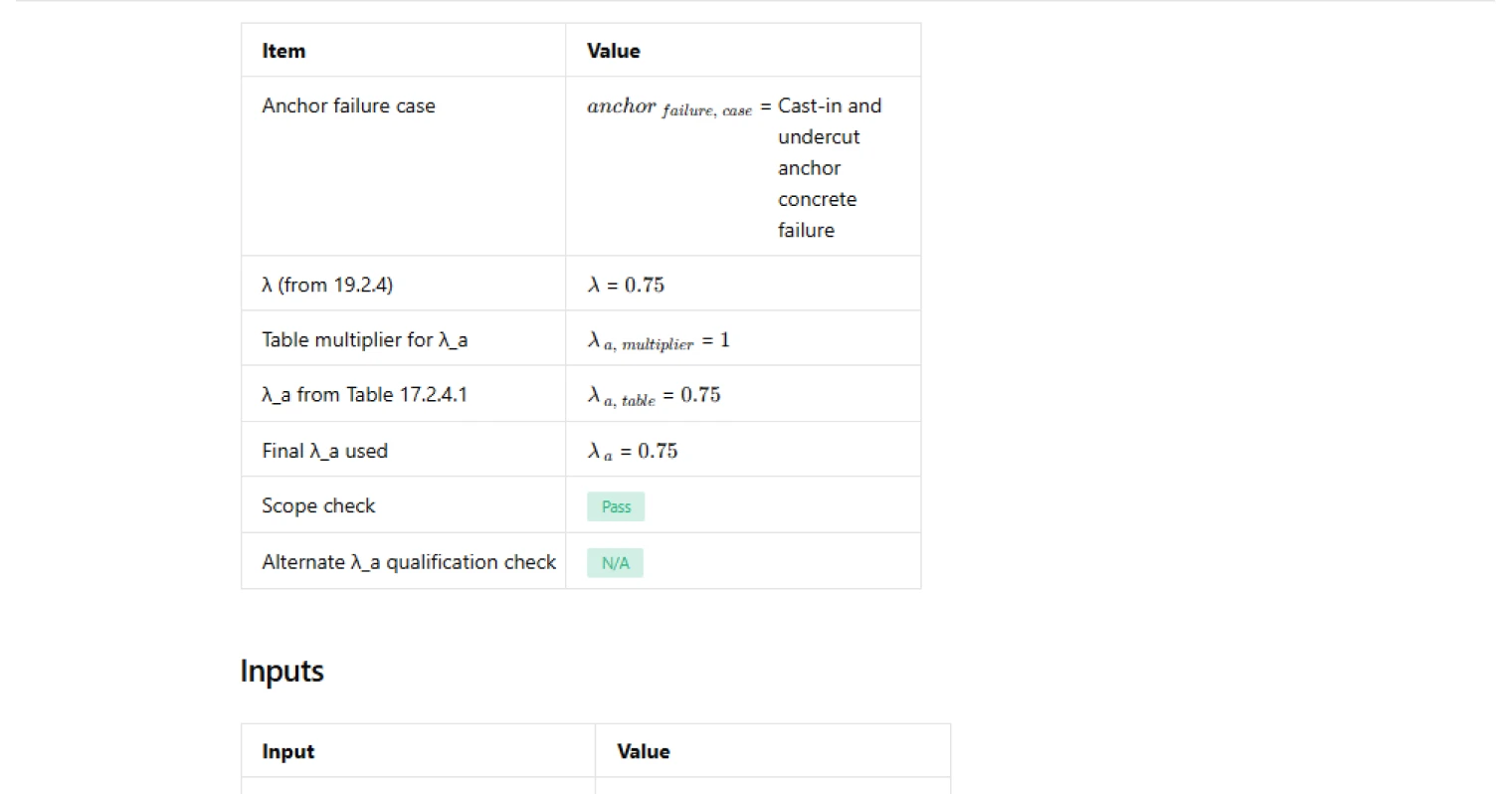
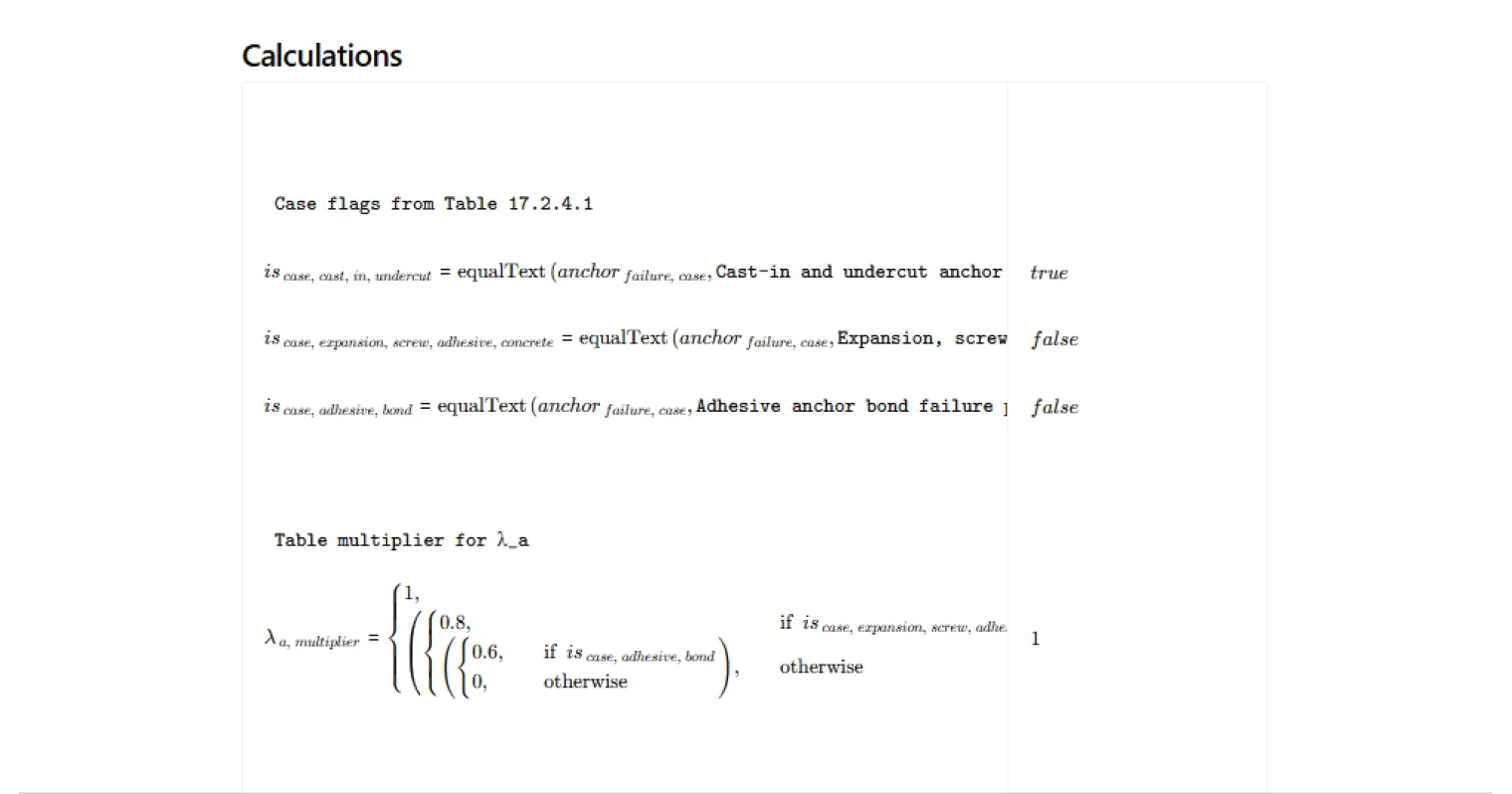
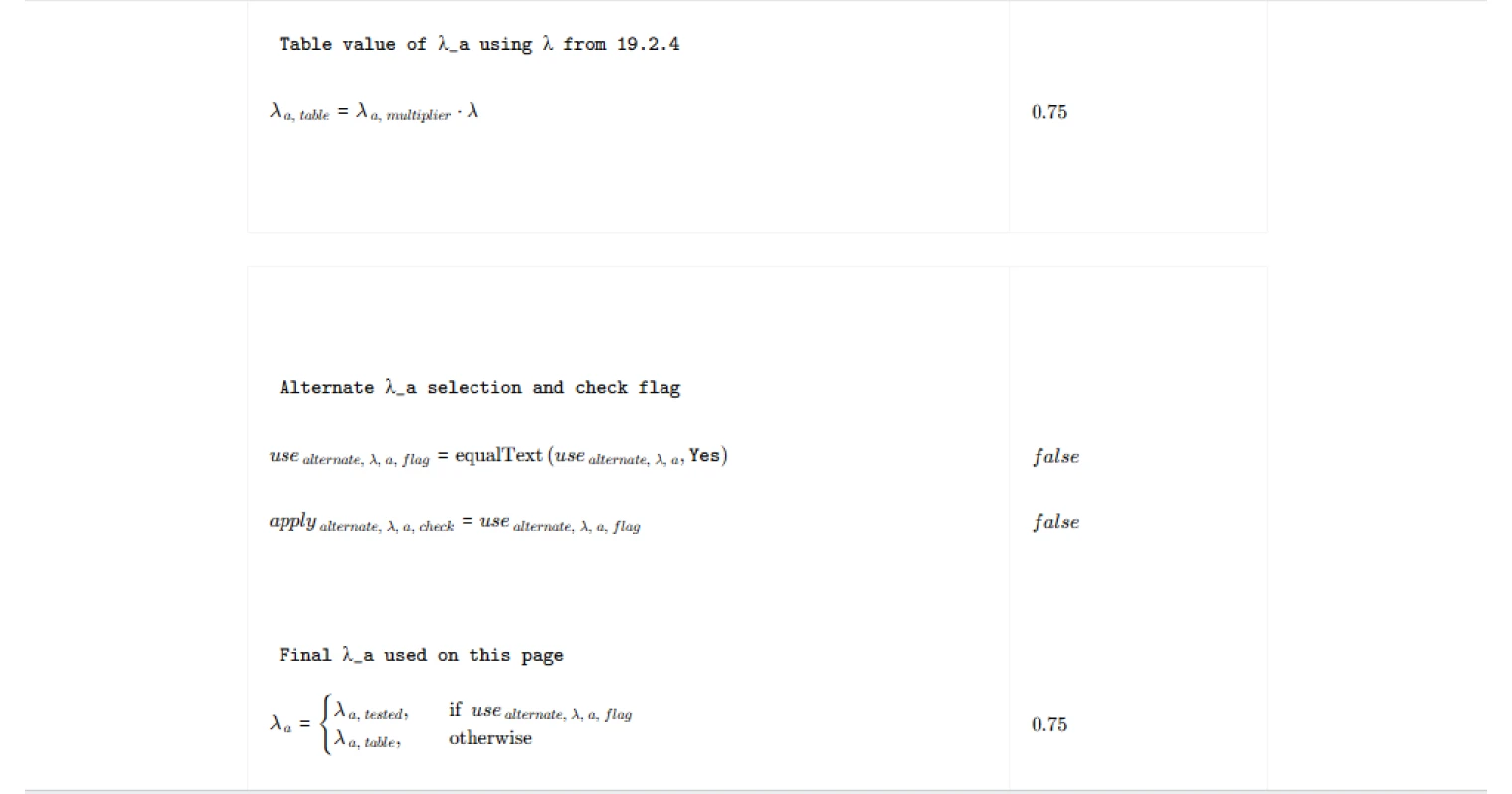
The calculator converts the selected anchor failure case into a table multiplier. It then computes the table-based value as:
- λa,table = (table multiplier) × λ
This isolates the code intent: Table 17.2.4.1 provides the multiplier (based on failure case), while λ itself is sourced from 19.2.4 and treated as an input on this page.
Alternate λa selection and qualification
ACI 318-19 17.2.4.1 permits an alternate λa when supported by testing evaluated to ACI 355.2 or ACI 355.4. The page implements this as a controlled override:
- If “use alternate λa” is selected, λa is taken from the tested input value.
- A dedicated qualification check confirms the required test basis is acknowledged before the alternate value is treated as valid for use.
- If the alternate option is not selected, the calculator uses the table-based λa.
Outputs and checks
The page reports the selected anchor failure case, λ, the multiplier, the table-based λa, and the final λa used. Two checks are provided:
- A scope check that the page is only being applied to lightweight concrete.
- An alternate λa qualification check that becomes active only when the alternate option is selected.
These outputs are designed to support quick peer review: you can see which failure case drove the multiplier and whether a tested value was substituted.
Common Calculation Errors to Avoid
- Using this page for normalweight concrete — λa modifiers in Table 17.2.4.1 are for lightweight concrete; if the concrete is normalweight, the lightweight reductions should not be applied.
- Selecting the wrong anchor failure case — the multiplier depends on the assumed governing failure mechanism; misclassifying the failure mode can under- or over-reduce the design strength.
- Confusing λ with λa — λ is an input from 19.2.4; λa is the anchor-specific factor after applying the Table 17.2.4.1 multiplier.
- Applying an alternate λa without test qualification — ACI 318-19 only permits alternate λa when testing is evaluated per ACI 355.2 or ACI 355.4; document and verify that basis before using the tested value.
- Leaving the table mapping in a fallback state — ensure the failure case selection always maps to a valid multiplier; an unmapped selection should be treated as an input/configuration error, not silently accepted.
Engineering templates
Common calculators
Design guides




FAQs
What is the lightweight concrete modification factor λ_a and why does it matter for anchor design?
λ_a reduces anchor design strengths to account for the lower tensile capacity and fracture energy of lightweight concrete compared to normalweight concrete. Anchors rely on concrete breakout, bond, and splitting resistance — all of which are reduced in lightweight mixes. ACI 318-19 Section 17.2.4.1 and Table 17.2.4.1 codify this reduction by multiplying the standard lightweight factor λ (from 19.2.4) by a case-specific multiplier of 1.0, 0.8, or 0.6 depending on the anchor failure mode being checked.
How do I choose the correct anchor failure case from Table 17.2.4.1?
The failure case depends on the anchor type and the limit state being evaluated. Use "Cast-in and undercut anchor concrete failure" for cast-in-place or undercut anchors governed by concrete breakout. Use "Expansion, screw, and adhesive anchor concrete failure" for those anchor types when governed by concrete failure. Use "Adhesive anchor bond failure per Eq. (17.6.5.2.1)" specifically when checking the bond strength of adhesive anchors. Each case maps to a different multiplier (1.0λ, 0.8λ, or 0.6λ), so selecting the wrong case directly affects your calculated capacity. If multiple failure modes govern across different limit states, run the calculation separately for each applicable case.
Where does the λ input come from, and what values are typical?
λ is the general lightweight concrete factor defined in ACI 318-19 Section 19.2.4. It is not calculated on this page — it is entered as an input carried over from a separate 19.2.4 calculation. Typical values are 0.75 for lightweight concrete of unspecified type and 0.85 for sand-lightweight concrete, though 19.2.4 also permits using a value derived from splitting tensile test data. Confirm which value applies to your mix design before entering it here.
When can I use an alternate tested value of λ_a instead of the table value?
ACI 318-19 Section 17.2.4.1 permits an alternate λ_a if the anchor system has been tested and the results evaluated in accordance with ACI 355.2 (for mechanical anchors) or ACI 355.4 (for adhesive anchors). This option is useful when a manufacturer's qualification testing was performed in lightweight concrete and yields a less conservative λ_a than the table default. To use this path, set "use alternate λ_a" to Yes, confirm testing complies with ACI 355.2 or 355.4, and enter the tested value. The calculation includes a qualification check that will flag a failure if the testing compliance confirmation is not provided.
What does the scope check flag, and what should I do if it fails?
The scope check confirms that this page is being applied to lightweight concrete. If you select "No" for the is_lightweight_concrete input, the check will fail with a clear message. For normalweight concrete, λ_a = 1.0 by default and no separate modification factor calculation is needed — this page does not apply in that case. If you are working with normalweight concrete, disregard this page and use λ_a = 1.0 directly in your anchor strength calculations.
Learn about the benefits of using CalcTree on engineering projects!