
Calculate Flexural Strength – Nominal Moment Strength of Rectangular Beam per ACI 318-19. Get Mn, ρ, and φMn≥Mu checks instantly. Try it free.

Tell us what you need, or sign up and build it yourself in minutes.
Leave your email and we'll tell you when a template for it is ready:
No items found.
No items found.
About this Flexural Strength - Nominal Moment Strength of Rectangular Beam Calculator
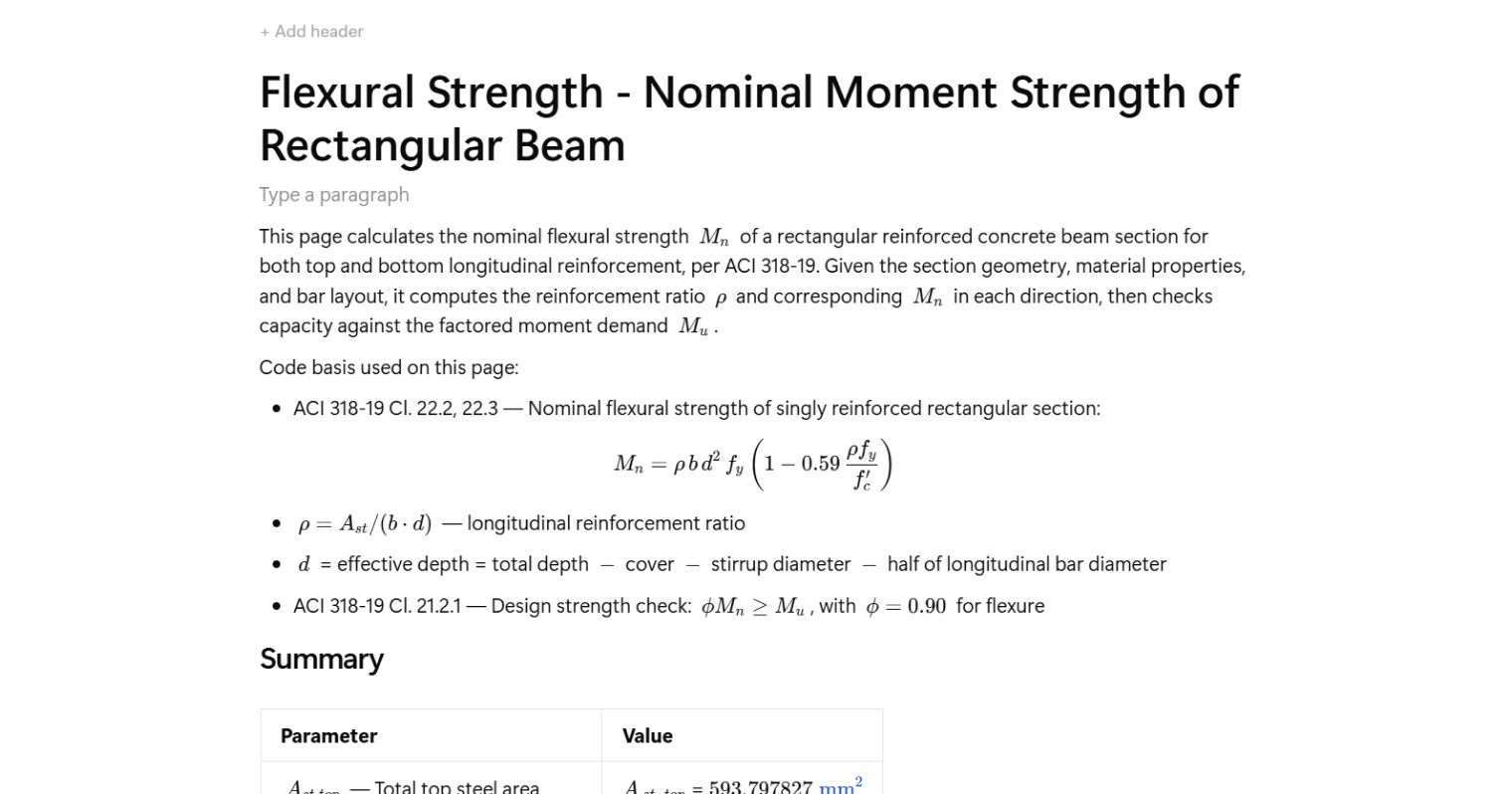
This calculator computes the nominal flexural strength of a singly reinforced rectangular concrete beam section per ACI 318-19. It handles both top and bottom longitudinal reinforcement independently, deriving effective depths, reinforcement ratios, and nominal moment capacities before checking each against the factored moment demand.
- Structural engineer — verify beam flexural capacity during design or peer review, with full traceability from bar layout through to the φMn ≥ Mu check.
- RC detailer — confirm that selected bar sizes and counts satisfy ACI 318-19 demand requirements before finalizing drawings.
- Graduate engineer — step through a code-compliant flexural strength calculation with clear inputs, intermediate values, and explicit clause references.
This is an engineering-grade calculator built on CalcTree, where you can audit every step, adjust inputs live, and save the calculation directly to a project page.
More info on Flexural Strength - Nominal Moment Strength of Rectangular Beam
Inputs
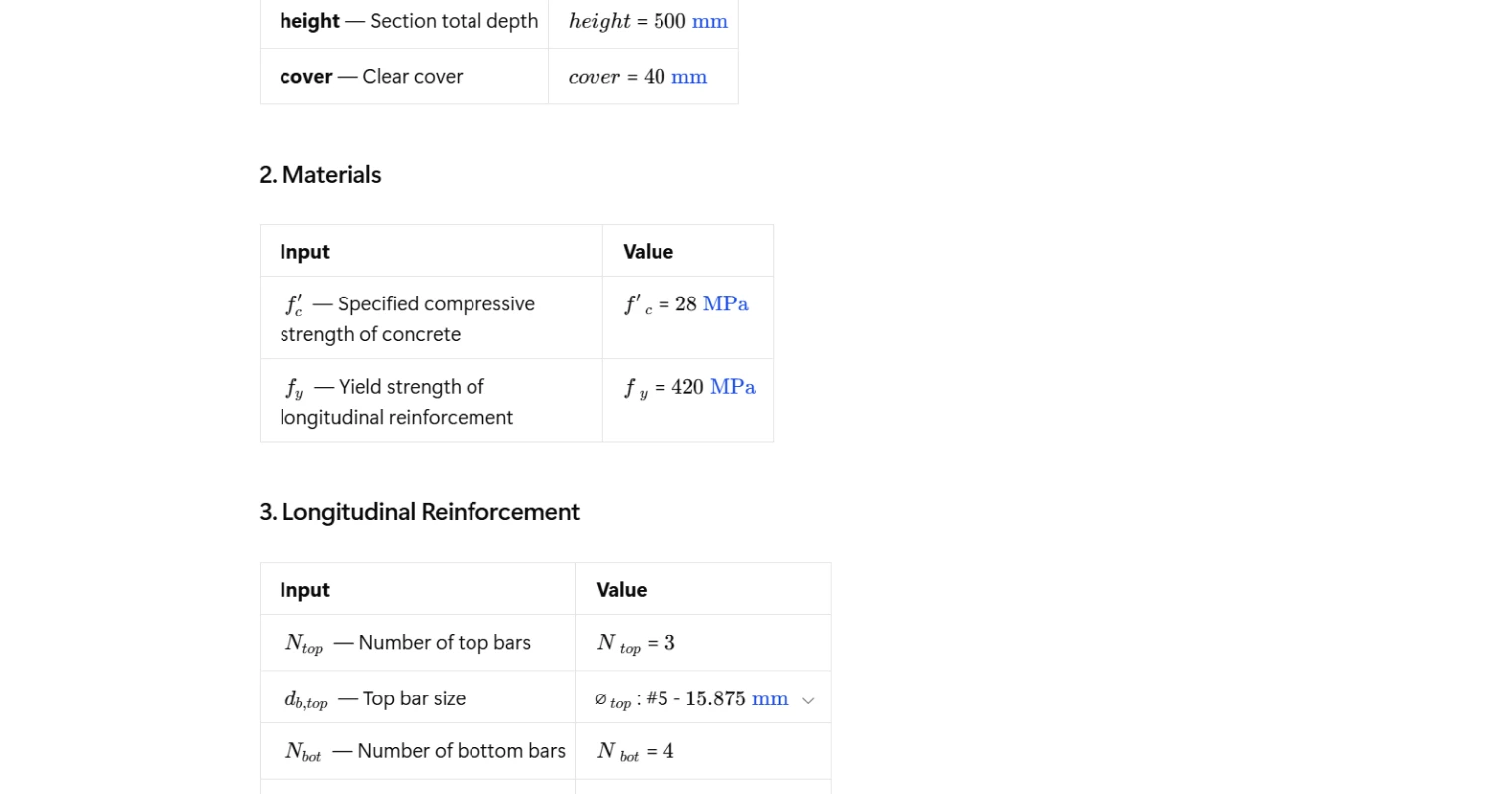
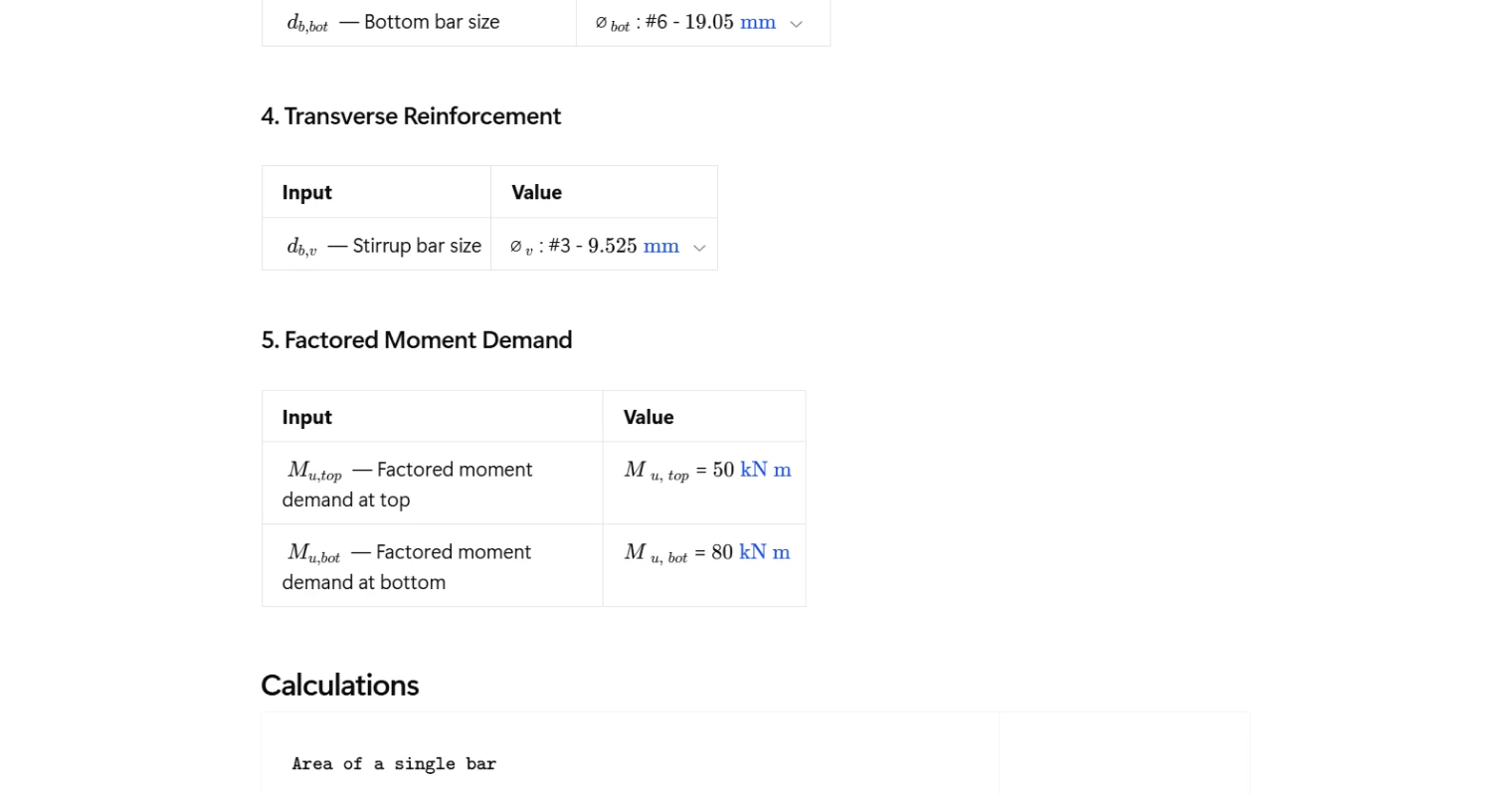
The calculator takes section geometry (width, total depth, and clear cover), material properties (concrete compressive strength f'c and steel yield strength fy), and longitudinal bar layout (number and size of top and bottom bars). Stirrup diameter is also required, as it directly affects the computed effective depth for each reinforcement layer. Factored moment demands Mu,top and Mu,bot are entered separately to allow independent capacity checks at both faces of the section.
Derived Section Properties
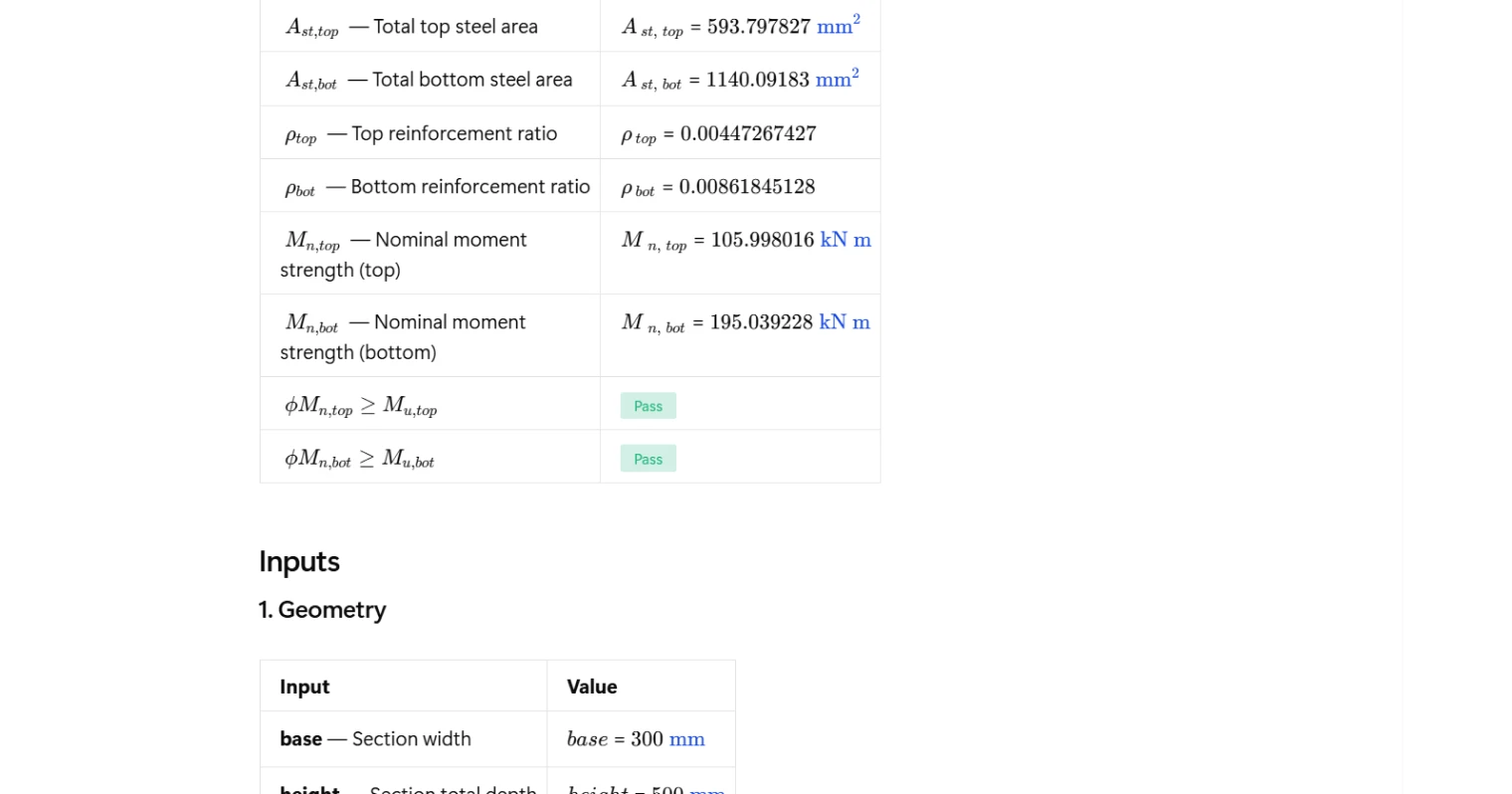
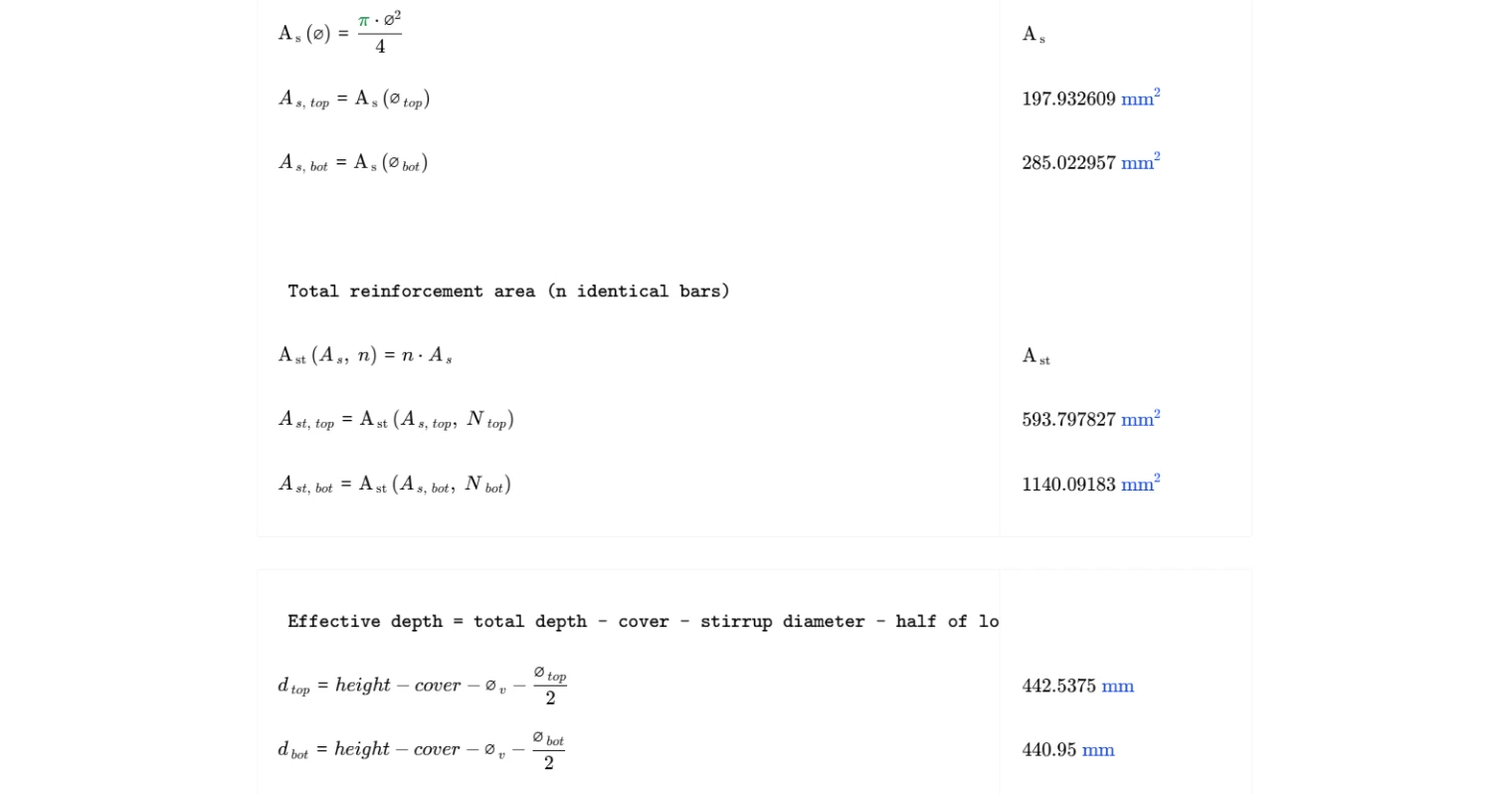
From the geometry and bar layout, the calculator computes the effective depth d for both the top and bottom reinforcement layers. Effective depth is taken as total section depth minus clear cover, minus stirrup diameter, minus half the longitudinal bar diameter. Individual bar areas are computed from the selected bar diameter, then summed across the number of bars to give the total steel area Ast for each face. The reinforcement ratio ρ is then derived as Ast divided by the product of section width and effective depth.
Nominal Flexural Strength
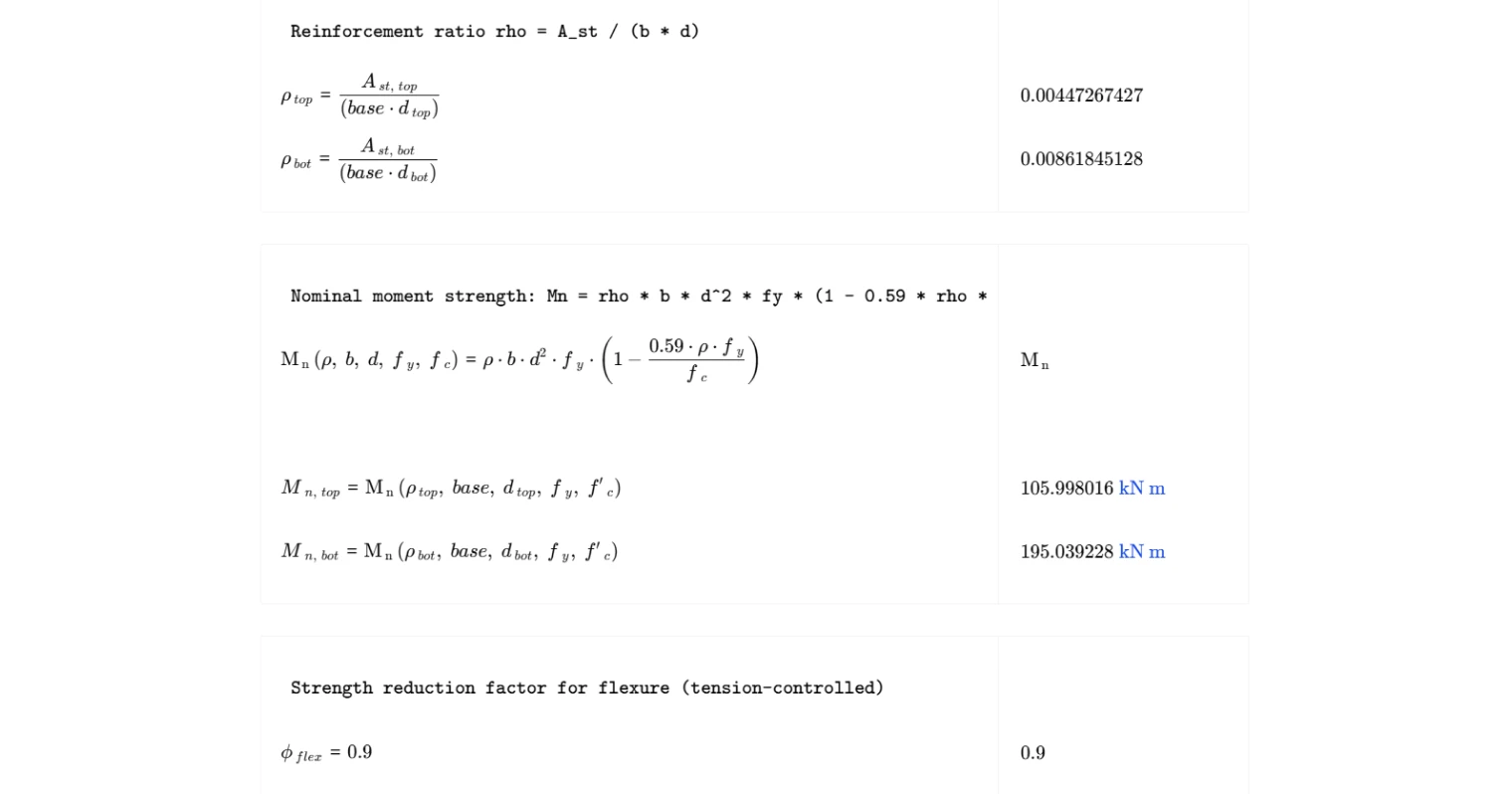
Nominal moment strength Mn is calculated for both the top and bottom steel using the ACI 318-19 rectangular stress block formulation per Cl. 22.2 and 22.3. The equation expresses Mn as a function of ρ, section width, effective depth, fy, and f'c, with the term in parentheses accounting for the reduction in internal moment arm as the compression zone deepens with increasing reinforcement ratio. This is evaluated independently for top and bottom steel using their respective effective depths and reinforcement ratios.
Design Strength Checks
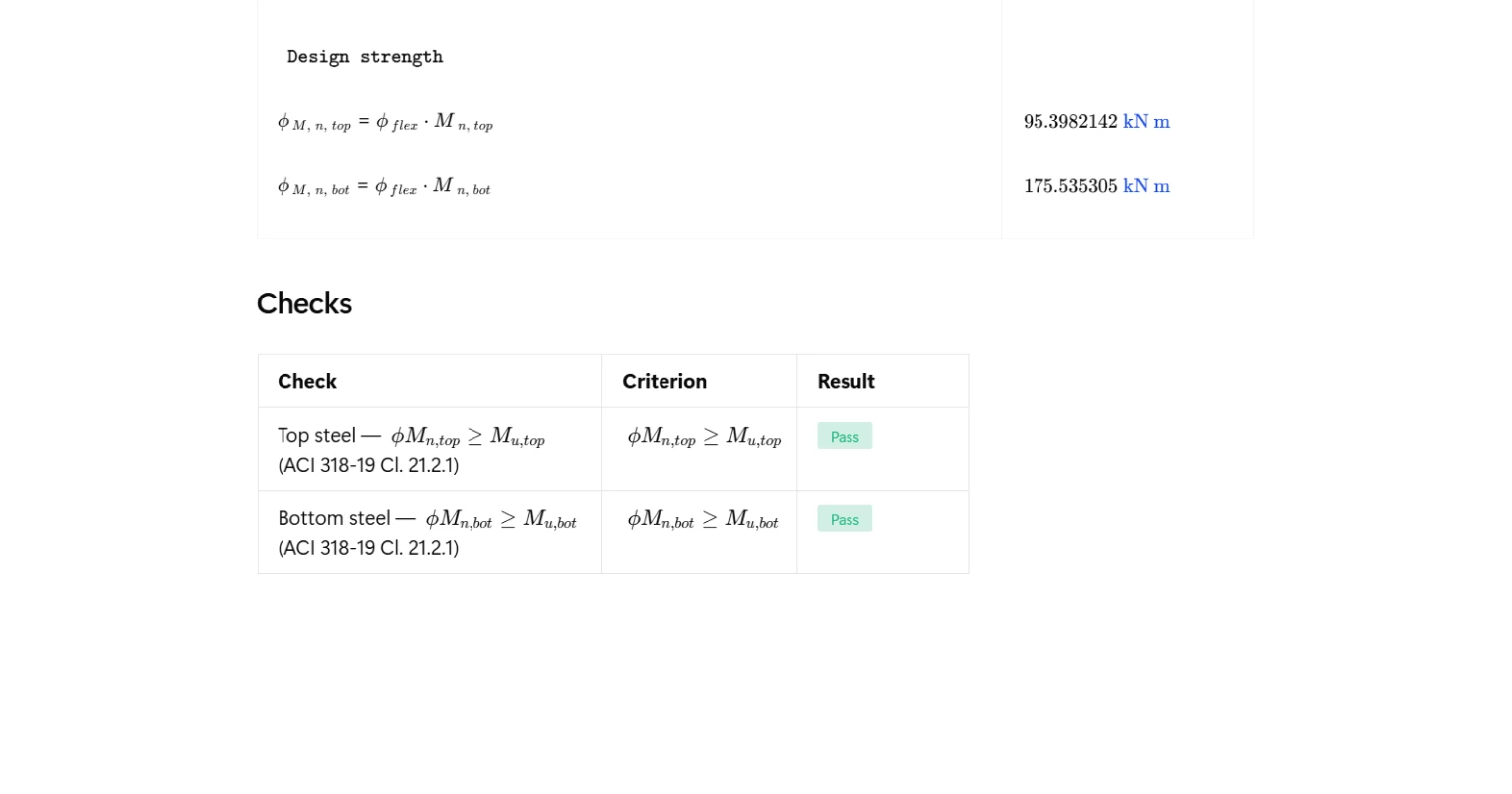
The strength reduction factor φ of 0.90 is applied to each nominal moment to obtain the design flexural strength φMn, per ACI 318-19 Cl. 21.2.1. The calculator then checks φMn,top ≥ Mu,top and φMn,bot ≥ Mu,bot separately, reporting a pass or fail result for each. This makes it straightforward to identify which face of the beam, if either, is deficient and by how much, without manually tracking intermediate results.
Common Calculation Errors to Avoid
- Using gross depth instead of effective depth — substituting total section height h for the effective depth d inflates Mn significantly. Always deduct cover, stirrup diameter, and half the bar diameter to get the correct lever arm.
- Ignoring stirrup diameter in the effective depth calculation — omitting the stirrup layer from the depth reduction is a common oversight, particularly for larger stirrup sizes, and leads to an unconservative effective depth.
- Applying a single reinforcement ratio to both faces — top and bottom steel often differ in bar count, bar size, and effective depth. Each face must be evaluated with its own Ast and d.
- Confusing Mn with φMn — Mn is the nominal capacity; the code check requires the reduced design strength φMn to be compared against Mu. Using unreduced Mn against demand is unconservative.
- Entering Mu without load combinations — Mu must already account for the governing LRFD load combination. Entering an unfactored moment and comparing it to φMn will produce a meaningless result.
- Using inconsistent unit systems — mixing imperial bar designations with metric section dimensions, or entering f'c in psi while fy is in MPa, will produce incorrect reinforcement ratios and moment values. Keep all inputs in a consistent unit system throughout.
Engineering templates
Common calculators
Design guides




FAQs
What does this calculation actually check?
It computes the nominal flexural strength Mn of a singly reinforced rectangular concrete beam section per ACI 318-19, for both top and bottom steel independently. It then applies the strength reduction factor φ = 0.90 and checks that φMn meets or exceeds the factored moment demand Mu at each face.
How is the nominal moment strength formula derived?
The formula Mn = ρ · b · d² · fy · (1 − 0.59 · ρfy/f'c) comes from ACI 318-19 Cl. 22.2 and 22.3, based on a rectangular stress block assumption at ultimate. The 0.59 factor is a simplification of the stress block depth parameter, valid for singly reinforced sections with tension-controlled behavior. It assumes the steel yields before concrete crushes, which should be confirmed separately for heavily reinforced sections.
Why does the calculation use separate effective depths for top and bottom steel?
Effective depth d depends on bar diameter, so top and bottom bars of different sizes produce different d values. The template computes d = height − cover − stirrup diameter − half of longitudinal bar diameter for each layer separately. Using the wrong d, even by a few millimeters, directly affects the Mn result, so this distinction matters.
Why are separate Mu inputs required for top and bottom?
Top steel resists hogging (negative) moments, typically at supports, while bottom steel resists sagging (positive) moments at midspan. These demands come from your moment envelope and are generally different values. Entering them separately lets the tool check each face of the beam against the correct factored demand.
What are the limitations of this calculation?
This template covers singly reinforced rectangular sections only. It does not account for compression steel contribution, T-beam or flanged behavior, axial load interaction, or moment redistribution. It also does not check minimum or maximum reinforcement ratio limits per ACI 318-19 Cl. 9.6.1 and 9.7.3, so those checks should be done alongside this calculation.
How do I use this for a different bar size or layout?
Update the bar size selectors for top and bottom steel and enter the number of bars. The template recalculates single bar area, total steel area, reinforcement ratio, and Mn automatically. If your section uses bundled bars or multiple layers, calculate an equivalent total steel area and verify that the effective depth assumption still holds for your actual bar arrangement.
Learn about the benefits of using CalcTree on engineering projects!