
Check max wall reinforcement spacing per ACI 318-19 Cl. 11.7.2 & 11.7.3. Covers cast-in-place, precast & two-layer rules. Try the free CalcTree template.

Tell us what you need, or sign up and build it yourself in minutes.
Leave your email and we'll tell you when a template for it is ready:
No items found.
No items found.
About this ACI 318 Wall Reinforcement Spacing Calculator
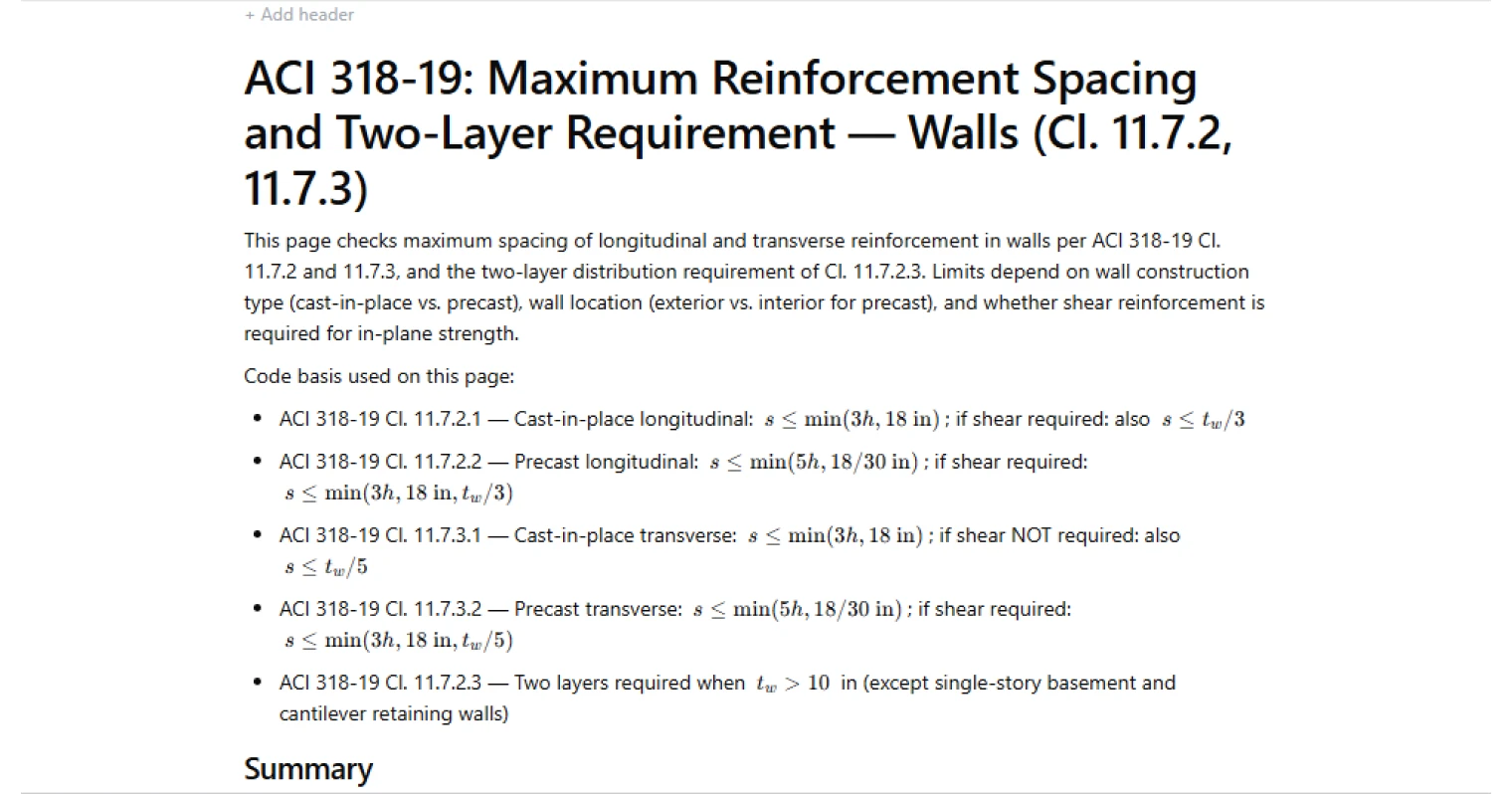
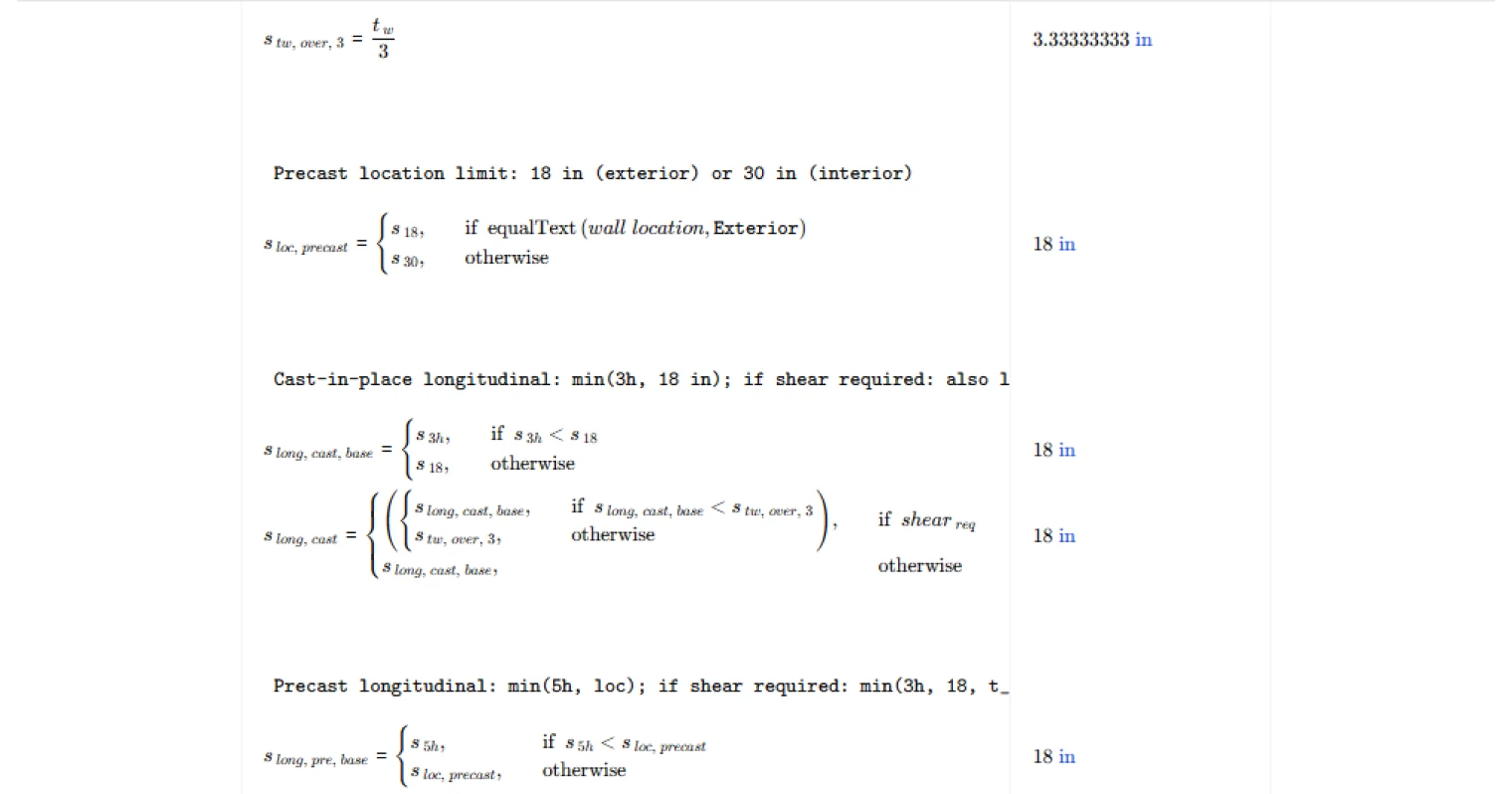
This calculator checks the maximum permitted spacing of longitudinal and transverse reinforcement in structural walls in accordance with ACI 318-19 Clause 11.7.2 and 11.7.3. It evaluates spacing limits based on wall construction type, wall location for precast systems, and whether in-plane shear reinforcement is required.
- Structural engineer — verify that distributed wall reinforcement spacing complies with ACI 318 limits during design or checking of concrete wall elements.
- Design engineer — quickly test alternative bar spacing layouts to confirm compliance before producing drawings or specifications.
- Engineering reviewer — confirm that reinforcement detailing provided in calculations or drawings meets the maximum spacing limits and distribution requirements of the code.
This calculator exposes the governing spacing limits, evaluates compliance of the provided reinforcement spacing, and checks whether two reinforcement layers are required based on wall thickness. It is an engineering-grade calculator on CalcTree that allows traceable verification of ACI wall reinforcement detailing rules.
More info on ACI 318 Wall Reinforcement Spacing
Inputs
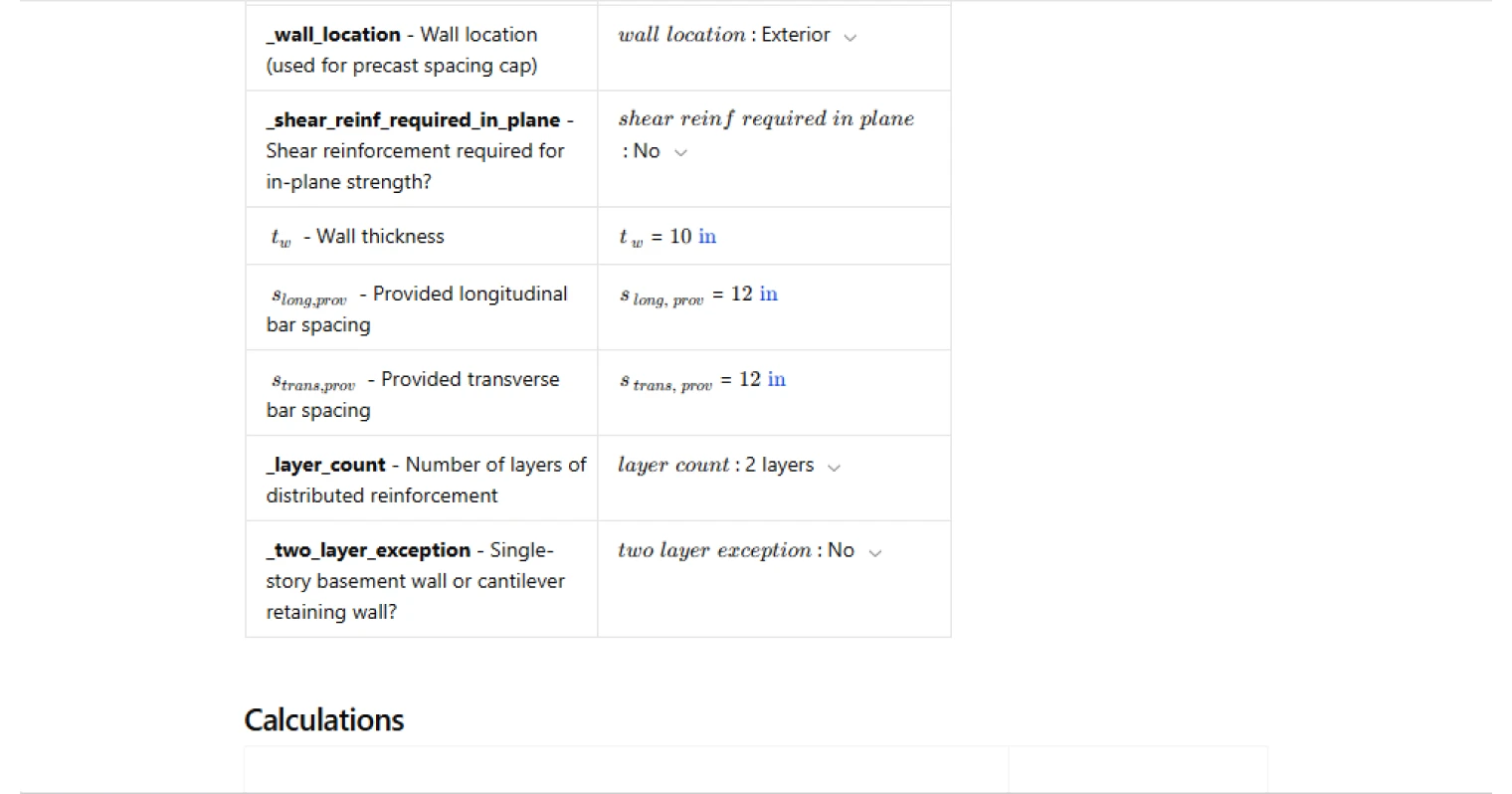
The calculator requires information describing the wall construction and reinforcement arrangement. These include the wall thickness, provided spacing of longitudinal and transverse reinforcement, and the number of distributed reinforcement layers. The user also specifies whether the wall is cast-in-place or precast, the wall location for precast construction, and whether in-plane shear reinforcement is required. These parameters determine the applicable spacing limits defined by ACI 318.
Longitudinal reinforcement spacing limits
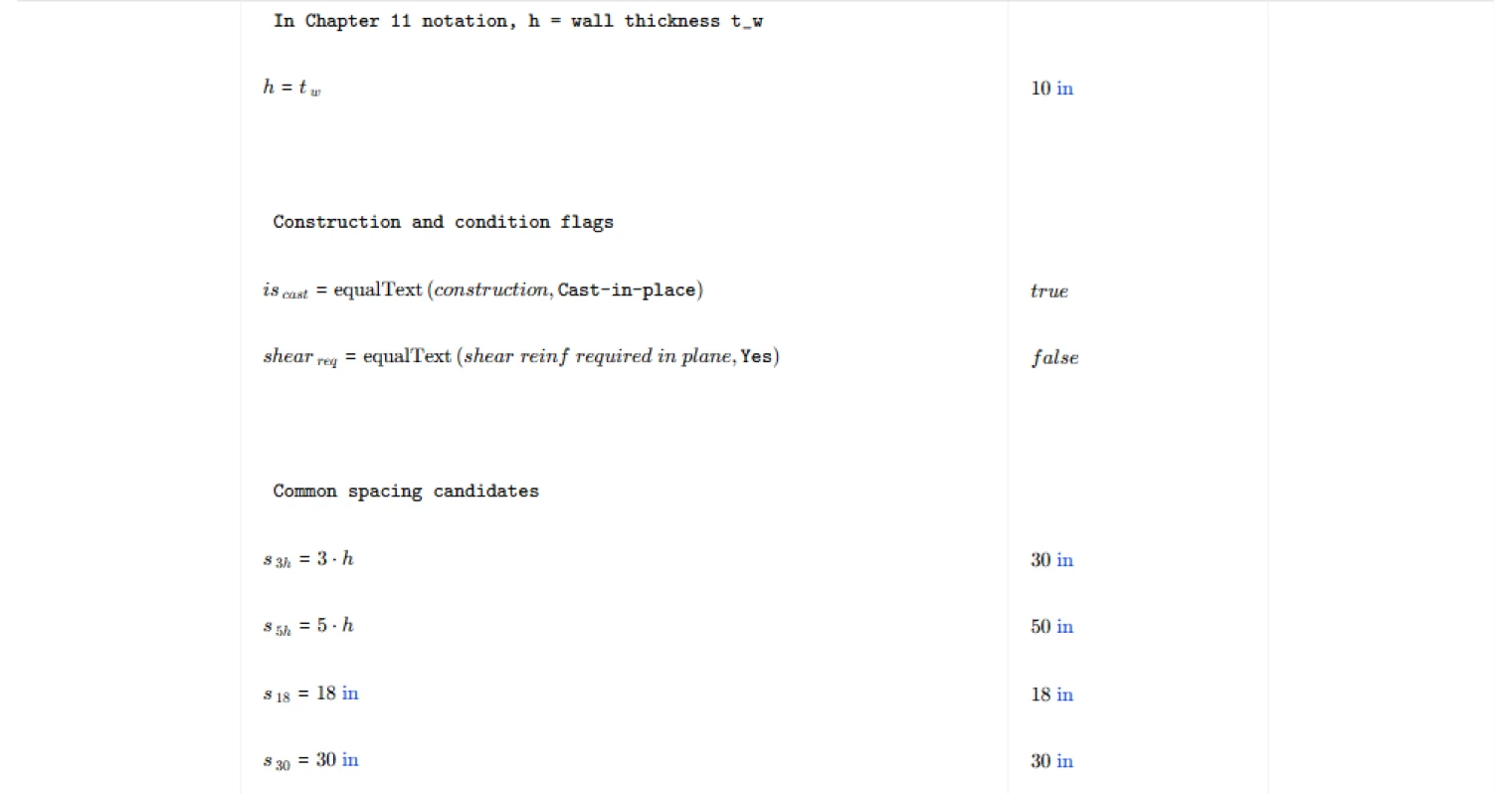
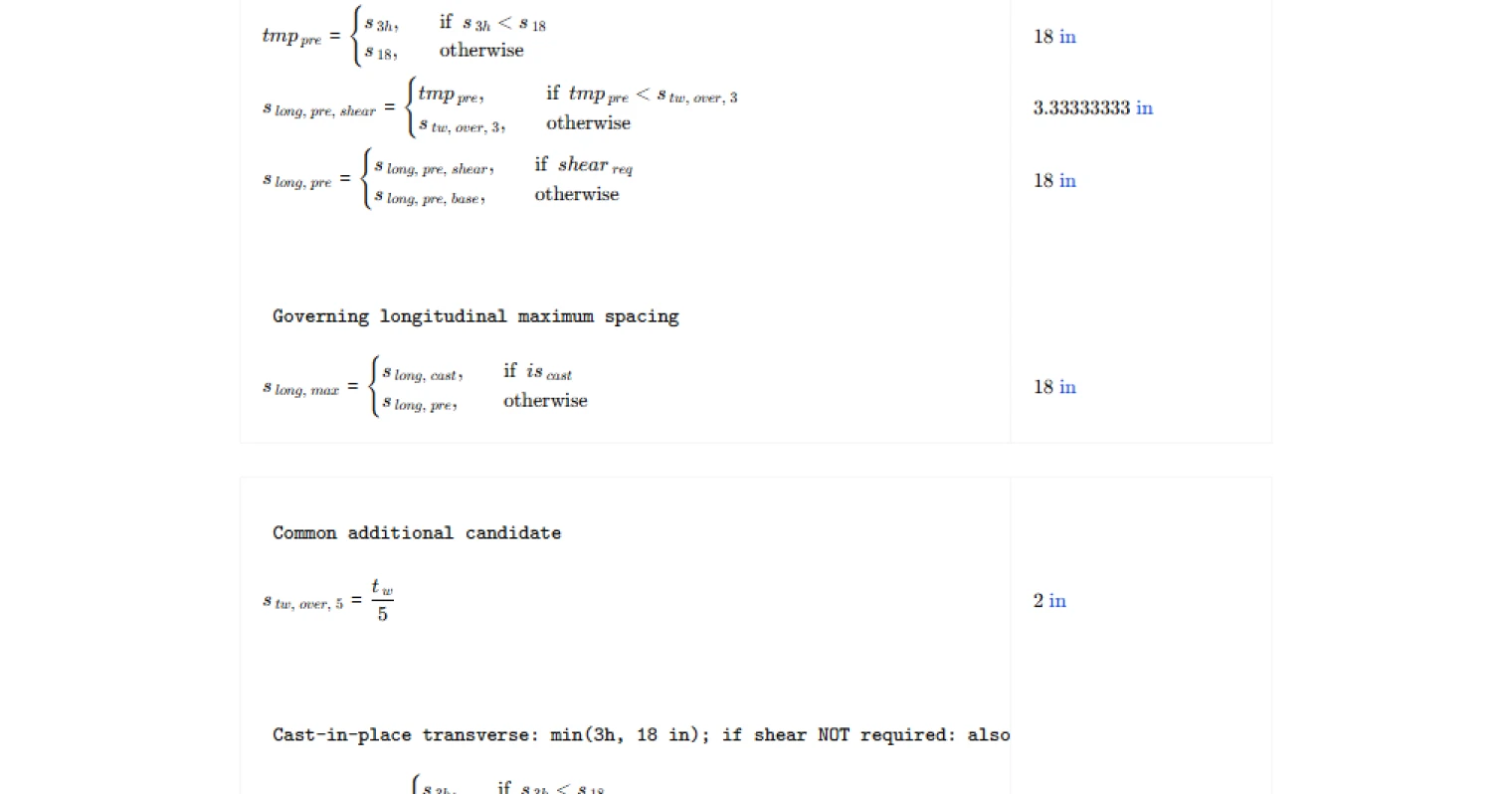
Maximum spacing for longitudinal reinforcement is determined using the rules of ACI 318 Clause 11.7.2. The allowable spacing depends on whether the wall is cast-in-place or precast. For precast walls, the maximum spacing also depends on whether the wall is interior or exterior. Additional spacing limits apply when in-plane shear reinforcement is required, introducing a restriction related to wall thickness. The calculator evaluates all applicable limits and determines the governing maximum longitudinal spacing.
Transverse reinforcement spacing limits
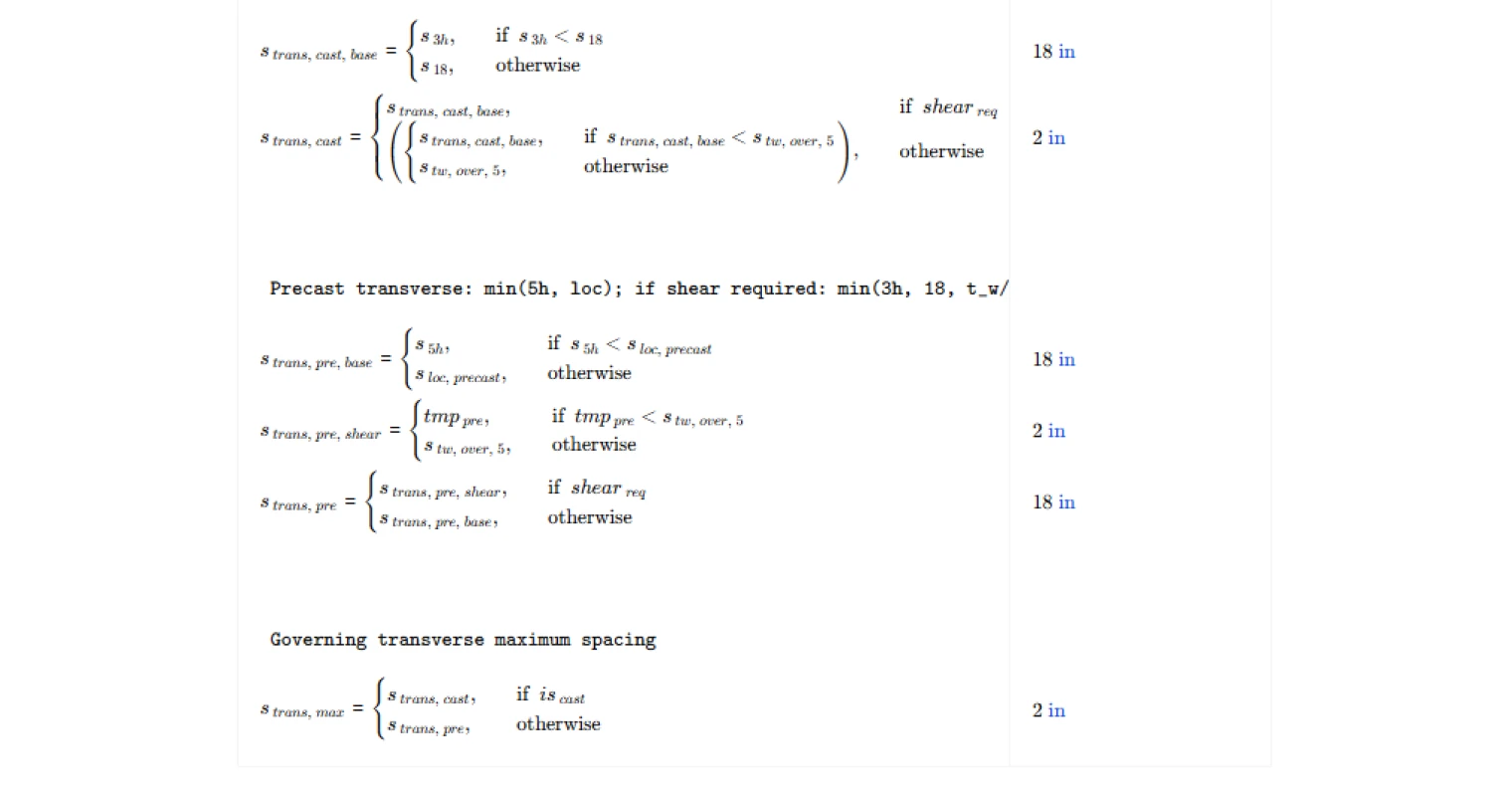
Maximum spacing for transverse reinforcement follows ACI 318 Clause 11.7.3. Similar to longitudinal reinforcement, the limits vary depending on wall construction type and whether shear reinforcement is required for in-plane strength. In some cases, additional spacing limits based on wall thickness apply. The calculator evaluates the candidate spacing limits and determines the controlling maximum transverse spacing.
Two-layer reinforcement requirement
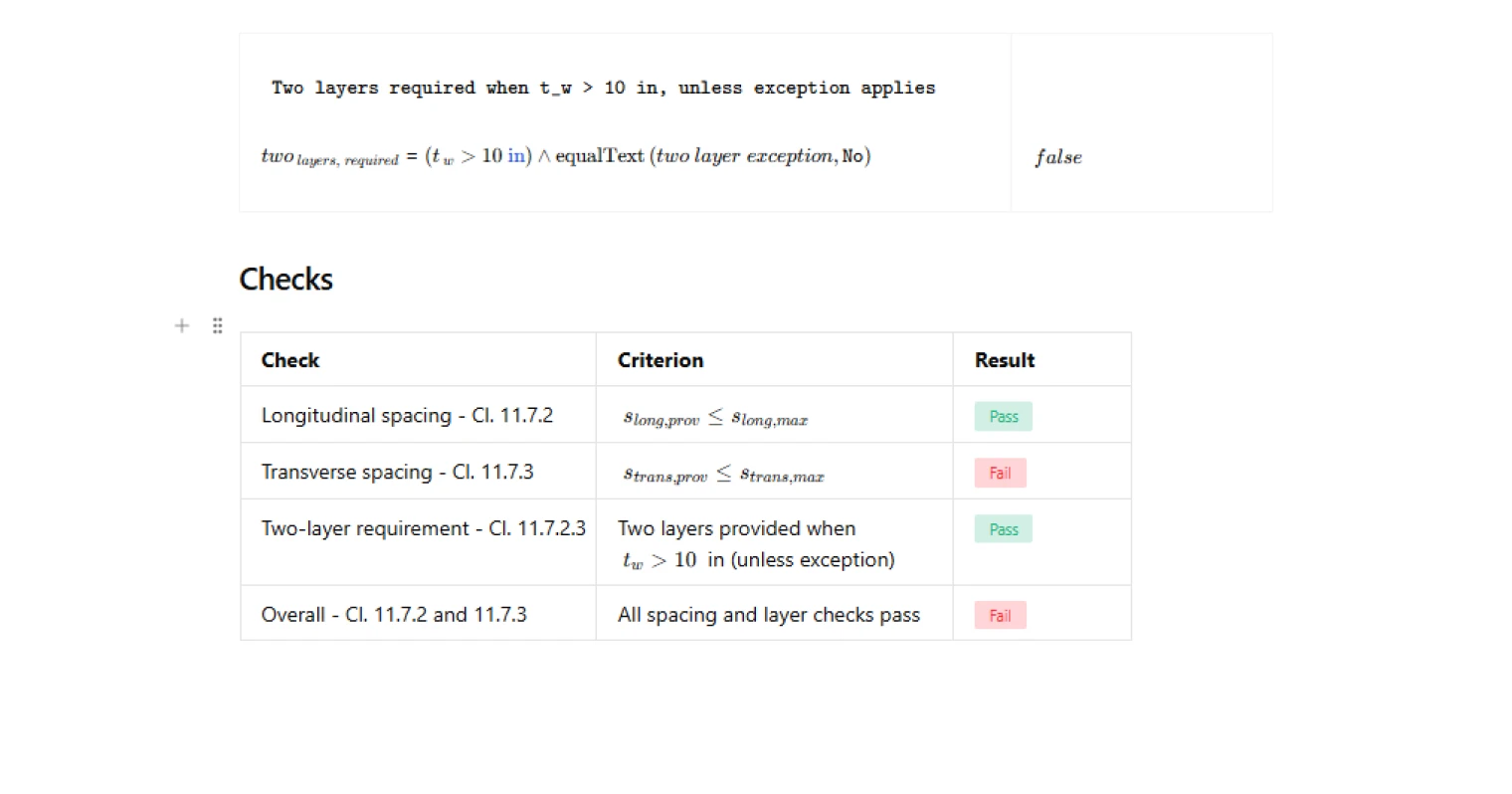
ACI 318 requires distributed reinforcement to be placed in two layers when the wall thickness exceeds a specified limit, except in certain situations such as single-story basement walls or cantilever retaining walls. The calculator evaluates whether the two-layer requirement applies and checks the provided reinforcement layout against this requirement.
Outputs and compliance checks
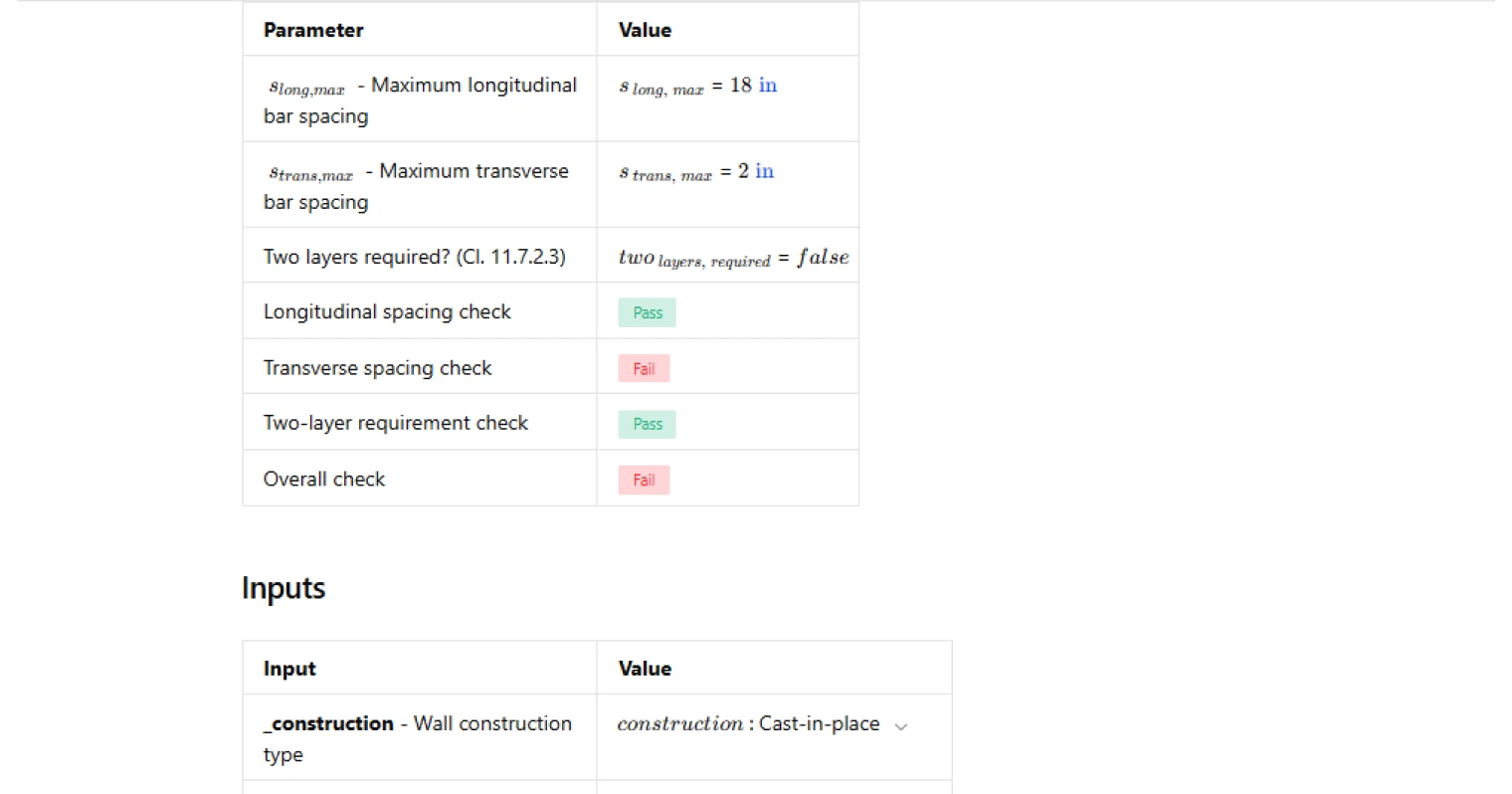
The calculator reports the governing maximum allowable spacing for both longitudinal and transverse reinforcement. It then checks the provided reinforcement spacing against these limits and evaluates whether the reinforcement layer requirement is satisfied. Each check returns a clear pass or fail result so designers can quickly confirm compliance with the code provisions.
Common Calculation Errors to Avoid
- Confusing wall thickness with effective height — spacing limits use wall thickness in the relevant provisions, not the clear wall height or story height.
- Ignoring construction type differences — cast-in-place and precast walls have different allowable spacing limits, and the correct clause must be applied.
- Overlooking precast wall location limits — exterior and interior precast walls may have different maximum spacing caps that affect the governing limit.
- Missing the shear reinforcement condition — when in-plane shear reinforcement is required, additional spacing limits tied to wall thickness may control.
- Forgetting the two-layer requirement — walls exceeding the thickness threshold generally require reinforcement distributed in two layers unless a specific exception applies.
Engineering templates
Common calculators
Design guides




FAQs
What does ACI 318-19 Clause 11.7 actually control in wall design?
Clause 11.7 sets upper limits on how far apart distributed reinforcement bars can be spaced in structural walls, both longitudinally (vertical) and transversely (horizontal). It also triggers a two-layer requirement for thicker walls. These limits exist to ensure cracks are adequately controlled, load paths are maintained, and concrete confinement is sufficient across the wall face. They are minimum detailing requirements independent of strength calculations.
Why do the spacing limits differ between cast-in-place and precast walls?
Precast walls are manufactured under controlled plant conditions and are permitted slightly relaxed limits in some cases — up to min(5h, 18 in) or 30 in for interior walls — compared to the min(3h, 18 in) cap for cast-in-place. The distinction reflects the quality control inherent in precast production. However, when shear reinforcement is required for in-plane strength, precast walls revert to the same tighter limits as cast-in-place walls.
When does the tw/3 or tw/5 thickness-based limit kick in, and why?
The wall thickness limits — tw/3 for longitudinal spacing and tw/5 for transverse spacing — apply when in-plane shear reinforcement is or is not required, depending on bar direction. These limits ensure that as wall thickness increases, bar spacing scales proportionally to maintain effective shear distribution across the section. For thin walls these limits rarely govern, but for walls 12 in and thicker they can become the controlling constraint.
When is two-layer reinforcement required, and are there any exceptions?
Two layers of distributed reinforcement are required when wall thickness exceeds 10 in, per Cl. 11.7.2.3. The code recognizes two exceptions: single-story basement walls and cantilever retaining walls. Use the two-layer exception toggle in the inputs to apply this. Note that the 10 in threshold is a hard limit — a wall at exactly 10 in does not require two layers; it must be greater than 10 in.
How do I use this calculator for a precast interior wall with shear reinforcement required?
Set construction type to Precast, wall location to Interior, and shear reinforcement required to Yes. The calculator will apply the location cap of 30 in for the no-shear precast base case, then override with min(3h, 18 in, tw/3) for longitudinal and min(3h, 18 in, tw/5) for transverse, since shear is required. Enter your provided spacings and wall thickness, and the checks will report pass or fail directly.
Why does the transverse spacing limit tighten when shear reinforcement is not required for cast-in-place walls?
This is specific to cast-in-place transverse reinforcement under Cl. 11.7.3.1. When shear reinforcement is not needed for strength, the code adds a tw/5 limit to keep horizontal bars close enough for adequate crack control and concrete integrity across the wall thickness. When shear reinforcement is required, the presence of that reinforcement for strength purposes already implies closer spacing is being managed through the design, so the tw/5 limit is not additionally imposed.
Learn about the benefits of using CalcTree on engineering projects!