
Check ACI 318-19 minimum slab thickness for two-way slabs with beams (Cl. 8.3.1.2). Instant pass/fail results. Run the free calculation on CalcTree.

Tell us what you need, or sign up and build it yourself in minutes.
Leave your email and we'll tell you when a template for it is ready:
No items found.
No items found.
About this ACI 318 Two-Way Slab Minimum Thickness Calculator
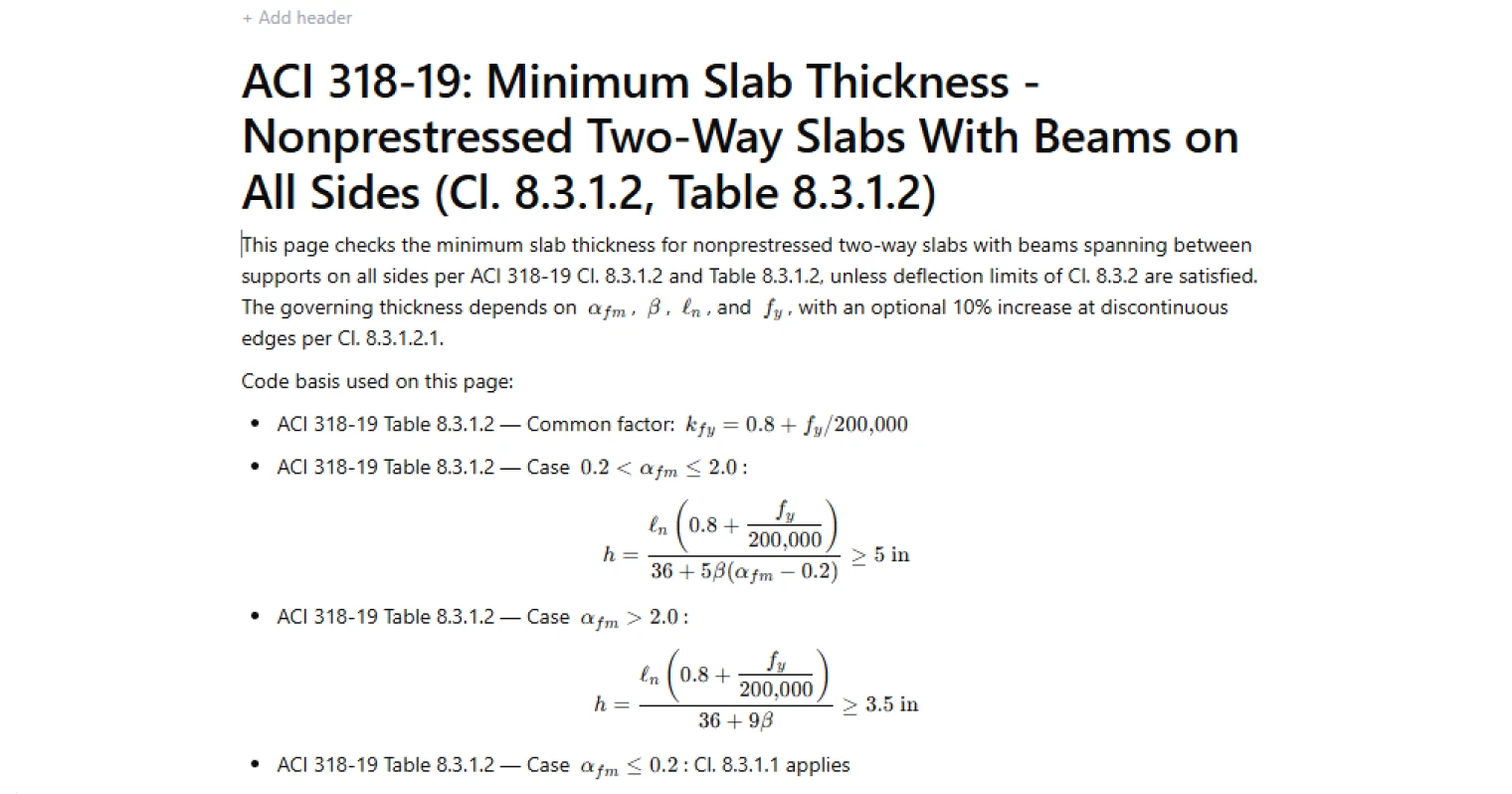
This calculator determines the minimum thickness for nonprestressed two-way slabs with beams spanning between supports on all sides in accordance with ACI 318-19 Clause 8.3.1.2 and Table 8.3.1.2. It evaluates the required slab depth based on span geometry, reinforcement yield strength, and beam-to-slab stiffness parameters, and applies additional adjustments when discontinuous slab edges are present.
- Structural engineer — quickly determine the minimum slab thickness required to satisfy ACI 318 span-to-depth limits for two-way slab systems.
- Building designer — perform rapid sizing checks during concept design before running detailed deflection analysis.
- Peer reviewer — verify that slab thickness complies with ACI minimum requirements and edge-condition adjustments.
The calculator exposes the intermediate thickness values derived from ACI 318 Table 8.3.1.2 and clearly shows the governing requirement after any code adjustments. It is implemented as an engineering-grade calculator in CalcTree, allowing teams to audit the logic, reuse it as a template, and integrate it into calculation workflows.
More info on ACI 318 Two-Way Slab Minimum Thickness
Inputs
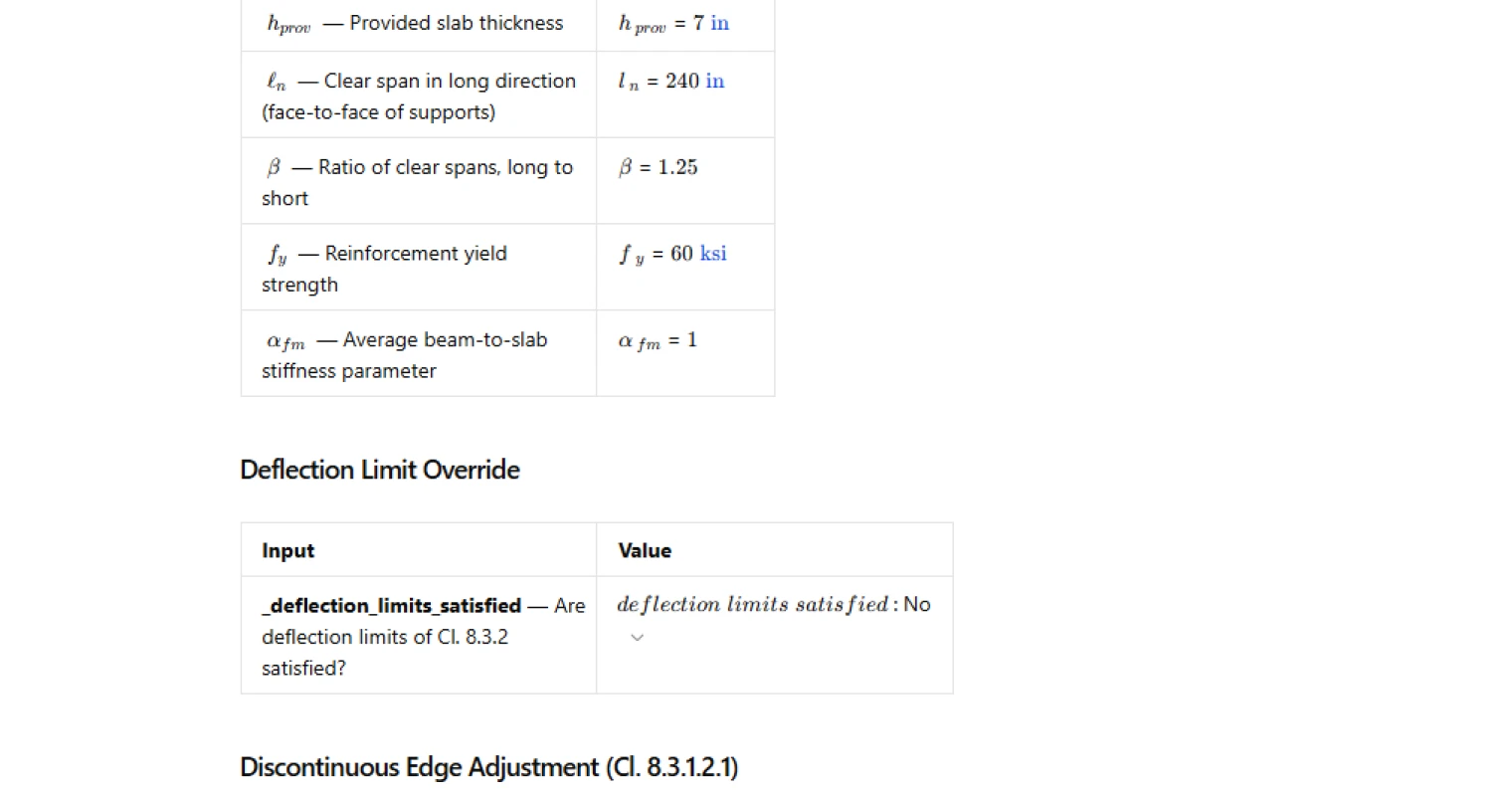
The calculation requires the key geometric and material parameters defined in ACI 318 for slab thickness limits. These include the clear span in the long direction, the ratio of long-to-short spans, reinforcement yield strength, and the average beam-to-slab stiffness parameter. These values define the span-to-depth relationships used in Table 8.3.1.2.
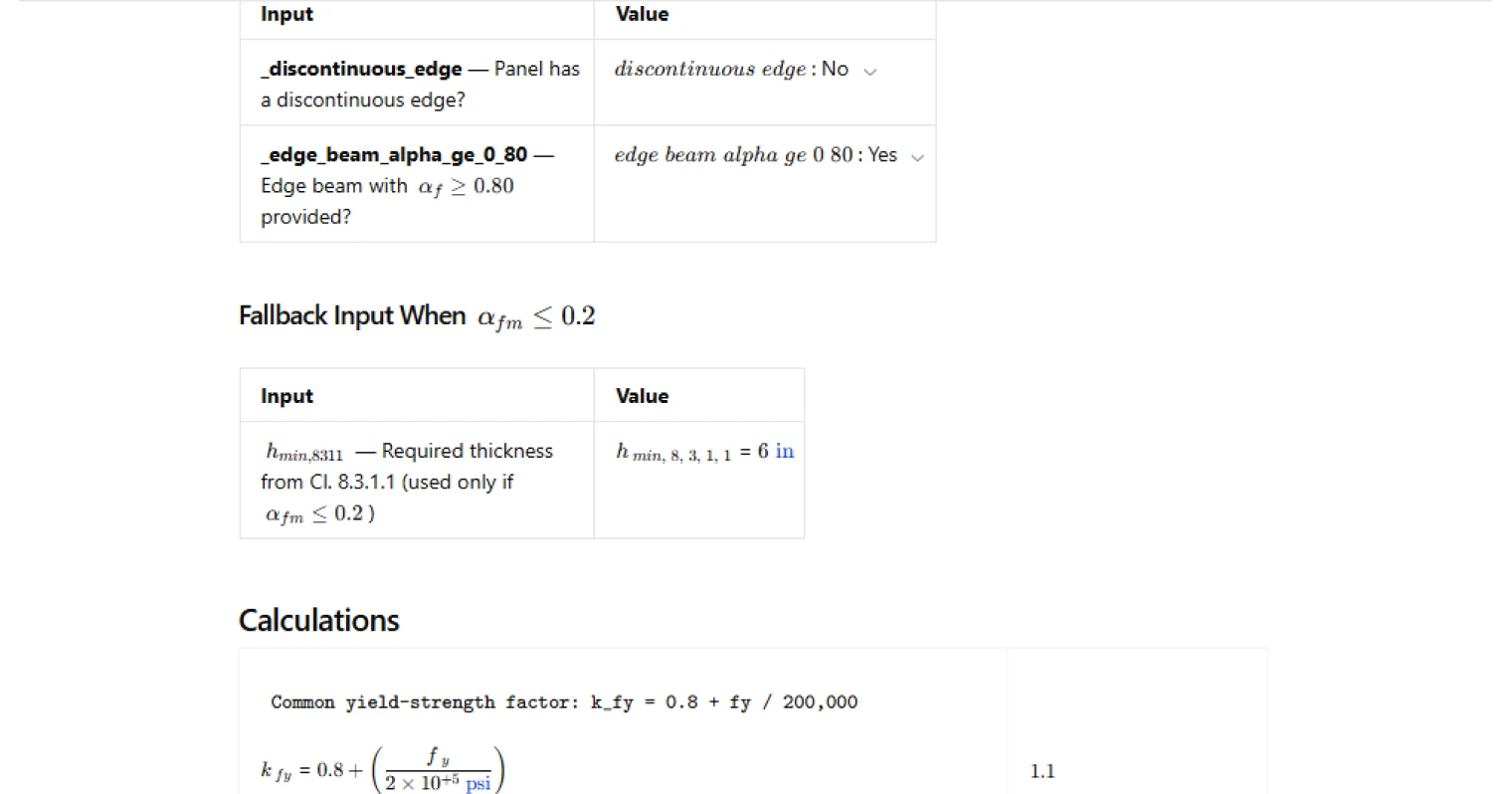
The calculator also includes user inputs to indicate whether deflection limits have already been satisfied through separate analysis and whether the slab panel includes a discontinuous edge requiring special consideration.
Thickness determination from Table 8.3.1.2
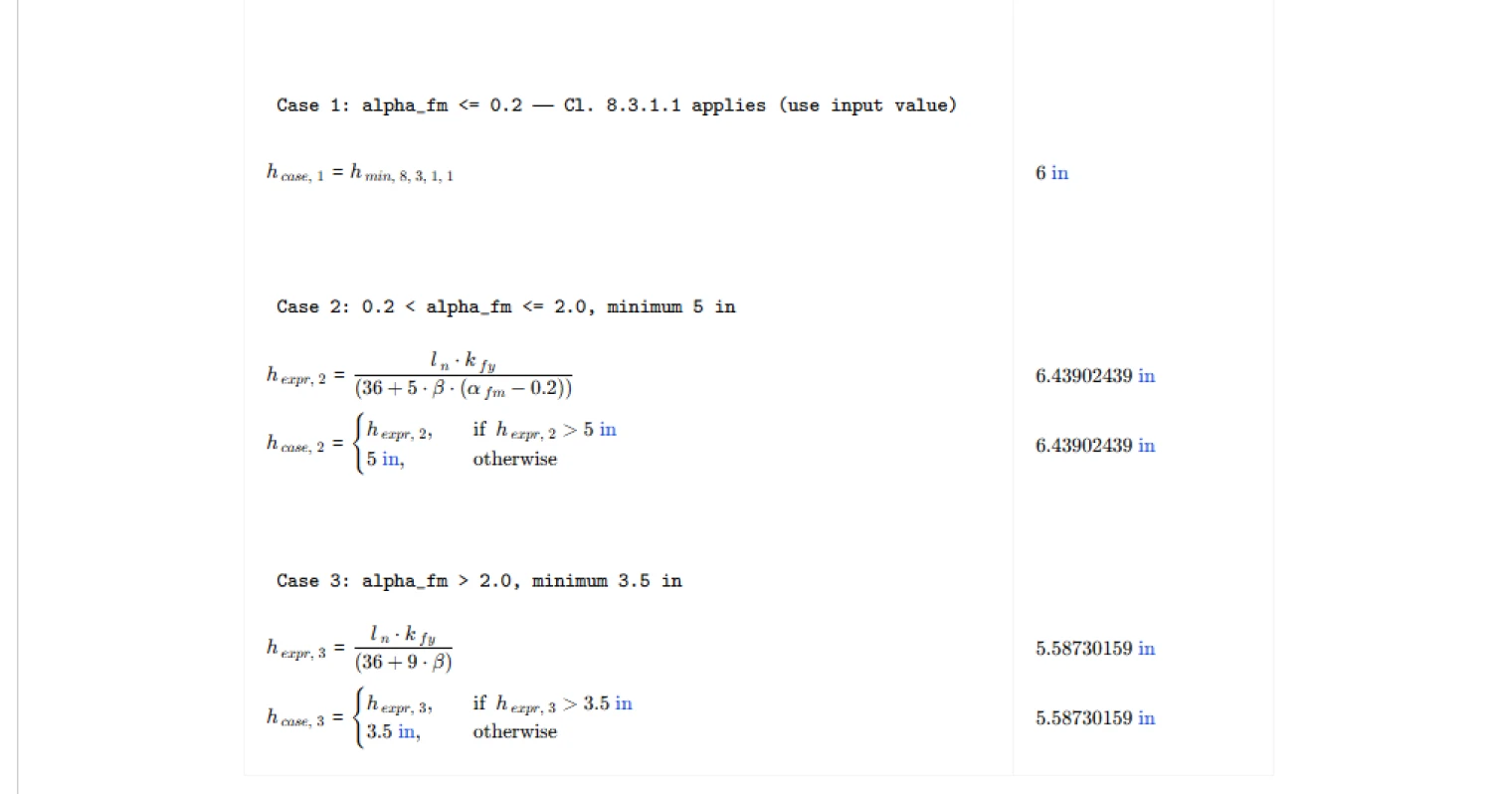
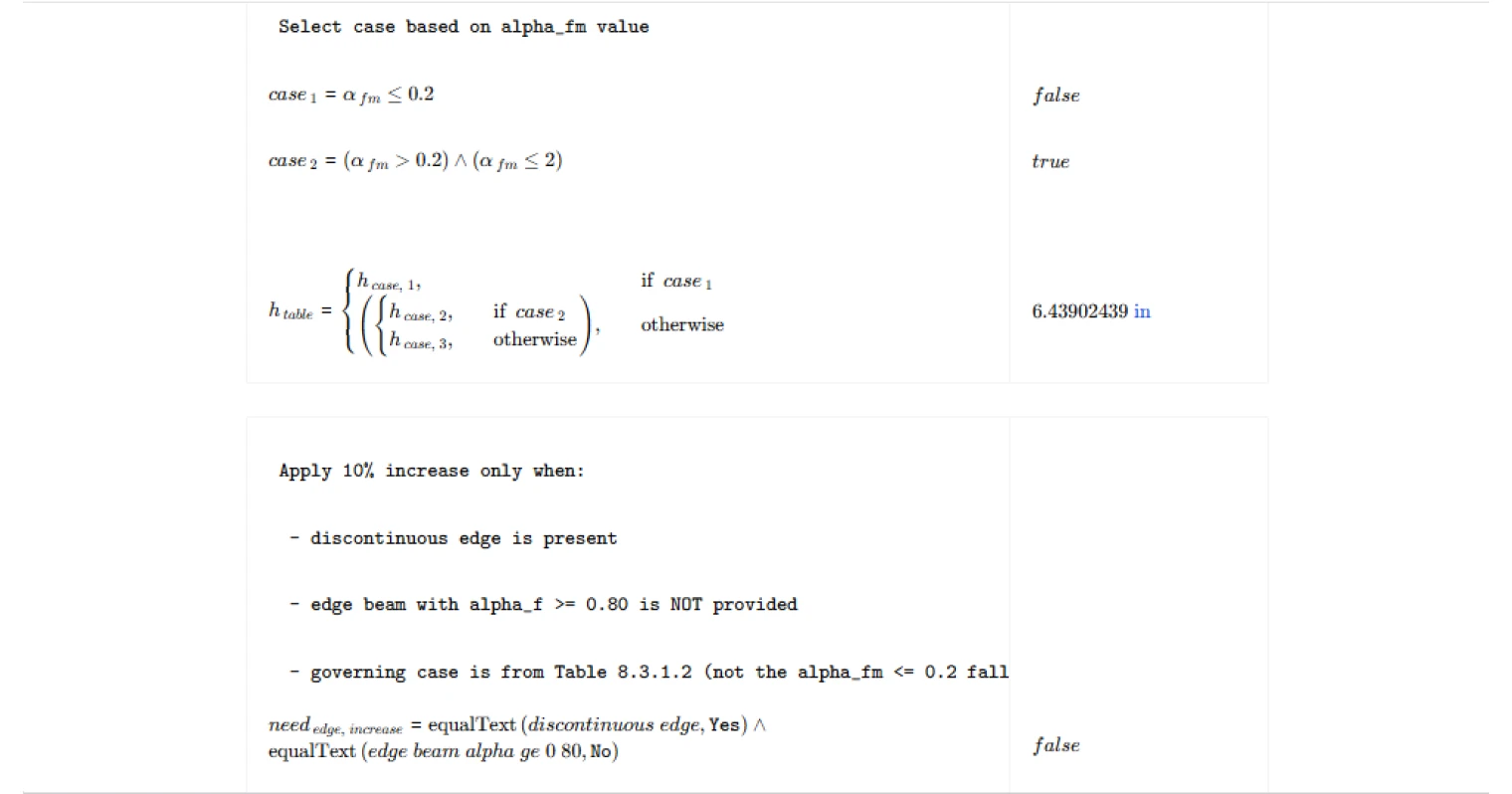
ACI 318 provides different expressions for minimum slab thickness depending on the beam stiffness parameter. The calculator evaluates all relevant expressions and selects the correct case based on the stiffness parameter range.
Each equation incorporates a yield-strength adjustment factor and span geometry parameters to produce a candidate slab thickness. Minimum thickness limits specified in the code are also enforced to ensure the calculated depth does not fall below the permitted lower bound.
Discontinuous edge adjustment
If the slab panel includes a discontinuous edge, the code requires additional provisions to maintain adequate stiffness and control deflections. Where a sufficiently stiff edge beam is not provided, the minimum slab thickness must be increased.
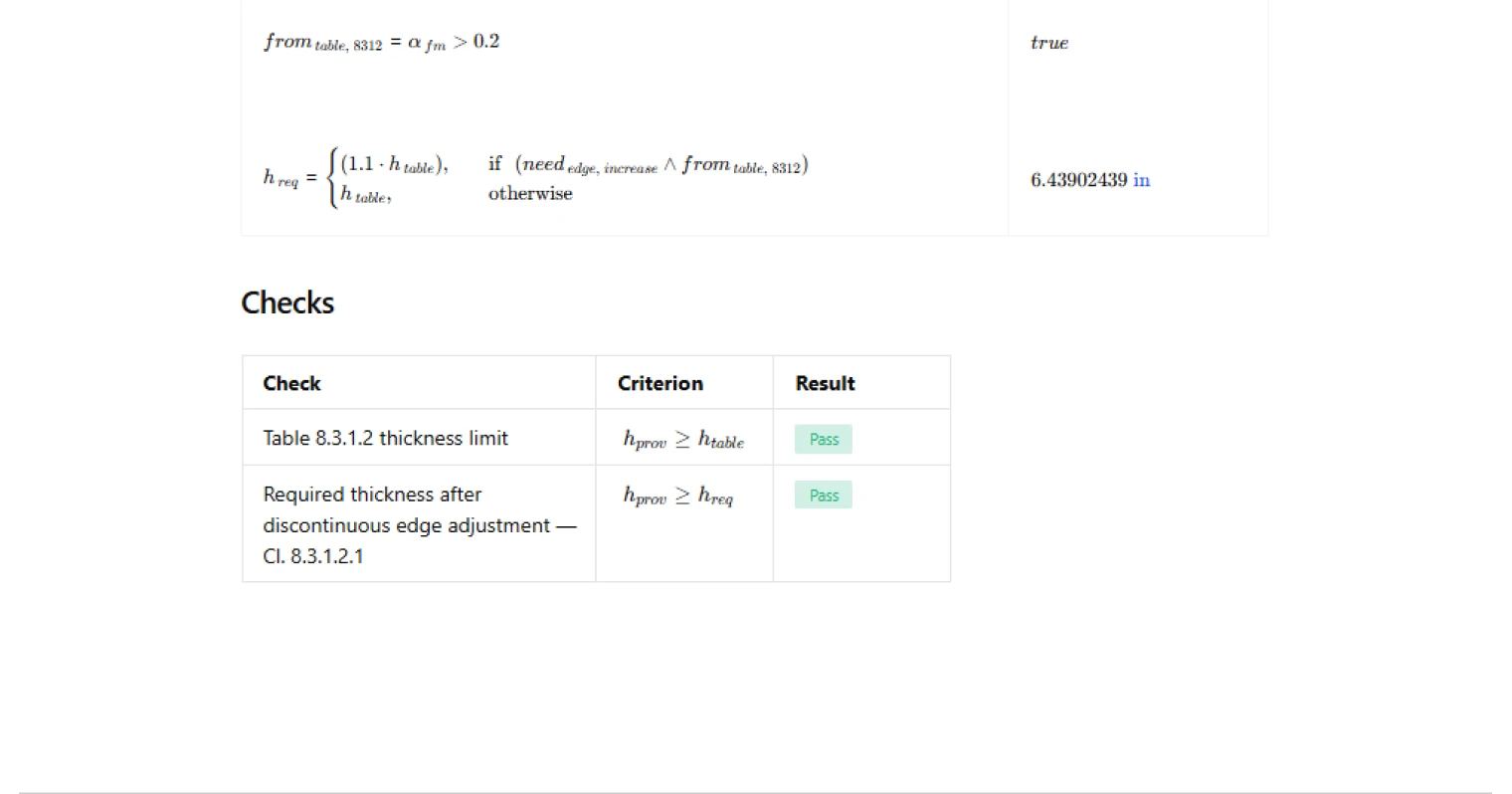
The calculator automatically detects this condition based on user inputs and applies the required increase to the calculated slab thickness before performing the final check.
Output checks
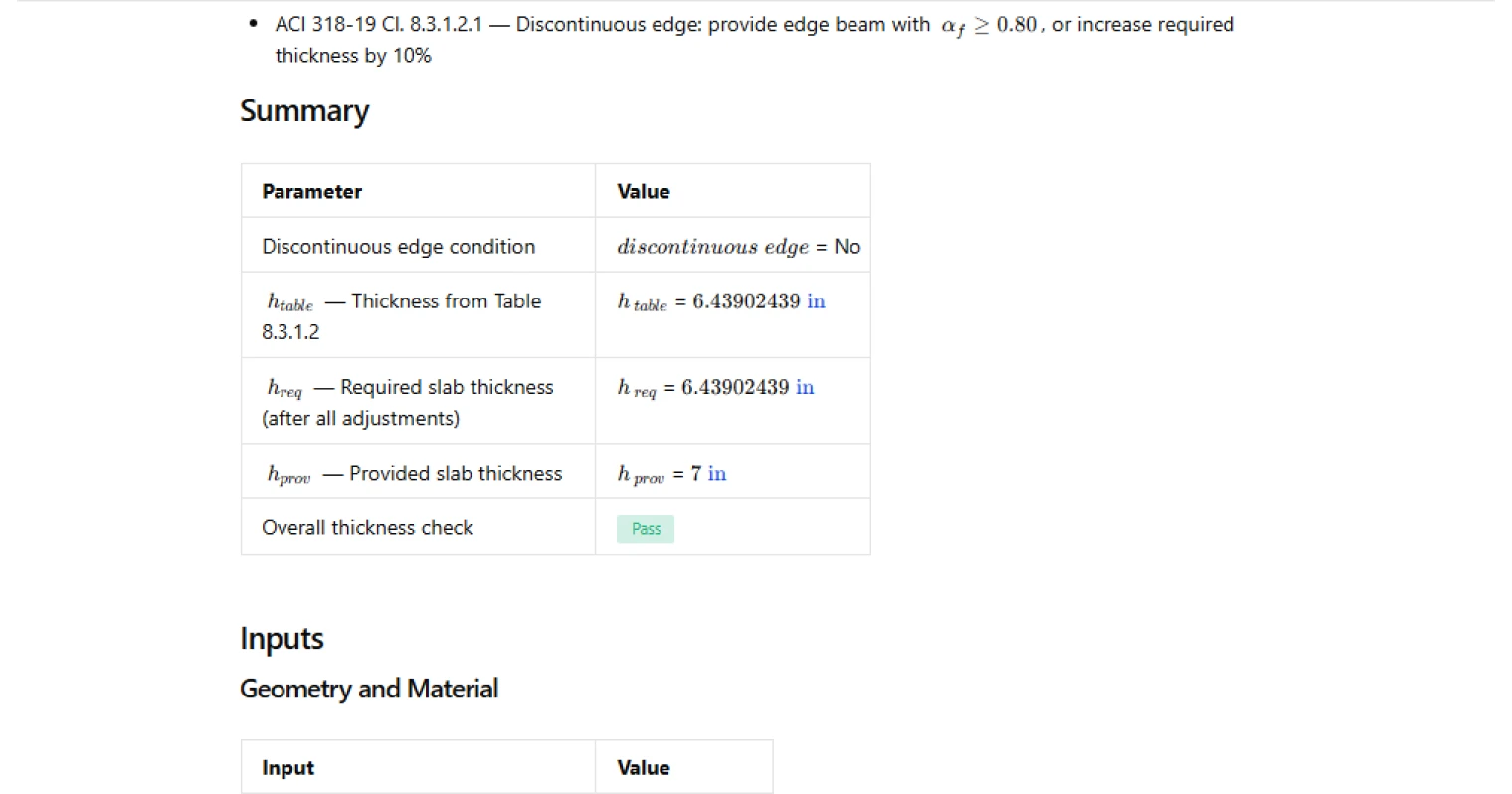
The results section presents the thickness derived directly from the ACI table expressions, the adjusted required thickness after any edge-condition modifications, and the slab thickness provided by the user.
Traffic-light checks are then performed to confirm whether the provided slab thickness satisfies both the base table requirement and the final required thickness after all code adjustments.
Common Calculation Errors to Avoid
- Using incorrect span definition — the clear span must be measured face-to-face of supports, not centre-to-centre, which can significantly affect the required slab thickness.
- Incorrect span ratio — the span ratio should represent the long span divided by the short span of the slab panel; reversing this ratio can produce incorrect thickness results.
- Ignoring discontinuous edges — panels with discontinuous edges may require a thickness increase unless a sufficiently stiff edge beam is provided.
- Applying the wrong stiffness parameter range — the equation used for minimum thickness depends on the beam-to-slab stiffness parameter range, so selecting the wrong case leads to incorrect results.
- Assuming thickness limits replace deflection checks — the table method is intended as a simplified approach; if deflection limits are satisfied through analysis, different provisions may apply.
Engineering templates
Common calculators
Design guides




FAQs
What does αfm represent and how do I calculate it?
αfm is the average value of αf for all beams on the edges of a panel, where αf is the ratio of the flexural stiffness of a beam section to the flexural stiffness of the slab bounded laterally by centerlines of adjacent panels. In practice, compute αf for each of the four beams framing the panel using EcbIb / EcsIs, then average the four values. A higher αfm means the beams carry more load relative to the slab, which allows a thinner slab. If αfm falls at or below 0.2, the beams provide negligible stiffness and ACI 318-19 Cl. 8.3.1.1 governs instead.
What is the clear span ln and which direction do I measure it?
ln is the clear span in the long direction, measured face-to-face of supports. Use the longer of the two panel dimensions. The ratio β = long clear span / short clear span captures the panel aspect ratio and directly affects the denominator of the thickness formula, so getting both ln and β right from the same geometry is important.
When does the 10% discontinuous edge increase apply, and can I avoid it?
The 10% increase applies when the panel has a discontinuous edge and no edge beam with αf ≥ 0.80 is provided at that edge, per Cl. 8.3.1.2.1. It only applies when the governing case comes from Table 8.3.1.2, not when αfm ≤ 0.2 and Cl. 8.3.1.1 controls. You can avoid the increase by providing a stiff enough edge beam. In the calculator, set the discontinuous edge inputs accordingly and the 10% multiplier is applied or skipped automatically.
What happens if I toggle "Deflection limits satisfied" to Yes?
If the computed deflections are explicitly checked against the limits in ACI 318-19 Cl. 8.3.2 and found to satisfy them, the minimum thickness requirements of Cl. 8.3.1.2 do not need to be met. Toggling this input to Yes signals that your design takes that deflection-based route. In that case, the thickness check here is effectively bypassed, but you are responsible for providing and documenting that deflection analysis separately.
Why are there absolute minimums of 5 in and 3.5 in in the formulas?
ACI 318-19 sets floor values on slab thickness regardless of what the formula produces. For αfm between 0.2 and 2.0, the minimum is 5 in. For αfm greater than 2.0, where stiff beams provide significant support, the minimum drops to 3.5 in. These limits exist to ensure practical constructability and adequate concrete cover. The calculator enforces these minimums automatically before selecting the governing thickness.
What do I input if αfm is at or below 0.2?
When αfm ≤ 0.2, Table 8.3.1.2 does not apply and Cl. 8.3.1.1 governs. Run a separate Cl. 8.3.1.1 check for your panel type and enter the required thickness from that check into the h_min_8311 input field. The calculator picks that value up as h_case_1 and carries it through to h_table without applying the beam-stiffness-based formulas.
Learn about the benefits of using CalcTree on engineering projects!