
Check ACI 318-19 minimum two-way slab thickness per Cl. 8.3.1.1. Instant pass/fail for any panel type and fy. Try it free on CalcTree.

Tell us what you need, or sign up and build it yourself in minutes.
Leave your email and we'll tell you when a template for it is ready:
No items found.
No items found.
About this ACI 318-19: Minimum Slab Thickness — Nonprestressed Two-Way Slabs Without Interior Beams (Cl. 8.3.1.1, Table 8.3.1.1) Calculator
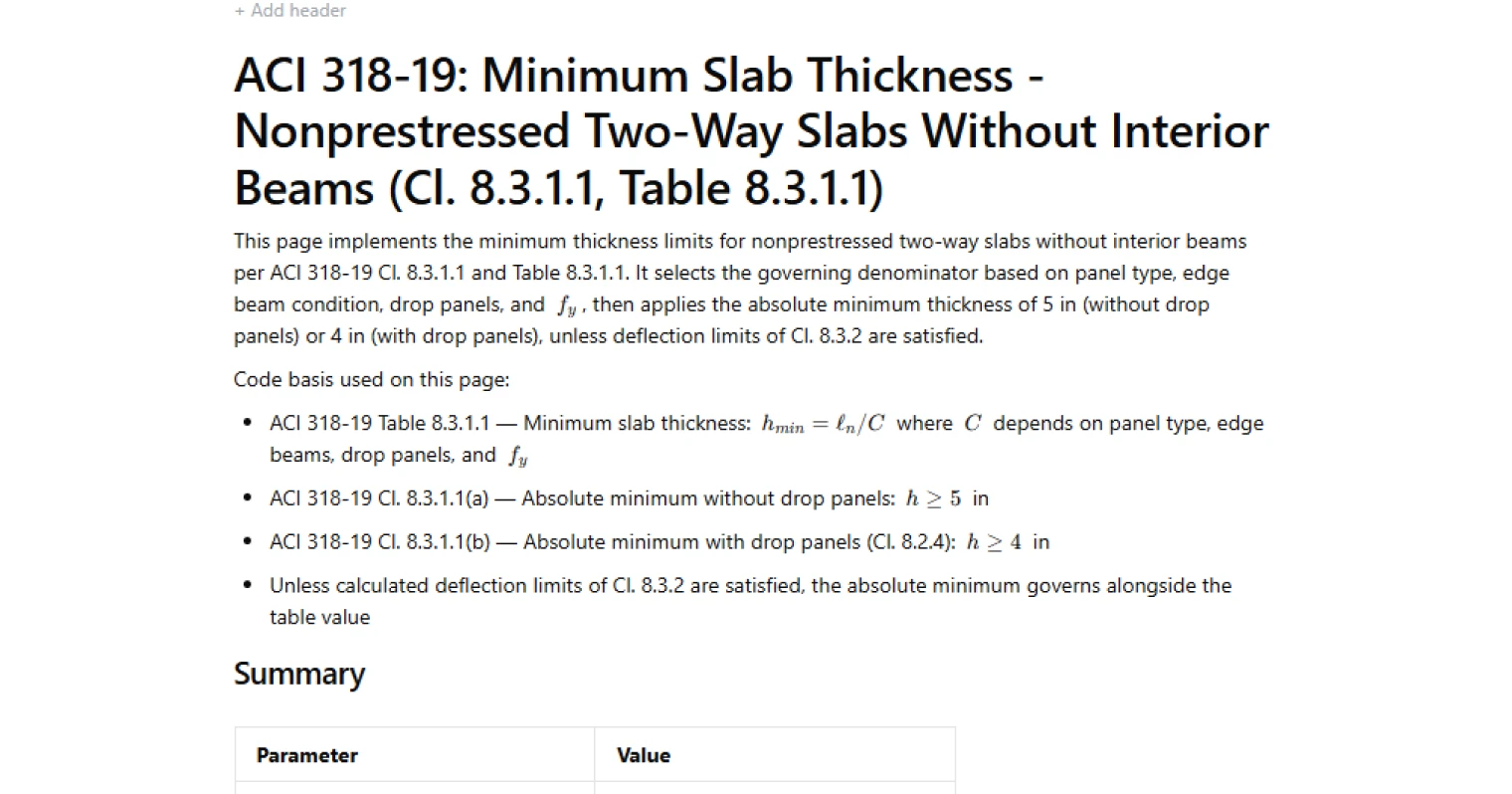
This calculator determines the minimum required thickness for nonprestressed two-way slabs without interior beams per ACI 318-19 Cl. 8.3.1.1 and Table 8.3.1.1. It selects the governing denominator based on panel type, edge beam condition, drop panel configuration, and reinforcement yield strength, then compares the table-derived thickness against the applicable absolute minimum. The result is a clear required thickness and a pass/fail check against the provided slab thickness.
- Structural engineer — verify minimum slab thickness compliance during design, iterate on panel layout and reinforcement grade, and document the governing ACI condition directly in your project calc.
- Engineer of record — confirm that slab thicknesses on the drawing set satisfy Table 8.3.1.1 for every panel type across a floor plate, including edge conditions and drop panel zones.
- Plan checker or reviewer — audit submitted calculations against the ACI 318-19 table requirements quickly, with all intermediate values and logic transparent and traceable.
This is an engineering-grade calculator built on CalcTree, where you can save it to a project workspace, audit every line of logic, and link it with other slab and concrete design calculations.
More info on ACI 318-19: Minimum Slab Thickness — Nonprestressed Two-Way Slabs Without Interior Beams (Cl. 8.3.1.1, Table 8.3.1.1)
Inputs
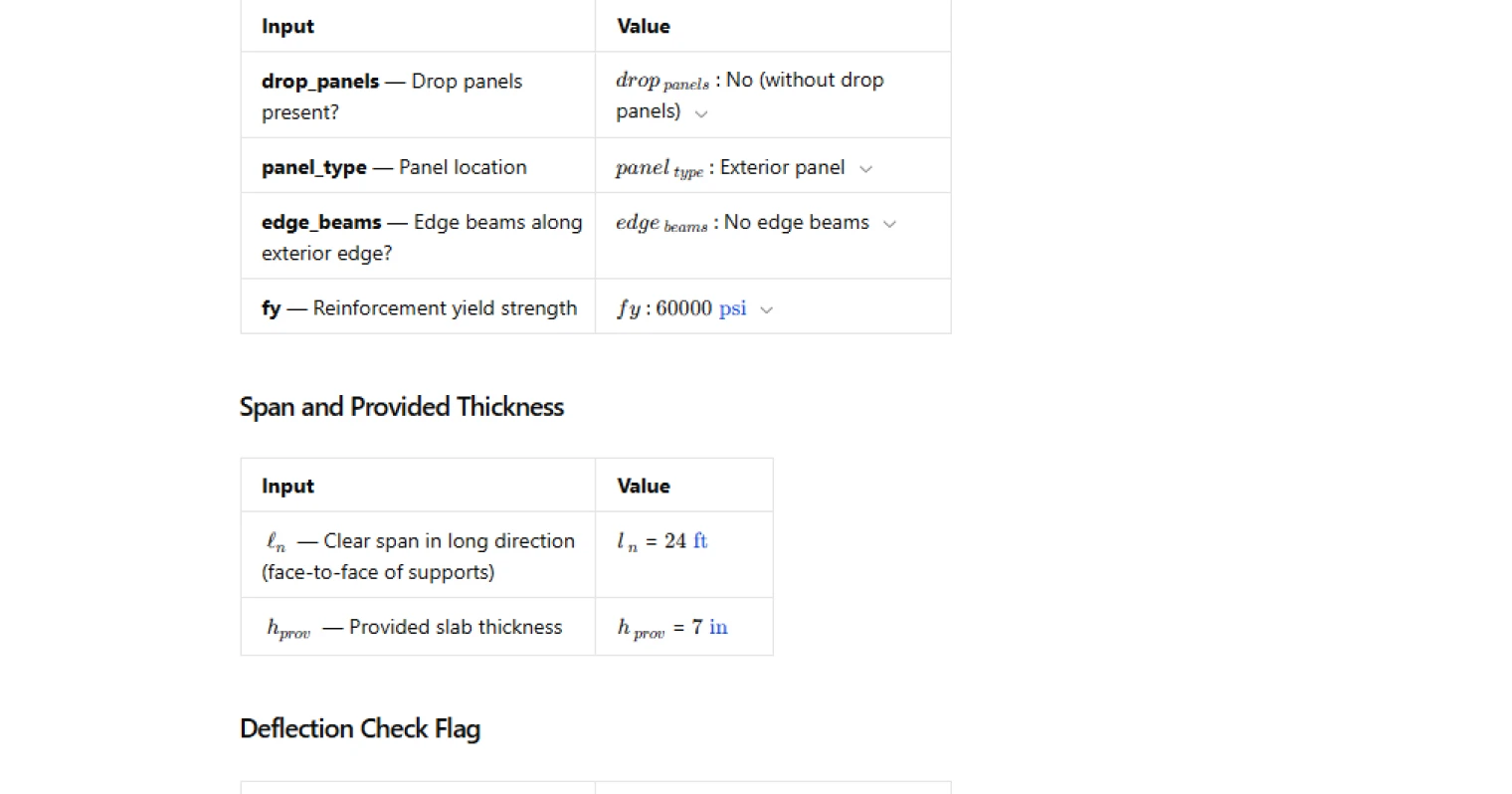
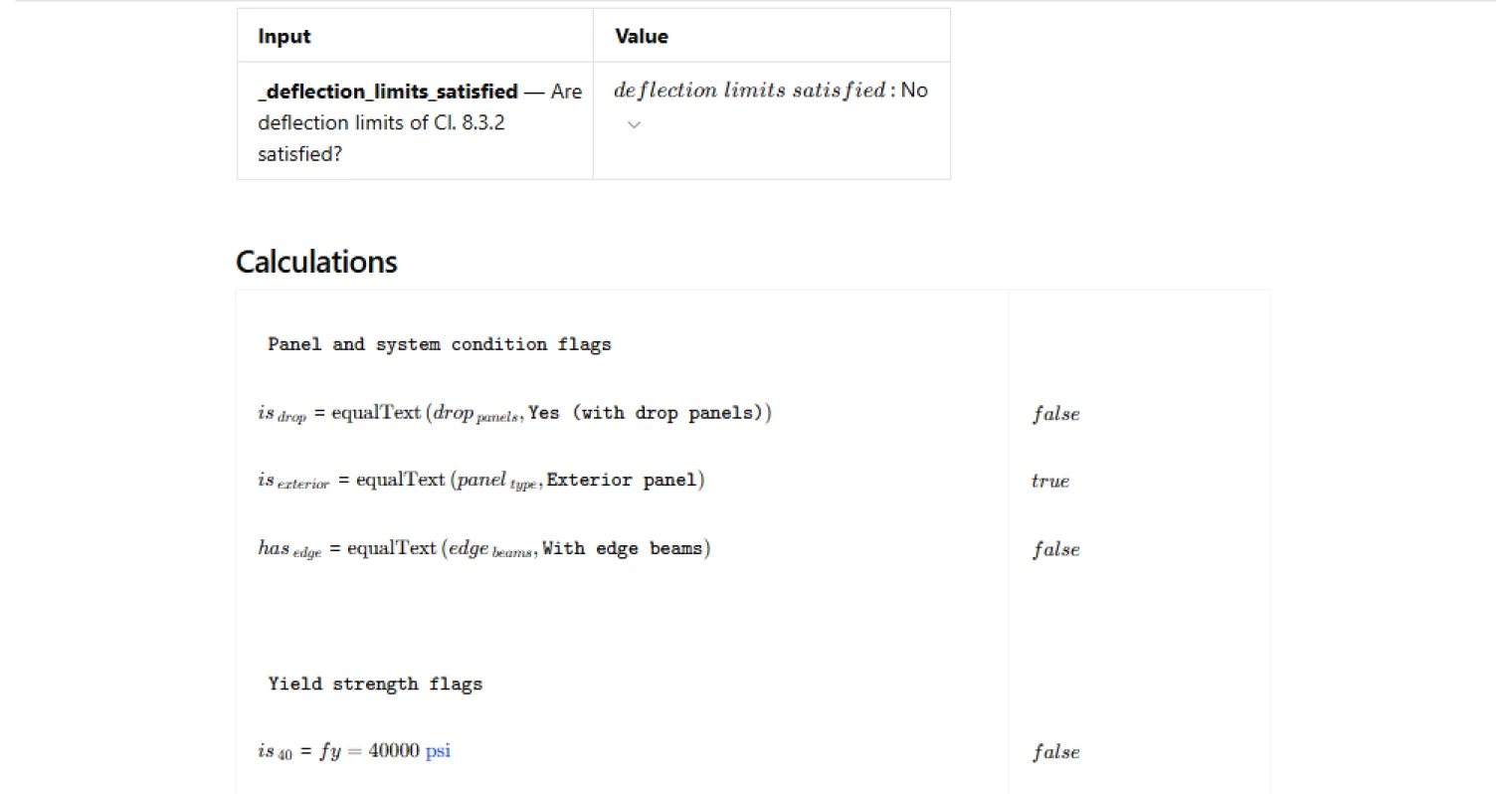
The calculator takes three categories of input. Panel and system classification covers whether drop panels conforming to ACI 318-19 Cl. 8.2.4 are present, whether the panel is an interior or exterior panel, whether edge beams are present along the exterior edge, and the reinforcement yield strength. These four selections directly control which denominator from Table 8.3.1.1 applies. Geometry inputs include the clear span in the long direction measured face-to-face of supports, and the provided slab thickness being checked. A deflection check flag is also included to indicate whether the calculated deflection limits of Cl. 8.3.2 have been separately satisfied, which affects whether the absolute minimum thickness must be enforced alongside the table value.
Method and Code Basis
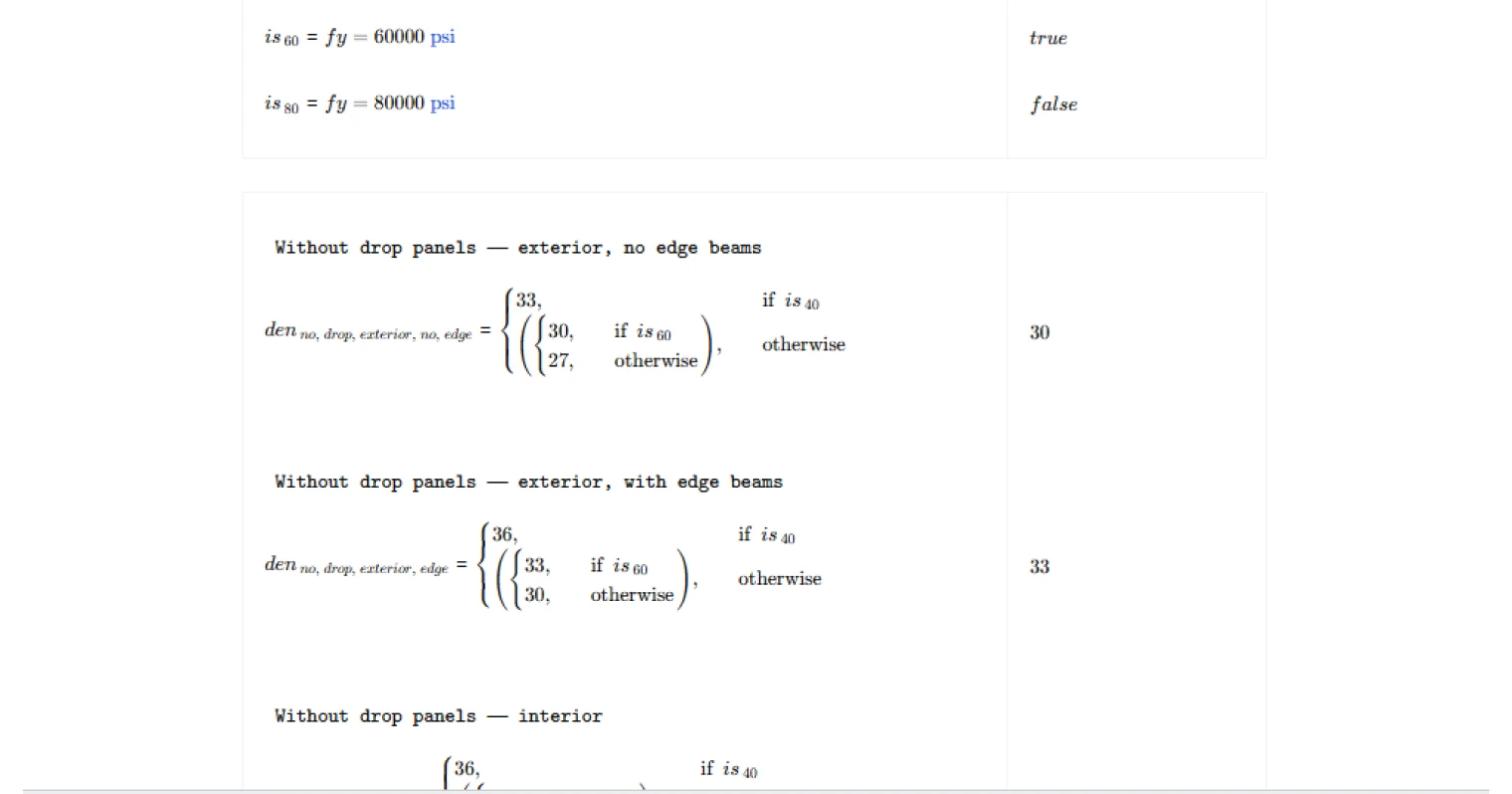
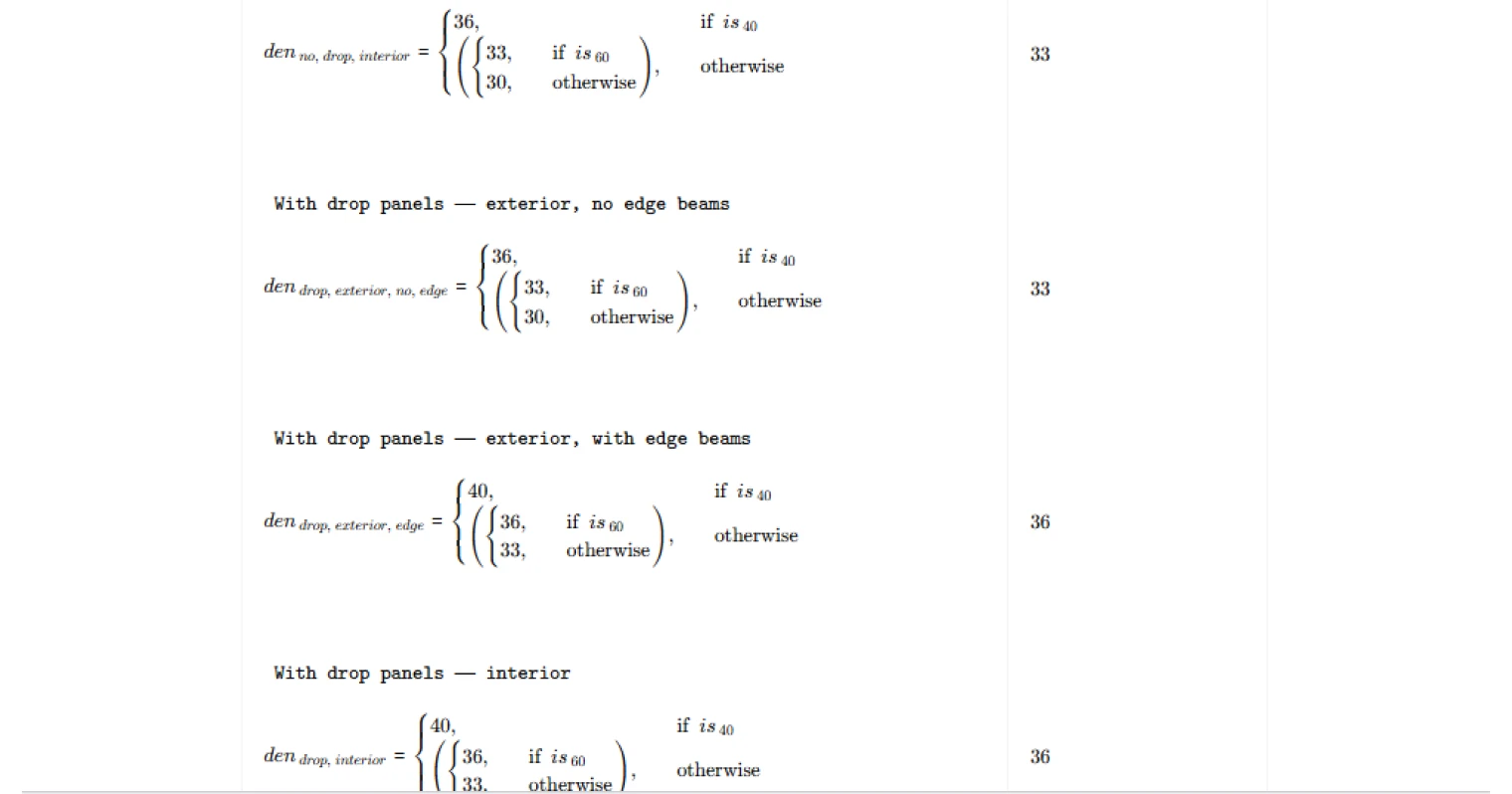
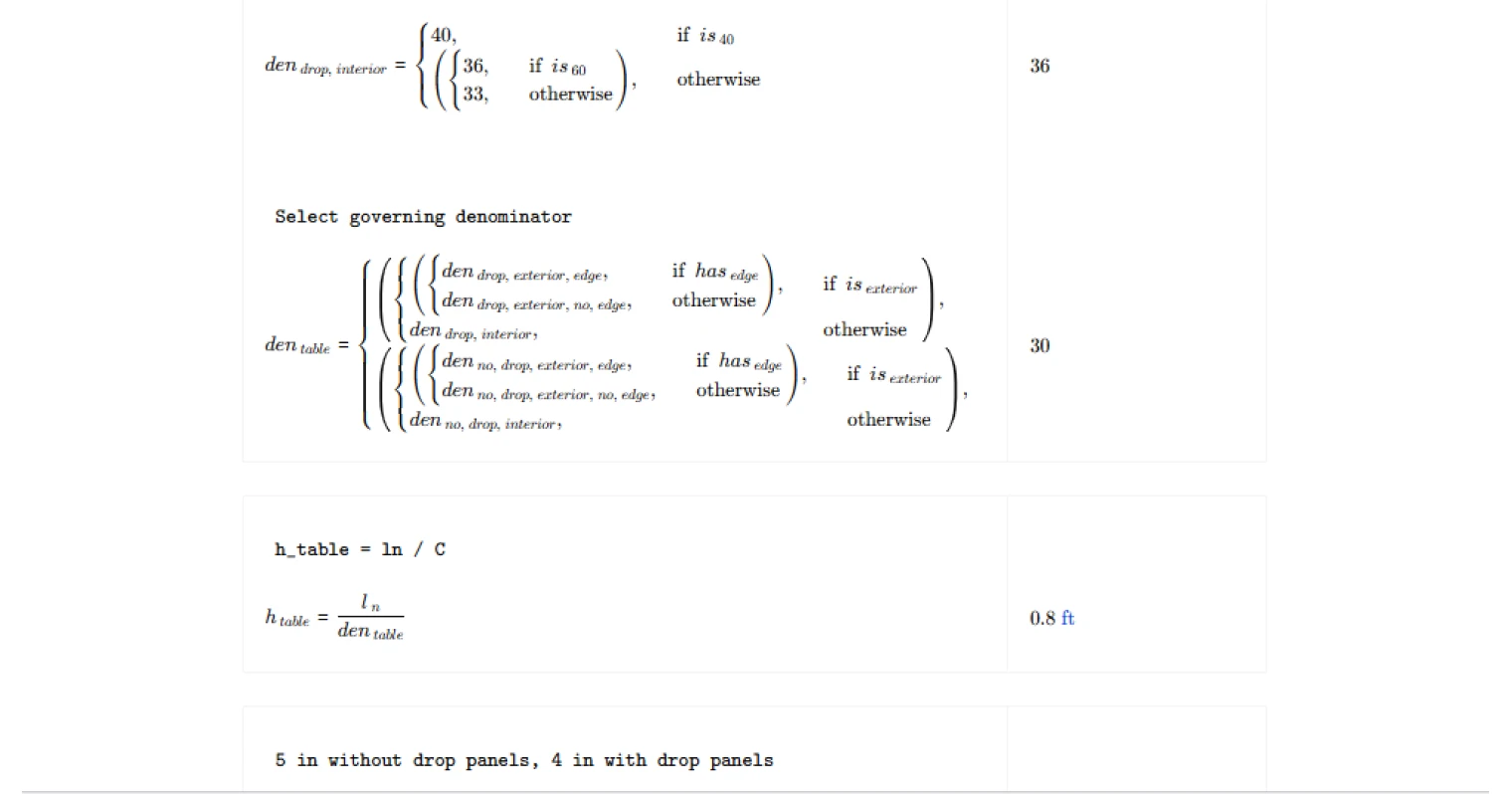
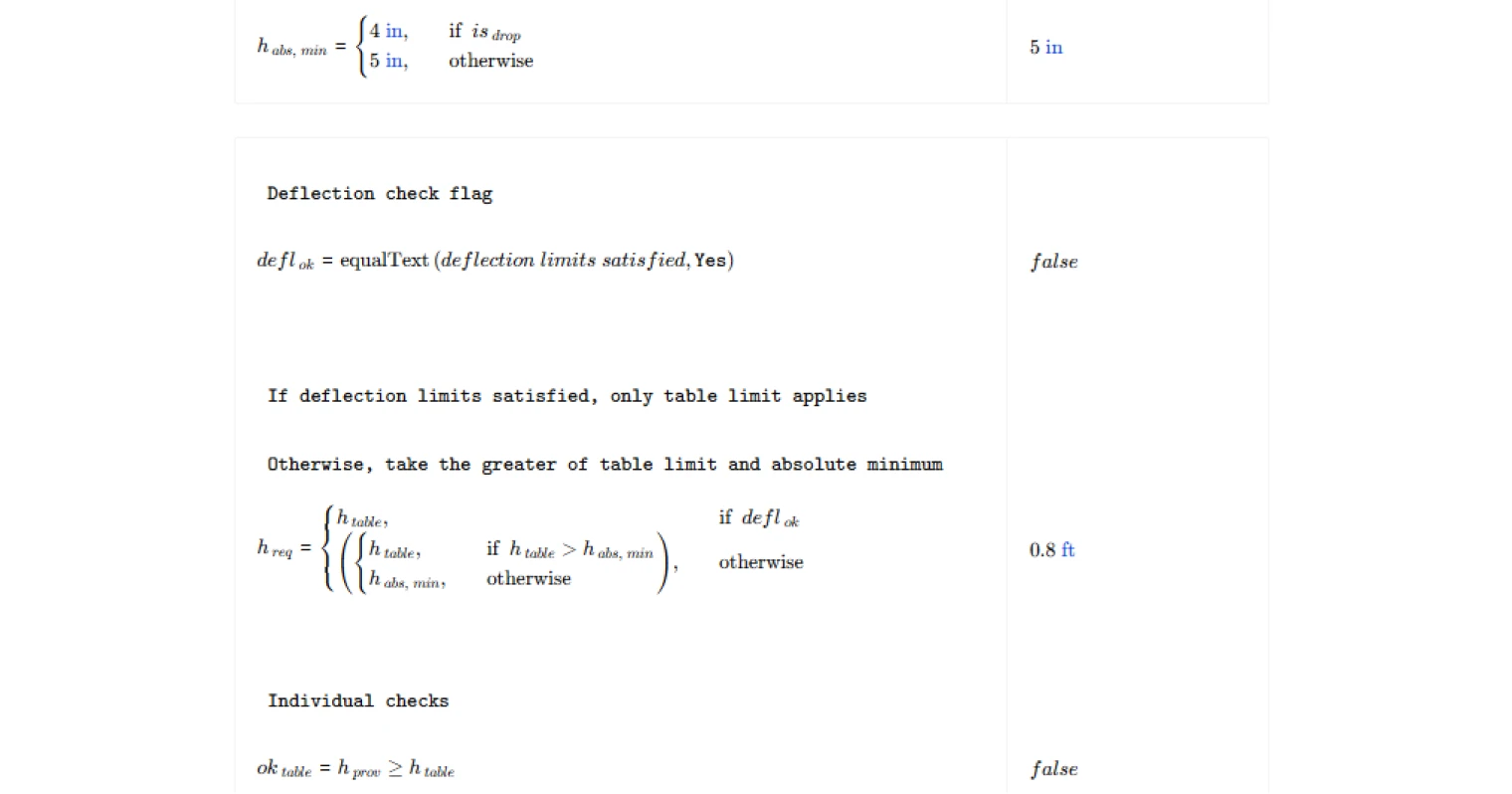
The core calculation follows ACI 318-19 Table 8.3.1.1, which expresses minimum slab thickness as the clear span divided by a denominator that varies with panel configuration and yield strength. The calculator maps every combination of drop panel presence, exterior or interior panel, edge beam condition, and yield strength to its corresponding denominator. The required thickness from the table is then compared against the absolute minimums set in Cl. 8.3.1.1: 5 in for slabs without drop panels and 4 in for slabs with drop panels. If the deflection limits of Cl. 8.3.2 are confirmed as satisfied, the absolute minimum is waived and only the table thickness governs. Otherwise, the required thickness is the greater of the two limits.
Outputs
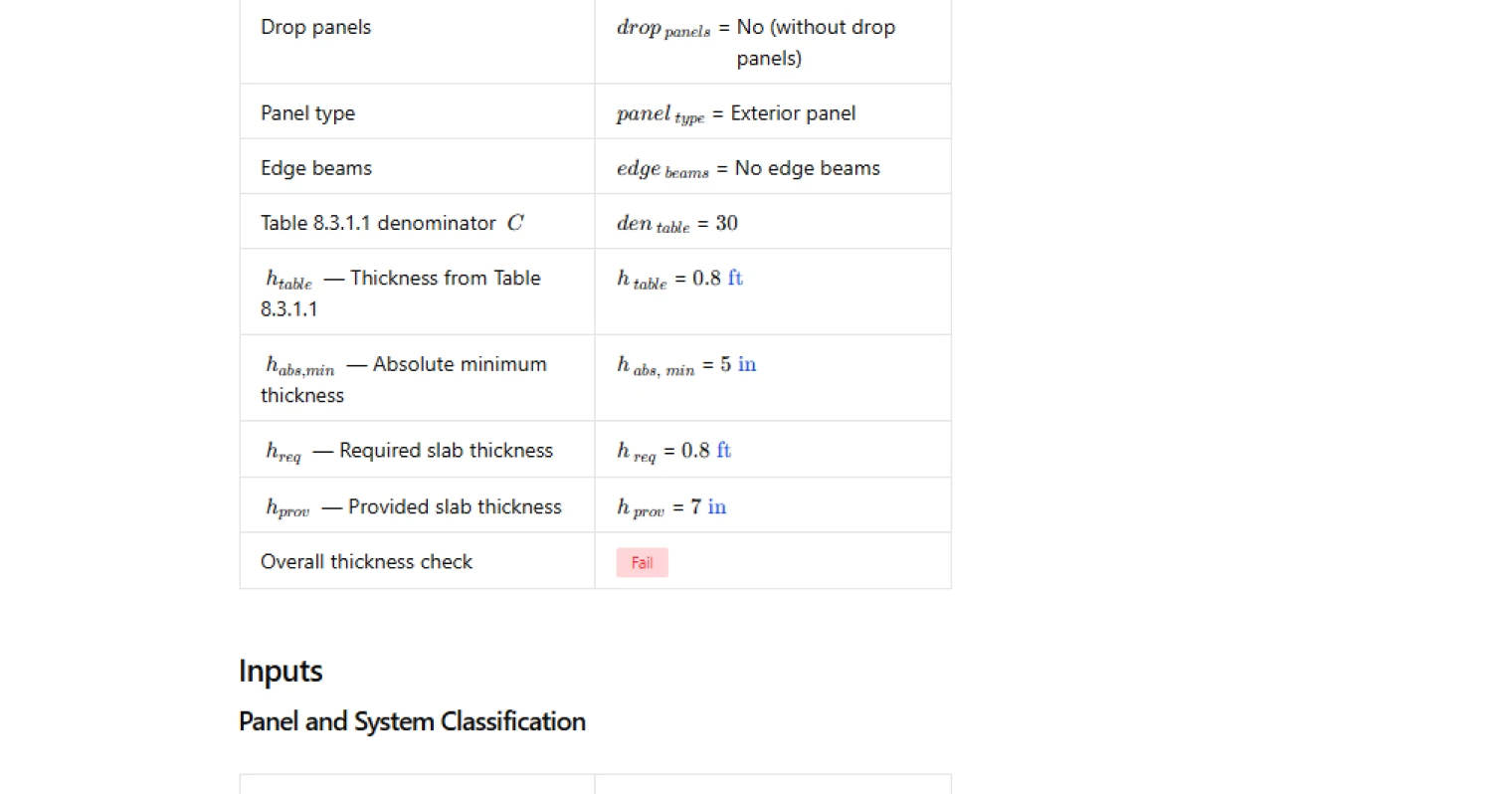
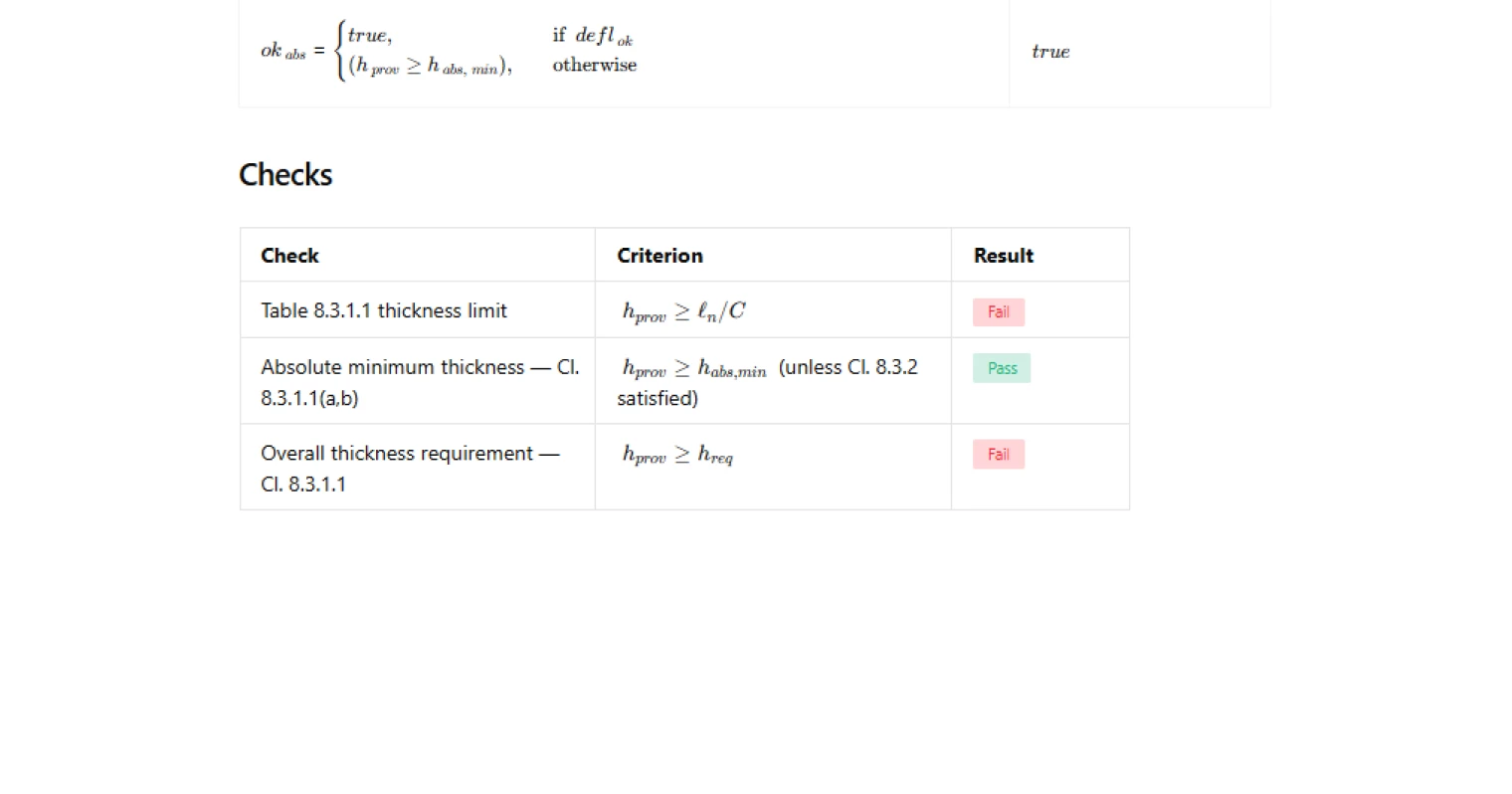
The calculator reports the selected Table 8.3.1.1 denominator, the table-derived minimum thickness, the applicable absolute minimum thickness, and the final required slab thickness combining both limits. The provided slab thickness is checked against each condition individually and against the overall requirement. All intermediate values are shown so the governing condition is immediately clear.
Design Checks
Three checks are reported with pass/fail results. The first confirms that the provided slab thickness meets the Table 8.3.1.1 thickness limit. The second checks compliance with the absolute minimum per Cl. 8.3.1.1(a) or (b), noting that this check is bypassed if deflection limits of Cl. 8.3.2 are satisfied. The third is the overall check, which passes only when the provided thickness meets or exceeds the required thickness combining both applicable limits.
Common Calculation Errors to Avoid
- Using the wrong panel classification — interior and exterior panels have different denominators, and misclassifying a panel at a slab edge or corner can lead to a non-conservative result.
- Ignoring the edge beam condition for exterior panels — the presence of an edge beam increases the permitted denominator; assuming no edge beam when one exists is conservative, but assuming one exists when it does not will underestimate the required thickness.
- Applying Table 8.3.1.1 without checking the absolute minimum — the table-derived value can fall below the absolute minimum, particularly for short spans. Both limits must be checked unless Cl. 8.3.2 deflection calculations have been completed and satisfied.
- Misidentifying drop panels — only drop panels that comply with the dimensional requirements of Cl. 8.2.4 qualify for the higher denominators and the reduced absolute minimum of 4 in. Thickened slabs that do not meet those criteria should be treated as slabs without drop panels.
- Measuring clear span incorrectly — the clear span is taken face-to-face of supports in the long direction, not center-to-center. Using the wrong dimension directly scales the required thickness and is one of the most common errors in routine application of this table.
- Selecting an incorrect yield strength — the denominator is sensitive to the reinforcement grade, and using a lower yield strength than specified is conservative but wastes material; using a higher value than actually specified is unconservative and must be avoided.
Engineering templates
Common calculators
Design guides




FAQs
What does ACI 318-19 Table 8.3.1.1 actually control?
Table 8.3.1.1 sets minimum slab thickness for nonprestressed two-way slabs without interior beams as a fraction of the clear span in the long direction: h = ln / C. The denominator C varies based on whether the panel is interior or exterior, whether edge beams are present along the exterior edge, whether drop panels meeting Cl. 8.2.4 are used, and the reinforcement yield strength fy. The table approach is a simplified deflection-control method that avoids explicit deflection calculations.
What is the difference between the table minimum and the absolute minimum?
The table minimum (ln / C) is span-dependent and accounts for system configuration. The absolute minimum is a flat floor: 5 in for slabs without drop panels and 4 in for slabs with drop panels conforming to Cl. 8.2.4. Both limits apply simultaneously unless you have separately satisfied the deflection limits of Cl. 8.3.2 through explicit calculation, in which case only the table value governs. This calculation takes the greater of the two by default unless you flag deflection limits as satisfied.
How does fy affect the required slab thickness?
Higher yield strength steel allows more slender slabs, which is why the denominator C increases as fy increases. At fy = 40 ksi, an interior panel without drop panels uses C = 36; at fy = 60 ksi it becomes 33; at fy = 80 ksi it drops further to 30. A smaller denominator means a thicker required slab, so lower-strength steel is the more conservative case.
What qualifies as a drop panel for the purposes of this calculation?
A drop panel must meet the geometric requirements of ACI 318-19 Cl. 8.2.4 to count as a drop panel under Table 8.3.1.1. It must extend at least one-sixth of the span length in each direction from the column centerline and project below the slab at least one-quarter of the slab thickness beyond the drop. If your drop panel does not meet these criteria, select "No (without drop panels)" in this calculator and apply the 5 in absolute minimum.
When does the edge beam condition apply in this calculation?
The edge beam input only affects the result when the panel type is set to "Exterior panel." For interior panels, edge beams are not a variable in Table 8.3.1.1 since all edges are continuous with adjacent panels. If you select an exterior panel with edge beams, the denominator C increases, permitting a thinner slab compared to an exterior panel without edge beams.
What clear span should I enter for ln?
Enter the clear span in the long direction of the panel, measured face-to-face of supports. For column-supported slabs, this is the clear distance between column capitals or column faces, not the centerline-to-centerline span. Using the wrong span definition is a common input error and directly scales the required thickness, so confirm the support geometry before running the calculation.
Learn about the benefits of using CalcTree on engineering projects!