
Calculate two-way shear vc with shear reinforcement per ACI 318-19 §22.6.6. Covers stirrups and headed studs. Try the free CalcTree template.

Tell us what you need, or sign up and build it yourself in minutes.
Leave your email and we'll tell you when a template for it is ready:
No items found.
No items found.
About this Two-Way Shear Strength With Shear Reinforcement Calculator
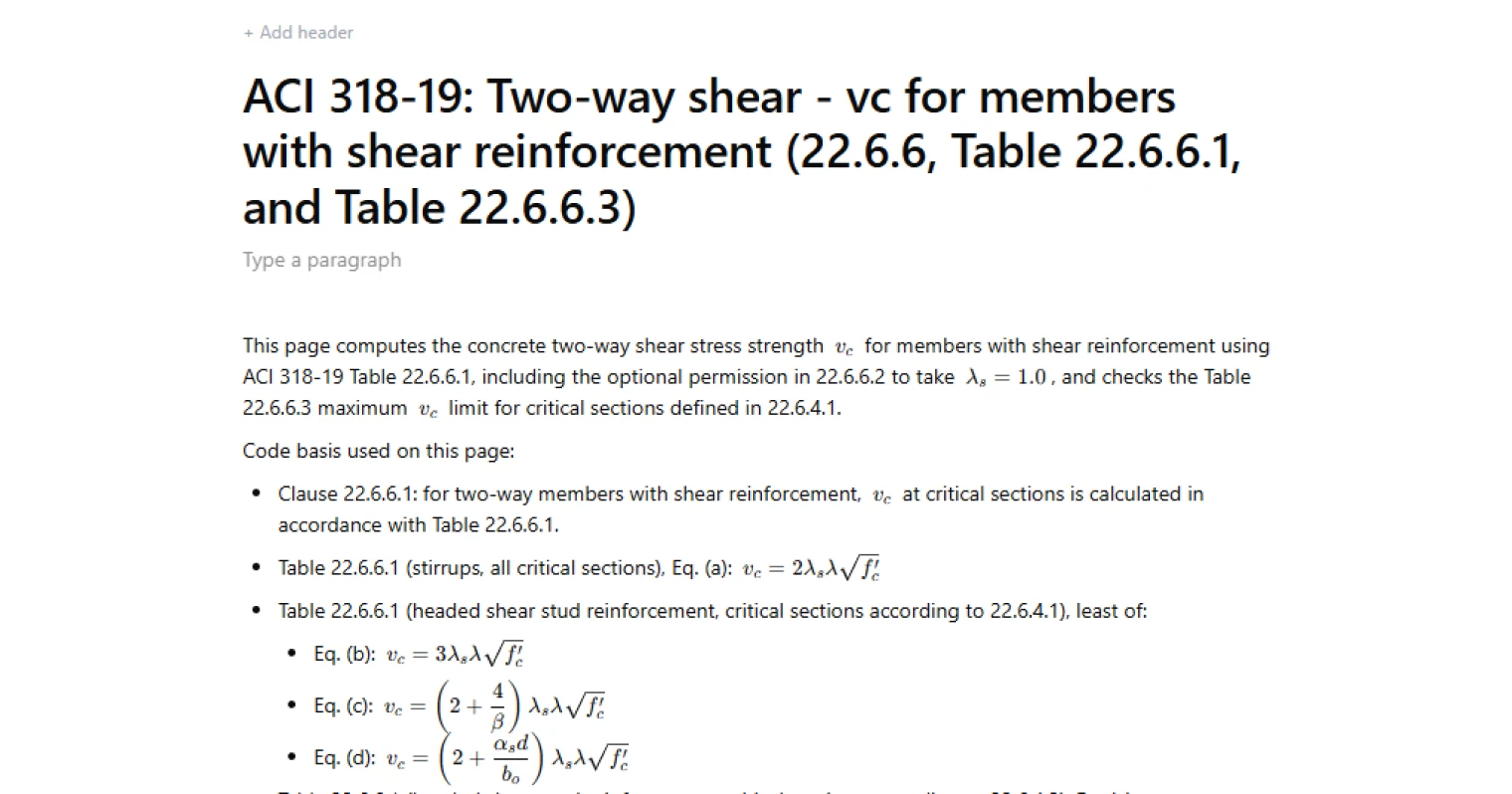
This calculator computes the concrete two-way shear stress strength (v_c) for slabs and footings with shear reinforcement using ACI 318-19 Table 22.6.6.1. It supports both stirrups and headed shear stud reinforcement, applies the size-effect factor (\lambda_s) (with the optional permission to take (\lambda_s = 1.0) when allowed by 22.6.6.2), and checks the Table 22.6.6.3 maximum (v_c) limit when the critical section is defined per 22.6.4.1.
- Structural engineer — evaluate the governing (v_c) expression for punching shear design around columns and confirm when the Table 22.6.6.3 cap applies.
- Reinforced concrete detailer — understand which detailing/compliance flags unlock the (\lambda_s = 1.0) permission and avoid detailing that invalidates the assumption.
- Design reviewer — audit the selection of Table 22.6.6.1 rows (22.6.4.1 vs 22.6.4.2) and verify the min-of logic for headed stud cases.
The page is built as an engineering-grade CalcTree template: it exposes the governing equation label, the intermediate candidates (where applicable), and the applicability notes so the result is traceable and reviewable.
More info on Two-Way Shear Strength With Shear Reinforcement
Inputs
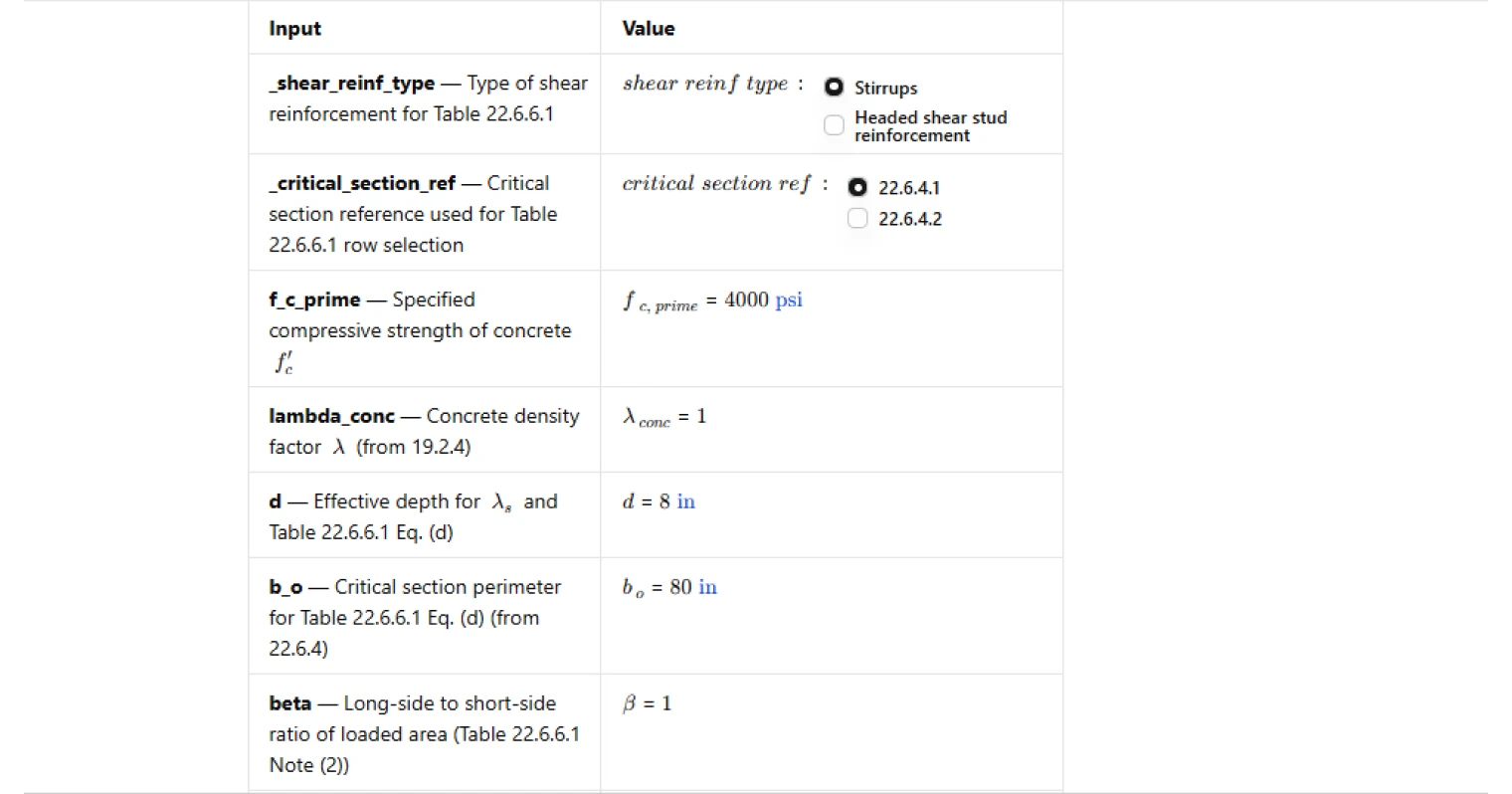
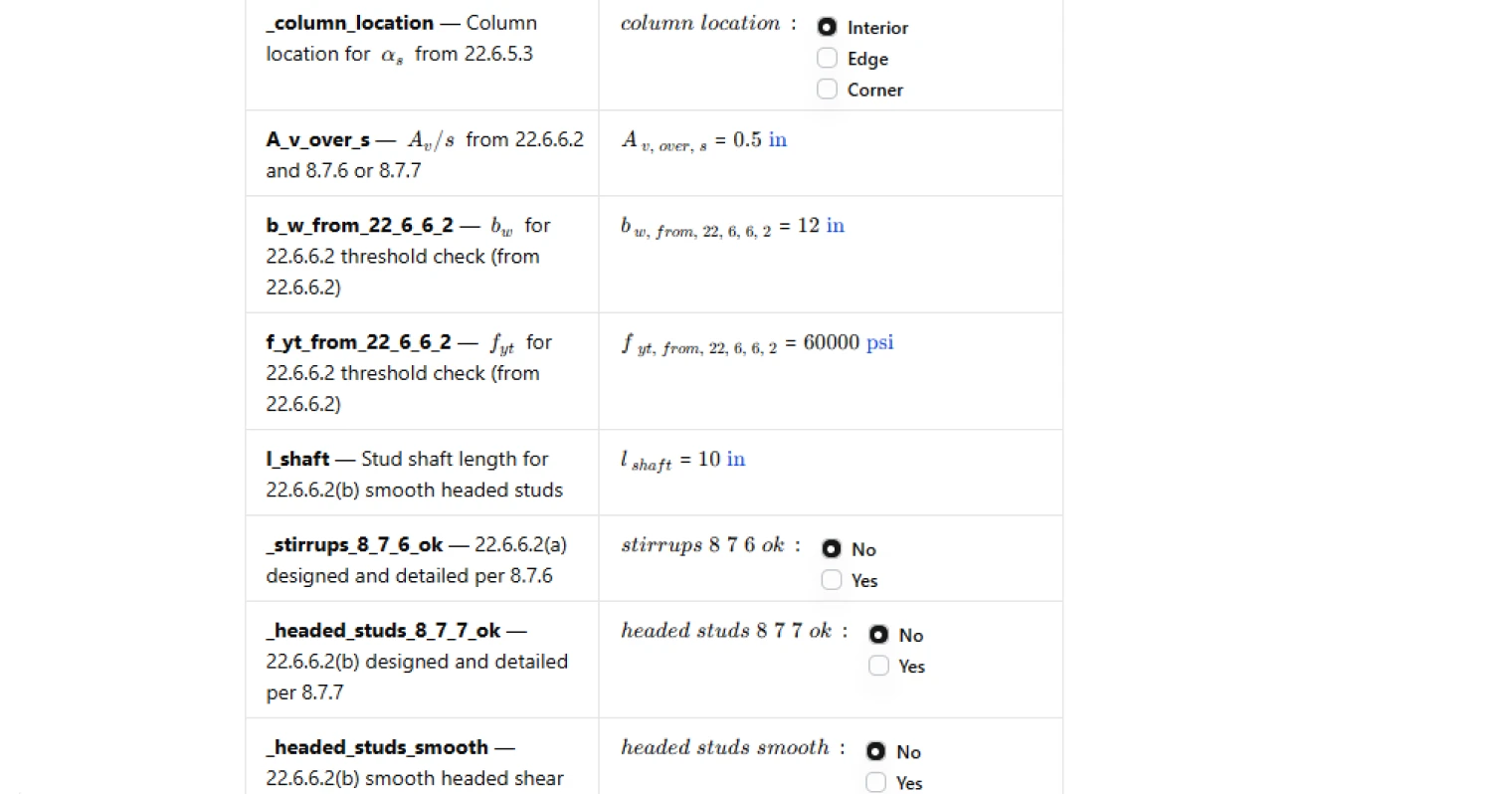
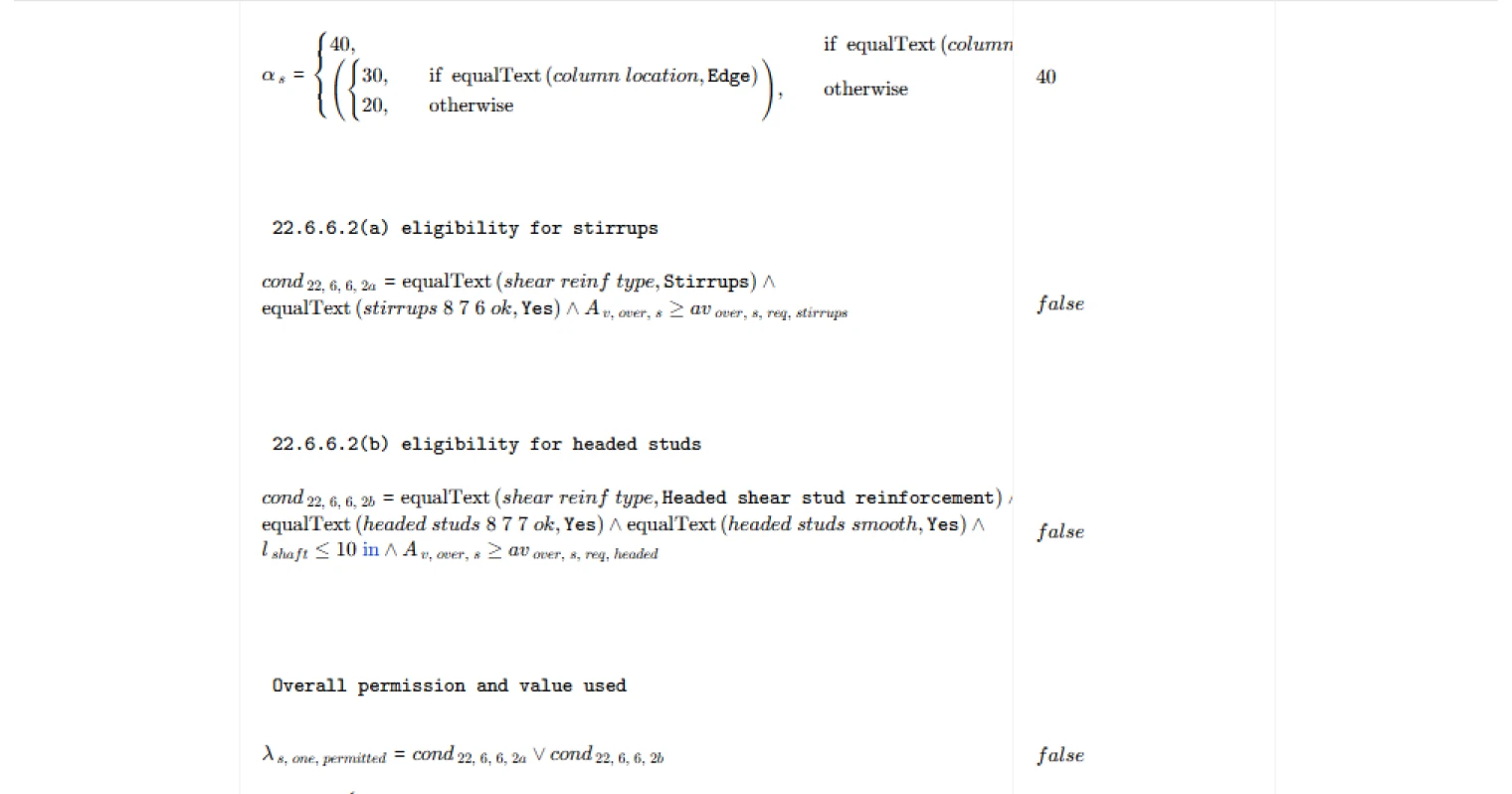
The calculator takes the concrete strength and density modification factor (\lambda), plus the geometric terms needed by Table 22.6.6.1. For headed stud checks it also uses the loaded-area aspect ratio (\beta) (long side / short side), the critical perimeter (b_o), and the effective depth (d) for the (\alpha_s d / b_o) candidate expression. A column location selector provides (\alpha_s) per 22.6.5.3 (interior/edge/corner).
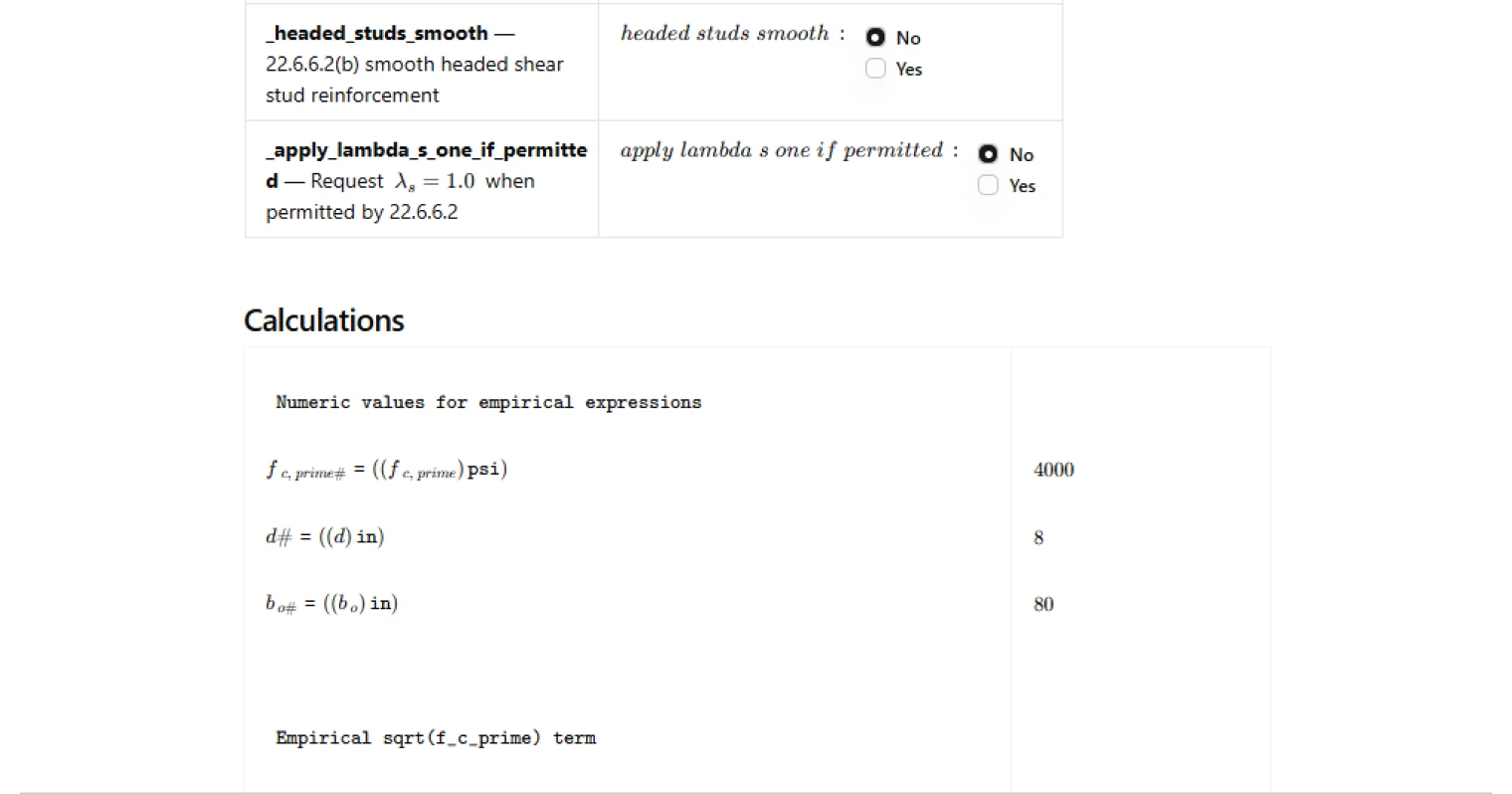
For the 22.6.6.2 permission logic, the page uses (A_v/s), a reference web width (b_w), and the reinforcement yield strength (f_{yt}), plus confirmation toggles that the reinforcement is designed and detailed to the relevant chapter requirements (8.7.6 for stirrups, 8.7.7 for headed studs). Headed studs also include checks for “smooth” studs and shaft-length eligibility.
Size-effect factor (\lambda_s) and the 22.6.6.2 permission
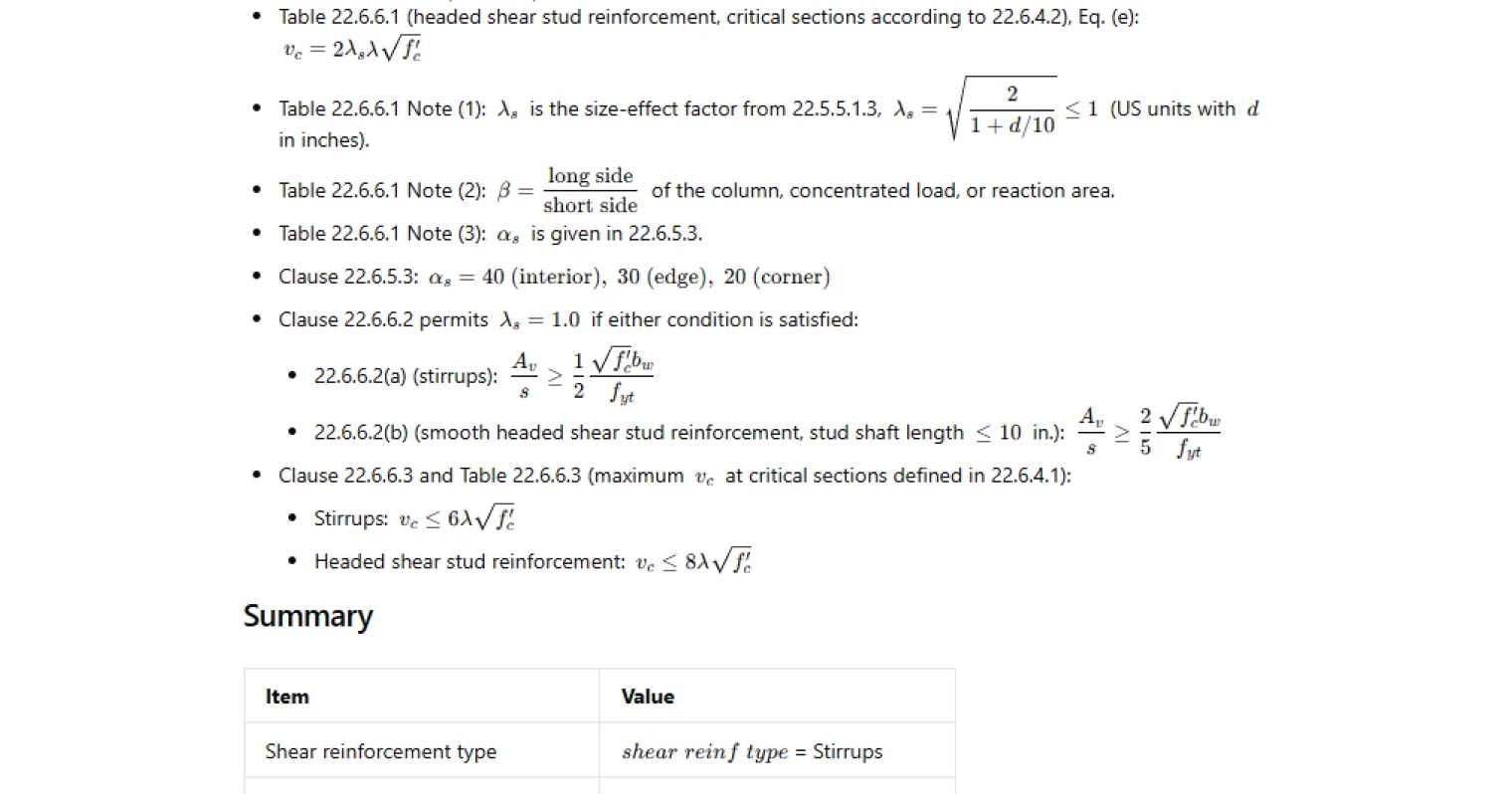
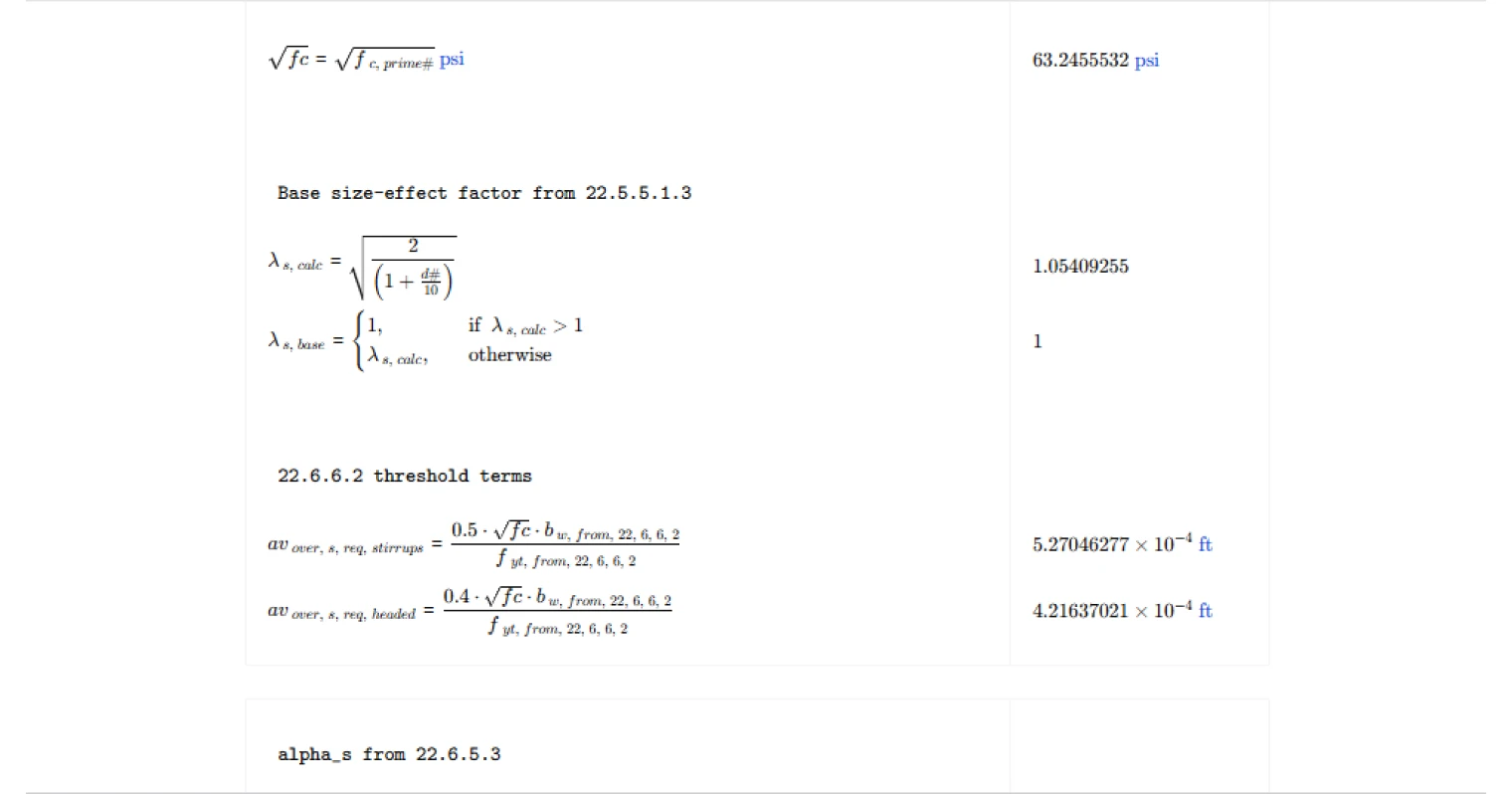
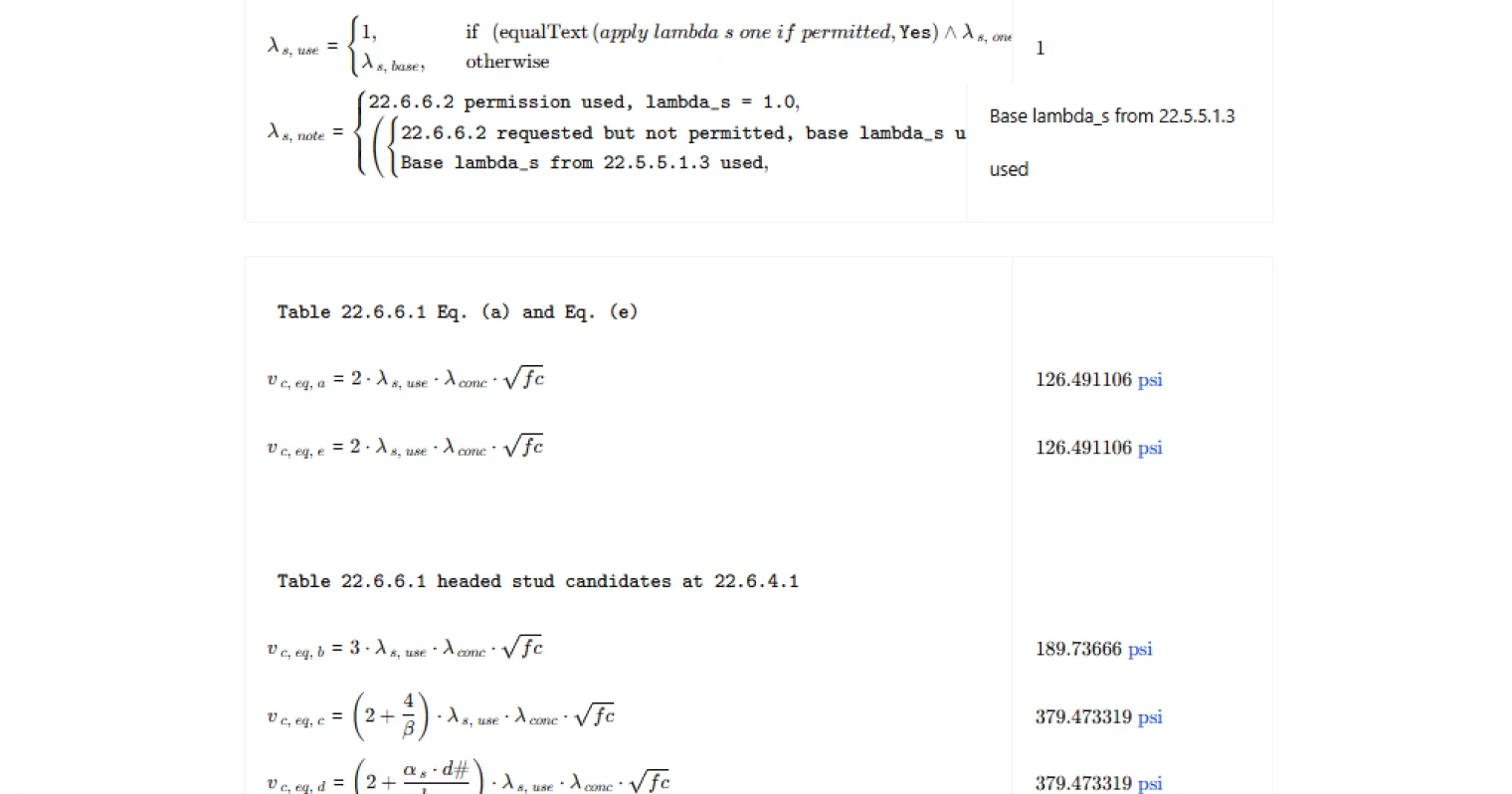
The base (\lambda_s) is computed from 22.5.5.1.3 and limited to not exceed unity. The page then evaluates whether (\lambda_s = 1.0) is permitted by 22.6.6.2 based on reinforcement type and threshold checks on (A_v/s), together with the required detailing-compliance flags. If the user requests the override and the criteria are satisfied, the calculator uses (\lambda_s = 1.0); otherwise it falls back to the base (\lambda_s) and reports a note explaining why.
This workflow makes it explicit when (\lambda_s = 1.0) is a permitted design assumption versus a requested but non-compliant override.
Table 22.6.6.1 equation selection and governing (v_c)
The calculator selects the governing Table 22.6.6.1 equation based on the shear reinforcement type and the critical section reference:
- For stirrups, it uses the Table 22.6.6.1 stirrup row for all critical sections.
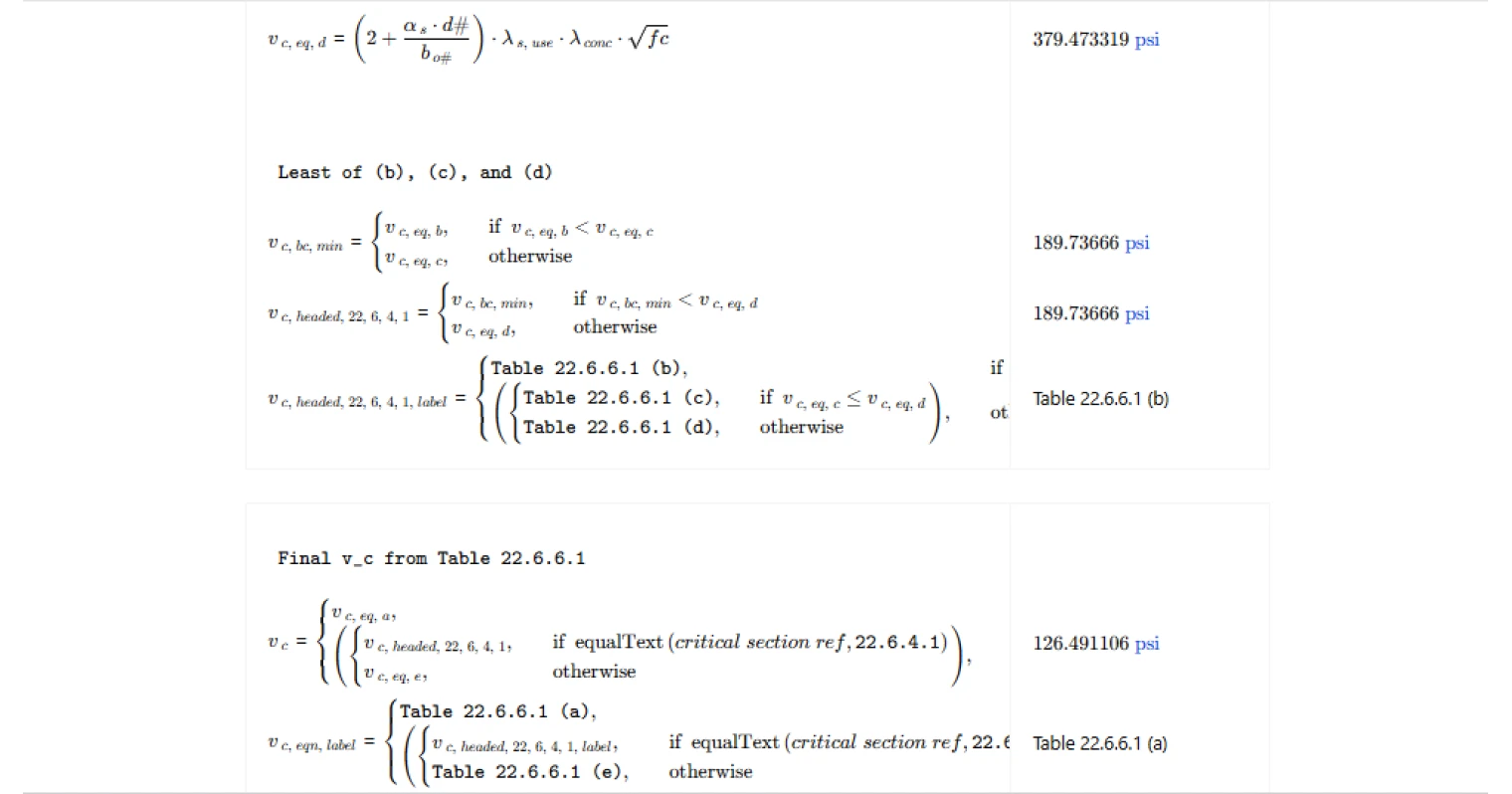
- For headed shear stud reinforcement, it distinguishes between critical sections per 22.6.4.1 versus 22.6.4.2. For the 22.6.4.1 case, it computes the candidate expressions and takes the least-of result, and reports which candidate governed. For the 22.6.4.2 case, it uses the corresponding single expression.
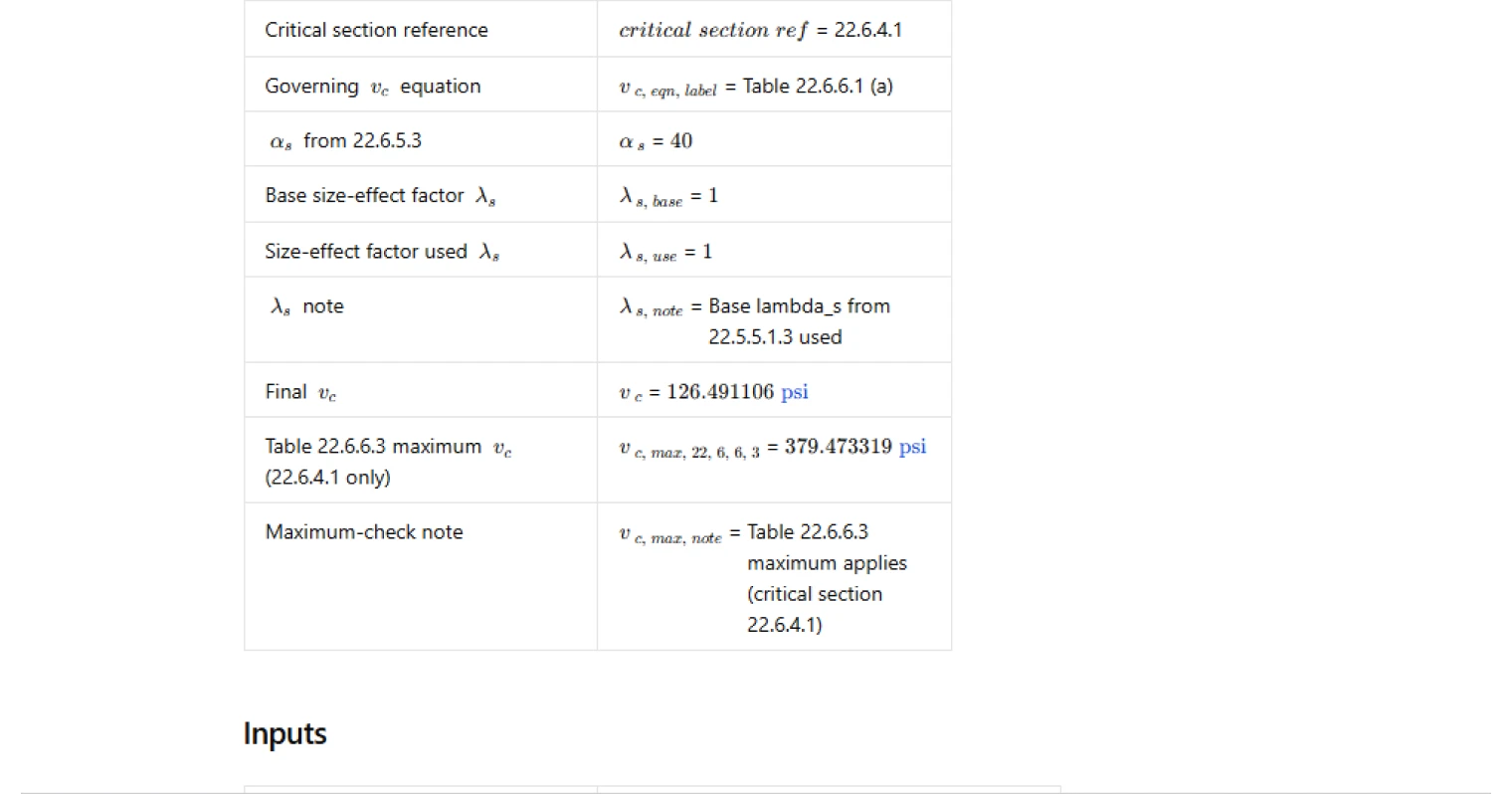
The summary panel exposes the selected equation label and the final (v_c) so users can quickly confirm the correct path through the table.
Table 22.6.6.3 maximum (v_c) limit
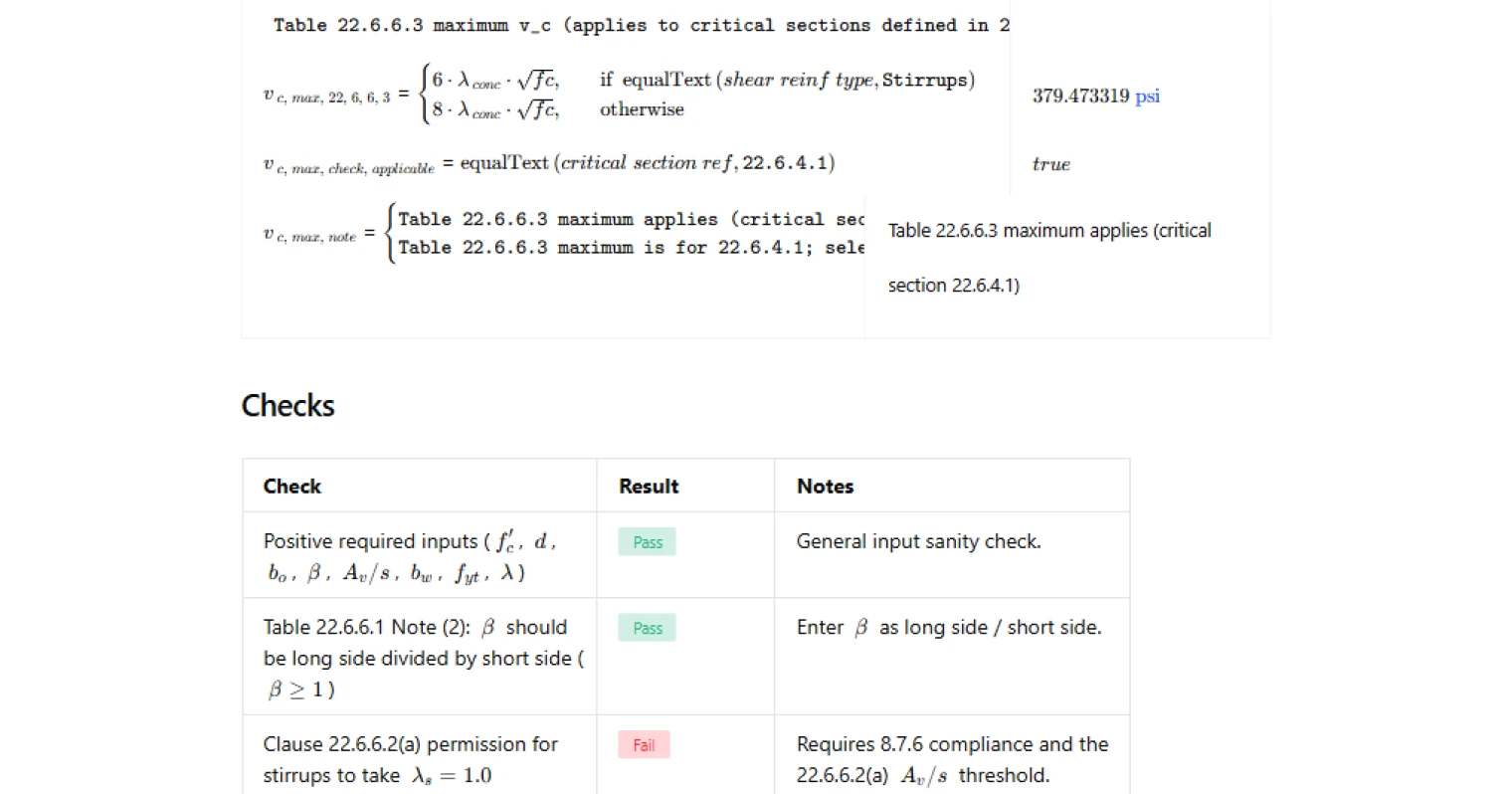
The calculator computes the Table 22.6.6.3 maximum (v_c) limit and applies it only when the critical section is defined in accordance with 22.6.4.1. If the user selects a 22.6.4.2 critical section, the page still reports the maximum as a reference value and prints an applicability note explaining that the table limit is tied to 22.6.4.1 critical sections.
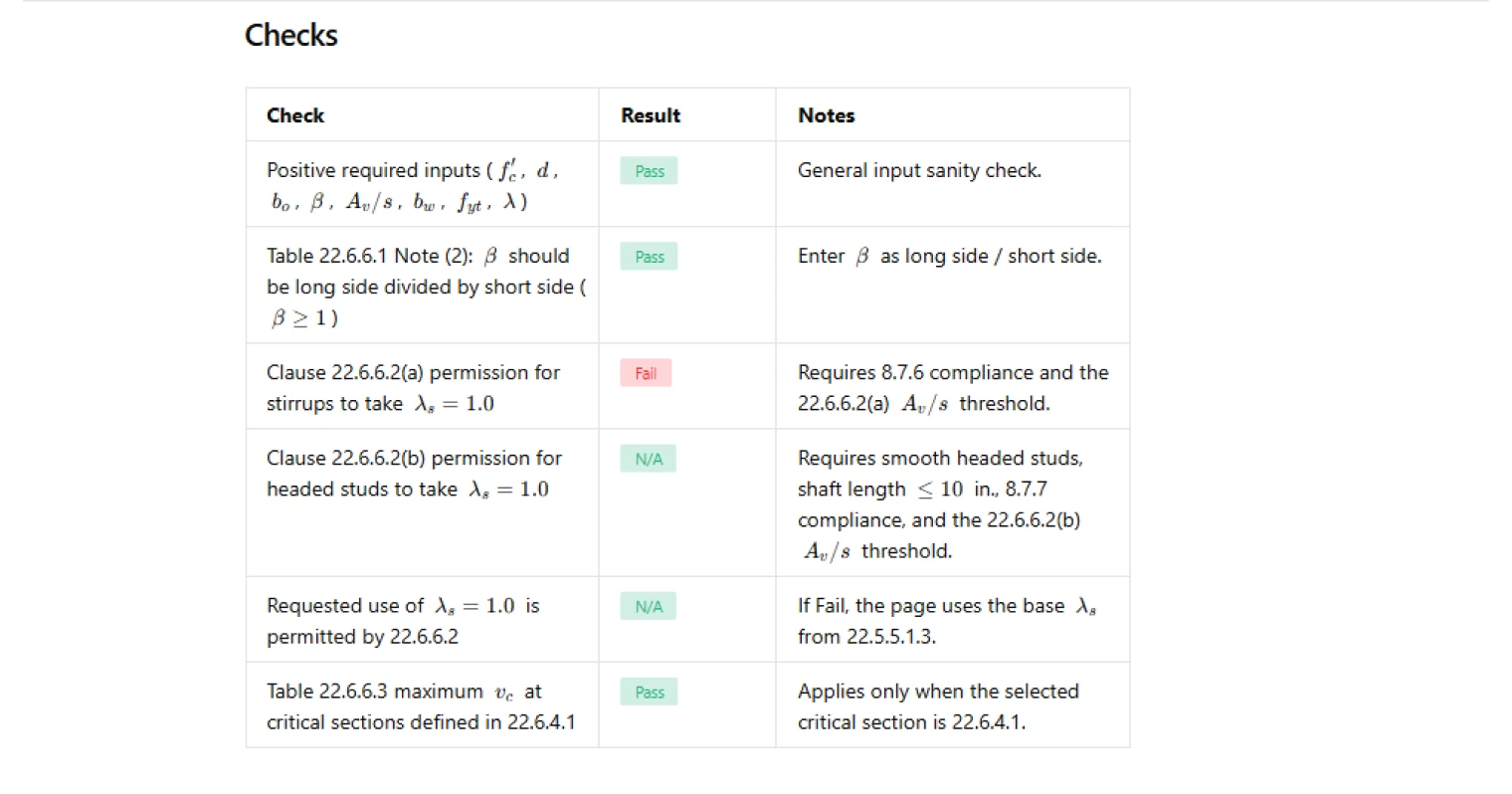
A dedicated pass/fail check flags when the computed (v_c) exceeds the applicable maximum.
Common Calculation Errors to Avoid
- Using (\beta < 1) — (\beta) is defined as long side divided by short side; reversing the ratio can inflate the headed-stud candidate expression.
- Applying the Table 22.6.6.3 maximum to the wrong critical section — the maximum limit is checked only for critical sections defined per 22.6.4.1; ensure the selected reference matches the design scenario.
- Forcing (\lambda_s = 1.0) without meeting 22.6.6.2 — the override is conditional on reinforcement thresholds and detailing compliance; if not satisfied, the base (\lambda_s) must be used.
- Mixing up (b_o) definitions across checks — (b_o) must correspond to the selected critical section definition; inconsistent perimeter selection changes the (\alpha_s d / b_o) term.
- Incorrect (\alpha_s) selection — (\alpha_s) depends on interior/edge/corner location; using the wrong location changes the headed-stud candidate expression.
- Unit inconsistency in (\lambda_s) evaluation — the base (\lambda_s) expression depends on the units assumed for (d); keep (d) consistent with the chosen code-unit basis in the implementation.
Engineering templates
Common calculators
Design guides




FAQs
What is two-way shear vc and why does it matter for reinforced concrete slabs?
Two-way shear (punching shear) is the failure mode where a column or concentrated load punches through a flat slab along a diagonal surface around the loaded area. The concrete shear stress strength vc is the concrete contribution to resisting that failure. When shear reinforcement is present, ACI 318-19 permits a higher vc than the unreinforced case, but the reinforcement type and detailing affect which equations apply. Getting vc right directly affects the adequacy of the slab at the column-slab connection.
What is the difference between critical sections 22.6.4.1 and 22.6.4.2, and which should I select?
Section 22.6.4.1 defines the first critical section located at d/2 from the face of the column, concentrated load, or reaction area. This is the primary section used for most punching shear checks and is the one governed by Table 22.6.6.3 upper limits. Section 22.6.4.2 defines outer critical sections beyond the shear-reinforced zone, typically checked when the reinforcement does not extend far enough to satisfy 22.6.4.1 demands alone. For headed shear stud reinforcement, Eq. (e) applies at 22.6.4.2 sections and gives a lower vc than the 22.6.4.1 equations. Select the section that matches the location you are checking.
When can I take the size-effect factor λs as 1.0 instead of the calculated value?
By default, λs is calculated from 22.5.5.1.3 as sqrt(2 / (1 + d/10)) ≤ 1.0, which reduces vc for deeper members. Clause 22.6.6.2 permits overriding this and using λs = 1.0 if minimum shear reinforcement thresholds are met. For stirrups, Av/s must be at least 0.5 * sqrt(f'c) * bw / fyt and the stirrups must be detailed per 8.7.6. For smooth headed shear studs with shaft length ≤ 10 in., the threshold is 0.4 * sqrt(f'c) * bw / fyt and detailing must comply with 8.7.7. In the calculator, set the relevant detailing flags to Yes, confirm Av/s meets the threshold, and toggle the λs = 1.0 request. The tool checks eligibility and reports whether the override is applied.
Why are three equations checked for headed shear stud reinforcement at 22.6.4.1 critical sections, and which governs?
Table 22.6.6.1 requires that vc for headed studs at 22.6.4.1 sections be taken as the least of Eq. (b), (c), and (d). Eq. (b) gives 3 * λs * λ * sqrt(f'c) and is a flat upper limit. Eq. (c) introduces the column aspect ratio β and becomes critical when the column is elongated, producing higher stress concentrations. Eq. (d) accounts for column location via αs and the ratio d/bo, making it sensitive to slab depth and perimeter geometry. The calculator evaluates all three and reports the governing equation label in the summary.
What does the Table 22.6.6.3 maximum vc check do, and when does it apply?
Table 22.6.6.3 places an absolute ceiling on vc at critical sections defined in 22.6.4.1, independent of the computed value. For stirrups the limit is 6 * λ * sqrt(f'c); for headed shear stud reinforcement it is 8 * λ * sqrt(f'c). This cap recognizes that regardless of reinforcement quantity, the concrete alone cannot sustain unlimited shear stress. The check is not applicable to 22.6.4.2 sections, so the calculator marks it N/A when that section is selected. If the computed vc exceeds the Table 22.6.6.3 limit at a 22.6.4.1 section, the check fails and the slab geometry or reinforcement type needs to be reconsidered.
What inputs do I need to prepare before running this calculation?
You need the concrete compressive strength f'c, effective slab depth d, critical section perimeter bo, column aspect ratio β, column location (interior, edge, or corner), shear reinforcement type and detailing compliance flags, the ratio Av/s, the strip width bw and yield strength fyt used in the 22.6.6.2 threshold, the concrete density factor λ, and for headed studs the stud shaft length. Most of these come from the structural layout and reinforcement drawings. The column location sets αs directly, so confirm edge and corner conditions carefully before running the check.
Learn about the benefits of using CalcTree on engineering projects!