
Check ACI 318-19 Section 22.7.7 torsional stress limits for solid and hollow sections instantly. Verify combined shear-torsion compliance — try it free.

Tell us what you need, or sign up and build it yourself in minutes.
Leave your email and we'll tell you when a template for it is ready:

No items found.
No items found.
About this ACI 318-19: Cross-sectional Limits - Torsional Stress Limitations for Solid and Hollow Sections (Section 22.7.7) Calculator
This calculator checks whether a concrete cross section satisfies the torsional and shear stress limits required by ACI 318-19 Section 22.7.7. It evaluates combined stress demand against the allowable limit of √f'c, applying the correct equation based on whether the section is solid or hollow. The template handles both non-prestressed and prestressed conditions, including the additional torsional stress term from prestressing where applicable.
- Structural engineer — verify that beam cross sections are adequately sized under combined torsion and shear before detailing torsional reinforcement, without resorting to excessive steel to compensate for an undersized section.
- Bridge or precast designer — check hollow section compliance under factored load combinations, including the wall thickness provisions for thin-walled sections per Section 22.7.7.1.2.
- Checking engineer — audit cross-sectional stress limits against code equations with full transparency into each stress component and the applicable equation path.
This is an engineering-grade calculator built on CalcTree, where all inputs, intermediate stress components, and compliance checks are visible, traceable, and editable within a live project workspace.
More info on ACI 318-19: Cross-sectional Limits - Torsional Stress Limitations for Solid and Hollow Sections (Section 22.7.7)
Inputs
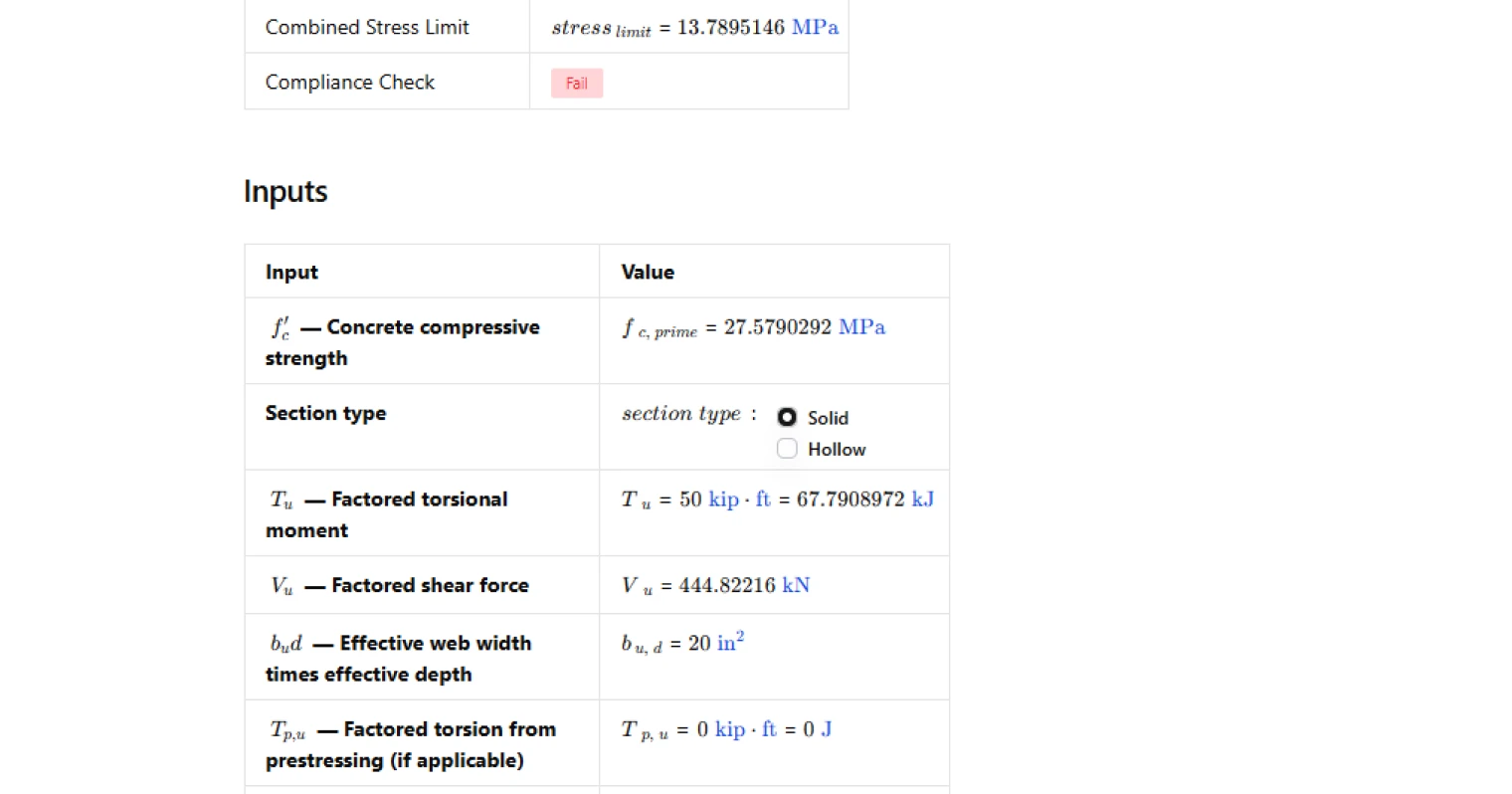
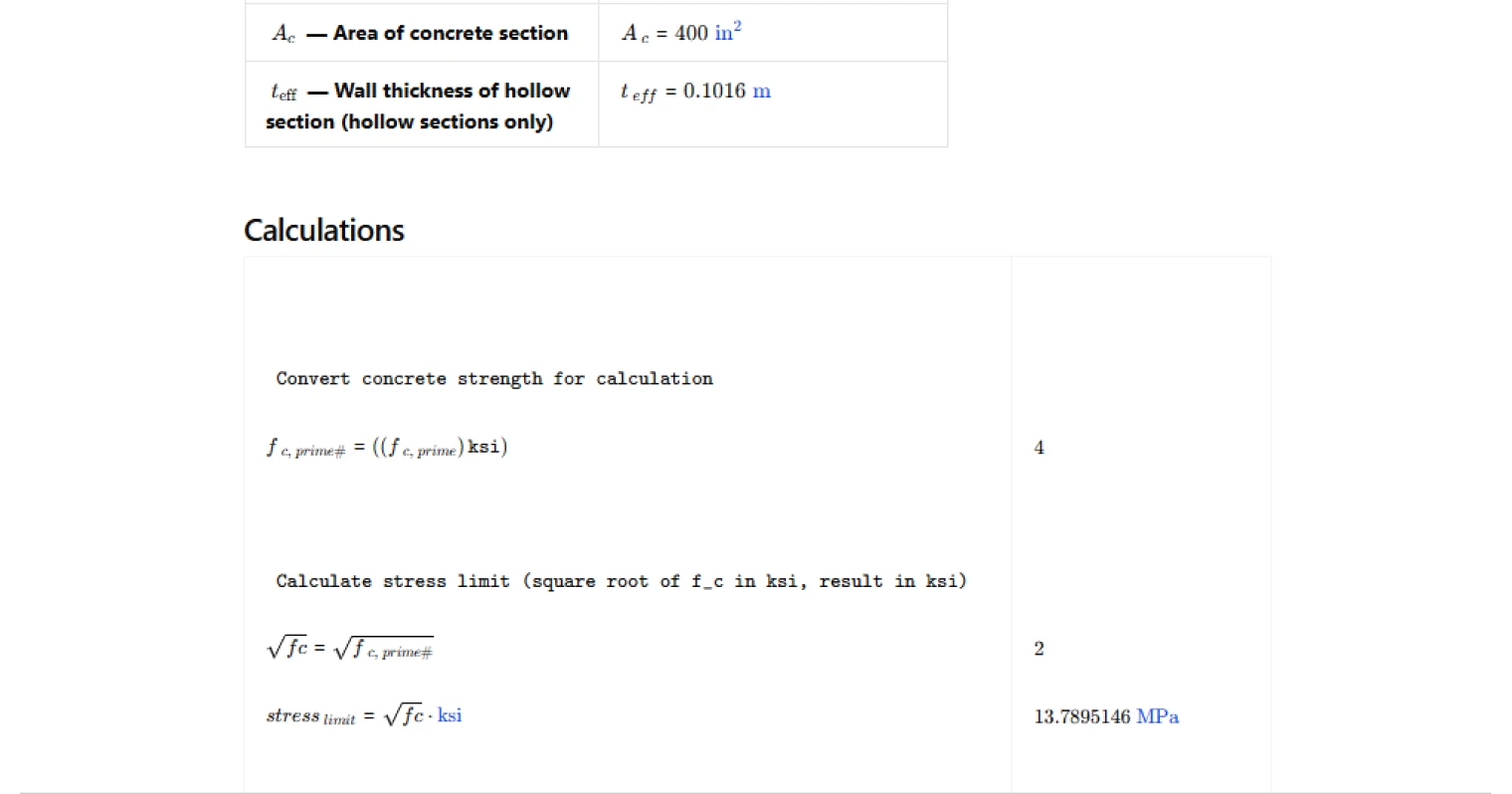
The calculator takes the factored torsional moment and factored shear force as the primary load inputs, along with the concrete compressive strength. Cross-sectional geometry is captured through the effective web width times effective depth product and the gross area of the concrete section. For prestressed members, the factored torsion contribution from prestressing is entered separately and fed into the torsional stress term. A section type selector switches the calculation between the solid and hollow section equations. For hollow sections, the effective wall thickness at the location being checked is also required to handle the thin-wall provisions of Section 22.7.7.1.2.
Methods Used
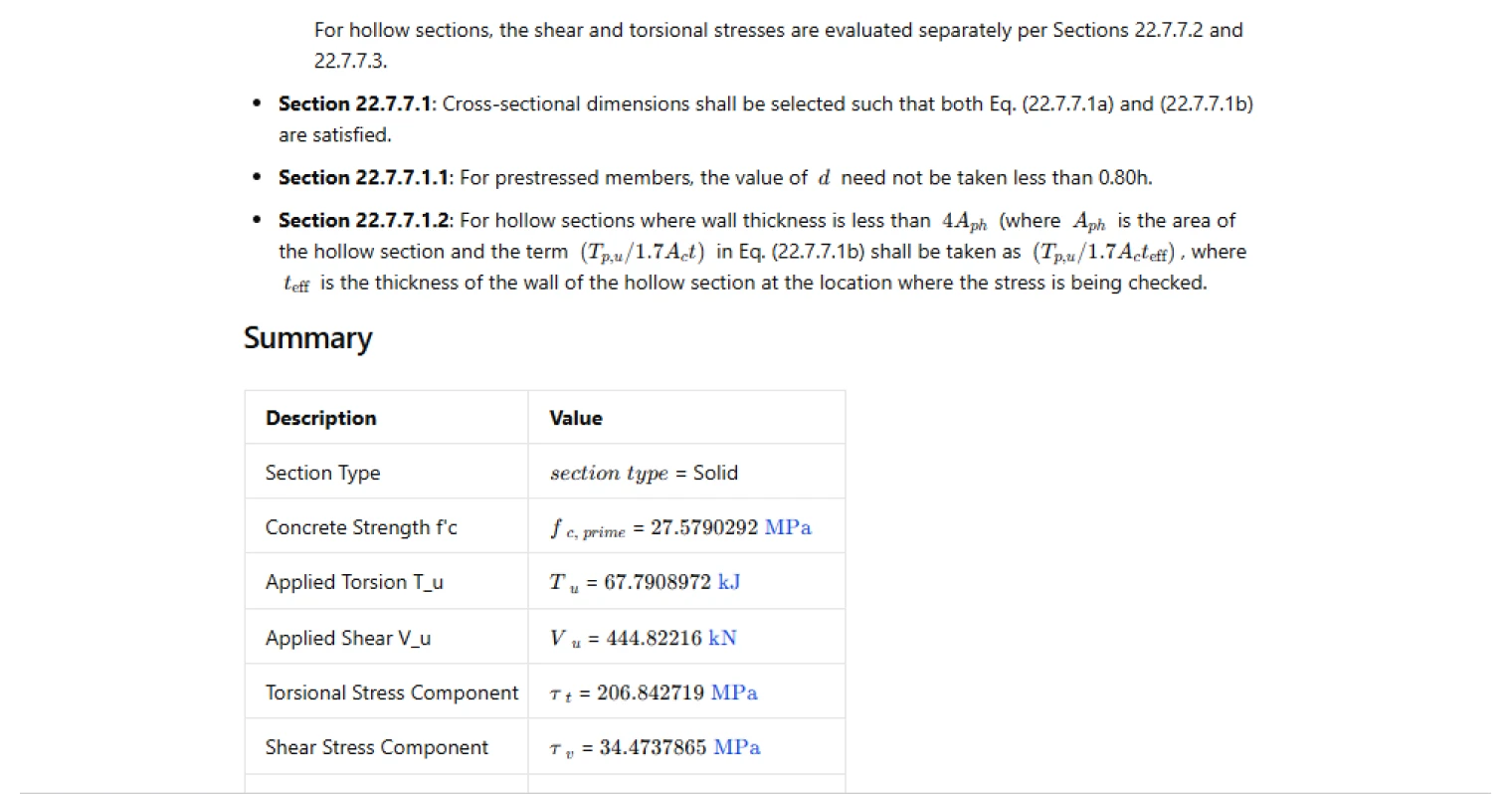
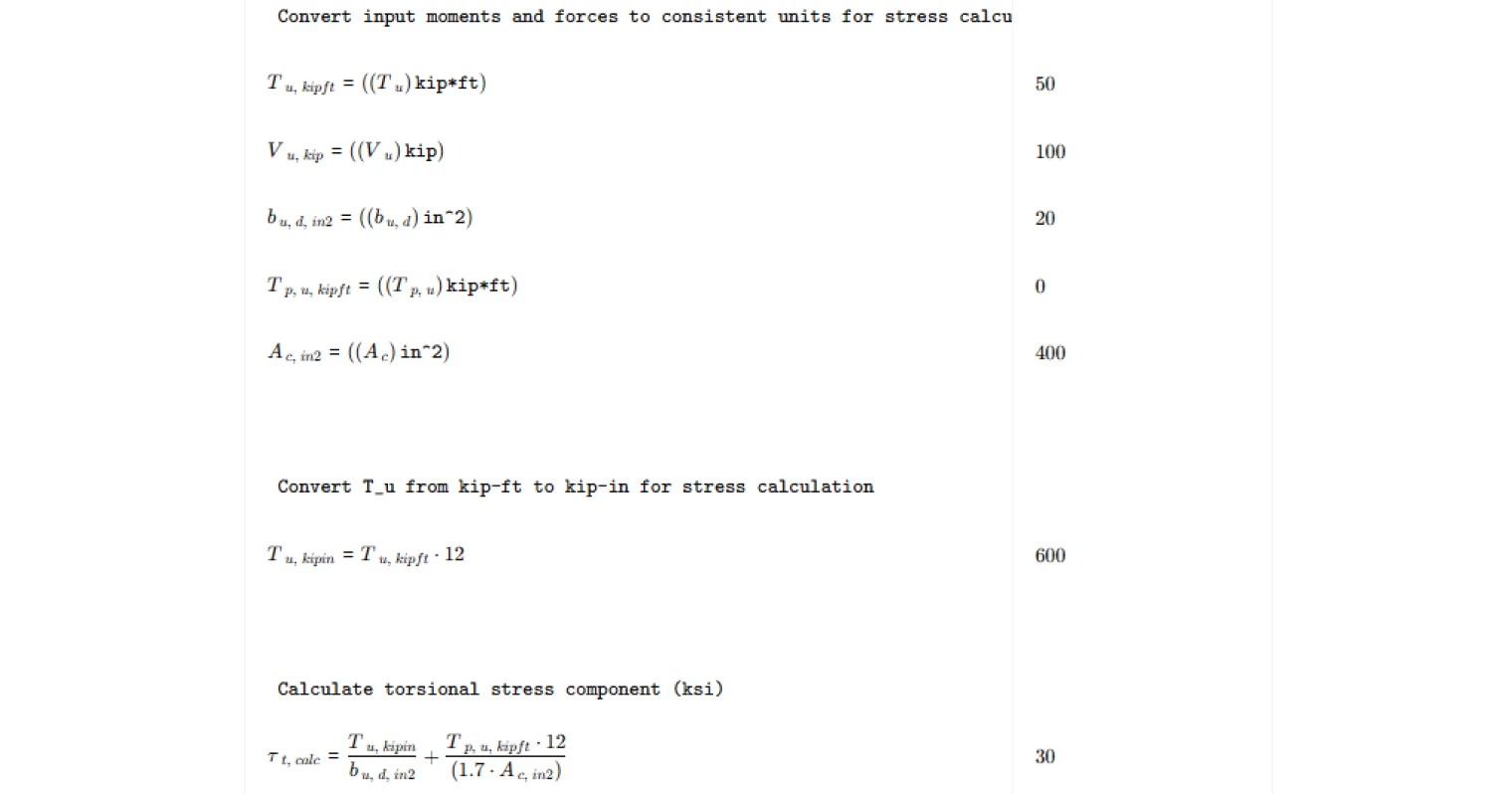
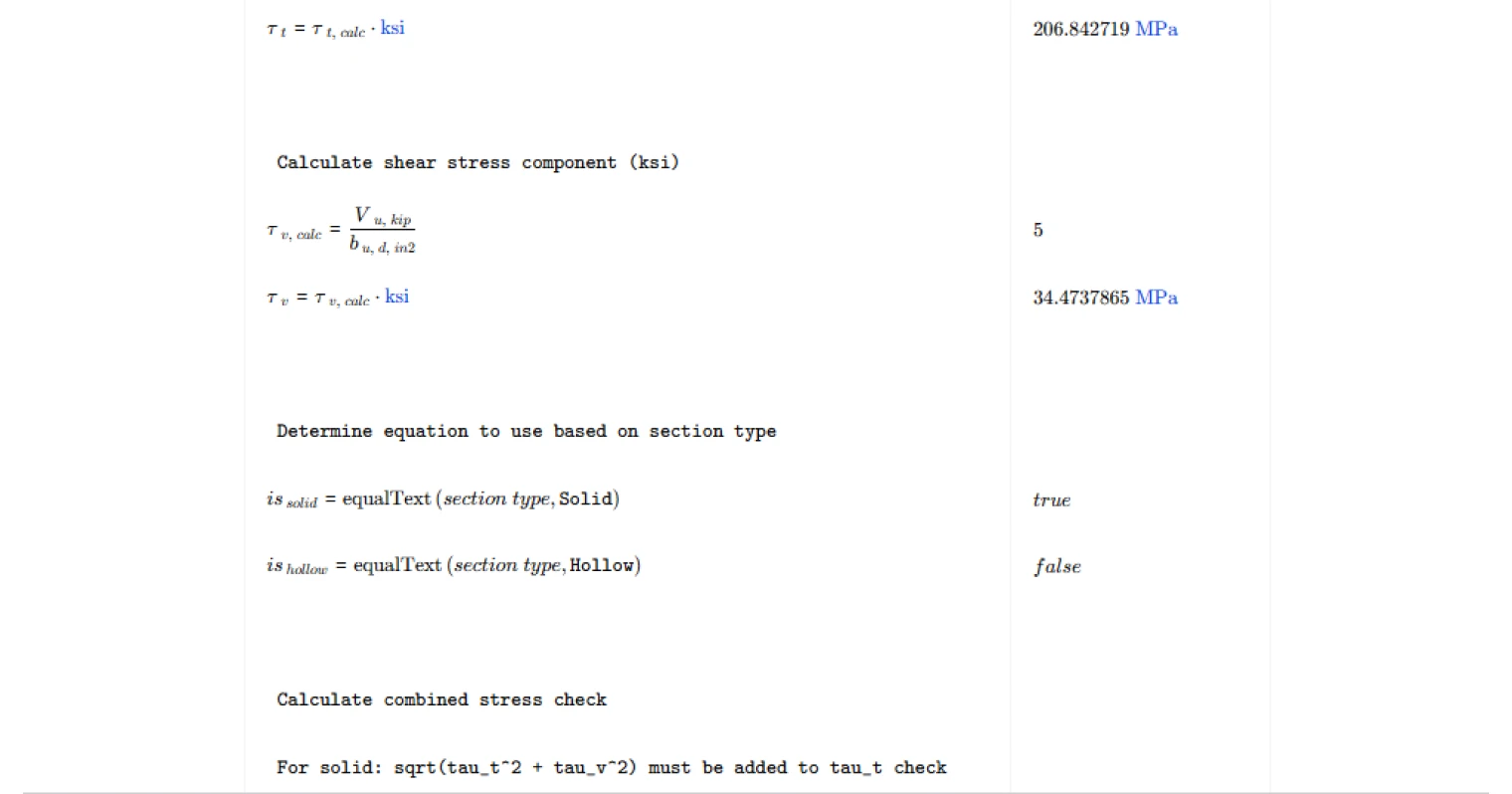
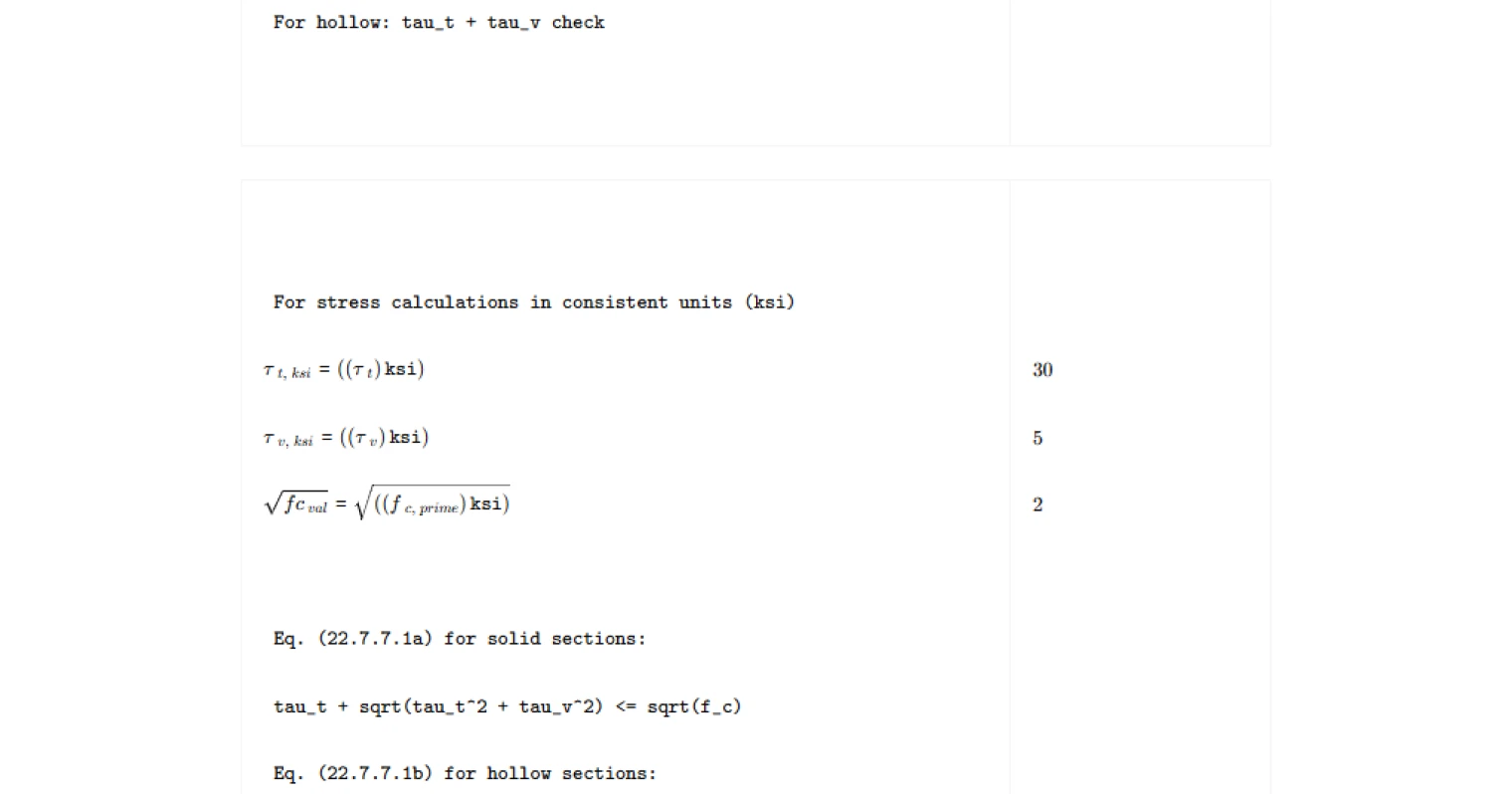
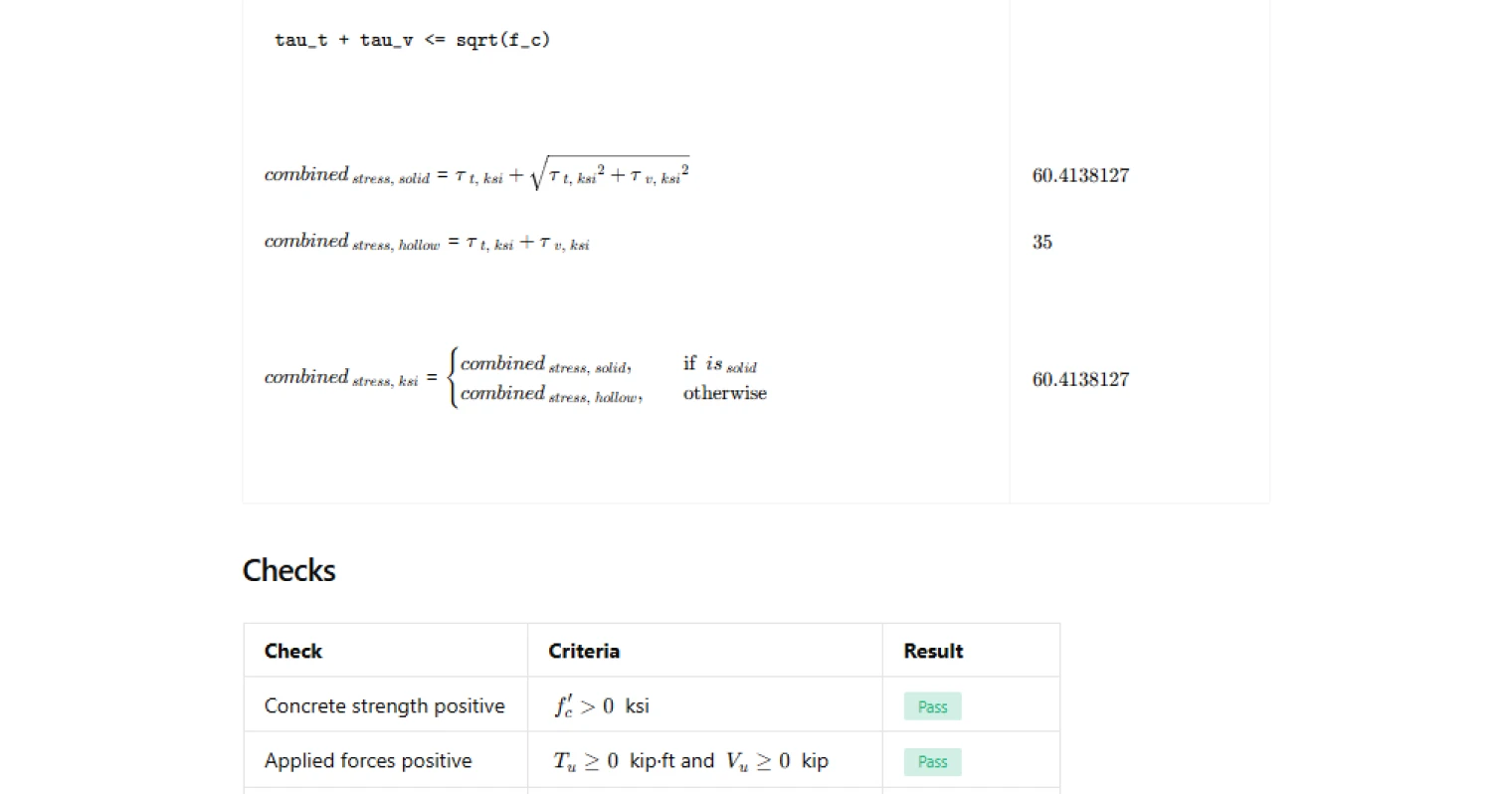
The calculator implements two distinct equations from ACI 318-19 Section 22.7.7. For solid sections, Equation 22.7.7.1a combines the torsional stress term with the square root of the sum of squares of torsional and shear stress components, reflecting the circular interaction of these effects in solid webs. For hollow sections, Equation 22.7.7.1b treats the stresses as additive, consistent with the way shear flow accumulates on one face of a thin-walled element. In both cases, the torsional stress term includes the prestressing contribution through the 1.7Ac denominator. The allowable stress limit is taken as √f'c, expressed in consistent units with the stress demand.
Outputs and Design Checks
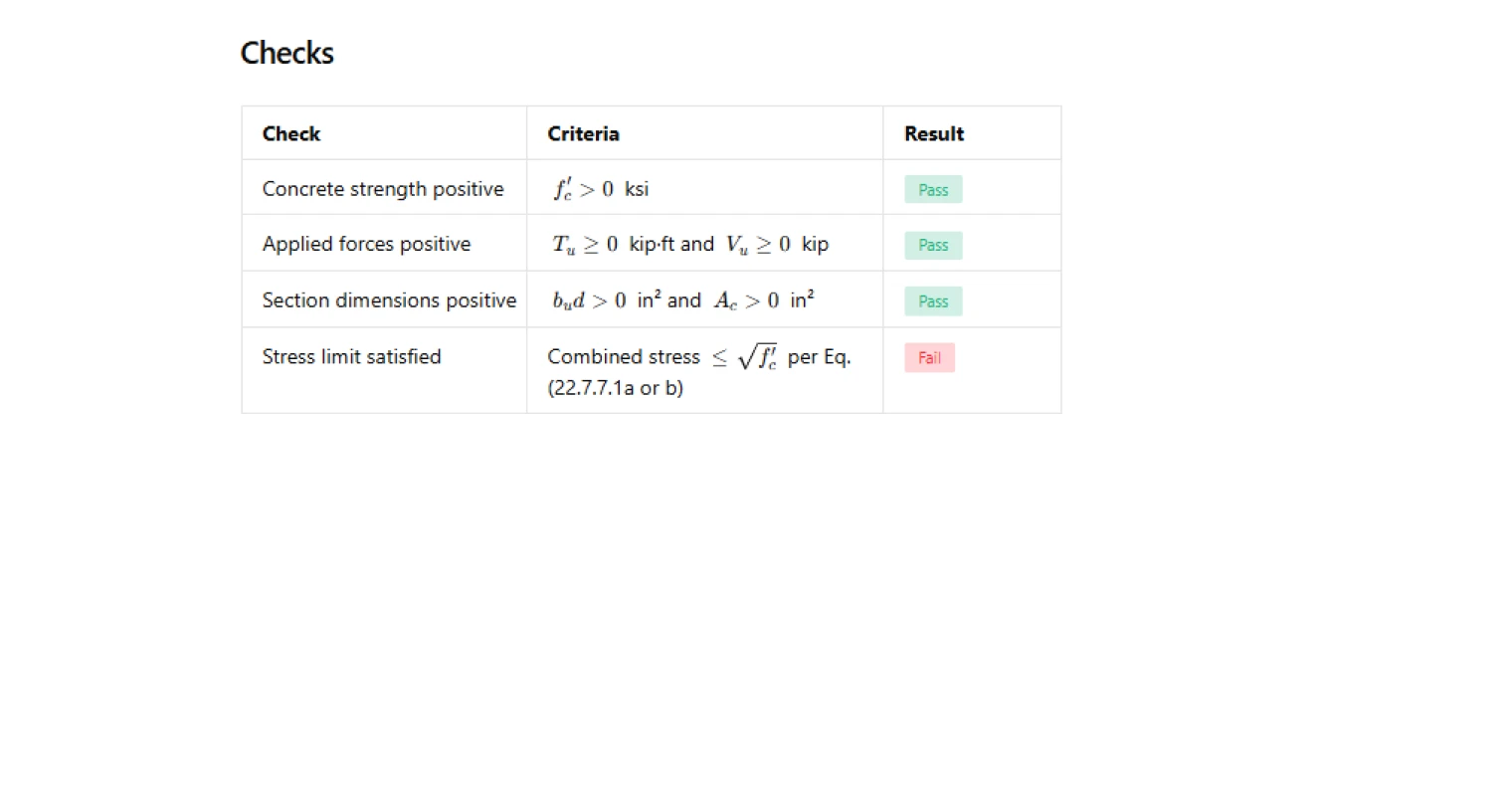
The calculator outputs the torsional stress component, shear stress component, combined stress demand, and the applicable stress limit, all in consistent pressure units. The compliance check confirms whether the combined stress satisfies the Section 22.7.7.1 limit. A set of input validation checks runs alongside the main result, confirming that concrete strength is positive, applied forces are non-negative, and section dimensions are valid before the stress check is evaluated. The summary table collects all key results in one place for quick review and documentation.
Prestressed and Hollow Section Provisions
For prestressed members, Section 22.7.7.1.1 permits the effective depth d to be taken as not less than 0.80h, which affects the b·d product used in the stress denominators. For hollow sections where the wall thickness falls below the threshold defined relative to the enclosed area, Section 22.7.7.1.2 requires the torsional stress term to use the effective wall thickness rather than the full section area term. The calculator accommodates both conditions through the prestressing torsion input and the t_eff wall thickness input for hollow sections.
Common Calculation Errors to Avoid
- Using inconsistent units across stress terms — torsional moments must be converted to force-length units consistent with the stress denominator; mixing kip-ft and kip-in in the same expression produces incorrect stress values by a factor of twelve.
- Applying the solid section equation to hollow sections — the two equations are not interchangeable; solid sections use an SRSS-type combination while hollow sections use direct addition, and applying the wrong form can unconservatively underestimate demand.
- Omitting the prestressing torsion term — for prestressed members, the T_p,u contribution must be included in the torsional stress component; setting it to zero when prestress is present underestimates torsional stress demand.
- Ignoring the thin-wall provision for hollow sections — when wall thickness is less than the code threshold, t_eff must replace the standard area term; using the gross section area in this case is non-conservative.
- Using gross area instead of the correct A_c — A_c in the torsional stress denominator refers to the area of the concrete cross section as defined in the code context; substituting transformed or net section areas introduces error.
- Not checking d against the 0.80h floor for prestressed members — if the calculated effective depth falls below 0.80h, it must be taken as 0.80h per Section 22.7.7.1.1; using a smaller d overstates the stress demand but using an incorrect d in b·d changes the computed stress directly.
Engineering templates
Common calculators
Design guides




FAQs
What is the purpose of the ACI 318-19 Section 22.7.7 stress limit check?
Section 22.7.7 sets upper bounds on combined torsional and shear stress in a cross section. The limits are not about reinforcement design — they ensure the concrete itself can carry the demands without requiring an impractical amount of torsional steel. If the check fails, the section needs to be resized before detailing reinforcement.
Why does ACI 318-19 use different equations for solid and hollow sections?
In a solid section, torsional and shear stresses act on the same concrete area, so they are combined using a vector (root-sum-of-squares) approach per Eq. 22.7.7.1a. In a hollow section, the two stress demands are more independent and additive per Eq. 22.7.7.1b. Using the solid equation for a hollow section would be unconservative because it underestimates the combined demand on thin walls.
What is the stress limit and where does the √f'c value come from?
The combined stress demand must not exceed √f'c, where f'c is in ksi and the result is in ksi. This threshold is a concrete shear capacity benchmark used throughout ACI 318. It reflects the diagonal tension strength of plain concrete and is the same basis used for basic shear capacity limits elsewhere in the code.
What inputs are specific to prestressed members, and how are they handled here?
The term T_p,u represents the factored torsion contribution from prestressing. For non-prestressed members, set T_p,u to zero and the term drops out. For prestressed members, ACI 318-19 Section 22.7.7.1.1 also allows the effective depth d to be taken as no less than 0.80h, which affects the b_u·d input — apply that minimum when entering your section geometry.
What do I do if the stress limit check fails?
A failing result means the combined torsional and shear stress exceeds √f'c for the section as sized. The fix is to increase the cross-sectional dimensions — specifically b_u·d for shear and A_c for torsion. Increasing concrete strength f'c raises the limit but is generally less efficient than resizing. Adding more reinforcement does not resolve a Section 22.7.7 failure; the limit is on the concrete, not the steel.
How do I handle a hollow section where the wall thickness is less than A_ph/4?
For thin-walled hollow sections meeting that condition, ACI 318-19 Section 22.7.7.1.2 requires replacing the full gross torsional term with one based on t_eff, the actual wall thickness at the critical location. Enter the effective wall thickness in the t_eff input field. The calculation will apply the modified term automatically when hollow section is selected.
Learn about the benefits of using CalcTree on engineering projects!