
Check minimum torsional reinforcement for nonprestressed beams per ACI 318-19 Cl. 9.6.4. Verify transverse & longitudinal steel fast. Try it free.

Tell us what you need, or sign up and build it yourself in minutes.
Leave your email and we'll tell you when a template for it is ready:




No items found.
No items found.
About this ACI 318 Minimum Torsional Reinforcement Calculator
This calculator checks whether torsional reinforcement is required for a nonprestressed concrete beam and, when it is, computes the ACI 318-19 minimum transverse and longitudinal torsion reinforcement requirements per Clause 9.6.4. It also compares provided reinforcement against the calculated minimums and returns clear pass/fail (or N/A) checks.
- Structural engineer — confirm whether torsion detailing is triggered at a section and verify provided closed stirrups and longitudinal torsion steel meet ACI minimums before issuing drawings.
- Detailer / reinforcement modeller — iterate stirrup spacing and bar areas to satisfy minimum torsion ratios while keeping the reinforcement layout practical.
- Design checker / reviewer — audit the trigger condition and minimum reinforcement equations in one place, with traceable clause references and explicit governing “max/min” selection.
This is an engineering-grade calculator on CalcTree: it exposes the clause logic used (trigger, governing minimum expressions, and clamping) and presents checks in a format that can be reviewed, shared, and reused across projects.
More info on ACI 318 Minimum Torsional Reinforcement
Torsion trigger logic
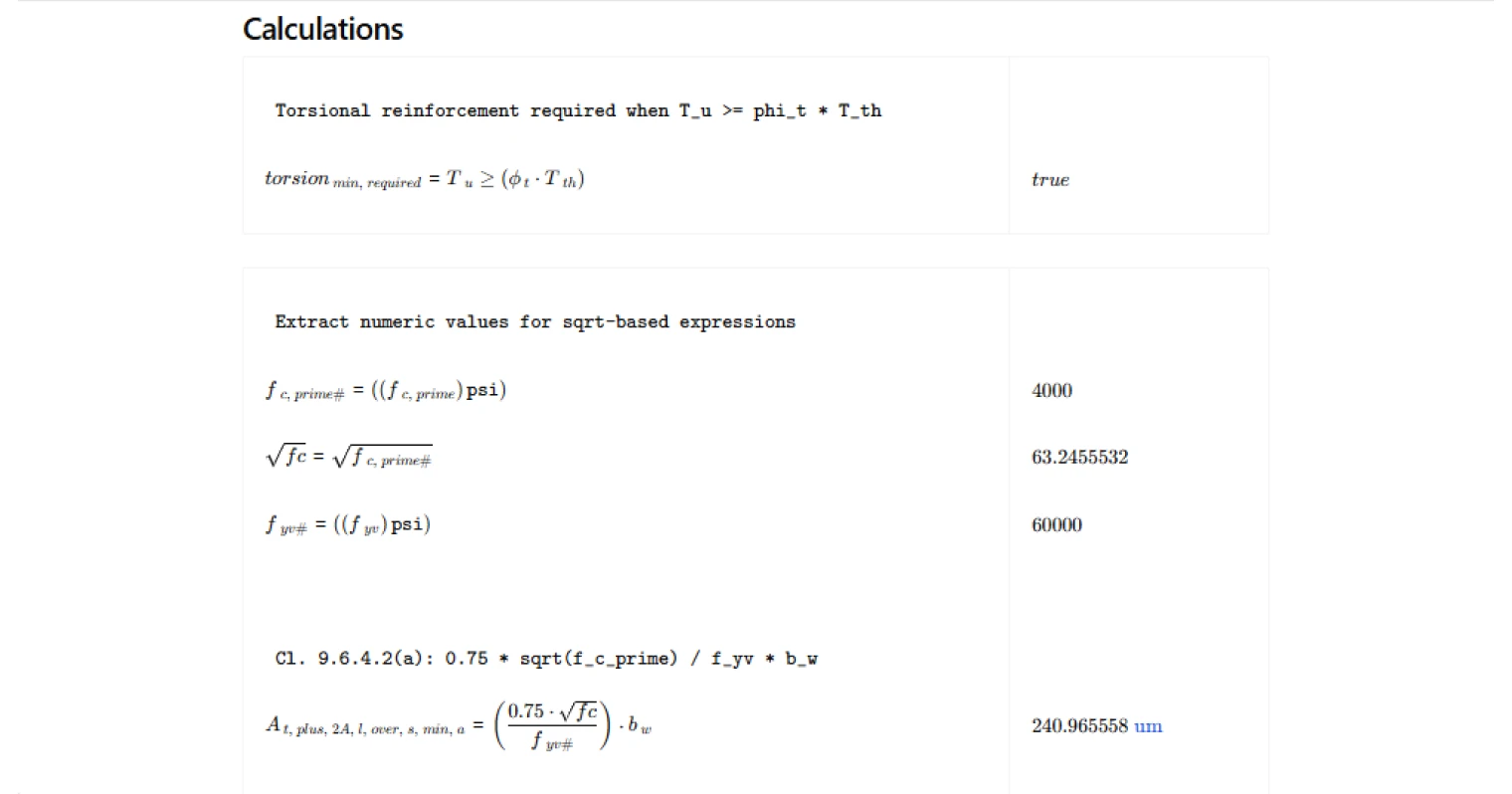
The page first determines if minimum torsional reinforcement checks are applicable using ACI 318-19 Cl. 9.6.4.1. The trigger is based on comparing factored torsion at the section against the strength-reduced threshold torsion, so the downstream reinforcement checks only apply when torsional reinforcement is required. If the trigger is not met, the transverse and longitudinal checks return N/A rather than forcing a pass/fail against minimums.
Inputs and modelling assumptions
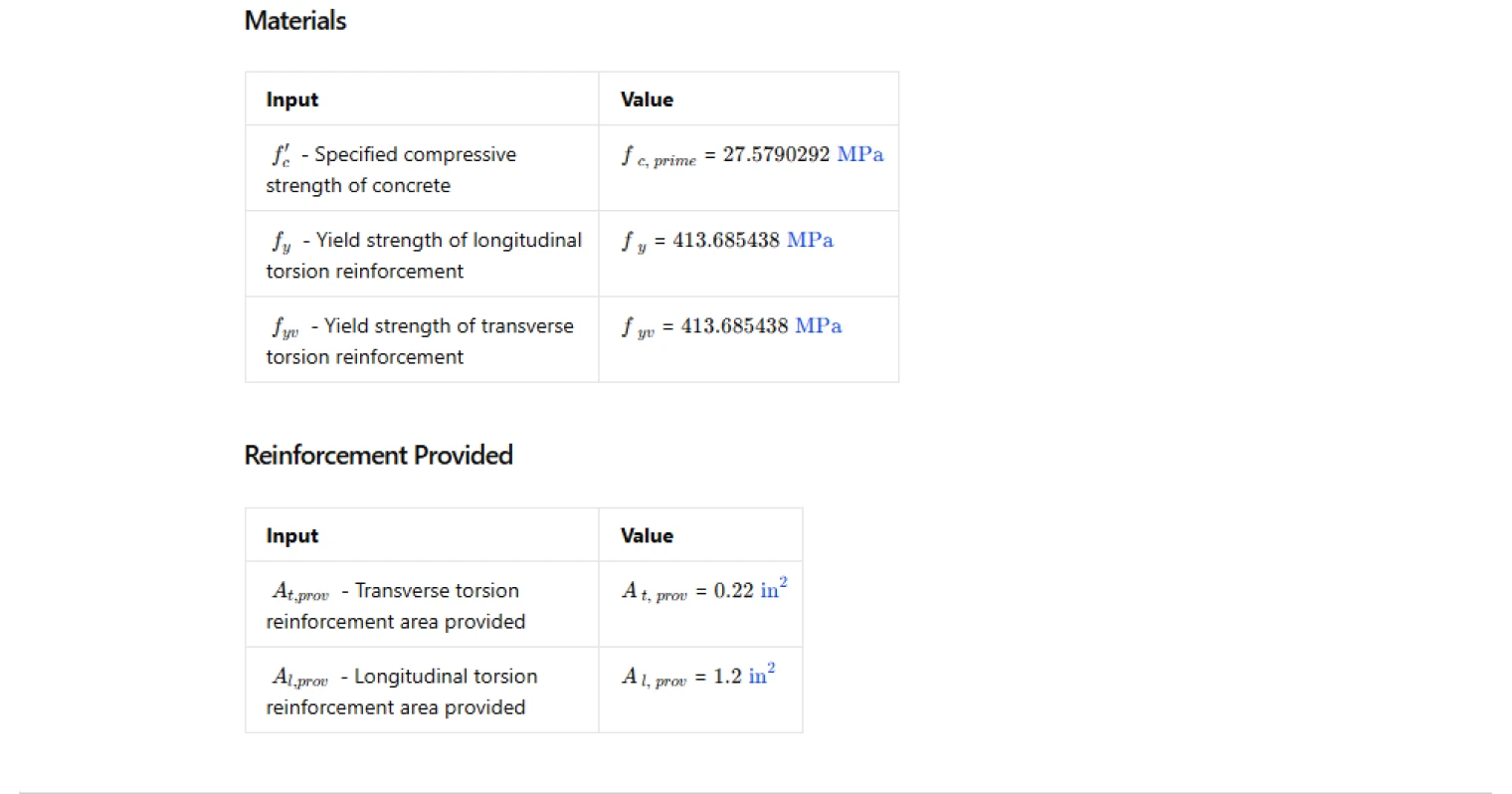
Inputs are grouped into actions, geometry, materials, and reinforcement provided. Actions include the factored torsion, threshold torsion, and the torsion strength reduction factor. Geometry includes the web width, the area enclosed by the outside perimeter of the section, the torsion stirrup centerline perimeter used for torsion design, and stirrup spacing. Materials capture concrete compressive strength and the yield strengths for longitudinal and transverse torsion reinforcement. Provided reinforcement is entered as transverse torsion reinforcement area and longitudinal torsion reinforcement area so the calculator can compute the provided ratios and compare against the code minimums.
Minimum transverse torsion reinforcement
When torsion is triggered, the calculator evaluates the minimum transverse torsion reinforcement requirement per ACI 318-19 Cl. 9.6.4.2(a,b). It calculates both clause expressions and takes the governing maximum to obtain the required minimum transverse torsion ratio expressed as a combined term ((A_t + 2A_l){min}/s). It then computes the provided combined ratio ((A_t + 2A_l)/s{prov}) from the user’s provided areas and spacing, and checks that the provided value meets or exceeds the governing minimum.
Minimum longitudinal torsion reinforcement
The calculator then evaluates the minimum longitudinal torsion reinforcement per ACI 318-19 Cl. 9.6.4.3(a,b). It forms a common base term and computes two alternatives: one based on the provided transverse reinforcement per spacing and one using the clause’s minimum substitute for the transverse term. It takes the governing minimum (the lesser of the two alternatives) and clamps the result to a non-negative minimum so the reported (A_{l,min}) does not go below zero. Finally, it checks that the provided longitudinal torsion reinforcement area meets or exceeds the computed minimum when torsion is required.
Common Calculation Errors to Avoid
- Forgetting the torsion trigger — running minimum torsion reinforcement checks even when (T_u) does not exceed (\phi_t T_{th}) leads to unnecessary reinforcement and confusing “fails” that should be N/A.
- Mixing up transverse vs longitudinal yield strengths — use (f_{yv}) for transverse torsion reinforcement and (f_y) for longitudinal torsion reinforcement; swapping them distorts both minimum expressions.
- Using the wrong perimeter for (p_h) — (p_h) should match the stirrup centerline perimeter associated with the torsion stirrup layout, not the gross outer perimeter unless they coincide.
- Inconsistent reinforcement areas in the combined term — ((A_t + 2A_l)/s) requires that (A_t) and (A_l) are defined consistently with the detailing interpretation used in your calculation and documentation.
- Unit handling in (\sqrt{f'_c}) terms — ensure concrete strength units are consistent with the clause form you’re applying so the square-root term behaves correctly in the reinforcement expressions.
- Not applying the governing max/min selection — Cl. 9.6.4.2 uses a maximum of two expressions, while Cl. 9.6.4.3 uses a minimum of two expressions; flipping these changes the governing reinforcement demand.
Engineering templates
Common calculators
Design guides




FAQs
When does ACI 318-19 require torsional reinforcement in a nonprestressed beam?
Per Cl. 9.6.4.1, torsional reinforcement is required when the factored torsion Tu at the section equals or exceeds the threshold value φt · Tth. The threshold torsion Tth is calculated separately per Cl. 22.7 and accounts for concrete cross-section geometry and material strength. If Tu falls below this threshold, torsion is considered negligible and the checks in this template return N/A.
What is the difference between transverse and longitudinal torsion reinforcement?
Transverse torsion reinforcement refers to closed stirrups or ties that resist the shear flow induced by torsion around the perimeter of the beam. Longitudinal torsion reinforcement consists of bars distributed along the length of the beam that resist the accompanying axial tension generated by the torsional shear flow. Both are required together — neither alone is sufficient to carry torsion in a ductile manner.
Why does the minimum longitudinal reinforcement formula use the lesser of two expressions?
Cl. 9.6.4.3 provides two expressions for Al,min: one uses the actual provided At/s, and the other substitutes a floor value of 25·bw/fyv in place of At/s. The lesser result governs to prevent the formula from producing an artificially low longitudinal requirement when a high transverse reinforcement ratio has been provided. This ensures a reasonable baseline of longitudinal steel regardless of stirrup area.
What inputs do I need to provide before running this calculation?
You need the factored torsion Tu and threshold torsion Tth from a separate demand and capacity analysis, the strength reduction factor φt (typically 0.75), cross-section geometry including bw, Acp, ph, and stirrup spacing s, material strengths f'c, fy, and fyv, and the areas of transverse and longitudinal torsion steel you intend to provide. The threshold torsion Tth is not computed here and must come from a Cl. 22.7 calculation.
How is the combined transverse torsion ratio (At + 2Al)/s used in the check?
The minimum transverse requirement from Cl. 9.6.4.2 is expressed as a combined steel-area-to-spacing ratio rather than a raw area. This allows the check to remain independent of stirrup spacing choices. The provided ratio is computed from your actual At,prov, Al,prov, and spacing s, then compared directly against the code minimum. If your provided ratio meets or exceeds the minimum, the transverse check passes.
What happens if my Al,min calculation produces a negative value?
This can occur when the provided At/s is large enough that the subtracted perimeter term exceeds the first term in the Cl. 9.6.4.3 expressions. ACI does not intend a negative minimum, so the calculation clamps Al,min to zero in this case. In practice this means the concrete section and provided transverse steel are more than adequate, and any nominal longitudinal steel satisfies the minimum requirement.
Learn about the benefits of using CalcTree on engineering projects!