
ACI 318-19 Cl. 6.6.4.4: instantly calculate stability index Q, effective stiffness (EI)eff, and critical buckling load Pc. Try it free on CalcTree.

Tell us what you need, or sign up and build it yourself in minutes.
Leave your email and we'll tell you when a template for it is ready:
No items found.
No items found.
About this ACI 318 Stability Index and Column Effective Stiffness Calculator
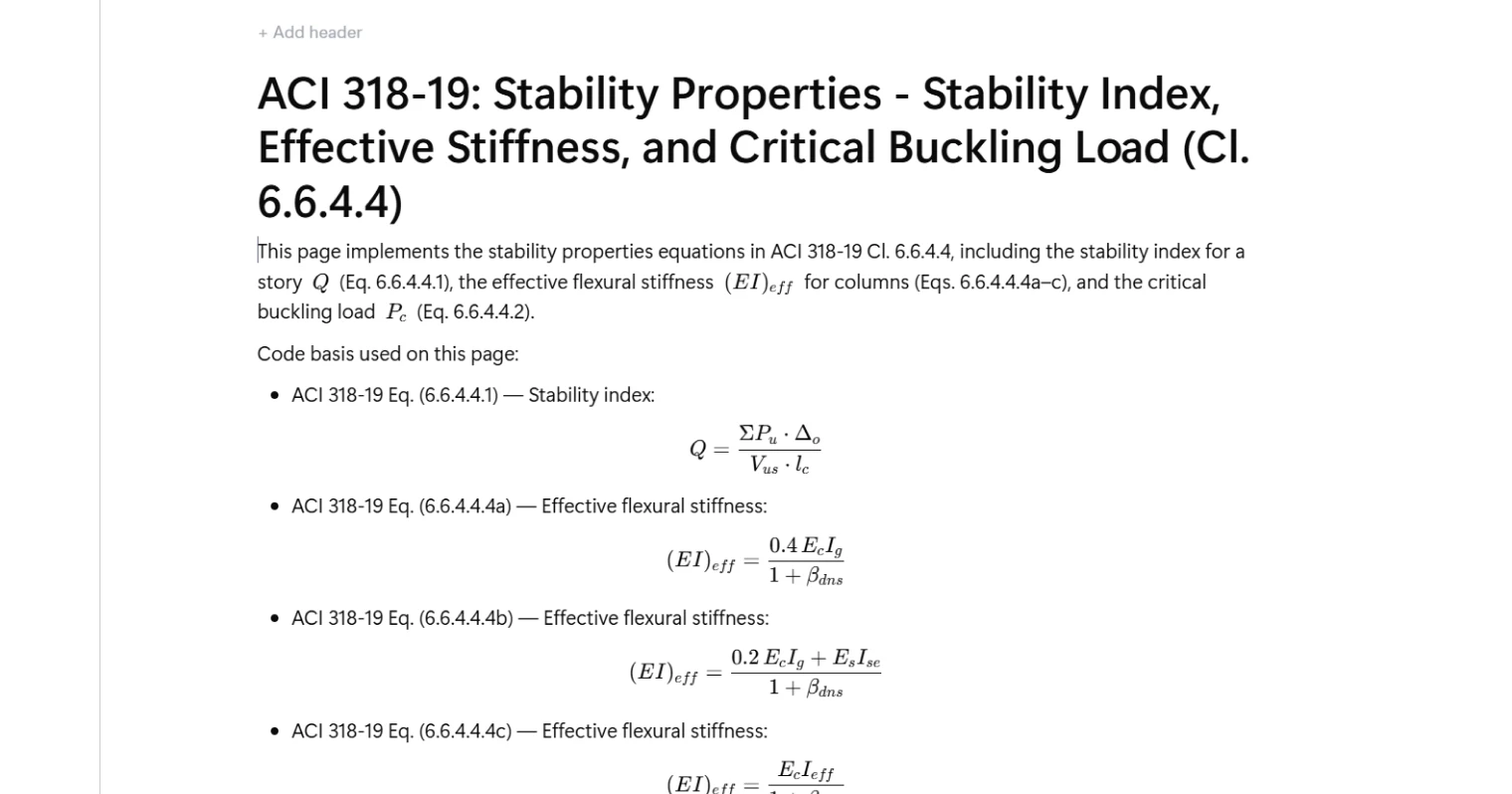
This calculator implements the stability provisions from ACI 318 for reinforced concrete frames. It evaluates the story stability index, computes the effective flexural stiffness of columns using the permitted code formulations, and determines the corresponding Euler critical buckling load used in stability checks.
- Structural engineer — assess second-order stability effects in concrete frames and confirm whether additional analysis or stiffness adjustments are required.
- Building designer — quickly evaluate story stability parameters when sizing columns or reviewing lateral system performance.
- Engineering reviewer — verify that stability checks and stiffness assumptions comply with ACI 318 requirements.
The calculator exposes each step of the stability evaluation and stiffness selection logic so engineers can trace exactly how the governing values are obtained. It is an engineering-grade calculator built for transparency, verification, and reuse within CalcTree.
More info on ACI 318 Stability Index and Column Effective Stiffness
Story stability index
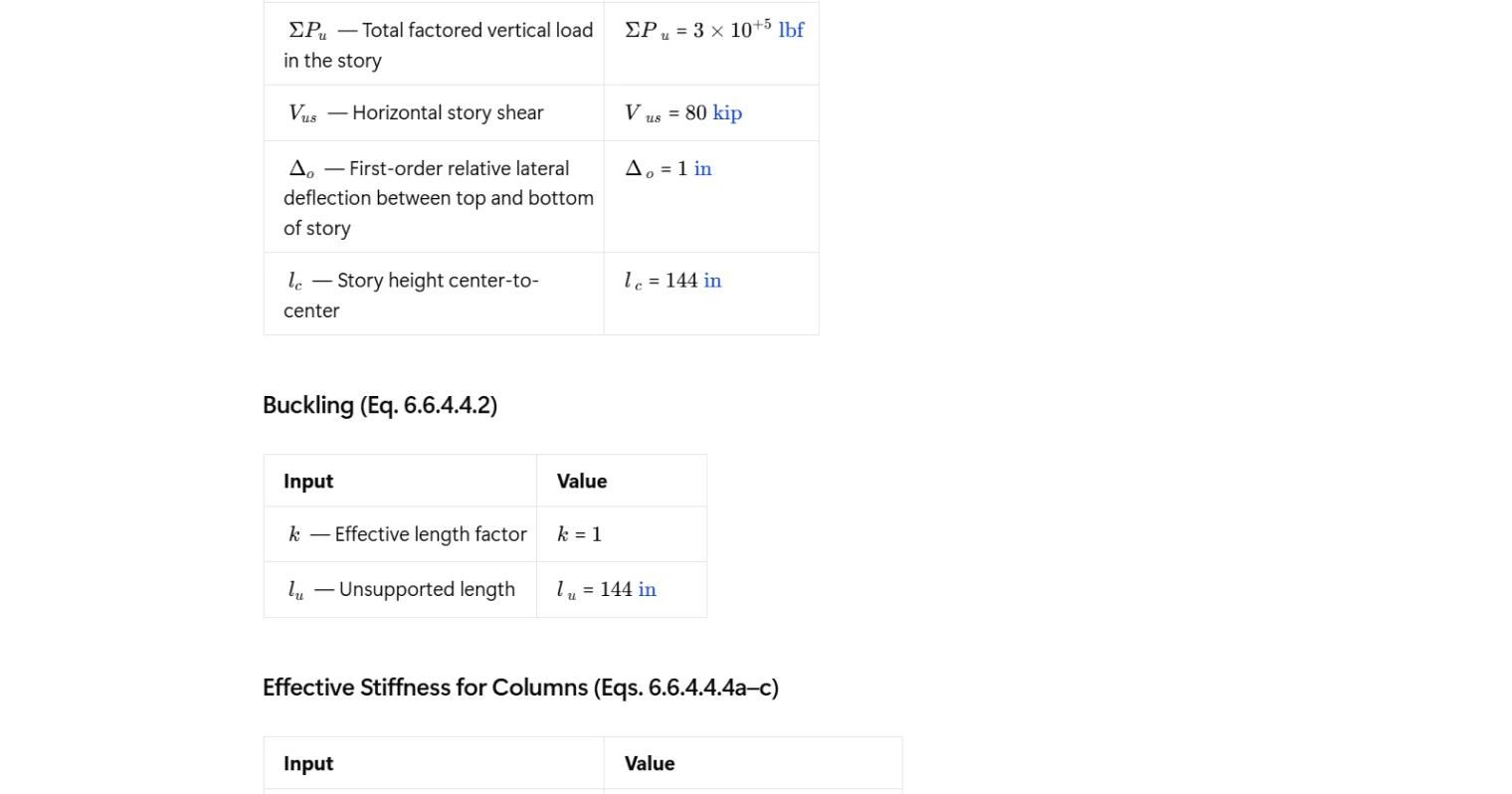
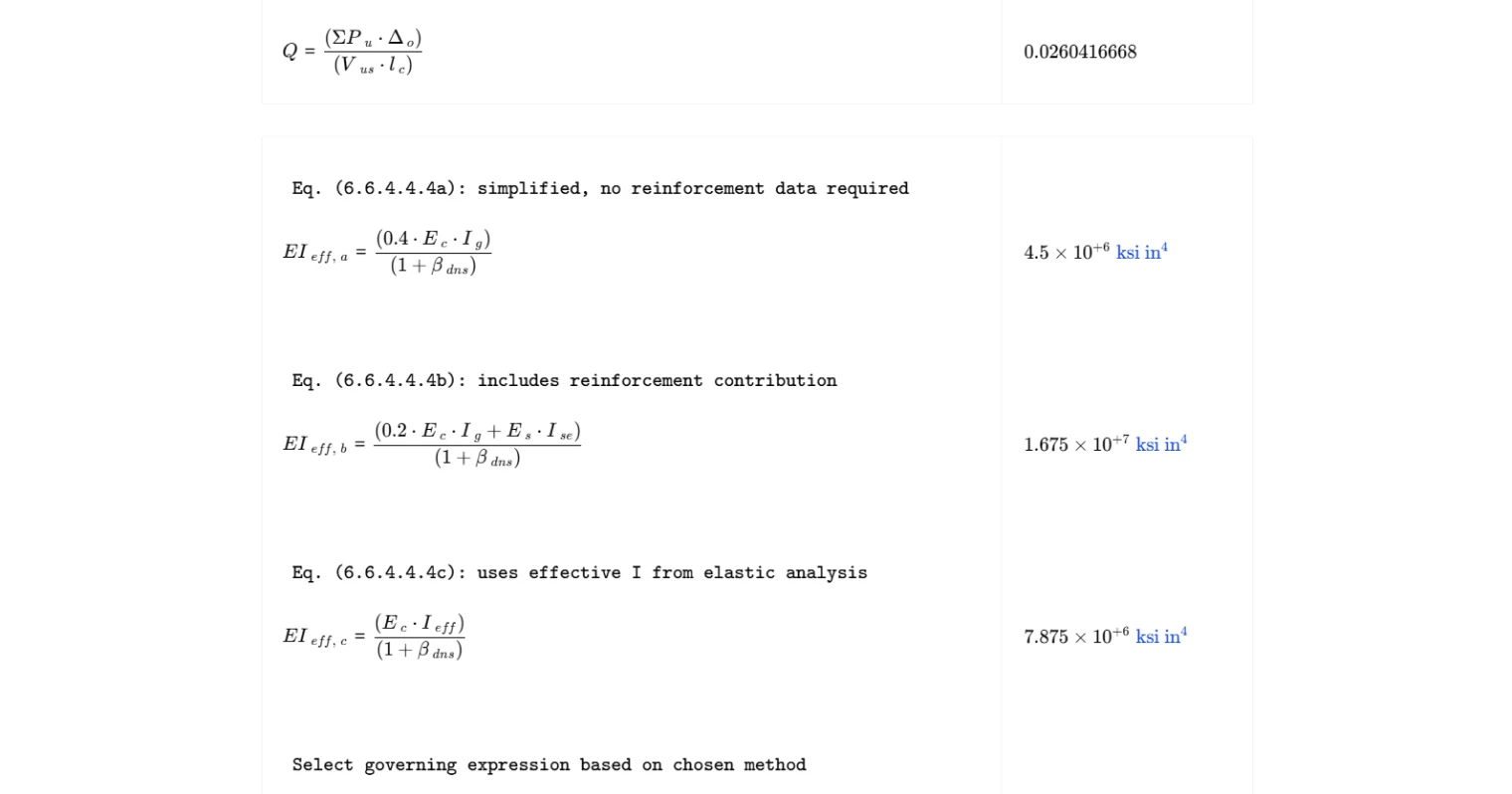
The stability index represents the relative importance of second-order (P-Δ) effects in a building story. It is calculated from the total factored vertical load acting on the story, the first-order lateral deflection between the story levels, the factored horizontal shear, and the story height.
This index is used to determine whether second-order effects must be explicitly considered in the analysis. Higher values indicate that the structure is more sensitive to stability effects caused by axial loads acting through lateral displacements.
Effective flexural stiffness of columns
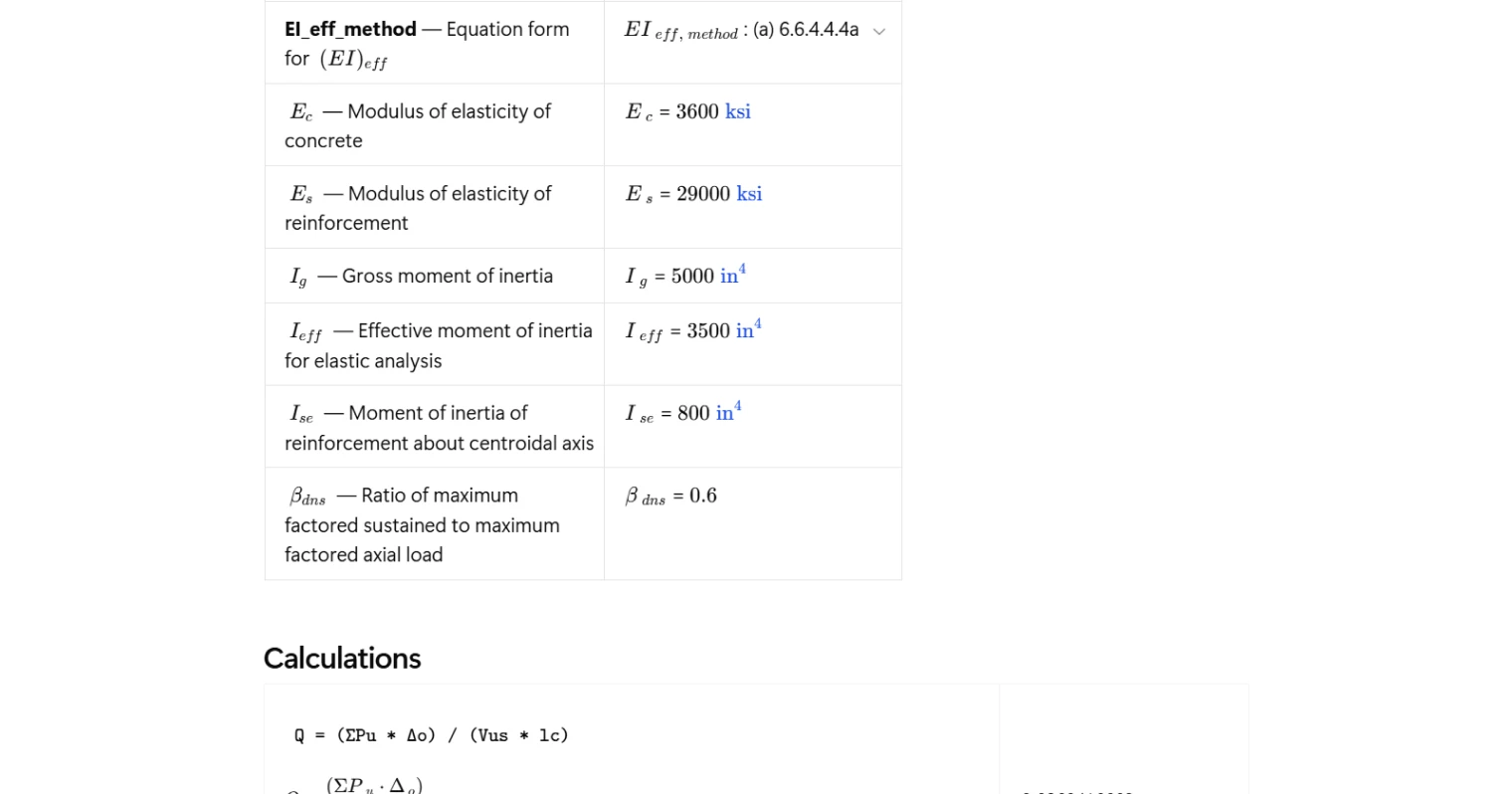
ACI 318 allows several alternative expressions for the effective flexural stiffness of reinforced concrete columns. The calculator implements each of the permitted equations and allows the user to select the preferred formulation.
The simplified method uses the concrete modulus and gross moment of inertia. A second formulation incorporates the stiffness contribution of reinforcement. The third option uses an effective moment of inertia obtained from elastic analysis. In all cases, the stiffness is modified by a sustained load ratio that accounts for long-term effects such as creep.
Critical buckling load
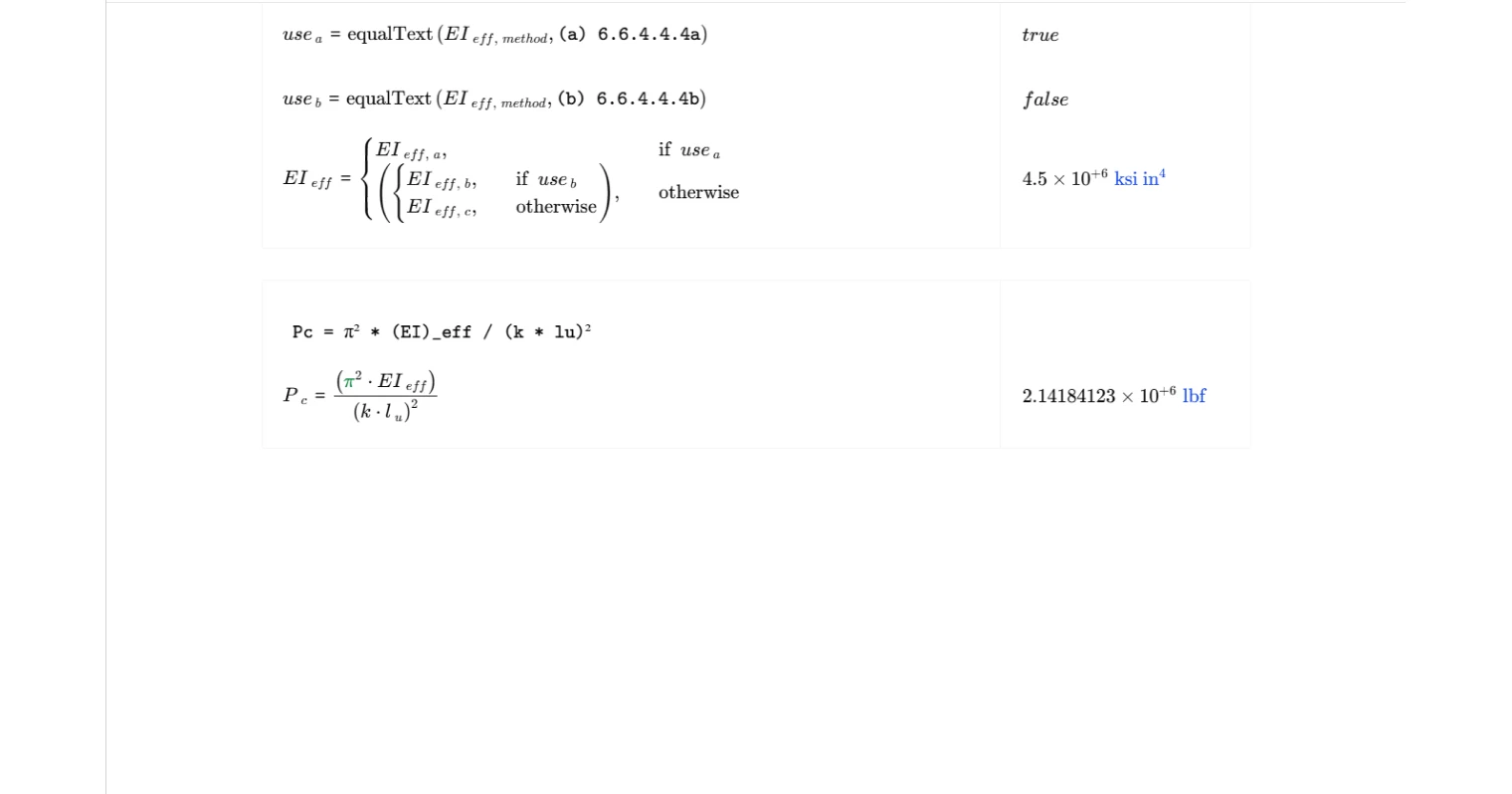
Once the effective stiffness is determined, the Euler critical buckling load for the column can be evaluated. This value represents the theoretical load at which the column becomes unstable under axial compression.
The calculation considers the effective flexural stiffness together with the column effective length factor and unsupported length. These parameters reflect the boundary conditions and restraint provided by the structural system.
Calculation outputs
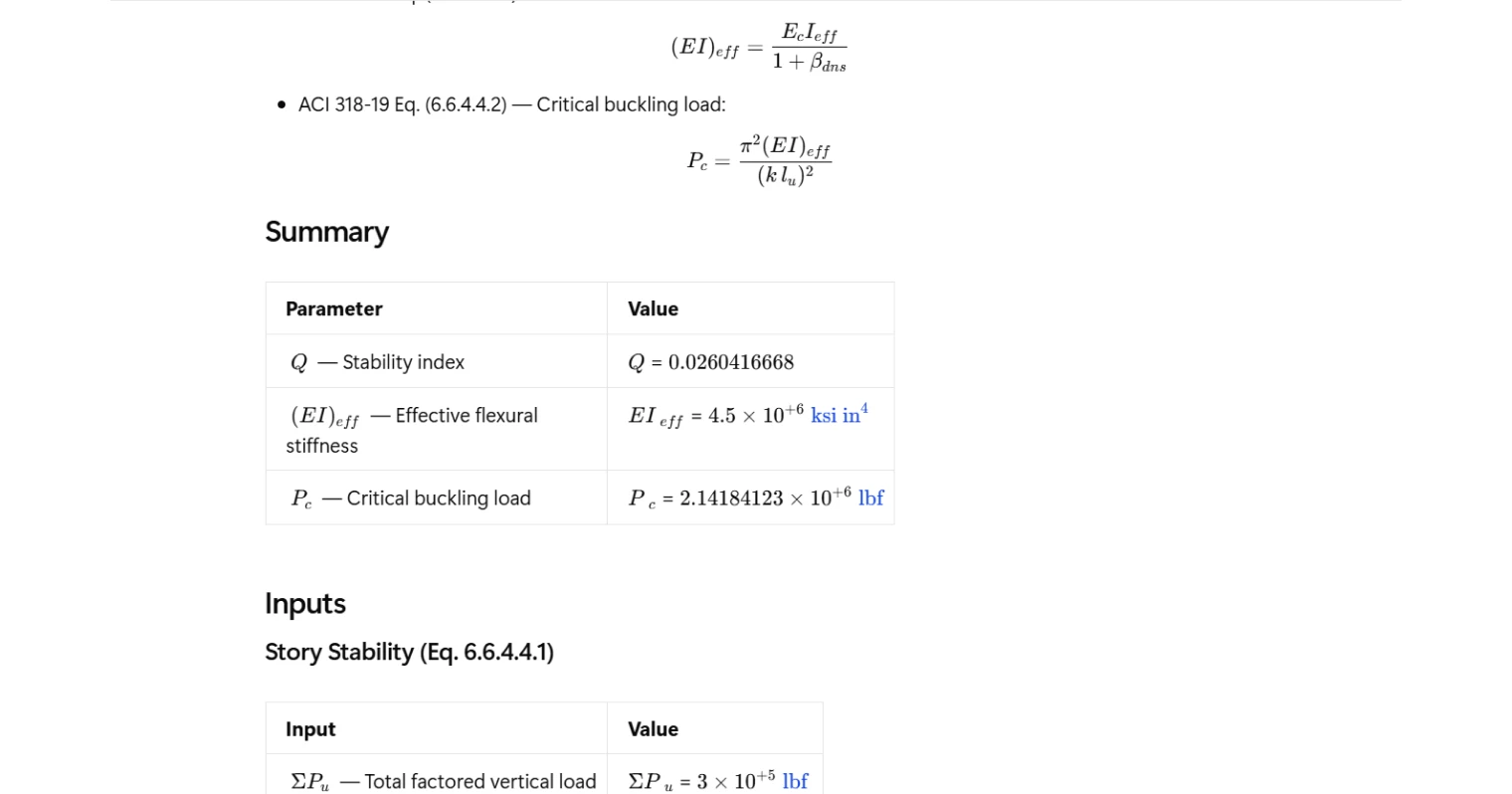
The calculator reports three key outputs used in stability assessments:
- The story stability index used to judge the significance of second-order effects.
- The effective flexural stiffness selected according to the chosen ACI formulation.
- The Euler critical buckling load associated with the column stiffness and effective length.
These outputs allow engineers to confirm compliance with ACI stability provisions and understand the sensitivity of the design to stiffness assumptions.
Common Calculation Errors to Avoid
- Using inconsistent load combinations — the stability index should be calculated using the governing factored load combination for both axial load and lateral effects.
- Incorrect story height definition — the story height must be measured center-to-center between levels; using clear height can distort the stability index.
- Selecting the wrong stiffness formulation — ensure the chosen effective stiffness equation matches the level of detail available in the analysis model.
- Ignoring sustained load effects — the sustained load ratio modifies stiffness to account for long-term behavior; omitting it can overestimate stiffness.
- Incorrect effective length factor — the buckling calculation is highly sensitive to the assumed effective length factor, which should reflect the actual end restraint conditions.
- Mixing units between stiffness and length terms — the stiffness terms and geometric parameters must use consistent units to produce a valid buckling load.
Engineering templates
Common calculators
Design guides




FAQs
What does the stability index Q tell me about my structure?
Q measures the sensitivity of a story to second-order (P-delta) effects. ACI 318-19 Cl. 6.6.4.4.1 defines it as the ratio of the destabilizing moment from factored vertical loads to the restoring moment from story shear. If Q ≤ 0.05, the story is non-sway and second-order effects can be ignored. If 0.05 < Q ≤ 0.2, the story is sway and magnified moments must be used. If Q > 0.2, ACI requires the frame to be redesigned; the lateral stiffness is insufficient.
Which (EI)eff equation should I use for my column?
Eq. 6.6.4.4.4a is the simplest option and requires only concrete and gross section properties, making it suitable for preliminary design or when reinforcement details are not yet finalized. Eq. 6.6.4.4.4b adds the reinforcement contribution explicitly and is more accurate when reinforcement layout is known. Eq. 6.6.4.4.4c uses Ieff from a cracked section elastic analysis and gives the most refined result. In general, use 6.6.4.4.4c when a full elastic analysis has already been run, 6.6.4.4.4b when reinforcement is detailed, and 6.6.4.4.4a for early-stage checks.
What is β_dns and how do I calculate it?
β_dns is the ratio of the maximum factored sustained axial load to the maximum total factored axial load in the column. It accounts for creep under long-term loading, which reduces effective stiffness. In practice, sustained loads typically come from dead load only, so β_dns is often close to the ratio of factored dead load to total factored axial load (1.2D / (1.2D + 1.6L) for a typical gravity combination). It ranges from 0 to 1, and a higher value reduces (EI)eff, making the column more susceptible to buckling.
How does the effective length factor k affect P_c, and what value should I use?
P_c is inversely proportional to (k·lu)², so k has a large effect on the result. For a column pinned at both ends, k = 1.0. For a column fixed at both ends, k = 0.5. For a sway frame, k ≥ 1.0 and must be determined from the alignment chart in ACI 318-19 Fig. R6.2.5 or a rational analysis using the Jackson-Moreland method. Using k = 1.0 for a sway frame is unconservative; make sure to confirm boundary conditions before setting this input.
What is the difference between lu and lc, and why does the template use both?
lc is the center-to-center story height used in the stability index Q calculation. It represents the full height over which lateral drift is measured, including beam/slab depth at each end. lu is the unsupported column length used in the buckling load P_c calculation, measured between lateral restraints (typically face-to-face of beams or slabs). In most practical frames lu < lc, and using lc in place of lu for the buckling calculation would be unconservative.
Can I use this calculation for wall-type elements or only columns?
The (EI)eff equations in Cl. 6.6.4.4.4 are written specifically for columns. For wall members in a sway frame, ACI 318-19 Cl. 6.6.3.1 provides separate stiffness modifiers. The stability index Q in Cl. 6.6.4.4.1 is a story-level check and applies regardless of whether lateral resistance comes from columns or walls, as long as you sum all factored vertical loads and use the correct story shear and drift for that story.
Learn about the benefits of using CalcTree on engineering projects!