
Check ACI 318-19 Cl. 7.6.1.1 minimum flexural reinforcement for one-way slabs instantly. Computes As,min = 0.0018Ag and checks provided steel. Try it free.

Tell us what you need, or sign up and build it yourself in minutes.
Leave your email and we'll tell you when a template for it is ready:
No items found.
No items found.
About this ACI 318-19: Minimum Flexural Reinforcement - Nonprestressed One-Way Slabs (Cl. 7.6.1.1) Calculator
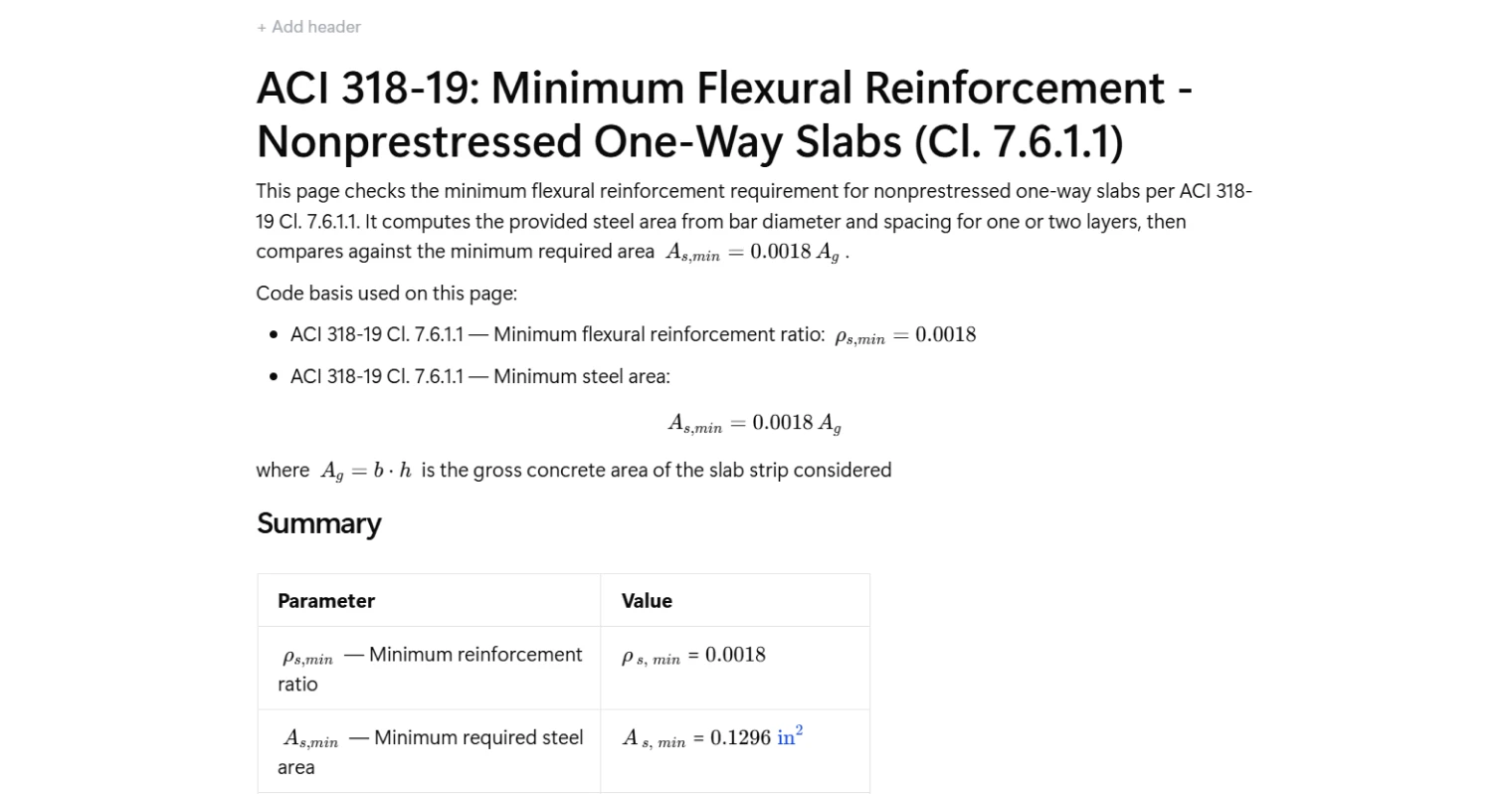
This calculator checks the minimum flexural reinforcement requirement for nonprestressed one-way slabs per ACI 318-19 Cl. 7.6.1.1. It computes the provided steel area from bar size and spacing for one or two reinforcement layers, then compares that against the minimum required area defined by the code minimum reinforcement ratio of 0.0018 applied to the gross concrete section.
- Structural engineer — verify that a proposed slab reinforcement layout satisfies ACI 318-19 minimum steel requirements before committing to construction documents or during design review.
- EOR / plan checker — quickly confirm code compliance for one-way slab sections with one or two reinforcement layers without manually working through bar area tables and gross section calculations.
- Junior engineer / detailer — run the check transparently with all intermediate values shown, reducing the risk of errors when converting bar size and spacing into a usable steel area.
This is an engineering-grade calculator built on CalcTree, where all inputs, intermediate calculations, and code references are fully traceable and editable within a live project workspace.
More info on ACI 318-19: Minimum Flexural Reinforcement - Nonprestressed One-Way Slabs (Cl. 7.6.1.1)
Inputs
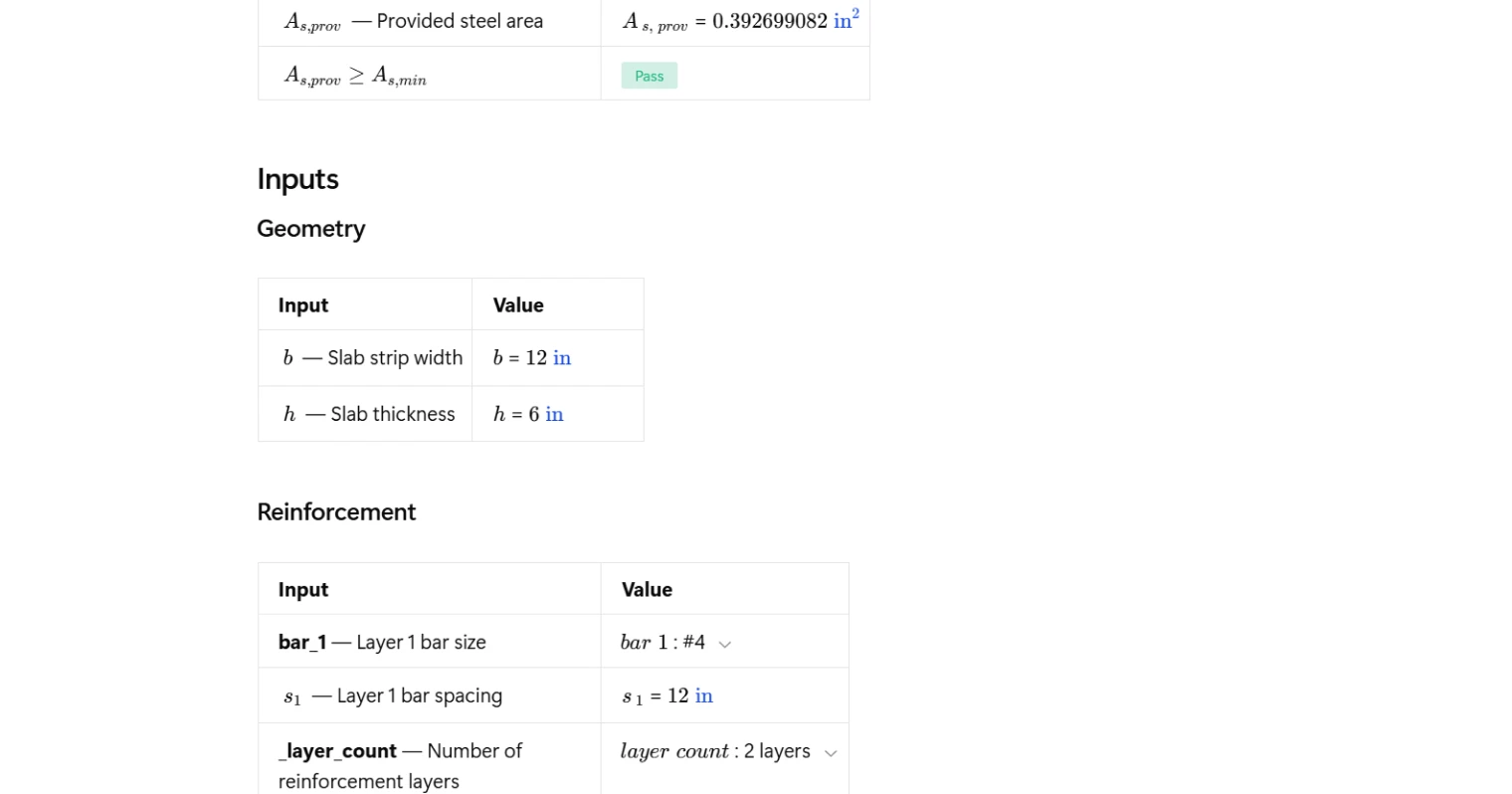
The calculator requires two sets of inputs. For geometry, the user defines the slab strip width and slab thickness, which together form the gross concrete area of the section being checked. For reinforcement, the user selects a bar size from a standard ASTM designation list and enters the corresponding bar spacing for layer 1. If two reinforcement layers are present, the user toggles the layer count and provides the bar size and spacing for layer 2 as well. Bar diameters are resolved automatically from the selected bar designation, so no manual lookup is required.
Calculations
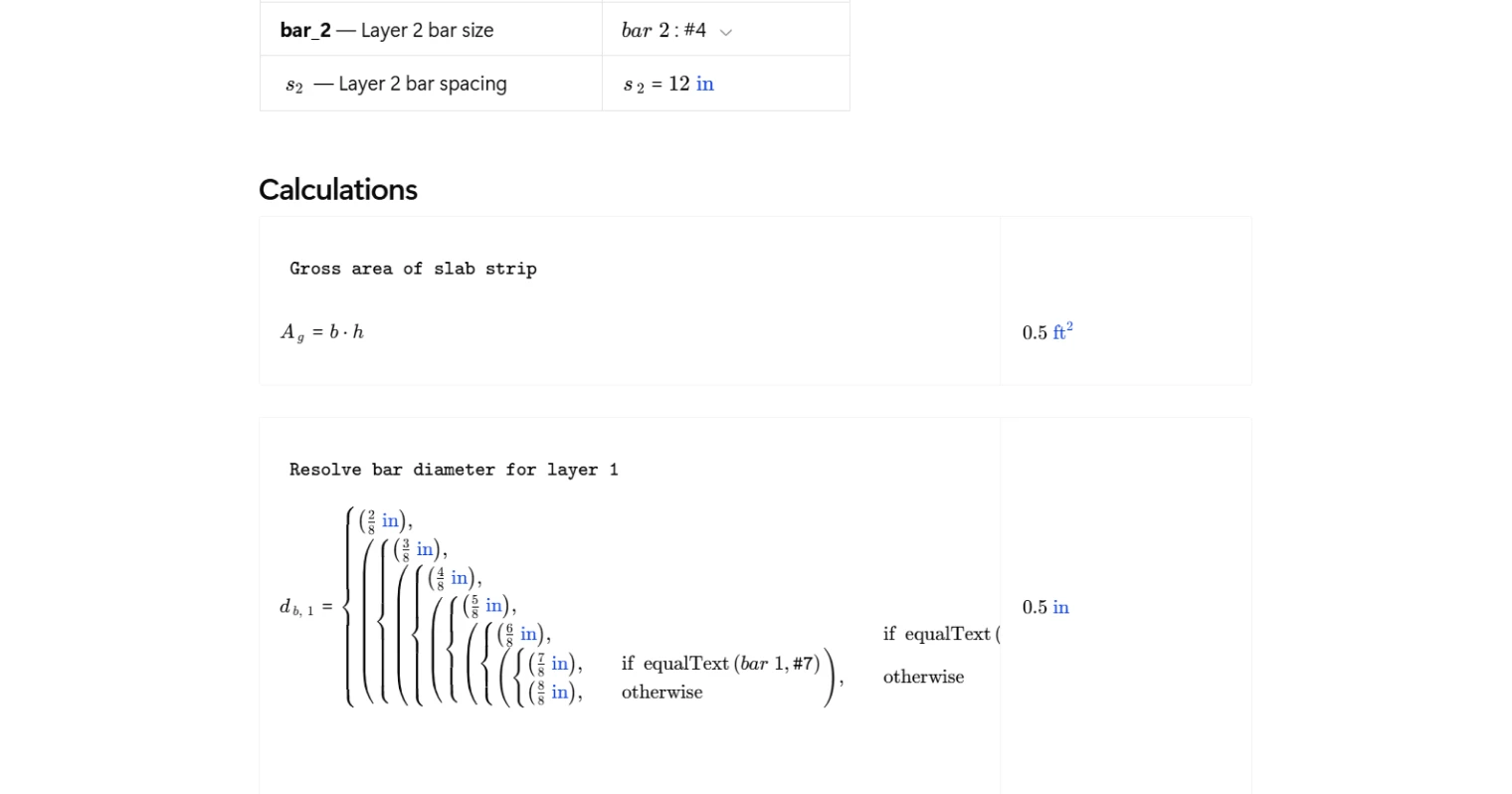
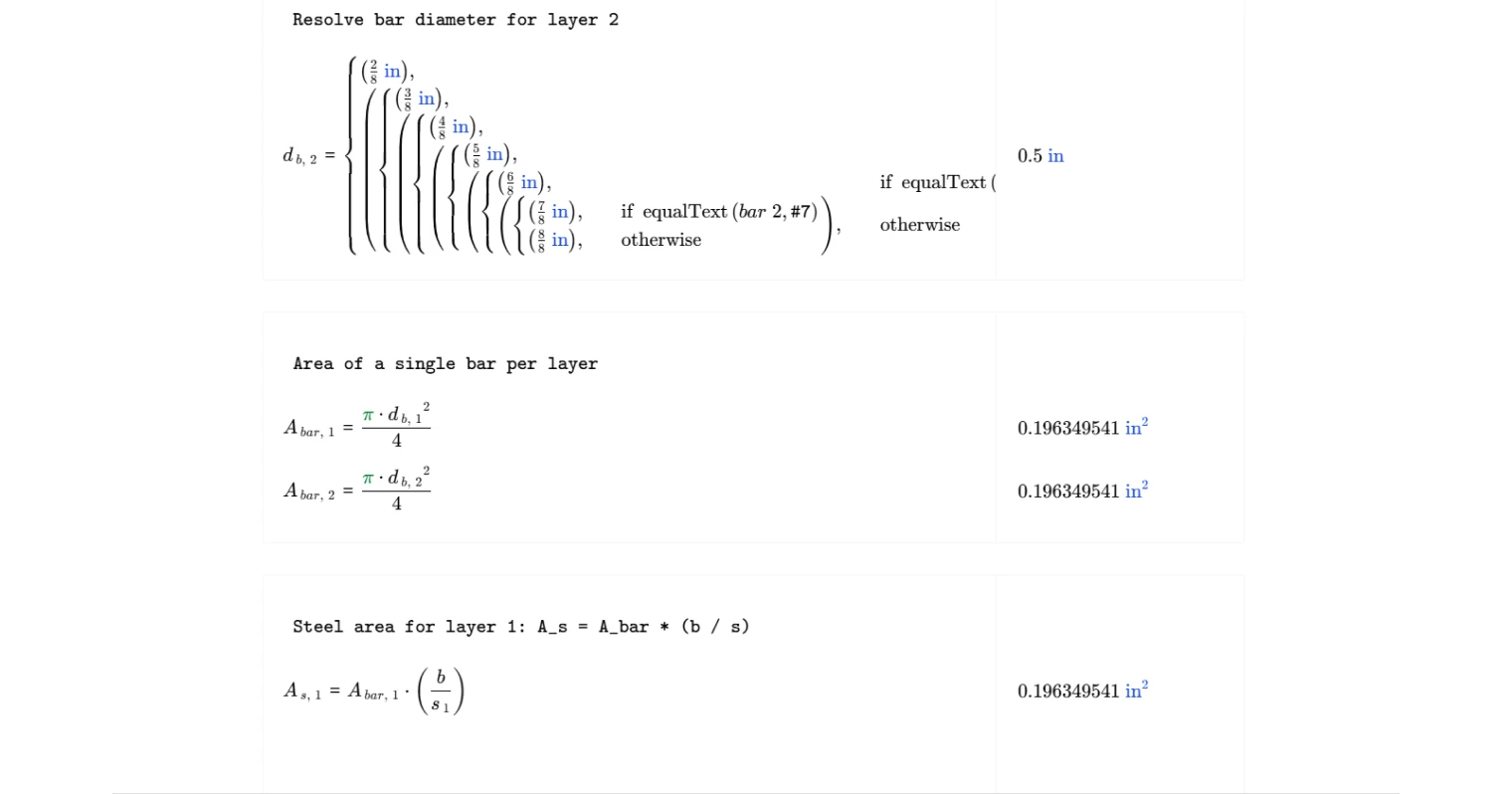
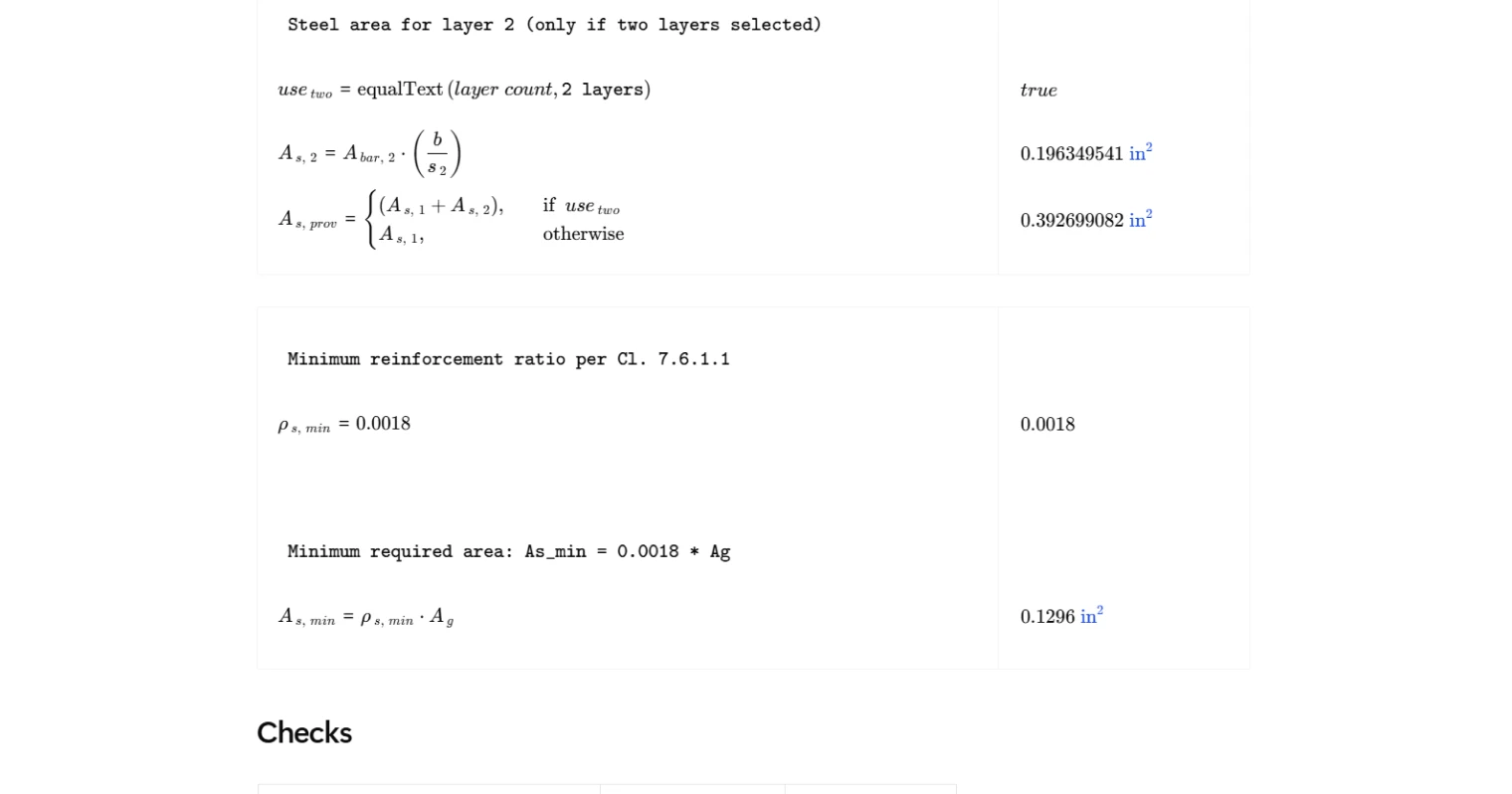
From the geometry inputs, the gross concrete area of the slab strip is computed as the product of the strip width and slab thickness. Each bar's cross-sectional area is derived from its resolved diameter using the standard circular area formula. The provided steel area per layer is then calculated by multiplying the individual bar area by the number of bars fitting within the strip width at the given spacing. Where two layers are selected, the total provided steel area is the sum of both layers. The minimum required steel area is calculated by applying the ACI 318-19 Cl. 7.6.1.1 minimum reinforcement ratio of 0.0018 directly to the gross concrete area.
Design Check
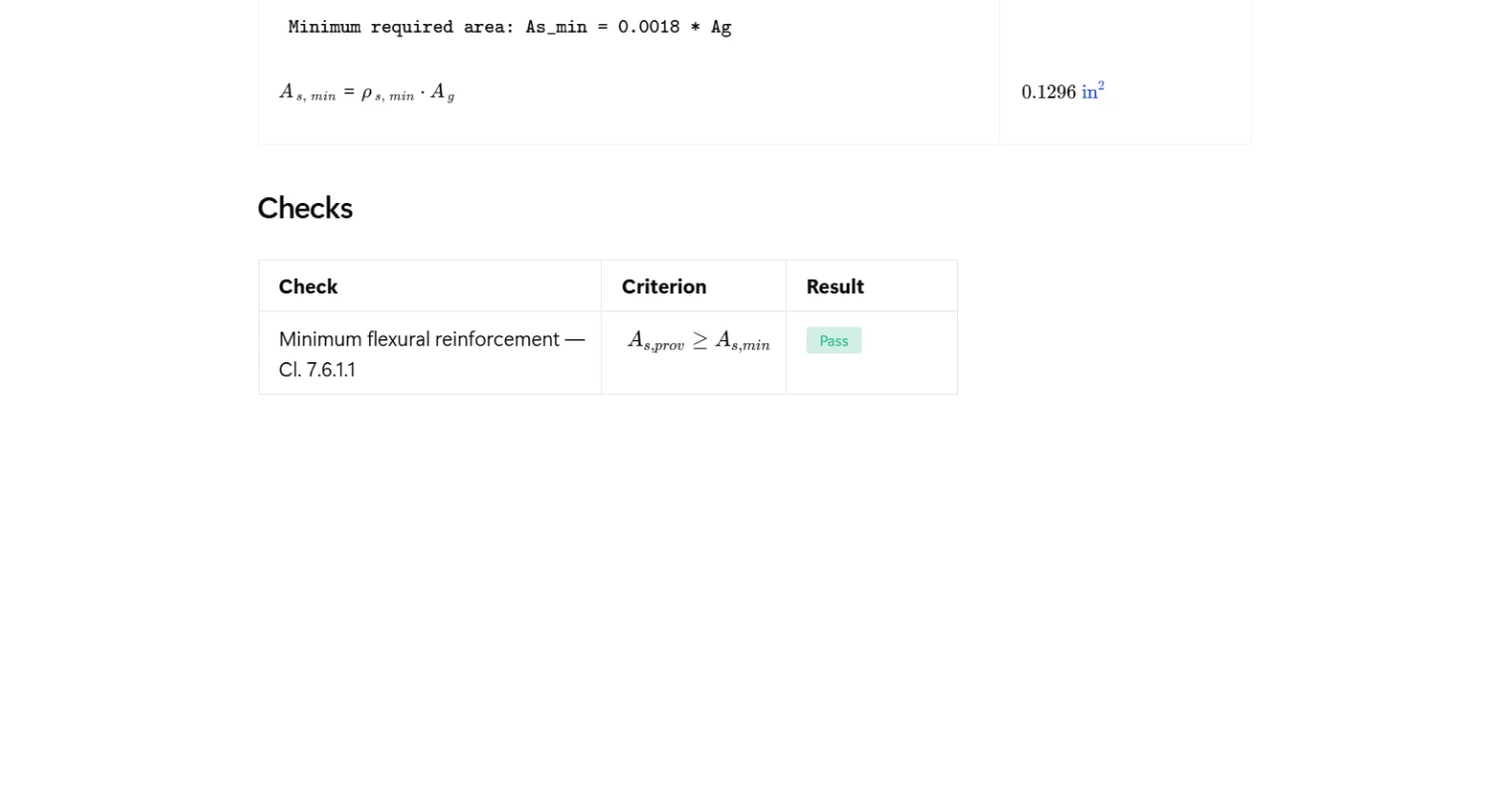
The single design check on this page compares the total provided steel area against the minimum required steel area. The check passes when the provided area meets or exceeds the minimum threshold and fails otherwise. The result is displayed as a traffic light indicator in the summary table, giving an immediate visual read on code compliance. This check applies to the slab section as configured — adjusting bar size, spacing, or the number of layers will update the result in real time.
Code Basis
The calculation follows ACI 318-19 Cl. 7.6.1.1, which sets the minimum flexural reinforcement ratio for nonprestressed one-way slabs at 0.0018 regardless of steel grade or concrete strength. The minimum steel area is therefore a function of gross section geometry alone, not material strength, which distinguishes it from the beam minimum reinforcement provisions elsewhere in ACI 318-19. This page does not cover prestressed slabs, two-way slabs, or temperature and shrinkage reinforcement requirements, which are addressed under separate code provisions.
Common Calculation Errors to Avoid
- Confusing gross area with net or transformed area — the ACI 318-19 Cl. 7.6.1.1 minimum is applied to the full gross concrete area, not a cracked or transformed section.
- Using the wrong strip width — the slab strip width used to compute both the gross area and the provided steel area must be consistent; mixing a per-metre strip with per-foot bar spacings, or vice versa, will give incorrect results.
- Applying beam minimum reinforcement provisions to slabs — ACI 318-19 uses a strength-based minimum for beams that depends on concrete and steel properties; the flat 0.0018 ratio for one-way slabs is a separate, simpler requirement and the two should not be interchanged.
- Neglecting to account for both layers — when two reinforcement layers are present, omitting one layer underestimates the provided steel area and may produce a false fail result.
- Treating this check as a substitute for flexural design — satisfying the minimum reinforcement requirement does not confirm that the section has adequate moment capacity; this check is a code floor, not a strength verification.
- Misidentifying the slab as two-way — this calculation applies specifically to one-way slabs; applying it to two-way slab systems would require checking reinforcement in both directions under different provisions.
Engineering templates
Common calculators
Design guides




FAQs
What does ACI 318-19 Cl. 7.6.1.1 require for minimum flexural reinforcement in one-way slabs?
Clause 7.6.1.1 sets a minimum reinforcement ratio of 0.0018 for nonprestressed one-way slabs with deformed bars. This gives a minimum steel area of As,min = 0.0018 × Ag, where Ag is the gross cross-sectional area of the slab strip (b × h). The requirement is independent of concrete strength or yield strength for Grade 60 bars at this ratio, and it controls shrinkage and temperature cracking as well as minimum flexural capacity.
Why does the calculation use gross area Ag rather than effective depth d?
ACI 318-19 Cl. 7.6.1.1 explicitly ties the minimum steel area to the gross concrete area, not the effective depth. This differs from beam provisions under Cl. 9.6.1, which use bw × d. For slabs, the intent is to ensure a baseline steel quantity relative to the full slab thickness regardless of cover or bar placement.
How is the slab strip width b used in this calculation?
The slab strip width b defines the tributary width over which reinforcement is being checked. A common convention is to use a 12-inch (1 ft) unit strip, which directly gives steel area in in²/ft. You can also enter a wider tributary width if you are checking a larger panel segment. The provided steel area scales proportionally with b, so the choice of strip width affects both As,prov and As,min equally.
How does the two-layer option work and when would I use it?
When two reinforcement layers are selected, the calculation sums the steel area from both layers: As,prov = As,1 + As,2. Each layer is defined independently by bar size and spacing. Two-layer arrangements are common in thicker slabs or where top and bottom steel both contribute to meeting the minimum, such as slabs with significant two-way restraint at supports still being designed as one-way.
What bar sizes are supported and why is the range limited to #2–#8?
The template covers ASTM standard bar sizes #2 through #8, which covers the practical range used in slab construction. Bars smaller than #2 are non-standard in structural applications, and bars larger than #8 are rarely used in slabs due to development length and flexural depth constraints. Bar diameters are resolved internally from the selected designation, so no manual diameter entry is needed.
How do I interpret a Fail result on the minimum reinforcement check?
A Fail means the provided steel area As,prov is less than As,min = 0.0018 × Ag for the slab strip defined. To resolve this, either decrease bar spacing, increase bar size, or add a second reinforcement layer. The summary table shows both values side by side so you can quickly determine how much additional steel is needed to satisfy the clause.
Learn about the benefits of using CalcTree on engineering projects!