
Calculate ACI 318-19 Cl. 22.5.5.1.1 max nominal shear strength of concrete fast. Get Vc,max in x & y directions instantly. Try it free on CalcTree.

Tell us what you need, or sign up and build it yourself in minutes.
Leave your email and we'll tell you when a template for it is ready:
No items found.
No items found.
About this ACI 318-19: Shear Strength - Maximum Nominal Shear Strength of Concrete (Cl. 22.5.5.1.1) Calculator
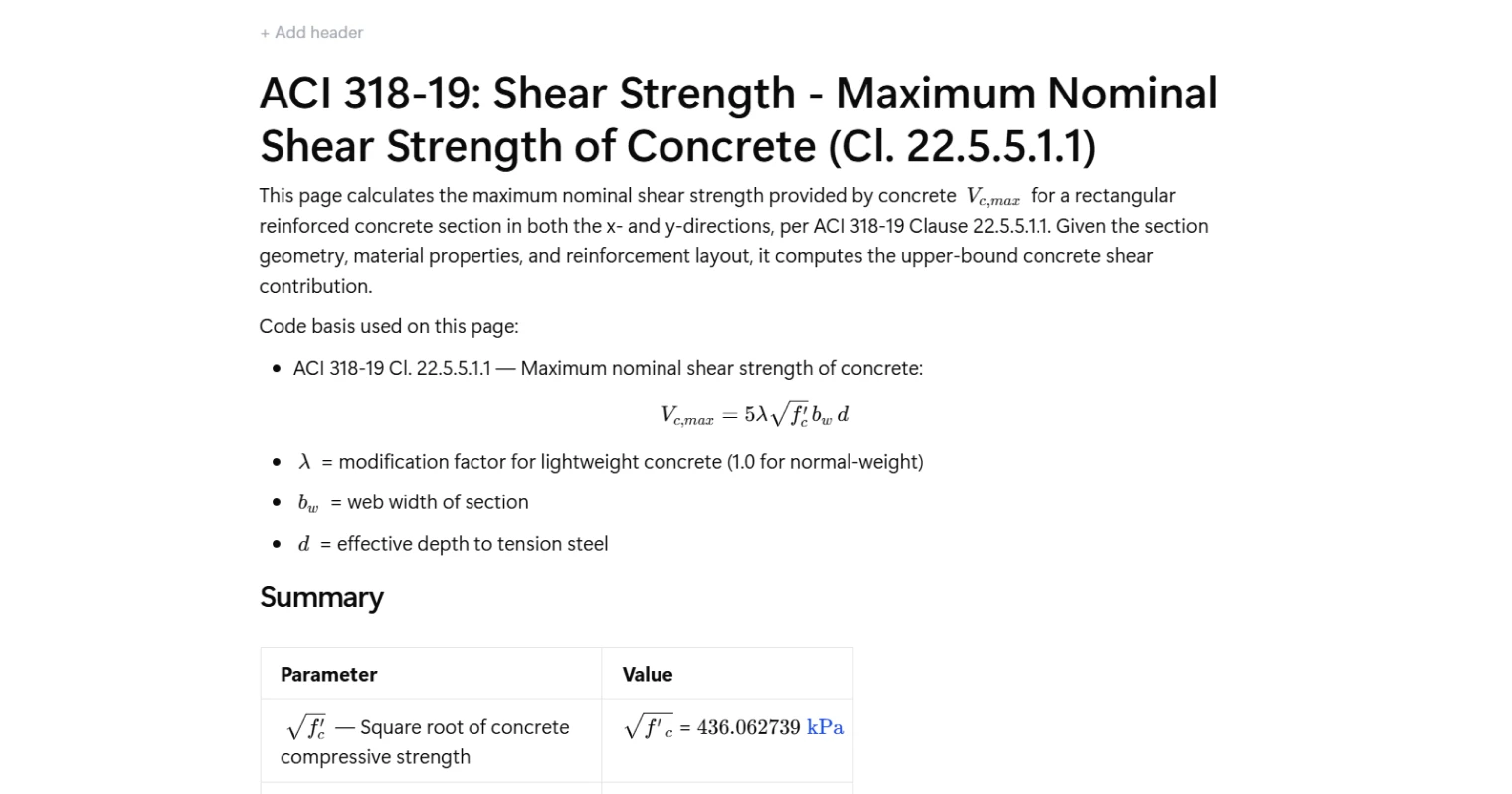
This calculator computes the maximum nominal shear strength provided by concrete, $V_{c,max}$, for a rectangular reinforced concrete section in both the x- and y-directions per ACI 318-19 Clause 22.5.5.1.1. Given the section geometry, material properties, and reinforcement layout, it evaluates the upper-bound concrete shear contribution using the code-prescribed formula and returns directional shear capacities ready for use in member design.
- Structural engineer — verify that concrete shear demand stays within the ACI 318-19 upper-bound limit before sizing transverse reinforcement, and quickly iterate on section dimensions or concrete strength.
- RC detailer — confirm effective depth values derived from cover, stirrup size, and longitudinal bar size are consistent with the reinforcement layout before finalising drawings.
- Checking engineer — trace every step from input geometry and material properties through to directional shear capacity results to satisfy independent review requirements.
This is an engineering-grade calculator on CalcTree that follows ACI 318-19 directly, exposes all intermediate values for full traceability, and can be saved, shared, and linked within a project workspace.
More info on ACI 318-19: Shear Strength - Maximum Nominal Shear Strength of Concrete (Cl. 22.5.5.1.1)
Inputs
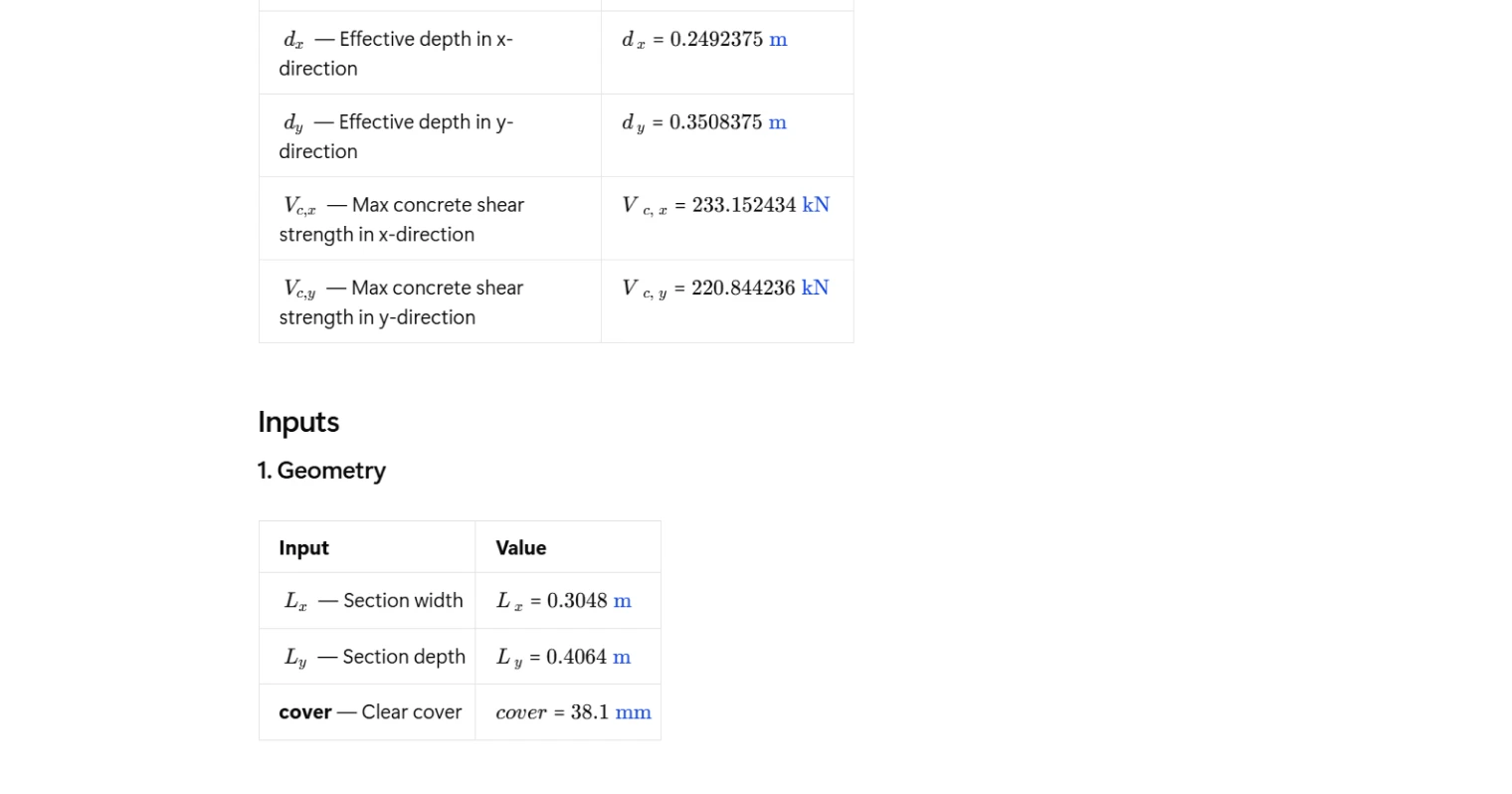
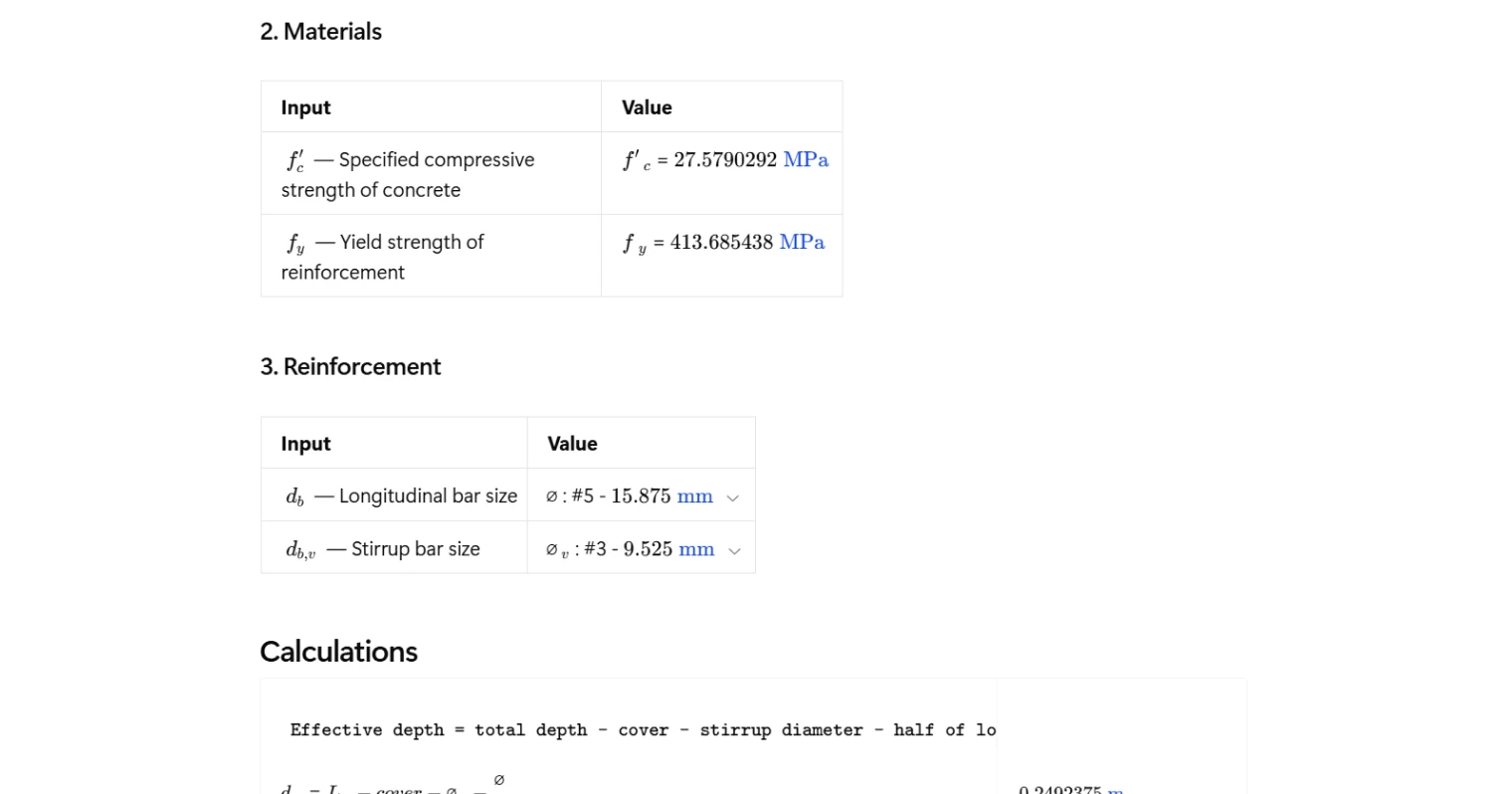
The calculator takes three categories of input. Section geometry requires the overall width and depth of the rectangular section along with the clear cover to the outermost reinforcement. Material properties require the specified compressive strength of concrete and the yield strength of the longitudinal reinforcement. Reinforcement inputs require the diameter of the longitudinal bars and the diameter of the transverse stirrup bars, both selected from standard bar size options. Together these inputs fully define the section needed to compute directional effective depths and apply the ACI 318-19 shear formula.
Effective Depth Calculation
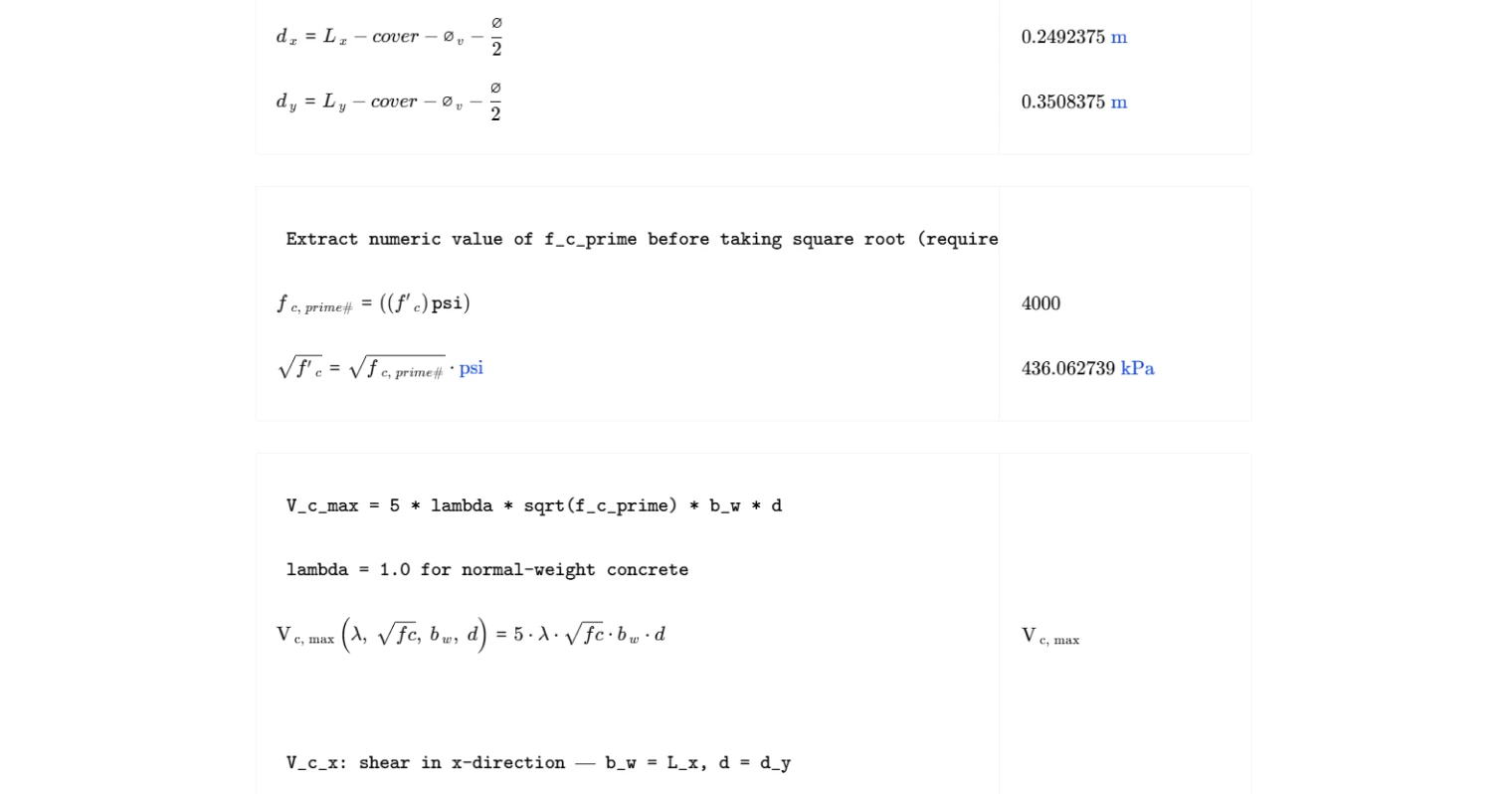
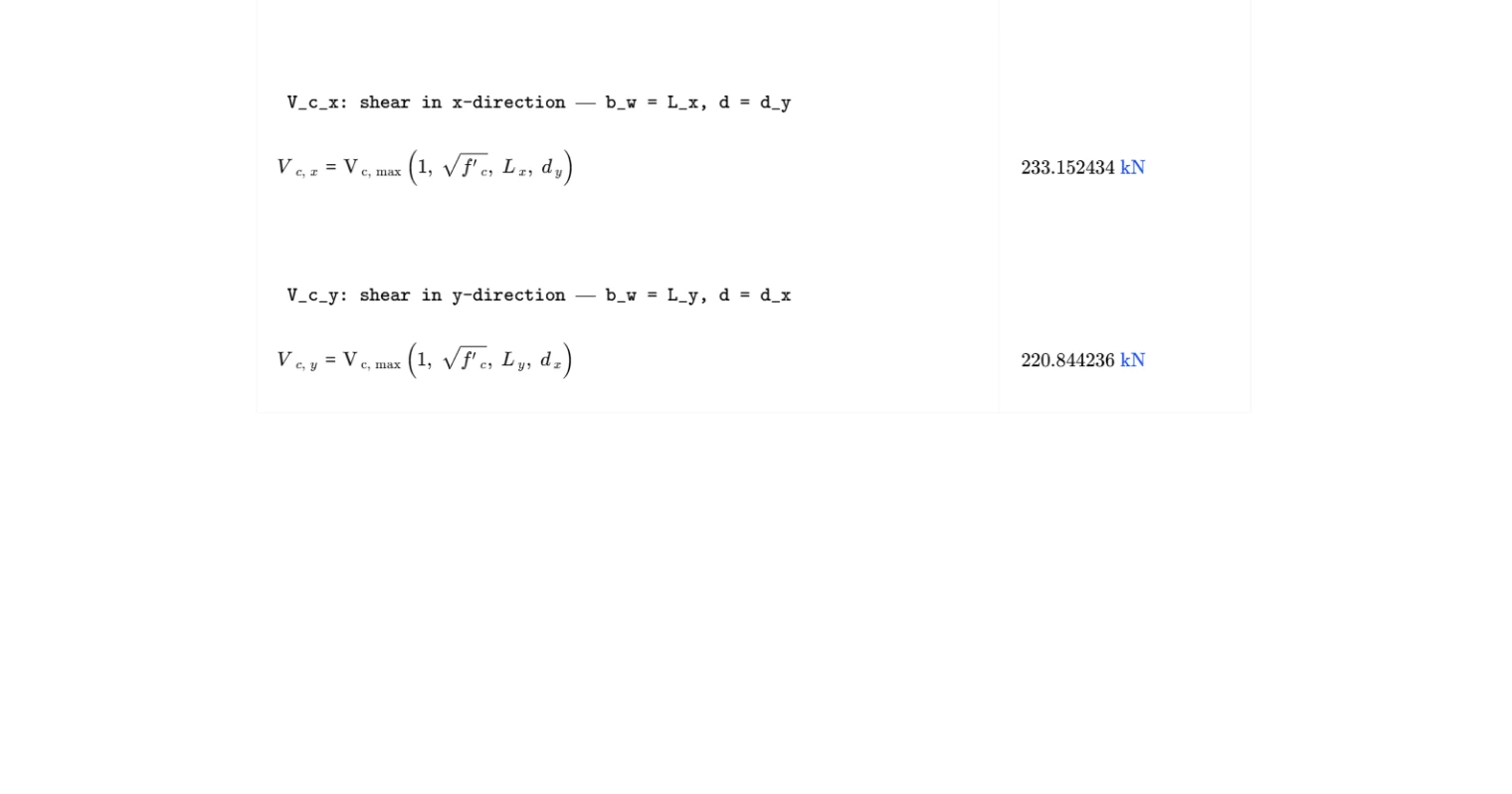
The effective depth in each direction is calculated as the total section dimension in that direction minus the clear cover, the stirrup bar diameter, and half the longitudinal bar diameter. Because shear in the x-direction acts on the face with width $L_x$ and mobilises reinforcement spanning the depth $L_y$, the effective depth used for $V_{c,x}$ is $d_y$, and vice versa for $V_{c,y}$. This cross-pairing of section dimension and effective depth is a common source of confusion and is handled explicitly in the calculation.
ACI 318-19 Cl. 22.5.5.1.1 — Shear Strength Formula and Lightweight Concrete Modifier
The maximum nominal shear strength is computed from the ACI 318-19 expression $V_{c,max} = 5\lambda\sqrt{f'_c}, b_w, d$, where $\lambda$ is the lightweight concrete modification factor, $b_w$ is the web width of the section for the direction being checked, and $d$ is the corresponding effective depth. The calculator applies $\lambda = 1.0$ for normal-weight concrete. The square root of the concrete compressive strength is extracted from the unit-bearing input as a numeric operation before being reattached with consistent units, ensuring dimensional correctness throughout.
Outputs
The primary outputs are the maximum nominal concrete shear strengths in the x- and y-directions, $V_{c,x}$ and $V_{c,y}$, reported in kips. The summary table also presents the effective depths $d_x$ and $d_y$ and the computed value of $\sqrt{f'_c}$ for immediate review. These results represent the upper-bound concrete shear contribution per ACI 318-19 and are intended to feed directly into broader shear design checks where the calculated shear demand is compared against the code limit.
Common Calculation Errors to Avoid
- Swapping $b_w$ and $d$ between directions — for shear in the x-direction the web width is $L_x$ and the effective depth is $d_y$; reversing this pairing produces incorrect results for non-square sections.
- Forgetting to deduct the stirrup diameter from the effective depth — the clear cover alone does not account for the stirrup bar sitting outside the longitudinal reinforcement; omitting the stirrup diameter overstates $d$.
- Using the full section depth as the effective depth — the effective depth $d$ runs to the centroid of the tension steel, not to the far face of the section; using the gross dimension inflates the calculated shear capacity.
- Applying $\lambda = 1.0$ to lightweight concrete — the normal-weight assumption must be confirmed before use; lightweight and sand-lightweight mixes require a reduced $\lambda$ per ACI 318-19 Table 19.2.4.2.
- Taking the square root of $f'_c$ with inconsistent units — the ACI 318-19 empirical expression is calibrated in psi; if $f'_c$ is entered in ksi or MPa without conversion, the result will be off by a significant factor.
- Treating $V_{c,max}$ as the design shear strength — this clause gives the upper-bound shear contribution from concrete only; it must be used within the full ACI 318-19 shear design procedure alongside transverse reinforcement contributions and applicable strength reduction factors.
Engineering templates
Common calculators
Design guides




FAQs
What does the maximum nominal shear strength of concrete represent in ACI 318-19?
The maximum nominal shear strength Vc,max is an upper-bound limit on the shear that the concrete section alone can resist, per ACI 318-19 Cl. 22.5.5.1.1. It caps the concrete contribution regardless of how much longitudinal reinforcement is present. The formula 5λ√f'c · bw · d reflects an empirical upper limit derived from test data, preventing overly optimistic shear capacity predictions in heavily reinforced or high-strength sections.
Why are shear strengths calculated separately in the x- and y-directions?
For a rectangular section, the web width bw and effective depth d swap depending on which direction shear is acting. When shear acts in the x-direction, the web width is Lx and the effective depth is dy (measured through the section depth Ly). The reverse applies for the y-direction. This template computes both to cover biaxial loading scenarios and ensures the correct geometry is paired with each shear demand.
How is effective depth calculated in this template?
Effective depth d is measured from the extreme compression fiber to the centroid of the tension steel. This template computes it as the gross section dimension minus clear cover, minus stirrup diameter, minus half the longitudinal bar diameter. Bar sizes are selected from a dropdown for both the longitudinal bars and stirrups, so changing bar sizes automatically updates d in both directions.
What is the lambda factor and when would I change it from 1.0?
Lambda is the ACI lightweight concrete modification factor. It equals 1.0 for normal-weight concrete and reduces to 0.75 for lightweight concrete, reflecting lower tensile strength relative to compressive strength. This template defaults to λ = 1.0. If your mix uses lightweight aggregate, you would need to update the lambda value in the calculation to apply the appropriate reduction per ACI 318-19 Table 19.2.4.2.
Is Vc,max the same as the design shear strength used in demand-capacity checks?
No. Vc,max is the upper bound on the concrete shear contribution, not the final design shear strength. A complete shear design also includes the strength reduction factor φ (typically 0.75 for shear per ACI 318-19) and the shear steel contribution Vs. Vc,max sets a ceiling so that even with added transverse reinforcement, the total nominal shear strength does not exceed this limit on the concrete component.
What should I check if my calculated Vc,max seems too low or too high?
First verify that f'c is entered in psi, as the formula is calibrated to that unit and the template extracts the numeric value accordingly. Then confirm that the correct bar sizes are selected for both longitudinal bars and stirrups, since these directly affect effective depth. Finally, check that section dimensions Lx and Ly are assigned to the correct directions, as swapping them will flip bw and d between the two shear calculations.
Learn about the benefits of using CalcTree on engineering projects!