
Check ACI 318-19 deep beam dimensional limits per Cl. 9.9.2.1. Prevent diagonal compression failures fast. Try the free CalcTree template.

Tell us what you need, or sign up and build it yourself in minutes.
Leave your email and we'll tell you when a template for it is ready:


No items found.
No items found.
About this ACI 318-19: Deep Beam Dimensional Limit (Cl. 9.9.2.1) Calculator
This calculator checks the deep beam dimensional limit per ACI 318-19 Cl. 9.9.2.1. It verifies that the factored shear demand does not exceed the upper bound shear capacity defined by the code, a check that controls diagonal compression failures and manages cracking under service loads in deep beam members.
- Structural engineer — verify that a deep beam's cross-section satisfies the ACI 318-19 dimensional limit before proceeding with full strut-and-tie or detailed shear design.
- Project engineer — run a fast code compliance check on deep transfer beams or coupling beams during design development, with all inputs and factors clearly traceable.
- Checking engineer — audit deep beam dimensional adequacy against ACI 318-19 without reconstructing the calculation from scratch.
This is an engineering-grade calculator built on CalcTree, where you can save it to a project page, adjust inputs for your specific member, and keep a complete audit trail alongside your other structural calculations.
More info on ACI 318-19: Deep Beam Dimensional Limit (Cl. 9.9.2.1)
Inputs
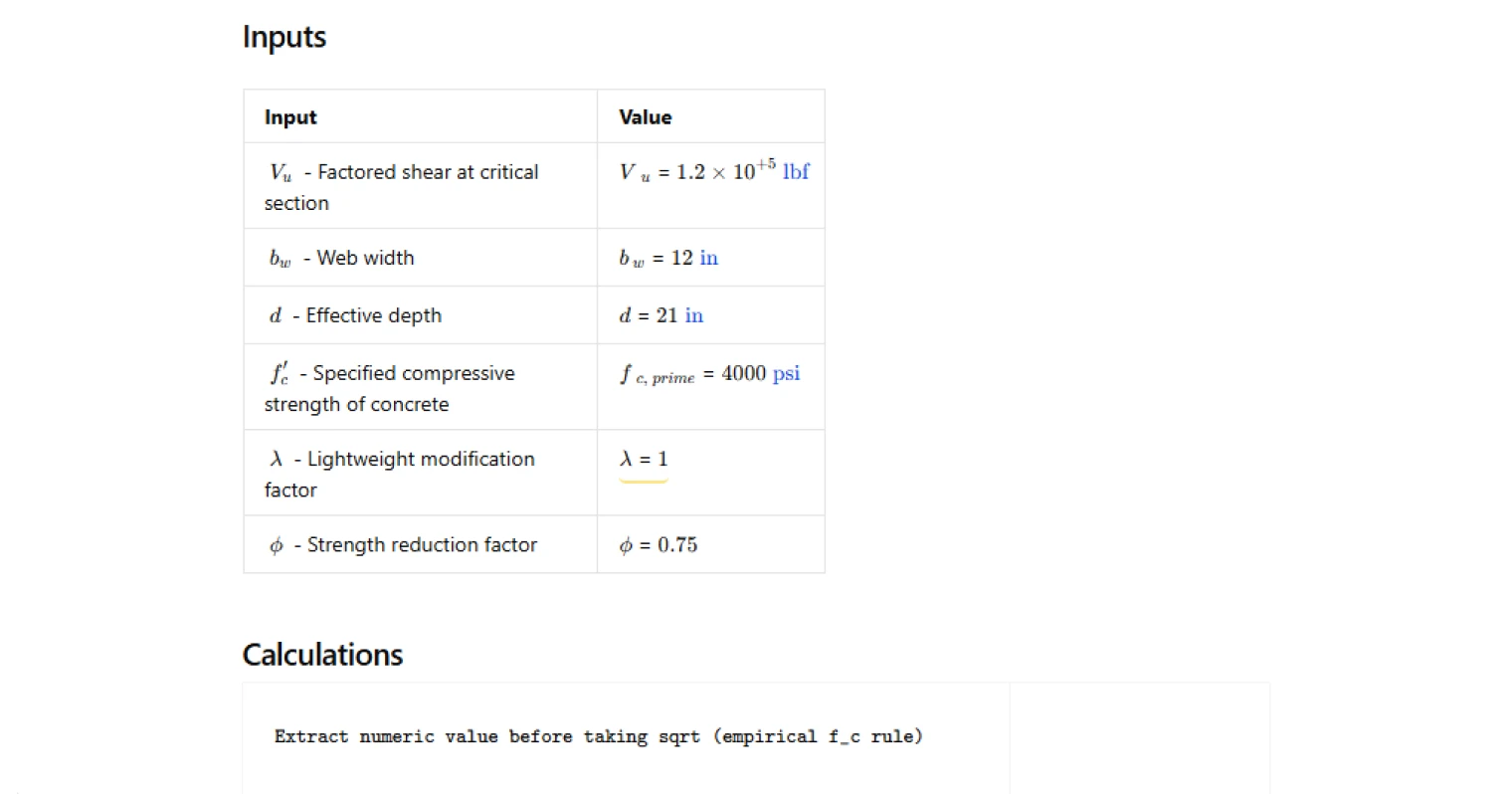
The calculator requires six inputs that fully define the dimensional check. The factored shear at the critical section represents the maximum shear demand the deep beam must resist under the governing load combination. The web width and effective depth define the cross-sectional area available to carry that shear. The specified compressive strength of concrete governs the concrete's contribution to shear resistance. The lightweight modification factor accounts for reductions in tensile capacity when lightweight concrete is used in place of normalweight concrete. Finally, the strength reduction factor is applied in accordance with ACI 318-19 to convert nominal capacity to design capacity.
Dimensional Limit Shear Capacity
The dimensional limit shear capacity is computed directly from ACI 318-19 Cl. 9.9.2.1. The expression multiplies the strength reduction factor, the empirical coefficient of ten, the lightweight modification factor, the square root of the specified compressive strength, the web width, and the effective depth. Because the square root of the compressive strength is an empirical term with implicit unit conventions, the calculation extracts the numeric value of the compressive strength in psi before applying the square root, then reattaches the appropriate units. This approach ensures dimensional consistency throughout the calculation.
Design Check
The check compares the factored shear demand directly against the dimensional limit shear capacity. If the factored shear is less than or equal to the capacity, the member passes and the section geometry is adequate under ACI 318-19 Cl. 9.9.2.1. If the demand exceeds the capacity, the check fails and the section must be resized — typically by increasing the web width or effective depth — before shear design can proceed. The result is displayed as a clear pass or fail traffic light indicator so the outcome is immediately visible.
How This Fits Into Deep Beam Design
The dimensional limit check is a prerequisite, not a substitute, for full deep beam shear design. ACI 318-19 classifies a beam as deep when the clear span-to-overall-depth ratio is low, and such members are designed using strut-and-tie methods per Cl. 23. The dimensional limit of Cl. 9.9.2.1 sets an upper bound on shear regardless of the strut-and-tie model used, preventing unconservative designs driven by unusually high concrete strengths or oversized reinforcement. Satisfying this check confirms the section geometry is viable before investing in the full strut-and-tie analysis.
Common Calculation Errors to Avoid
- Using the wrong units for compressive strength — the coefficient of ten in the ACI 318-19 expression is calibrated for psi units. Inputting the compressive strength in ksi or MPa without proper conversion will produce a severely incorrect capacity value.
- Applying the wrong strength reduction factor — ACI 318-19 specifies a shear strength reduction factor of 0.75. Using a factor intended for flexure or axial compression will overstate the design capacity.
- Setting the lightweight factor to 1.0 for lightweight concrete — normalweight concrete uses a lambda value of 1.0, but lightweight concrete requires a reduced value per ACI 318-19 Table 19.2.4.2. Defaulting to 1.0 when lightweight aggregate is used is unconservative.
- Using overall depth instead of effective depth — the ACI 318-19 expression uses the effective depth measured to the centroid of the tension reinforcement, not the total section depth. Substituting overall depth inflates the calculated capacity.
- Treating this check as a complete shear design — passing the dimensional limit check only confirms the section geometry is permissible. It does not replace the strut-and-tie design required by ACI 318-19 Cl. 23 for deep beams.
- Misidentifying the critical section for shear — the factored shear used in this check must correspond to the correct critical section for deep beams, which differs from the d-from-face-of-support location used in ordinary beam shear design.
Engineering templates
Common calculators
Design guides




FAQs
What is the deep beam dimensional limit in ACI 318-19 Cl. 9.9.2.1 and why does it exist?
The dimensional limit caps the factored shear demand Vu against an upper bound tied to concrete compressive strength and cross-section geometry. It exists for two reasons: to control diagonal cracking under service loads and to prevent a brittle diagonal compression failure in the web before the strut-and-tie or shear reinforcement mechanism can engage. If the limit is exceeded, the section must be enlarged — increasing bw or d — before any reinforcement-based checks are meaningful.
What makes a beam qualify as a "deep beam" under ACI 318-19?
ACI 318-19 Cl. 9.9.1.1 defines a deep beam as a member loaded on one face and supported on the opposite face, where the clear span ln does not exceed four times the overall member depth h, or where a concentrated load exists within twice the member depth from a support. Deep beams transfer shear primarily through direct compression struts rather than beam-action shear, which is why special design provisions and this dimensional check apply.
What value should I use for the lightweight modification factor λ?
Use λ = 1.0 for normalweight concrete. For lightweight concrete, ACI 318-19 Table 19.2.4.2 sets λ = 0.75 for all-lightweight and λ = 0.85 for sand-lightweight concrete, unless a splitting tensile strength fct is specified, in which case λ = fct / (6.7√f'c) capped at 1.0. Reducing λ directly reduces the dimensional limit Vlim, so using the correct value is important for lightweight mixes.
Why is the strength reduction factor φ set to 0.75 in this calculation?
A φ of 0.75 applies to shear in ACI 318-19 for members designed using the strut-and-tie method, which governs deep beam design. This is lower than the 0.85 used for conventional beam shear because deep beam behavior involves compression strut mechanisms where failure modes are less ductile and prediction uncertainty is higher.
What should I do if the dimensional check fails?
A failing result means the cross-section is geometrically inadequate regardless of reinforcement. The only remedies are to increase the web width bw, increase the effective depth d, increase the concrete compressive strength f'c, or reduce the factored shear demand Vu by redesigning the loading or framing arrangement. Adding more reinforcement cannot resolve a dimensional limit failure.
Where do I find the factored shear Vu to enter into this calculation?
Vu is taken at the critical section, which for deep beams is typically at the face of the support per ACI 318-19 Cl. 9.9. It comes from your structural analysis under the governing LRFD load combination. Make sure the value entered reflects the maximum factored shear along the member, as the dimensional limit must be satisfied at every section.
Learn about the benefits of using CalcTree on engineering projects!