
Check ACI 318-19 Cl. 11.5.4 in-plane shear strength for structural walls. Computes αc, Vn, and φVn with code checks. Try it free on CalcTree.

Tell us what you need, or sign up and build it yourself in minutes.
Leave your email and we'll tell you when a template for it is ready:



No items found.
No items found.
About this ACI 318 In-Plane Shear Strength for Structural Walls Calculator
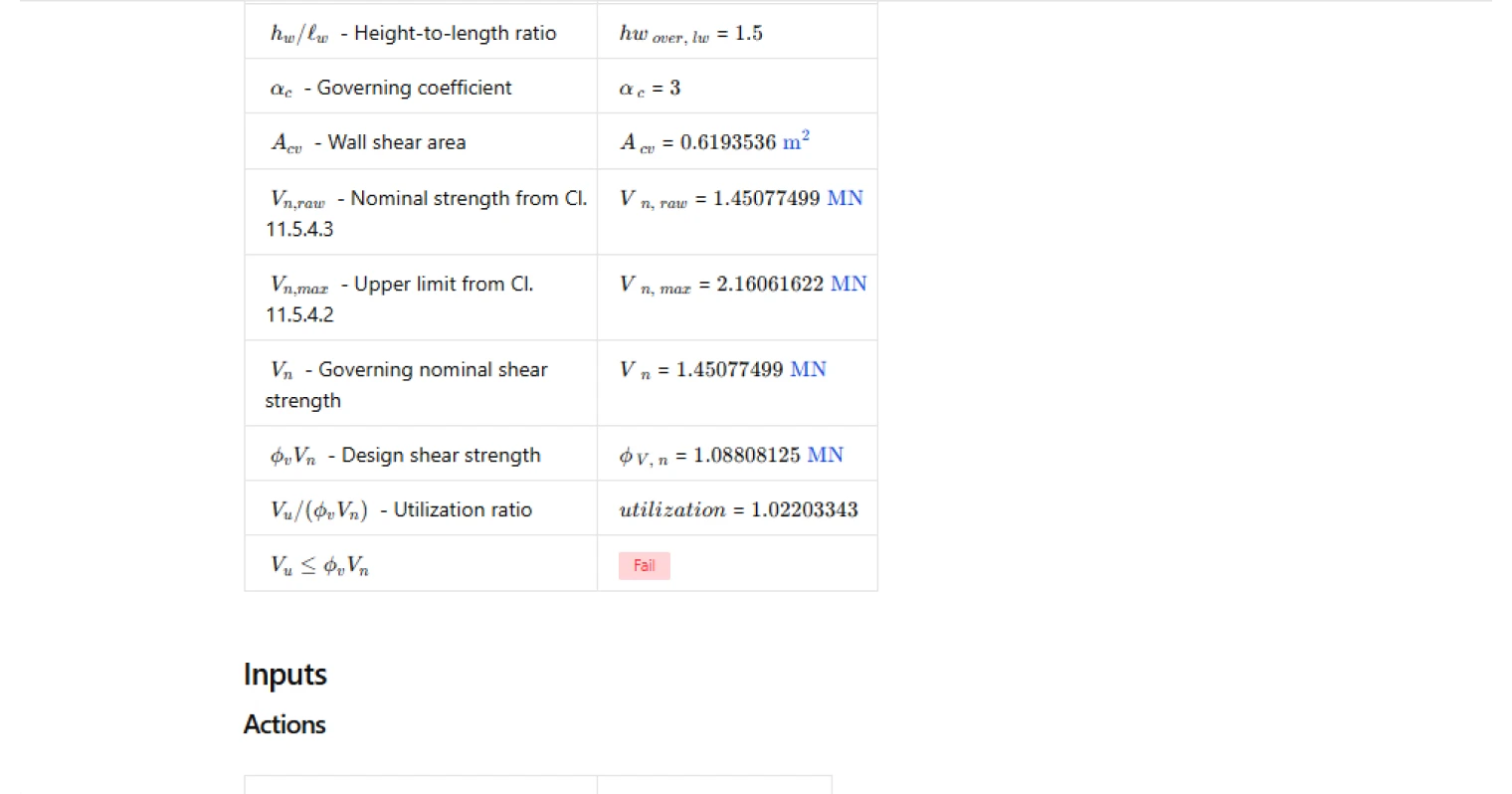
This calculator evaluates the in-plane shear strength of reinforced concrete structural walls according to ACI 318-19 Clause 11.5.4. It determines the governing shear capacity of the wall by computing the coefficient αc based on the wall aspect ratio or axial tension condition, calculating the nominal shear strength, and checking it against the code-specified upper limit and the applied factored shear demand.
- Structural engineer — verify wall shear capacity quickly during design or review by checking the governing nominal and design shear strength against applied loads.
- Design engineer — explore how wall geometry, axial load state, and reinforcement ratio influence shear capacity during early design iterations.
- Peer reviewer or checker — confirm that the wall shear provisions of ACI 318-19 Clause 11.5.4 are applied correctly with clear traceability of the governing parameters.
The calculator exposes the intermediate parameters such as the wall aspect ratio, the governing αc coefficient, and both the raw and capped nominal shear strengths. It is an engineering-grade calculator on CalcTree that allows designers to review assumptions, reproduce results, and document shear checks in a transparent workflow.
More info on ACI 318 In-Plane Shear Strength for Structural Walls
Wall geometry and shear area
The calculation begins with the geometric properties of the wall, including the wall height used in the aspect ratio evaluation, the wall length, and the wall thickness. These dimensions define the wall shear area Acv, which represents the effective concrete area resisting in-plane shear.
The wall aspect ratio, expressed as the ratio of wall height to wall length, is computed to determine the appropriate value of the coefficient αc used in the nominal shear strength equation.
Determination of the αc coefficient
The coefficient αc represents the concrete contribution to shear resistance and depends on the wall aspect ratio. For relatively squat walls the coefficient takes a higher value, while more slender walls use a lower value. When the aspect ratio lies between the limiting values specified in ACI 318-19, the calculator performs a linear interpolation between the two limits.
If the wall is subjected to net axial tension, the code provides an alternative expression for αc based on the axial stress relative to the gross wall area. This override condition is automatically applied when the axial force indicates tension, ensuring the correct governing coefficient is used.
Nominal shear strength calculation
The nominal in-plane shear strength is calculated using the expression provided in ACI 318-19 Clause 11.5.4.3. The formulation combines the concrete contribution, represented by the αc term and the square root of the concrete compressive strength, with the contribution of transverse reinforcement through the reinforcement ratio and steel yield strength.
The calculator multiplies these contributions by the wall shear area to obtain the raw nominal shear capacity.
Upper limit and design strength
ACI 318 places an upper bound on the nominal shear strength of structural walls to prevent unconservative estimates of shear capacity. The calculator evaluates this limit and compares it with the raw nominal shear strength, adopting the smaller value as the governing nominal shear capacity.
A strength reduction factor is then applied to determine the design shear strength. Finally, the factored shear demand is compared against the design capacity to produce a utilization ratio and a pass-fail design check.
Common Calculation Errors to Avoid
- Ignoring the wall aspect ratio when determining αc — the value of the concrete shear coefficient depends directly on the ratio of wall height to wall length, and incorrect classification can significantly change the predicted shear capacity.
- Forgetting the axial tension override — when a wall experiences net axial tension, the alternative αc expression must be used; neglecting this condition can overestimate the concrete contribution to shear resistance.
- Using incorrect shear area Acv — the shear area should correspond to the web area resisting shear; incorrect geometry inputs can lead to unconservative capacity estimates.
- Overlooking the code-imposed upper limit on Vn — ACI 318 restricts the nominal shear strength to prevent unrealistic capacities, and this cap must always be checked against the raw calculated value.
- Applying the wrong strength reduction factor — ensure the appropriate shear reduction factor is used consistently when converting nominal strength to design strength.
- Mixing units in the shear calculation — consistent units for concrete strength, reinforcement properties, and geometry are required to avoid scaling errors in the final shear capacity.
Engineering templates
Common calculators
Design guides




FAQs
What does ACI 318-19 Cl. 11.5.4 actually check for structural walls?
Clause 11.5.4 sets the nominal in-plane shear strength for structural walls. The core equation (Cl. 11.5.4.3) combines a concrete contribution, scaled by the aspect ratio coefficient alpha_c and the lightweight factor lambda, with a steel contribution from horizontal distributed reinforcement. The result is then capped by an upper limit of 8·lambda·sqrt(f'c)·Acv per Cl. 11.5.4.2 to prevent unconservative results in squat walls regardless of reinforcement content.
How is alpha_c determined, and when does the net axial tension override apply?
For walls under net compression or zero axial load, alpha_c comes from the hw/lw ratio: it equals 3 for hw/lw ≤ 1.5, equals 2 for hw/lw ≥ 2.0, and is linearly interpolated in between. When Nu is negative (net tension), Cl. 11.5.4.4 overrides this with alpha_c = 2·(1 + Nu/(500·Ag)), floored at zero. The tension override always governs when net tension is present, regardless of the hw/lw ratio, because axial tension directly reduces the concrete's shear contribution.
What is Acv and how does this template compute it?
Acv is the gross area of the wall cross-section resisting shear, taken as lw × tw for a rectangular wall. This template computes Acv directly from the wall length and thickness inputs. If your wall has a non-rectangular section or boundary elements that are excluded from the shear-resisting area, you should verify Acv against your geometry before using the output.
What is the role of rho_t, and what reinforcement direction does it represent?
In Eq. 11.5.4.3, rho_t is the ratio of horizontal distributed reinforcement area to the gross concrete area in the vertical plane. It represents the steel crossing potential diagonal shear cracks, which runs horizontally in a wall. This is distinct from the vertical reinforcement ratio rho_l, which appears in minimum reinforcement checks but not in this shear strength equation. Enter rho_t as a decimal (e.g., 0.0025 for 0.25%).
Why might Vn be governed by the upper limit rather than Eq. 11.5.4.3?
The cap of 8·lambda·sqrt(f'c)·Acv exists because test data shows shear strength does not continue increasing proportionally with reinforcement beyond this threshold. Squat walls with high rho_t or high f'c are most likely to hit this limit. When the template reports Vn = Vn,max, adding more horizontal reinforcement will not increase design shear capacity; geometry or concrete strength would need to change instead.
How do I interpret the utilization ratio output?
The utilization ratio is Vu divided by phi_v·Vn. A value at or below 1.0 means the wall passes the in-plane shear check. Values above 1.0 indicate the wall is overstressed in shear and requires either increased wall thickness, higher concrete strength, more horizontal reinforcement, or a reduction in the factored demand. The traffic light check directly reflects whether utilization is within the acceptable limit.
Learn about the benefits of using CalcTree on engineering projects!