
Calculate minimum one-way slab thickness per ACI 318-19 Table 7.3.1.1. Covers all support conditions with fy modifier. Try the free CalcTree template.

Tell us what you need, or sign up and build it yourself in minutes.
Leave your email and we'll tell you when a template for it is ready:
No items found.
No items found.
About this ACI 318-19: Minimum Slab Thickness - Solid Nonprestressed One-Way Slabs (Table 7.3.1.1) Calculator
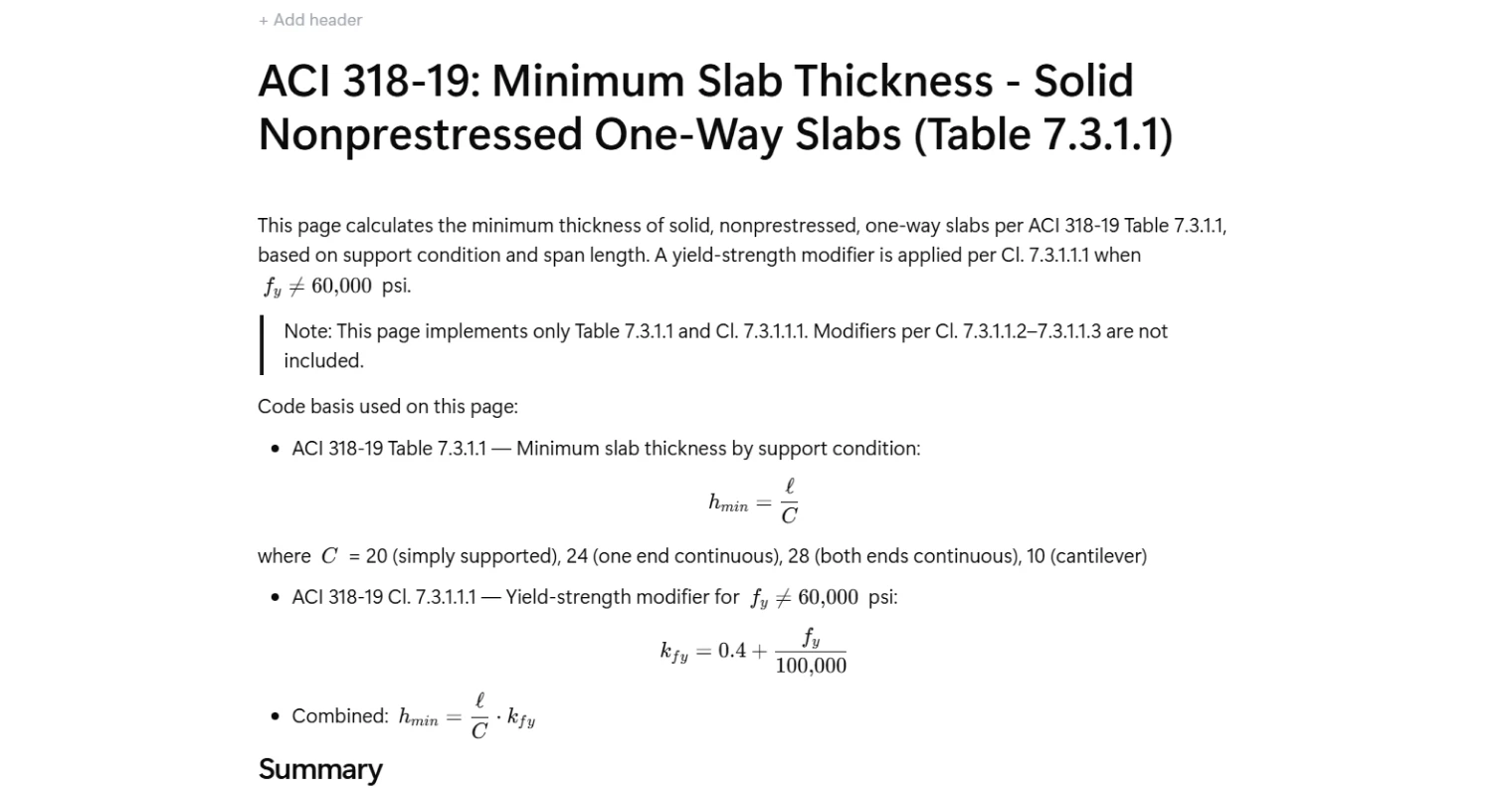
This calculator determines the minimum thickness of solid, nonprestressed, one-way slabs in accordance with ACI 318-19 Table 7.3.1.1. It selects the appropriate span-to-depth ratio based on the support condition and applies the yield-strength modifier from Cl. 7.3.1.1.1 when the reinforcement yield strength differs from the code reference value of 60,000 psi.
- Structural engineer — establish a compliant minimum slab thickness early in design to avoid deflection-governed iterations later, using actual span lengths and reinforcement grade.
- RC slab designer — quickly compare minimum thickness requirements across different support conditions and flag where a thicker slab may be needed for serviceability.
- Project engineer — run fast checks during concept or scheme design to size one-way slabs before a full deflection analysis is warranted.
This is an engineering-grade calculator built on CalcTree, where all inputs, intermediate values, and outputs are transparent, traceable, and saved directly to your project workspace.
More info on ACI 318-19: Minimum Slab Thickness - Solid Nonprestressed One-Way Slabs (Table 7.3.1.1)
Inputs
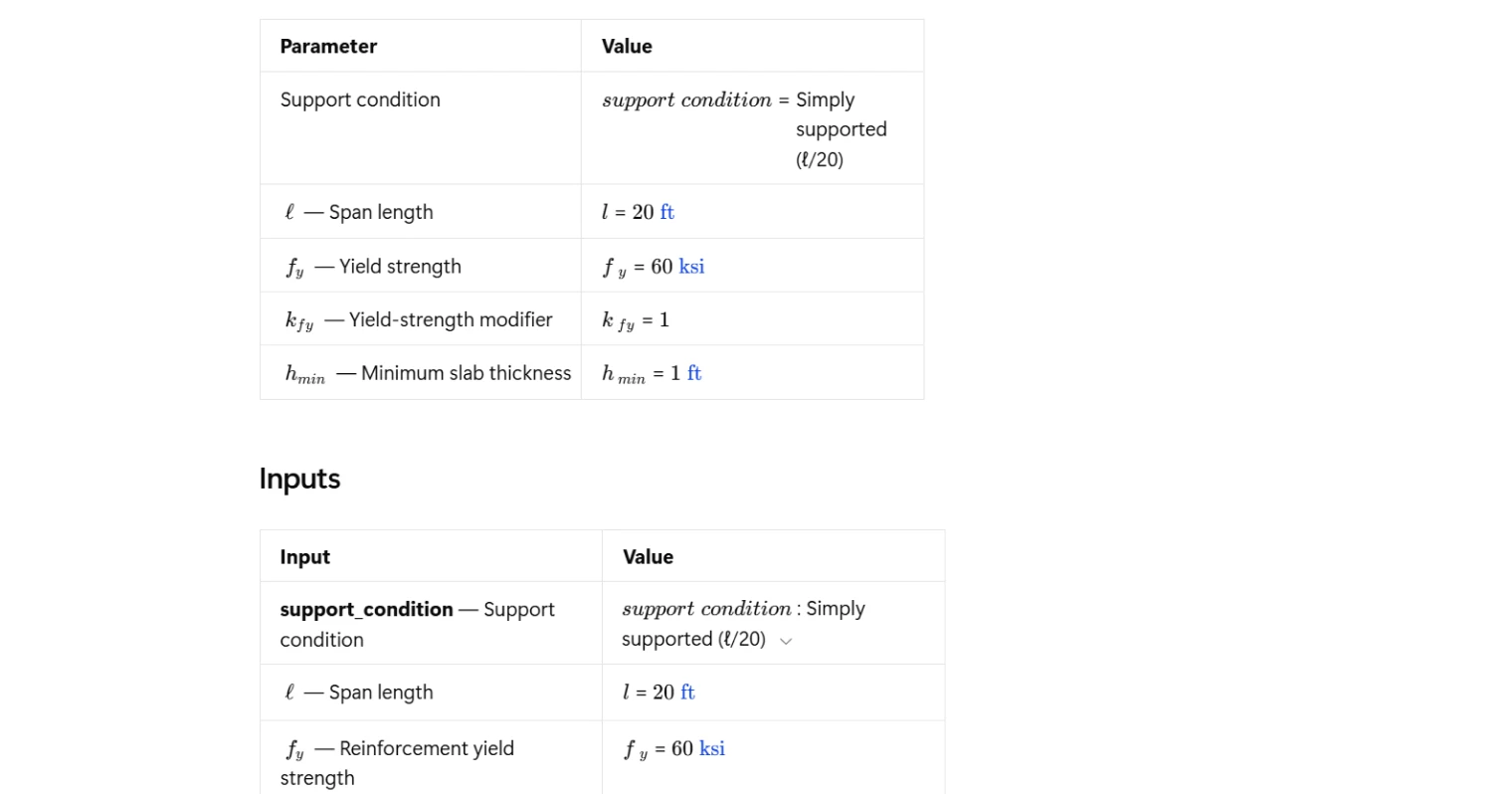
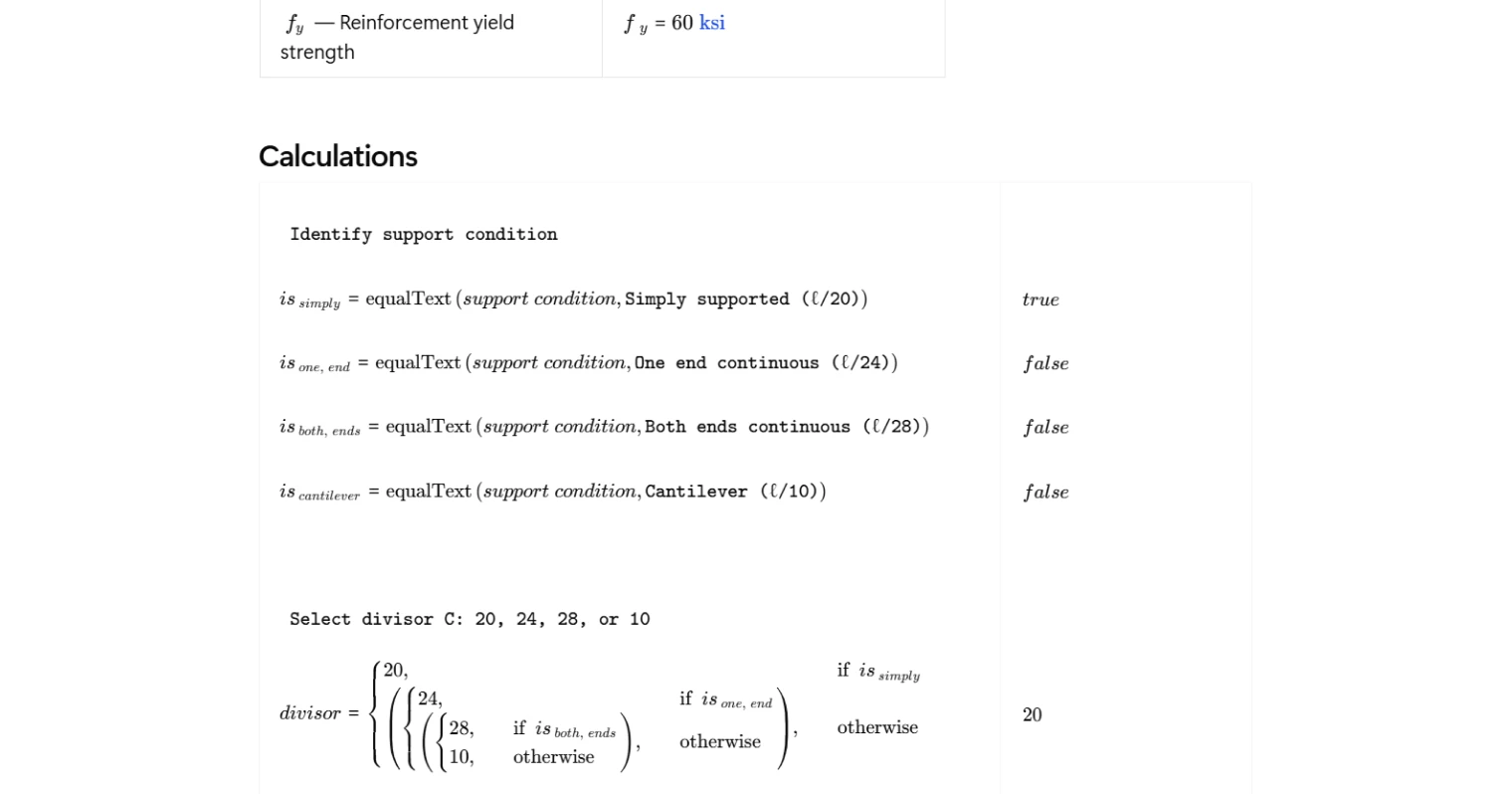
The calculator takes three inputs. The support condition is selected from four options — simply supported, one end continuous, both ends continuous, or cantilever — which determines the span-to-depth divisor used in the base thickness equation. The clear span length and the reinforcement yield strength are entered as dimensioned values. These three inputs are sufficient to fully define the minimum thickness per ACI 318-19 Table 7.3.1.1 and Cl. 7.3.1.1.1.
Method and Code Basis
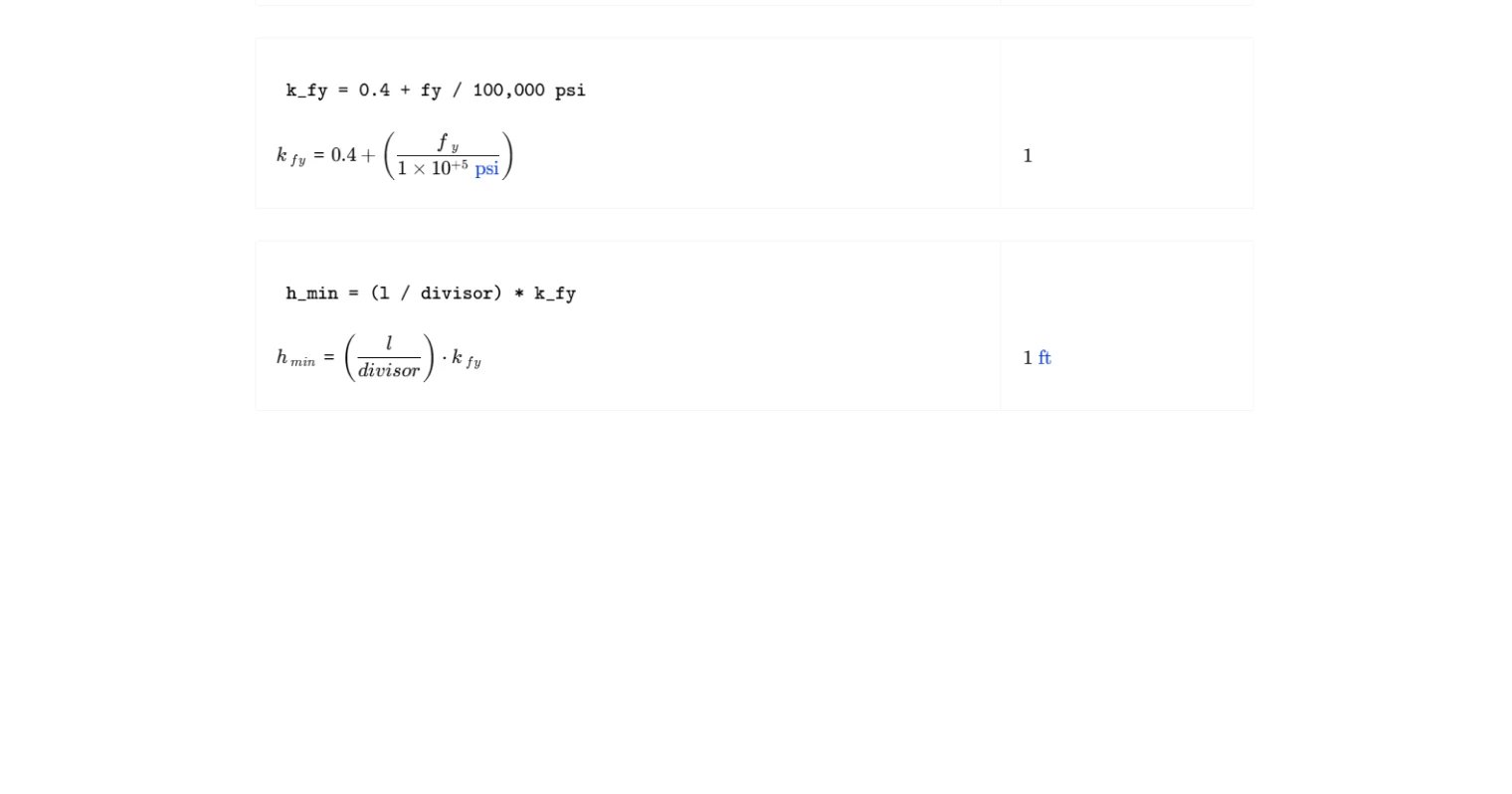
The base minimum thickness is calculated by dividing the span length by a support-condition divisor drawn directly from ACI 318-19 Table 7.3.1.1. When the specified yield strength differs from the reference value of 60,000 psi, a yield-strength modifier is calculated per Cl. 7.3.1.1.1 and applied as a scalar multiplier to the base thickness. The combined result gives the code-compliant minimum slab thickness for the given configuration. Note that the modifiers specified in Cl. 7.3.1.1.2 and 7.3.1.1.3 — for lightweight concrete and for slabs supporting or attached to partitions — are not included in this template.
Outputs
The calculator returns the yield-strength modifier and the minimum slab thickness as its primary outputs. These are presented alongside the key inputs in a summary table for easy reading and documentation. The minimum thickness can be taken directly as a design constraint for member sizing, or used as a starting point before more detailed deflection calculations are carried out.
Applicability and Limitations
This template applies only to solid, nonprestressed, one-way slabs. It does not apply to two-way slabs, ribbed or waffle systems, prestressed members, or slabs supporting significant superimposed loads where deflection control by analysis is more appropriate. The yield-strength modifier is only valid for the range of yield strengths for which ACI 318-19 Cl. 7.3.1.1.1 is intended, and engineers should verify that their chosen reinforcement grade falls within normal practice for the code edition in use.
Common Calculation Errors to Avoid
- Applying this table to two-way slabs — ACI 318-19 Table 7.3.1.1 is specific to one-way slabs; two-way slab minimum thickness is governed by a separate set of provisions and should not be conflated with this table.
- Using the wrong span definition — the span length used in the calculation should be the clear span of the slab, not the center-to-center distance between supports, unless otherwise specified by the applicable code clause.
- Omitting the yield-strength modifier — when reinforcement with a yield strength other than 60,000 psi is specified, the modifier from Cl. 7.3.1.1.1 must be applied; neglecting it will underestimate minimum thickness for higher-grade steel.
- Treating the minimum as the design thickness — Table 7.3.1.1 sets a lower bound to avoid detailed deflection calculations; the actual slab thickness must still satisfy strength, cover, and constructability requirements, and may need to be larger.
- Ignoring Cl. 7.3.1.1.2 and 7.3.1.1.3 — this calculator does not apply modifiers for lightweight concrete or slabs supporting partitions; engineers must apply those adjustments manually when the conditions are present.
- Selecting the wrong support condition — the divisor changes significantly between support conditions, so misclassifying a one-end-continuous slab as simply supported, for example, will yield a non-conservative result.
Engineering templates
Common calculators
Design guides




FAQs
What does ACI 318-19 Table 7.3.1.1 actually control?
Table 7.3.1.1 sets minimum slab thickness to limit deflections without requiring explicit deflection calculations. It applies only to solid, nonprestressed one-way slabs not supporting or attached to partitions or other construction likely to be damaged by large deflections. If those conditions aren't met, you need to run a full deflection check per ACI 318-19 Table 24.2.2 instead.
Why does the minimum thickness change with support condition?
A slab with both ends continuous deflects less than a simply supported slab under the same load and span, so ACI allows a thinner section. The divisor C reflects this: 28 for both ends continuous, 24 for one end continuous, 20 for simply supported, and 10 for a cantilever. Cantilevers get the most conservative limit because they deflect the most relative to span.
How does the yield-strength modifier work and when does it matter?
The modifier k_fy = 0.4 + fy/100,000 psi accounts for the fact that higher-strength steel allows wider crack widths and more curvature before yielding, which increases deflections. At the ACI baseline of 60,000 psi, k_fy = 1.0 and thickness is unchanged. For Grade 80 (80,000 psi), k_fy = 1.2, increasing the required thickness by 20%. For Grade 40 (40,000 psi), k_fy = 0.8, so the minimum thickness is actually reduced.
What limitations should I be aware of when using this calculation?
This page covers Table 7.3.1.1 and Cl. 7.3.1.1.1 only. It does not apply the additional modifiers from Cl. 7.3.1.1.2 (lightweight concrete) or Cl. 7.3.1.1.3 (slabs supported on masonry walls). If either condition applies to your project, you need to apply those modifiers manually on top of the result from this page.
What span length should I input for a continuous slab?
Use the clear span length between supports, not the center-to-center distance. ACI 318-19 defines the span used in Table 7.3.1.1 as the clear span in the direction of bending. For a continuous slab, apply the calculation independently to each span using its own clear length and support condition.
Can I use this result directly as my design thickness?
The output is a minimum — you still need to round up to a practical thickness, typically to the nearest 1/4 in for slabs under 6 in and to the nearest 1/2 in for thicker slabs. You should also verify that the chosen thickness satisfies your flexural and shear strength requirements, since minimum deflection control thickness doesn't guarantee adequate strength for all loading conditions.
Learn about the benefits of using CalcTree on engineering projects!